
B2C marketing is marketing aimed at individual consumers who buy for themselves or their households, rather than at other businesses. It covers everything from a clothing brand’s Instagram ads to a supermarket’s loyalty emails. Because consumers often decide quickly and on their own, it relies on clear offers, emotional appeal and a smooth path to purchase.
Key Takeaways
- B2C means business-to-consumer. One person usually makes the decision, and often fast.
- Emotion, convenience, price and trust drive most consumer choices.
- The checkout matters as much as the ad. Baymard Institute puts average online cart abandonment at about 70%.
- In the UK, consumer ads must follow the CAP Code, and pre-ticked boxes do not count as consent to extra payments.
- Typical channels include social media, search, email, marketplaces, influencers and video.
What Is B2C Marketing?
B2C stands for business-to-consumer. A coffee shop promoting a new drink on TikTok does it. So does an online bookshop sending a birthday discount, or a gym running a free first week to win new members.
The opposite is B2B marketing, where one company sells to another. In B2B, a group of people may take months to choose. By contrast, a consumer can see an ad, read a few reviews and buy in one sitting.
That speed changes the job. You have seconds to catch attention and a short window to remove doubt. As a result, consumer brands spend heavily on creative, reviews, simple checkouts and fast delivery.
How B2C Marketing Works
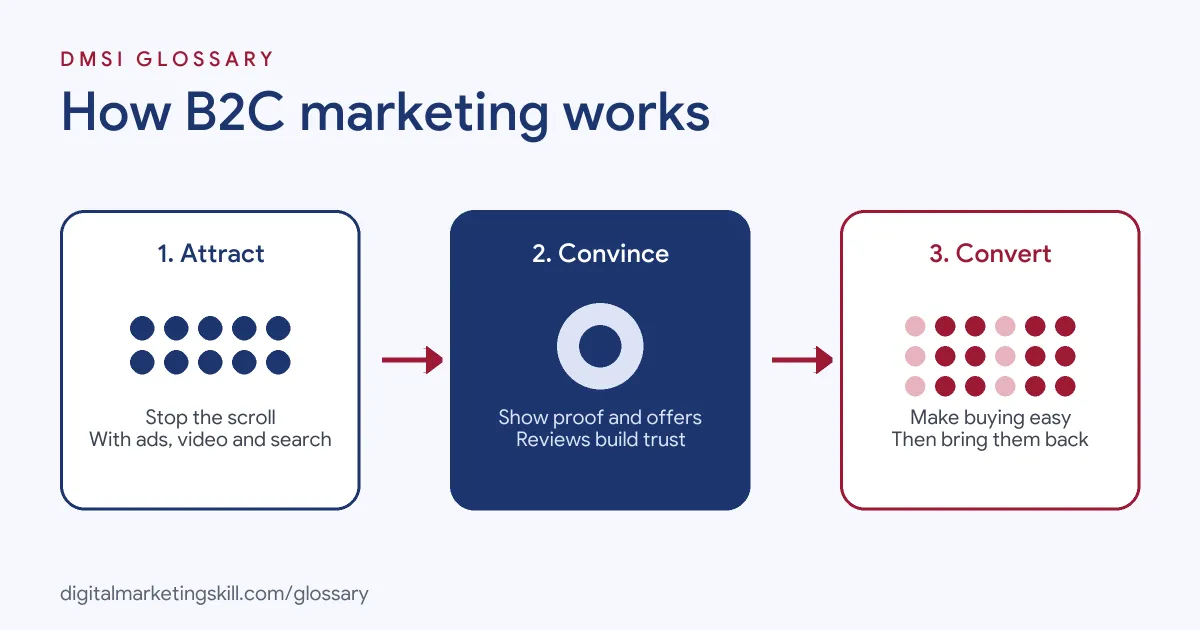
Most consumer campaigns follow three broad stages. First, you get noticed by the right people. Next, you persuade them that your product is the right choice. Finally, you make buying, and buying again, as easy as possible.
Attract Attention
Consumers scroll past hundreds of posts a day. So the first job is to stop the scroll. Brands use short video, bold visuals, creators and search ads to appear where shoppers already spend time.
Timing matters too. LinkedIn’s B2B Institute points out that even in consumer markets, “90% of consumers buy new cars every 10 years.” In other words, many people are not ready to buy right now. Brand building keeps you in mind until they are.
Build Trust and Desire
Next, shoppers look for reasons to believe you. Reviews, ratings, user photos and clear returns policies all help. This is where social proof does much of the work.
Trust is a real barrier online. Baymard Institute’s research found that 19% of shoppers who abandoned a purchase, excluding those just browsing, “didn’t trust the site with my credit card information.”
Convert and Retain
Finally, the sale has to happen. Baymard calculates an average documented cart abandonment rate of 70.22%, based on 50 studies. Among the reasons it lists, excluding “just browsing”, 40% of shoppers said extra costs such as shipping, tax and fees were too high. Meanwhile, 18% left because the site wanted them to create an account.
After the first purchase, email, SMS and loyalty schemes bring customers back. That’s why retention is a core part of the plan, not an afterthought.
B2C Marketing Examples
Here are three made-up examples that show the approach in action:
- Fashion brand: A label runs Reels with creators trying on a new range. Viewers who visit the site but do not buy see a retargeting ad with reviews.
- Food delivery app: An app offers free delivery on the first order. After that, it sends personalised push messages based on past orders.
- Skincare shop: A shop shows the full price, including delivery, on the product page. It also adds guest checkout, so nobody has to create an account.
In each case, the brand removes friction at the exact point where shoppers tend to drop off.
B2C Marketing vs B2B Marketing
| Factor | B2C | B2B |
|---|---|---|
| Who decides | One person or household | A buying group inside a company |
| Speed | Minutes to days | Weeks to months |
| Main drivers | Emotion, price, convenience, trust | Return on investment, risk, fit |
| Typical channels | Social media, search, marketplaces, influencers, email | LinkedIn, search, email, events, sales teams |
| Key metric | Sales, conversion rate, repeat purchase | Pipeline, qualified leads, win rate |
Of course, the line is not always sharp. Many brands, such as phone networks, sell to both groups.
How to Plan a B2C Marketing Campaign
- Know your customer. Describe who buys, why they buy and where they spend time online.
- Set one clear goal. For example, first orders, repeat orders or app installs.
- Write a simple offer. Explain the benefit in one line and show the full price.
- Pick the channels. Choose two or three places your customers already use, such as Instagram, search and email.
- Prepare proof. Gather reviews, user content and guarantees before launch.
- Fix the checkout. Offer guest checkout and show costs early.
- Measure and repeat. Track conversion rate, cost per sale and repeat purchase, then test changes.
How to Measure Results
Consumer campaigns move fast, so you can measure them closely. These are the numbers most teams watch:
- Conversion rate: the share of visitors who buy.
- Average order value: how much each order is worth on average.
- Return on ad spend: revenue earned for each unit of ad budget, explained in our return on ad spend entry.
- Repeat purchase rate: the share of customers who come back and buy again.
- Customer lifetime value: the total a customer is likely to spend with you over time.
Here is a simple made-up example. A shop gets 10,000 visits and 200 orders, so its conversion rate is 2%. If it removes a surprise delivery fee and orders rise to 240, the rate becomes 2.4%. That small change adds 40 sales with no extra ad spend. So checkout fixes are often the cheapest growth you can find.
Best Practices for B2C Marketing
- Lead with the benefit. Shoppers care about what the product does for them, not the spec sheet.
- Show costs early. Surprise fees are the most common reason Baymard lists for leaving a checkout.
- Follow the rules. The UK CAP Code covers misleading claims, pricing, the word “free” and product availability.
- Ask clearly for add-ons. Under UK consumer contract rules, a pre-ticked box is not express consent to an extra payment.
- Look after existing customers. A good welcome email and fast support often lead to the next order.
For more ideas, see our in-depth guide to B2C marketing strategy and our walkthrough of the e-commerce sales funnel.
Common Mistakes to Avoid
First, many brands pour budget into ads while ignoring a slow or confusing checkout. Second, they hide delivery costs until the final step. Third, they make claims they cannot back up, which breaks advertising rules and trust. Finally, they chase only new customers and forget the ones they already have. Each of these leaks money that good marketing has already earned. Fortunately, a short monthly review of your checkout, claims and customer emails catches most of them early.
Where You’ll Use B2C Marketing at Work
Consumer brands hire for many remote marketing roles. For example, job listings mention:
- “Set the digital marketing strategy and annual plan across B2C acquisition and B2B demand generation” (Director, Digital Marketing).
- “The ability to work comfortably across both B2C and B2B audiences, adapting the visual language and storytelling to each.” (Designer, Brand and Marketing).
- Writing “engaging, thought-provoking, B2B and B2C marketing content for a legal audience.” (Creative Copywriter).
So if you aim to be a Growth Marketer, Digital Marketing Manager or Freelance Digital Marketer, consumer campaigns will likely be part of your work. Clients will also want proof, such as a campaign where you increased sales.
Learn It in the Full Stack Programme
Consumer campaigns use social, email, search and web skills together, so the best fit is the Full Stack programme (all four tracks). You take all ten courses and complete one portfolio project from each track. You also get unlimited 1-on-1 mentoring and a U.S. Project Internship from day one.
Frequently Asked Questions
What does B2C marketing mean?
It means marketing from a business directly to individual consumers. The goal is to get people to buy for themselves or their household.
What is an example of B2C marketing?
A fashion brand running Instagram ads, then sending a discount email to people who left items in their basket, is a common example.
What channels work best for B2C?
Social media, search, email, marketplaces and creator partnerships are common choices. The best mix depends on where your customers spend time.
Why do shoppers abandon their carts?
In Baymard’s research, the top reason, excluding just browsing, is extra costs such as shipping, tax and fees. Forced account creation and slow delivery also rank highly.
Is B2C easier than B2B?
Not easier, just different. B2C decisions are faster, but competition for attention is fierce and margins can be thin.
Sources: Baymard Institute: Cart abandonment rate statistics; LinkedIn B2B Institute: The 95-5 rule; ASA: The CAP Code; legislation.gov.uk: Consumer Contracts Regulations, regulation 40; remote job listings on Himalayas.