
Social proof is the tendency for people to look at what others do, buy or recommend when deciding what to do themselves. In marketing, it shows up as reviews, ratings, testimonials, follower counts and customer stories. It matters because evidence that real people trust a product reduces doubt and makes new buyers more likely to act.
Key Takeaways
- Psychologist Robert Cialdini described it as one of six principles of influence.
- It works best when people feel uncertain, because others’ choices help them decide.
- Common forms include reviews, star ratings, testimonials, case studies, user-generated content and visible customer numbers.
- Fake reviews are illegal in the UK and the US. Rules also cover hiding bad reviews and fake follower counts.
- Test your proof. Nielsen Norman Group suggests A/B testing reviews, comments and testimonials to see which ones help conversions.
What Is Social Proof?
Nielsen Norman Group (NN/g), a user-experience research firm, defines it as “a psychological phenomenon where people reference the behavior of others to guide their own behavior.” In other words, when we are unsure, we copy the crowd.
The idea comes from psychologist Robert Cialdini. NN/g notes that in his book Influence: Science and Practice, Cialdini lists six principles of influence: reciprocation, social proof, liking, scarcity, authority, and commitment and consistency.
You see it every day online. For example, a restaurant with hundreds of good reviews feels safer than one with none. Similarly, a newsletter that says thousands of people read it feels worth joining.
How Social Proof Works
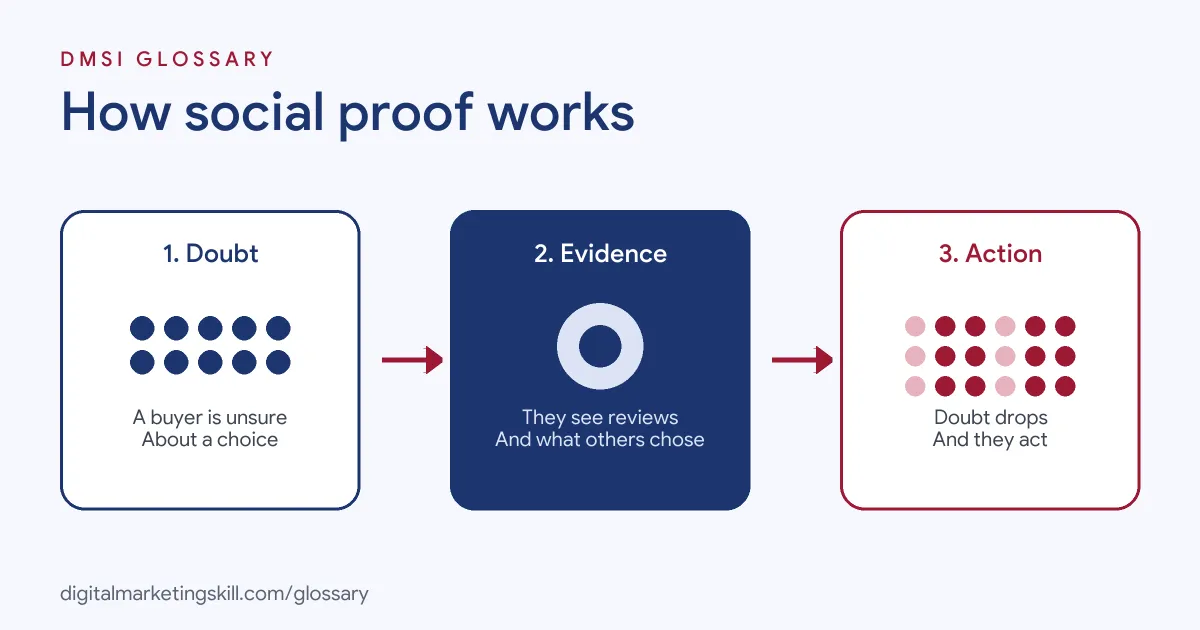
The effect follows a simple path. First, a buyer feels unsure about a choice. Next, they look for signs of what others did. Finally, those signs reduce their doubt, and they are more likely to act.
Reducing Uncertainty
NN/g explains that adding a sign that other people, “or even better, familiar people,” like a product “can remove decision-making uncertainty.” That is why reviews often sit right next to the buy button. They answer the silent question, “Will this work for someone like me?”
Encouraging Adoption
Numbers can also persuade. NN/g says that when you want people to subscribe or follow, “communicating that you already have a large number of subscribers can increase subscriptions because it indicates that others like your content.” So a simple line such as “Join 20,000 marketers” can do real work, as long as it is true.
Types of Social Proof
Marketers use several forms. Each one suits a different stage of the buying journey:
- Reviews and ratings: stars and written feedback from buyers.
- Testimonials: short quotes from named customers.
- Case studies: detailed stories with real results, often for B2B buyers.
- Customer content: photos and videos from customers, also known as user-generated content.
- Usage numbers: counts of customers, downloads or subscribers.
- Expert or media mentions: logos of publications or awards, where they are genuine.
Social Proof Examples
Here are three made-up examples of it in action:
- Online shop: A skincare brand shows star ratings on every product card and a review summary near the checkout button.
- Paid social ad: A fitness app runs a video of real users explaining what changed for them. As a result, viewers see people like themselves, not just a brand message.
- B2B landing page: A software firm adds a short case study with one clear result and a quote from the client, placed just above the demo form.
Starting With No Reviews
New brands often have no reviews yet. That is normal, and you can fix it fast. Here are a few honest ways to start:
- Ask your first buyers. Send a short, friendly email a few days after they buy. Keep the request to one or two questions.
- Share early wins. Post a real message or photo from a happy customer, with their permission.
- Show your own proof. Use a clear guarantee, a short video of the team or a behind-the-scenes post.
- Use small numbers well. “Loved by our first 50 customers” is honest and still helpful.
Each review you collect makes the next sale a little easier. So build the habit early, and keep asking as you grow.
Social Proof Rules in the UK and US
Because this kind of evidence is so powerful, regulators watch it closely. This table sums up key rules:
| Rule area | UK (DMCC Act) | US (FTC rule) |
|---|---|---|
| Fake reviews | Banned, including reviews that hide that they were incentivised | Banned, including reviews that misrepresent the reviewer’s existence or experience |
| Paying for reviews | Allowed only if clearly labelled as incentivised and genuine | No payment “in exchange for a review expressing a particular sentiment” |
| Hiding bad reviews | Misleading publication, such as suppressing negative reviews, is banned | Suppressing negative reviews is prohibited, with limited exceptions |
| Fake influence | Offering services to commission fake reviews is banned | Buying or selling fake social media indicators is prohibited |
In the UK, the Competition and Markets Authority (CMA) can impose fines of up to 10% of annual global turnover. In addition, businesses that publish reviews must take reasonable and proportionate steps to prevent and remove banned ones.
How to Use Social Proof
Follow these steps to add it to your marketing:
- Collect it honestly. Ask real customers for reviews after purchase, and never script or fake them.
- Get permission. Check that customers agree before you use their names, photos or quotes.
- Match proof to the doubt. Put delivery reviews near shipping details, and results-based case studies near the sign-up form.
- Be specific. “Cut our booking time in half” persuades more than “Great service!”
- Show balance. Keep genuine negative reviews visible, since hiding them can break the law.
- Label incentives. If you gave anything in return for a review, say so clearly.
- Test placement. After that, A/B test where and how you show proof, and keep what lifts conversions.
Best Practices for Social Proof
- Use real faces and names. With permission, they feel more trustworthy than anonymous quotes.
- Show people like your buyer. NN/g notes that proof from “familiar people” is even stronger.
- Keep it fresh. Old reviews can make a product look forgotten.
- Use numbers honestly. Round down rather than up, and update counts regularly.
- Reply to reviews. Thoughtful replies to criticism show future buyers that you care.
- Mix formats. For example, pair an overall star rating with one detailed quote, because the rating shows how many people are happy while the quote shows why.
Common Social Proof Mistakes
Some mistakes damage trust or break the law. First, businesses post fake or copied reviews. Second, they hide every negative review, which looks suspicious and is banned in the UK and US. Third, they show tiny numbers, such as “3 customers,” which can work against them. Finally, they buy followers to look popular, which the FTC rule treats as fake social media indicators.
Where You’ll Use Social Proof at Work
This is a regular task in content and ads roles. For example, recent remote job listings include:
- “Create and repurpose social proof assets (testimonials, influencer screenshots, reviews) for use in paid ads and organic content” (Creative Generalist).
- “Experience editing UGC and social proof content for performance-driven campaigns” (Creative Generalist).
- “Monitor reviews, ratings, and customer questions; use Vine and other compliant programs to build social proof” (Amazon Store Specialist).
So as a Social Media Manager, Paid Social Specialist or Content Creator, you will collect, design and test proof that persuades, while keeping it honest. You will also report on which reviews, quotes and customer videos lift clicks and sales, so the team knows what to collect next.
Learn It in the Social Media Track
You can learn to build trust with real customer content in the AI-Powered Social Media Management and Advertising track. There, you plan, create and run a paid social campaign for a real brand, so you can show results to employers. You also work on a U.S. Project Internship from day one, with unlimited 1-on-1 mentoring.
For more ideas, read our guide to social proof marketing.
Frequently Asked Questions
What is social proof in simple terms?
It is when people use what others do or say to decide what to do themselves. Reviews, ratings and testimonials are common examples.
Who came up with social proof?
Psychologist Robert Cialdini described it as one of six principles of influence in his book Influence.
What are examples of social proof?
Customer reviews, star ratings, testimonials, case studies, user photos and visible subscriber or customer numbers.
Are fake reviews illegal?
Yes, in both the UK and the US. UK law bans fake and concealed incentivised reviews, and the US FTC rule bans fake reviews and testimonials.
Can I pay for reviews?
Only with care. In the US, you cannot pay for a review that expresses a particular sentiment. In the UK, incentivised reviews must be clearly labelled and genuine.
Sources: Nielsen Norman Group: Social proof in the user experience; CMS: The DMCC Act bans fake reviews; Morgan Lewis: FTC issues final rule on consumer reviews and testimonials; remote job listings on Himalayas.