
A social media algorithm is the set of automated ranking systems a platform uses to decide which posts each person sees, and in what order. It predicts what you are most likely to watch, like, share or comment on, based on signals such as your past activity. It matters because these systems, not just your follower count, decide how many people see your content.
Key Takeaways
- There is rarely one single system. Instagram says it “doesn’t have a singular algorithm,” but uses different ranking for Feed, Reels and Explore.
- Your own activity is the strongest signal. Platforms look at what you like, share, save, comment on and follow.
- Rankings are predictions. Instagram, for instance, predicts how likely you are to spend a few seconds on a post, or watch a reel to the end.
- On TikTok, follower count is not a direct factor in For You recommendations.
- You cannot control any platform’s ranking system, but you can make content that earns the signals it rewards.
What Is a Social Media Algorithm?
Every time you open an app, there are far more posts than you could ever see. So the platform sorts them. An algorithm is simply the set of rules and models that does the sorting.
Instagram explains this plainly. It “doesn’t have a singular algorithm that oversees what people do and don’t see on the app.” Instead, each part of the app uses its own ranking, because people use Feed, Reels and Explore for different things.
The same idea applies elsewhere. LinkedIn says recommended content in your feed “is determined by LinkedIn’s algorithms and editorial team.” TikTok describes its For You feed as “powered by a recommendation system.” In each case, the goal is to show each person what they are most likely to value.
How a Social Media Algorithm Works
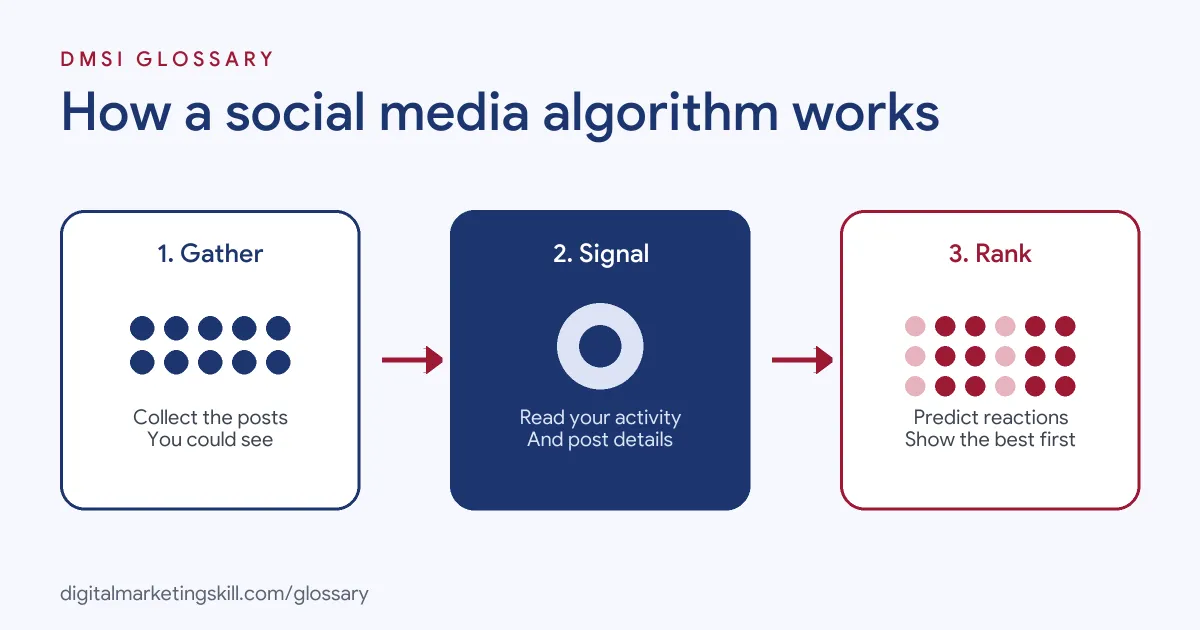
Most ranking systems follow the same three steps. First, the platform gathers the posts you could see. Next, it reads signals about you, the post and the creator. Finally, it predicts how you will react to each post and puts the best matches first.
Signals
Signals are pieces of information the system uses. For Instagram Feed, the most important signal is your activity. Instagram says: “Posts you’ve liked, shared, saved or commented on help us understand what you might be interested in.”
TikTok lists three groups of factors. These are user interactions, such as “the videos you like or share, accounts you follow, comments you post, and content you create.” Then there is video information, “which might include details like captions, sounds, and hashtags.” Finally, there are device and account settings, such as language and country, which TikTok says receive lower weight.
Predictions
Next, the system turns signals into predictions. In Instagram Feed, the five interactions it looks at most closely start with “how likely you are to spend a few seconds on a post.” The others include commenting, liking, sharing and tapping the profile. For Reels, it predicts “how likely you are to reshare a reel, watch a reel all the way through, like it.” In Explore, the most important actions it predicts include likes, saves and shares.
What Is Not a Direct Factor
Some common beliefs are wrong. TikTok says that “neither follower count nor whether the account has had previous high-performing videos are direct factors in the recommendation system.” In other words, a new account can still reach people if the video earns strong interactions. However, TikTok also notes that bigger accounts are likely to get more views because they have more followers.
How New Users Are Ranked
A ranking system needs data, so what happens on day one? TikTok explains that it invites new users to “select categories of interest, like pets or travel,” to help tailor early recommendations. Then, as the person watches, likes and skips videos, the system adjusts. For you as a marketer, this means each viewer’s feed is personal from the start. Two people can open the same app and see completely different content.
Social Media Algorithm Examples
Here are three made-up examples of the ranking system at work:
- A recipe reel: A food creator posts a 20-second reel. Many viewers watch to the end and share it with friends. As a result, Instagram shows it to more people who like cooking content.
- A new TikTok account: A small bakery with few followers posts a video using a popular sound. Because viewers like and comment, TikTok recommends it beyond the bakery’s followers.
- A LinkedIn post: A consultant shares a practical guide for finance teams. It is professionally relevant and not overly promotional, so it has a better chance of reaching people outside their network.
How Each Platform’s Algorithm Differs
Each platform publishes some detail about its ranking. This table sums up what their own guidance says:
| Platform | Key signals named | Notable detail |
|---|---|---|
| Your activity, such as likes, shares, saves and comments | Separate ranking for Feed, Reels and Explore | |
| TikTok | User interactions, video information, device and account settings | Follower count is not a direct factor |
| Professionally relevant, high-quality content and member feedback | Suggested posts aim to avoid content that is overly promotional |
How to Work With the Algorithm
You cannot change a platform’s ranking system. However, you can make content that earns the signals it looks for. Follow these steps:
- Know the surface. Decide whether you are making a Feed post, a reel or a story, since each one is ranked differently.
- Hook people early. Instagram’s first Feed prediction is whether someone spends a few seconds on a post.
- Make it worth sharing. Shares appear in the predictions for Feed, Reels and Explore.
- Keep reels watchable to the end. Cut slow intros and keep the main point clear.
- Use clear captions and relevant tags. TikTok reads captions, sounds and hashtags as video information.
- Invite real conversation. Ask a genuine question, so comments come naturally.
- Review your insights. After that, repeat the formats that earn the most saves, shares and watch time.
Best Practices for Working With an Algorithm
- Focus on your audience, not the system. Content that people value tends to earn the signals platforms reward.
- Post consistently. Regular content gives you more chances to learn what works.
- Track the right metrics. Watch engagement rate, shares and saves, not just likes.
- Test formats. Try short reels, carousels and text posts, then compare results.
- Read official guidance. Platforms explain their ranking in their own help and news pages.
Common Mistakes to Avoid
Many creators chase myths. First, they believe follower count is everything, although TikTok says it is not a direct factor. Second, they rely on tags alone, when interactions carry much more weight. Third, they post overly promotional content, which LinkedIn says it tries to keep out of suggested posts. Finally, they change strategy after every rumour instead of testing and checking their own data.
Where You’ll Use Algorithm Knowledge at Work
Employers expect social media staff to understand ranking systems. For example, recent remote job listings ask for:
- “Strong understanding of social media algorithms, trends, and growth strategies” (Social Media Manager, TikTok and Instagram).
- The ability to “Identify emerging trends, viral formats, and algorithm shifts, then rapidly translate them into content strategies” (Social Media Growth Manager).
- “Deep understanding of social media ad algorithms (Meta, TikTok, Google Ads) and how to make creatives perform better” (Paid Ads Content Strategist and Creator).
So if you want to work as a Social Media Manager, Paid Social Specialist or Content Creator, you will plan content around what each platform rewards, and report on what worked.
Learn It in the Social Media Track
You can learn how ranking systems shape reach in the AI-Powered Social Media Management and Advertising track. There, you plan, create and run a paid social campaign for a real brand, so you can show real results. You also work on a U.S. Project Internship from day one, with unlimited 1-on-1 mentoring.
Want more ways to earn interactions? Read our guide to Facebook engagement strategies.
Frequently Asked Questions
What is a social media algorithm in simple terms?
It is the system a platform uses to decide which posts you see and in what order. It ranks posts by predicting what you are most likely to enjoy or act on.
Does Instagram have one algorithm?
No. Instagram says it does not have a singular algorithm. Instead, it uses different ranking for Feed, Reels, Explore and other parts of the app.
Do followers matter on TikTok?
TikTok says follower count is not a direct factor in recommendations. However, accounts with more followers are likely to get more views simply because more people follow them.
Can you beat the algorithm?
No one can control it. Still, you can improve your chances by making content that people watch, share, save and comment on.
Do hashtags affect the algorithm?
They play a part. TikTok lists hashtags, captions and sounds as video information. Even so, user interactions are a bigger signal.
Sources: Instagram: Instagram ranking explained; TikTok Newsroom: How TikTok recommends videos #ForYou; LinkedIn Help: LinkedIn Feed overview; LinkedIn Help: Suggested posts in feed; remote job listings on Himalayas.