
Social proof marketing is the use of visible evidence that other people chose, trusted or endorsed something. It eases a new buyer’s fear of making a mistake. Done well, social proof marketing lifts conversions. Done vaguely, it reads as noise. This guide covers the mechanism, which proof type fits which decision, how to measure the lift, and one simple rule for choosing what to lead with.
Key Takeaways
- 49% of consumers say they trust online reviews as much as a personal recommendation from someone they know, according to BrightLocal’s Local Consumer Review Survey of 1,002 US adults.
- 97% of consumers read reviews for local businesses, and 41% say they “always” read reviews before deciding, per the same BrightLocal survey.
- 85% of consumers report being more likely to use a business after reading positive reviews. 93% have made a purchase after reading reviews, and 27% of that group spent over $1,000, per BrightLocal.
- Social proof marketing works through informational social influence, a documented decision shortcut. People copy the choices of others when they feel unsure, especially under time pressure.
- Not every proof format fits every buyer. Crowd counts suit frequent, low-risk purchases. Named credentials and certifications suit rare, high-stakes ones.
In this guide
- Why Most Social Proof Marketing Advice Under-Performs
- The Mechanism Behind Social Proof Marketing
- What Differs by Social Proof Marketing Type
- How to Lead With Each Social Proof Marketing Type
- Measuring Whether Your Social Proof Marketing Is Working
- The One Decision Rule for Social Proof Marketing
- A Real Case: Proof-of-Work as Its Own Form of Social Proof Marketing
- Frequently Asked Questions About Social Proof Marketing
- Put Social Proof Marketing to Work With a Structured Skill Set
Why Most Social Proof Marketing Advice Under-Performs
Search “types of social proof” and most pages return a list of 20 to 30 tactics. Few explain which tactic fits which buyer. That is the gap. Social proof marketing gets treated as one tactic instead of a family of signals. Each signal works differently depending on what the buyer is deciding and how confident they already feel.
The second gap is measurement. Most lists stop at “add testimonials.” They give no way to check afterward if the testimonials moved anything.
A vanity count, like total reviews collected, is not a trust signal. It does not show that a visitor’s behaviour changed. Treating the two as the same thing is why many redesigns add proof and see no real change. The element was never tied to a metric in the first place.
A few ground rules come before the detail. This is an informed framework, built from real consumer-trust research. It is not a settled formula. It will not work the same way on every site.
The BrightLocal figures here come from a US sample. Treat them as a directional benchmark outside the US, not an exact local number. Conversion lift from any proof element depends on your traffic, price and existing trust. Test it before you commit to a redesign. The same testing discipline matters when you fix friction on a landing page before you touch its proof elements.
The Mechanism Behind Social Proof Marketing
Social proof marketing works through a decision shortcut psychologists call informational social influence. When a person feels unsure about the right choice, they treat the visible choices of others as evidence of what the right choice probably is. It is strongest in three conditions: the buyer is unfamiliar with the category, several similar options make the decision feel ambiguous, and the buyer is under time pressure.
A specific detail is what separates proof from decoration. That is also why proof backfires when it stays vague. A plain “trusted by thousands” claim gives the brain nothing to hold onto. The same doubt shows up at checkout, covered in our breakdown of why customers abandon a purchase.
A number, a name, or a live counter gives the brain something real to copy instead. The strongest proof all shares one trait: a skeptical reader could go check it.
What Differs by Social Proof Marketing Type
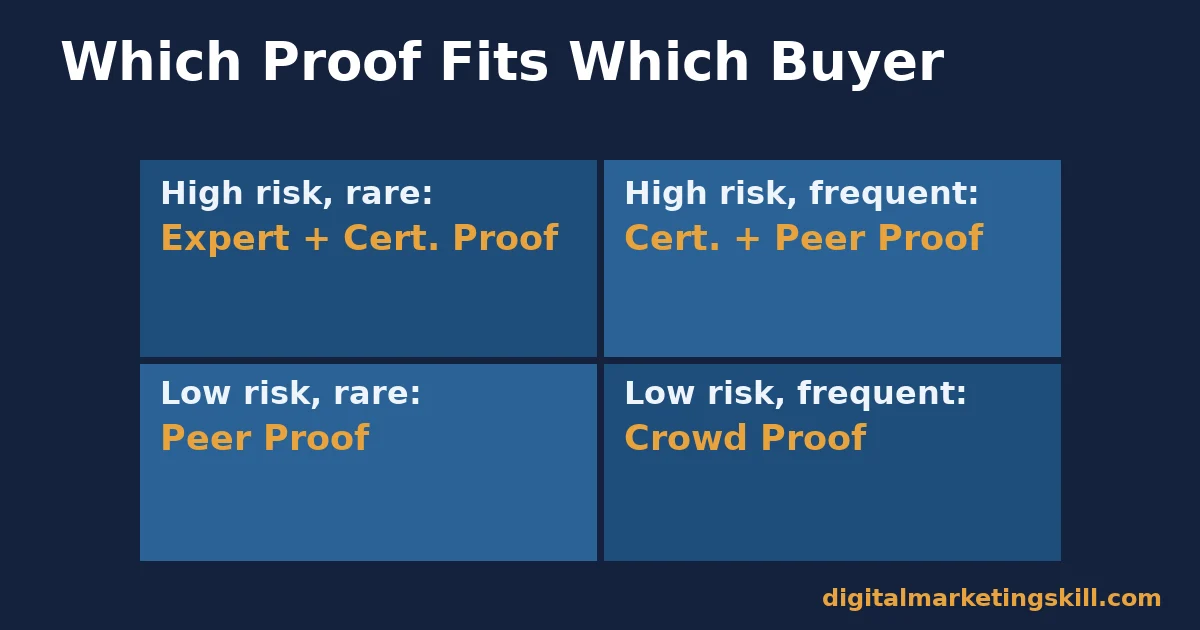
Four broad proof types cover almost every tactic on a landing page. Each is built for a different kind of buying decision.
Expert and Celebrity Proof: Built for High-Stakes Decisions
Named credentials, detailed case studies, and real endorsers ease fear on big, rare or costly decisions. The buyer cannot easily undo a bad choice here. This is proof by borrowed trust. The buyer trusts the expert, so some of that trust moves to the product.
A medical device, a big contract or a certification programme all lean on this type. The cost of a wrong call, in money, time or reputation, is high. So the buyer looks for a qualified third party before they commit.
Crowd Proof: Built for Low-Involvement, Frequent Purchases
Live visitor counts, “X people viewing this,” recent-purchase notes and subscriber counts work best on cheap, frequent, low-risk buys. Here the buyer mostly wants to know they are not the only one trying something new. A deep look at quality matters less.
A $12 snack subscription, a newsletter sign-up or a free tool download all fit here. The buyer is not weighing years of consequences. They are checking that the crowd already tried it, and nothing went wrong.
Peer Proof: Built for Trust Gaps Between Claim and Evidence
Specific, outcome-based testimonials and case studies close the gap between what a brand claims and what a buyer actually believes. The source is a peer with no financial stake in the sale. Our guide to getting good customer reviews covers this same gap. Vague testimonials (“great service!”) do almost none of this work. Specific ones (“went from 40 to 310 email subscribers in six weeks”) do most of it.
Certification Proof: Built for Risk-Averse, Comparison-Shopping Buyers
Security seals, accreditation marks and trust seals, guarantees and verified badges work on buyers who compare similar options. They want a tie-breaker, not a reason to keep shopping. This type answers “is this one of the legit options,” not “which one is best.”
It does its heaviest work on new or unfamiliar brands. The buyer has no past history with the company. They use the badge as a stand-in for years of earned reputation.
How to Lead With Each Social Proof Marketing Type
Picking the right category is only half the job. Each type also has a specific presentation that outperforms the generic version.
Expert and Celebrity Proof: Lead With Named Credentials, Not Logos Alone
Pair the endorser’s name, specific role and one sentence of relevant experience with their comment. A logo wall with no names attached reads as decoration. A named, qualified voice reads as a reference check. If you cannot name one qualified person behind a claim, that claim is not expert proof yet, no matter how official the layout looks.
Crowd Proof: Lead With Real-Time, Specific Numbers
Swap “thousands of happy customers” for a real, current count, such as “2,418 active subscribers this month.” Keep the number accurate and live. A round, static number that never changes reads as fake, within a few visits from a returning user.
If your real number is small, say so, and pair it with a growth trend instead, like “up from 340 to 610 subscribers this quarter.” A rising small number still reads as proof. A frozen big one does not.
Peer Proof: Lead With the Specific Outcome, Not the Compliment
Ask every testimonial source for a before-and-after number, a timeframe, and the obstacle they had before switching. Put that sentence first, and the generic praise, if any, last. An illustrative example: “our open rate went from 11% to 29% in five weeks after we fixed our subject lines.” One sentence like that earns more trust than three paragraphs of unqualified enthusiasm, because a reader can picture exactly what changed.
Certification Proof: Lead With a Verifiable Badge, Not a Claim
Only display a certification, guarantee name or security seal that a visitor can click through and verify on the issuing body’s own site. Instagram documents its own verified-badge criteria the same way. An unverifiable badge is worse than no badge. A skeptical buyer who checks and finds nothing loses trust in everything else on the page.
Measuring Whether Your Social Proof Marketing Is Working
Four KPIs show whether a proof element earns its place on the page, rather than just sitting there. None need specialised software. All four can be built from standard analytics event tracking plus a spreadsheet of testimonial dates.
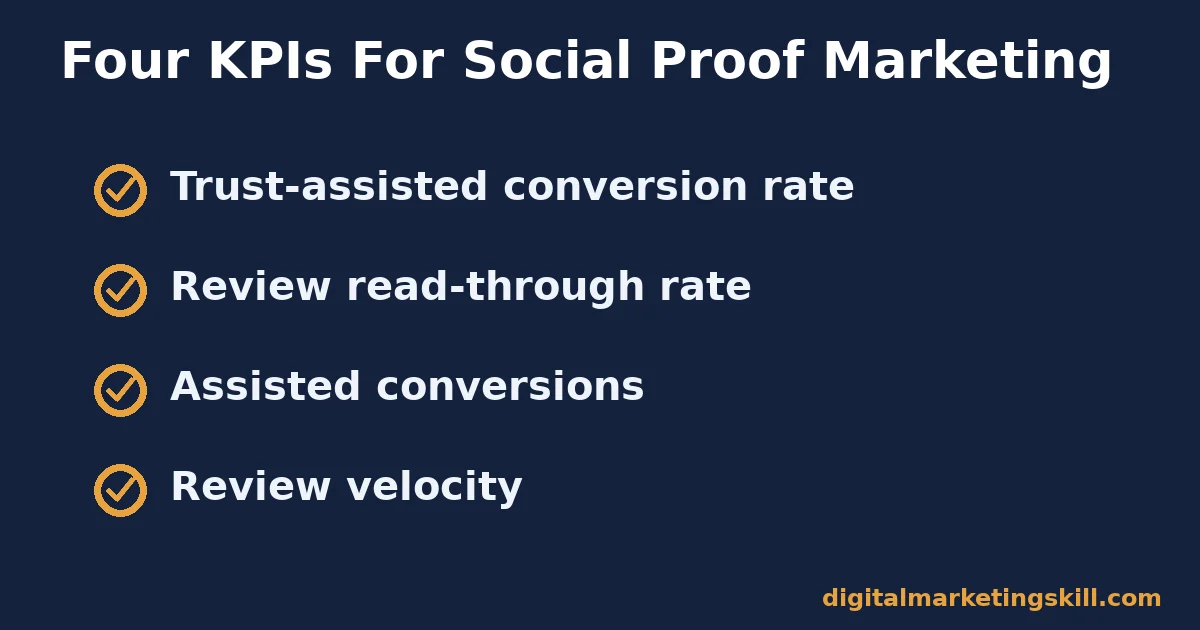
- Trust-assisted conversion rate — the conversion rate of visitors who scroll past or hover over a proof element, compared with those who do not. Read it as a signal that element is doing work, not as a stand-alone success metric.
- Review read-through rate — the share of product-page visitors who expand or click into full reviews. A low rate usually means the visible snippet is too generic to earn a click.
- Assisted conversions — purchases where a proof page appeared anywhere in that visitor’s path, even if it was not the last page viewed, the same multi-touch idea Google Analytics documents for attribution paths. This captures proof’s real job: reducing doubt earlier in the journey, not closing the sale alone.
- Review velocity — new reviews or testimonials collected per month, a signal Google’s own review-snippet guidance treats as part of review quality. A stalled velocity is the first sign your proof is quietly going stale while competitors’ keeps growing.
Track these for 2-4 weeks before and after any proof change, on the same traffic sources. That way seasonal or campaign shifts don’t get credited to the proof element by mistake. If your conversion leak sits earlier in the funnel, fix that leak first; proof cannot rescue a page nobody reaches.
The One Decision Rule for Social Proof Marketing
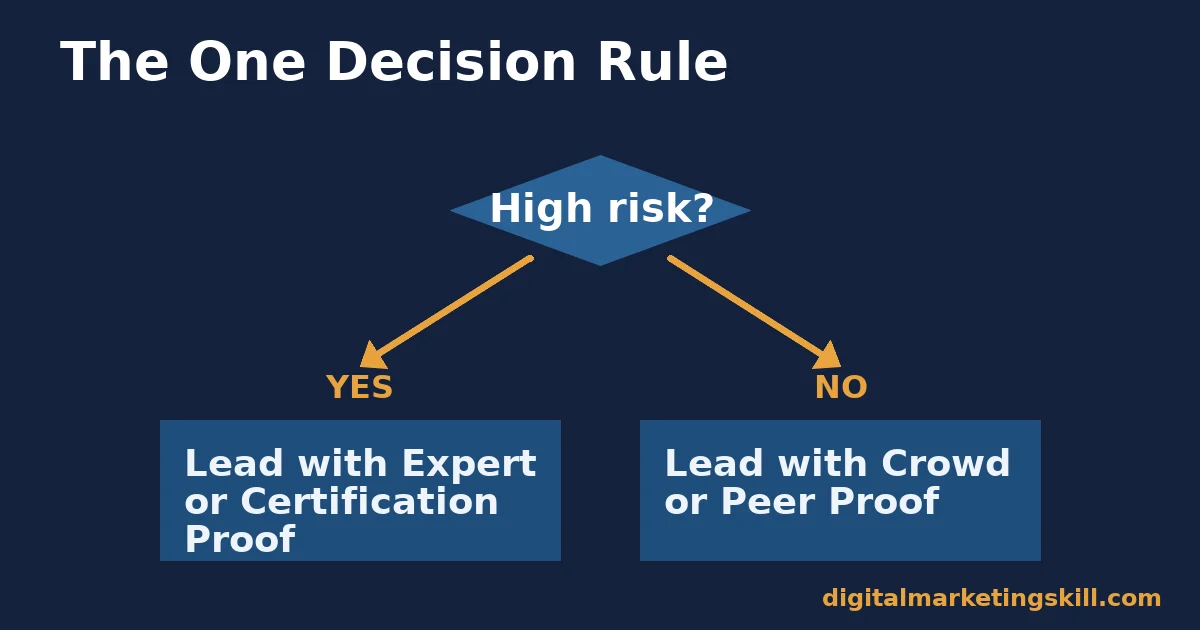
If the purchase is costly, rare or hard to reverse, lead with expert, certification or detailed peer-case proof. If it is cheap, frequent and easy to reverse, lead with crowd proof and simple, specific peer testimonials. Risk level, not price alone, decides which proof type a buyer wants.
A $300 purchase that is easy to return carries low risk, so it suits crowd proof. A $300 purchase that is non-refundable, or tied to a person’s job, carries high risk. It suits expert or certification proof instead, even at the same price.
Illustrative, invented numbers: picture two product pages with the same traffic. Page A sells a one-time $40 course bundle. It leads with a live “212 people enrolled this week” counter. Page B sells a $4,000 yearly software contract and leads with the same counter.
The counter likely helps Page A, where the choice is low-risk. It likely does little for Page B. There, the buyer wants a named reference customer and a security mark before a contract that size. Treat this as a reasoning example, not a measured result.
A second illustrative case: a freelancer’s page sells a $90 logo package (crowd proof: “47 logos delivered this month”) and a $6,000 brand package. However, the same “47 logos” line under-serves the bigger buyer. That buyer is really asking if this person has handled a project this size before, and whether they can check it.
So, splitting the page, so each price tier shows its own matching proof, is the practical version of the rule above.
A Real Case: Proof-of-Work as Its Own Form of Social Proof Marketing
Before pitching new clients, Digital Marketing Skill Institute student Ayooluwa Osemi ran a small, deliberately documented ad test. $14 in Facebook and Instagram ad spend produced $878 in sales, a figure published on the Institute’s student reviews page. The number itself became a proof asset she could show a prospective client, because it was specific, recent and checkable, not a vague claim of “great results.”
This matters beyond the raw figures. A documented, repeatable test works as expert and peer proof at once. It is specific enough to check, which is peer proof. It also shows a skill used under real conditions, which is expert proof.
That mix is exactly what the earlier sections flag as strongest. Anyone who sells a service, not only a physical product, can build the same kind of asset. Run one small, well-documented test before you ask a prospect to trust a bigger claim.
Limits: this is one campaign, on one small budget, for one product category. It is not typical or guaranteed for every account, product or market. Results like this vary by budget, niche, offer and the person running the campaign. See the Institute’s earnings disclaimer for full context before treating any single case as a forecast.
Frequently Asked Questions About Social Proof Marketing
What is social proof marketing?
Social proof marketing is any visible evidence that other people have chosen, used or endorsed a product, used to ease a new buyer’s uncertainty about whether that choice is safe or correct. It ranges from a simple review star-rating to a detailed named case study. Every version works by letting a hesitant buyer borrow confidence from someone else’s decision, instead of evaluating the product entirely from scratch.
Does social proof marketing actually increase conversions?
It can, but the effect depends on how specific and current the proof is, and on whether the proof type matches the buyer’s decision. Generic or stale proof elements show little to no measurable lift. Treat any proof addition as a test, not a guaranteed win, and measure it with the KPIs in this guide rather than assuming the lift happened because the element looks right.
What is the most trusted type of social proof?
Specific, outcome-based peer testimonials and reviews tend to carry more trust than vague praise or logo walls. A peer reviewer has no financial stake in the sale and gives a checkable detail. Per BrightLocal, readers of reviews look mainly for recency and detail over sheer volume. One long, specific, recent review commonly does more trust-building work than ten short, generic ones from years ago.
Can social proof backfire?
Yes. Static, round, unverifiable or clearly outdated numbers, like a visitor counter that never changes or a badge that links nowhere, create more distrust than having no proof element at all. The failure mode is almost always the same: a claim that looks impressive but cannot survive a few seconds of scrutiny, which then makes every other claim on the page feel less credible too.
How many reviews does a product need before social proof works?
There is no fixed universal threshold. What matters more than the count is whether the visible reviews are specific, recent and easy to scan. A handful of detailed reviews can outperform a large pile of one-line ones. Five detailed, named reviews that each describe a specific use case often persuade more than two hundred star-ratings with no written detail.
Is a verified badge the same as a security certification?
No. A verified badge, for example on a social profile, confirms identity. A security certification or trust seal confirms a separate technical or compliance standard. Only display either if a visitor can click through and confirm it on the issuing organisation’s own site. Never recreate a badge graphic yourself without the underlying verification; an unearned badge is a trust violation, not a shortcut.
Where should social proof appear on a page?
Place the proof type that matches the decision stage. Put broad trust signals, like counts and badges, near the top, where doubt runs highest. Put specific, detailed proof, like named testimonials and case studies, near the point of commitment, such as next to a price or a sign-up form.
How often should social proof be updated?
Refresh review counts, visitor numbers and “recently purchased” notifications continuously, or at least monthly. Named case studies and testimonials can stay longer, as long as the result is still accurate and the source would still vouch for it today. Re-check them at least twice a year so nothing stale stays live by accident.
Put Social Proof Marketing to Work With a Structured Skill Set
Social proof marketing is one lever inside a much bigger skill set. Strategy, content, ads, email, SEO and analytics all put your product in front of the right buyer. Proof only gets a chance to work after that happens.
So, none of the frameworks above matter if the traffic, the offer or the funnel is broken. Instead, build proof skills alongside the rest of a marketing stack, not in isolation; that combination tends to give steadier results.
Digital Marketing Skill Institute’s Master Diploma in Digital & AI Marketing is built around four AI-powered tracks: AI-Powered Social Media Management and Advertising, AI-Powered Lead Generation and Email Automation, AI-Powered Google Specialist, and AI-Powered WordPress and SEO Specialist.
Together they cover ten courses, with a Full Stack option to complete all four. Every track includes unlimited 1-on-1 coaching and mentoring, a U.S. Project Internship with a verified U.S. Work Reference Letter, and dual US and UK accreditation recognised in more than 100 countries. The program runs 100% online, so you can train from anywhere in your country.
Read verified outcomes like the one above on the reviews page, and browse more guides on the digital marketing blog. When you’re ready, see the full program on the Master Diploma page, or start your application at Digital Marketing Skill Institute.
Wherever you live, the program runs fully online, so your location never has to be the obstacle. Overall, the coaching and internship are built to give you your own checkable, documented result, the same way the case study above was built.
Every figure in this guide was checked against its original source before publication. Figures marked as illustrative are invented examples, not real results.
![9 Amazing Digital Marketing Skills to Make Money Online [With Proof]](https://digitalmarketingskill.com/wp-content/uploads/2019/07/9-Amazing-Digital-Marketing-Skills-to-Make-Money-Online-With-Proof-17.png)






