
AI governance is the set of rules, roles and processes an organisation uses to decide how artificial intelligence is chosen, used and checked. It covers who can approve an AI tool, what data it may use, how risks are reviewed and who is accountable when something goes wrong. It matters because, without it, AI use spreads unchecked, and legal, privacy and brand risks grow with it.
Key Takeaways
- AI governance is about control and accountability: who decides, who checks and who is responsible.
- The US NIST AI Risk Management Framework treats “govern” as a function that runs through all other risk work.
- The EU AI Act sorts AI systems by risk, from banned uses to minimal-risk tools.
- Good governance includes an inventory of AI tools, clear approval steps, risk reviews and records.
- For marketing teams, it often starts with a simple list of approved tools and rules for customer data.
What Is AI Governance?
First, AI ethics sets out values, such as fairness and privacy. Then responsible AI turns those values into everyday practice. AI governance is the structure that holds it all together. It answers practical questions: who can buy an AI tool, who signs off its use and who checks that the rules are followed.
NIST describes the govern function as one that builds and puts in place a culture of risk management within organisations that design, develop, use or buy AI systems. It also sets out the processes, documents and structures that anticipate, identify and manage the risks a system can pose.
For example, a marketing agency finds staff using five different AI writing tools, some with client data. Governance means the agency picks approved tools, sets rules on what data can go in and names someone to review new requests.
How AI Governance Works
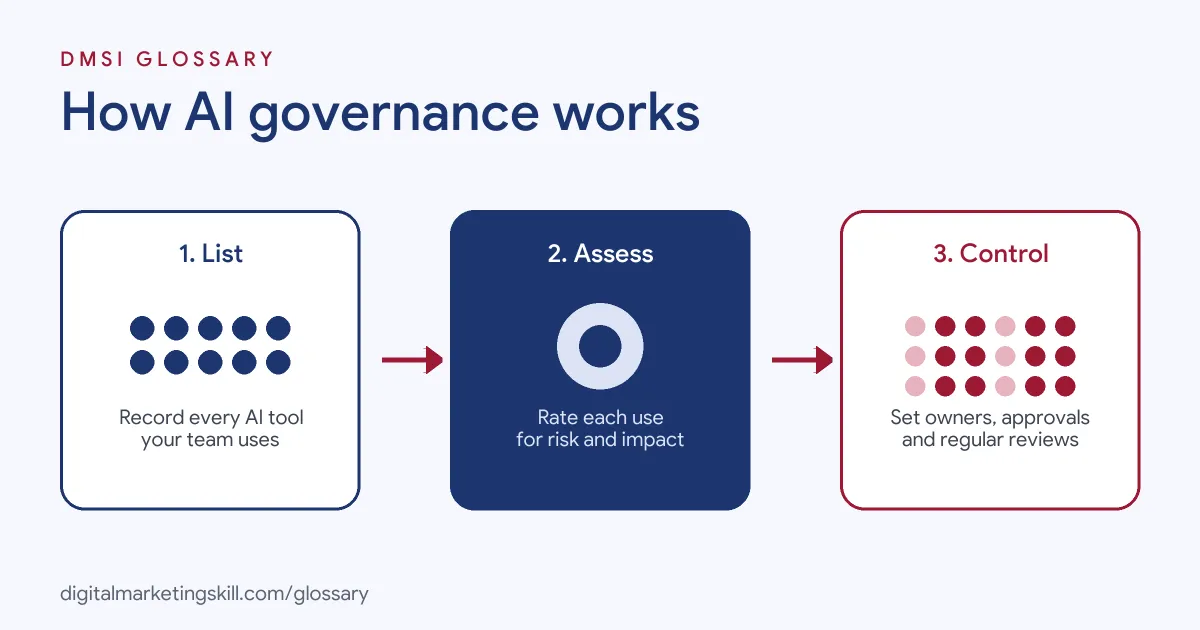
Most AI governance follows a simple loop. First, you list the AI you use. Next, you assess the risk of each use. Then you set controls, such as approvals and human review. Finally, you monitor, record and review.
The NIST Approach
NIST’s framework has four functions: govern, map, measure and manage. It describes governance as a cross-cutting function that informs and runs through the other three. In addition, NIST says risk management should be continuous and happen throughout the AI system’s lifecycle.
The EU Risk Levels
The EU AI Act takes a risk-based view. A high-level summary of the Act explains four levels:
| Risk level | What it means | Examples given |
|---|---|---|
| Unacceptable | Prohibited | Social scoring and manipulative AI |
| High | Regulated, with most obligations on providers | Systems in sensitive areas listed in the Act |
| Limited | Lighter transparency duties | Chatbots and deepfakes, where users must know they are dealing with AI |
| Minimal | Unregulated | Most everyday AI tools |
The summary also notes that deployers, meaning organisations that use AI in a professional capacity, have some duties too, though fewer than providers. The Act also covers general-purpose AI models. Their providers must, for example, provide technical documentation and publish a summary of the content used for training.
Governance Inside Companies
Meanwhile, large AI companies publish their own approaches. Google, for instance, says its AI governance works through a comprehensive, multi-layered approach that spans the entire model lifecycle. Smaller firms don’t need that scale. Even so, the same idea applies: decide, check, record and improve. The OECD makes the same point at a global level, listing accountability as one of its five values-based principles for trustworthy AI. In other words, someone must always answer for how AI is used.
AI Governance Examples in Marketing
Here are three made-up examples:
- Approved tool list (example): A retailer’s marketing team keeps a list of approved AI tools. Before anyone adds a new one, the data lead checks how it stores and uses inputs.
- Chatbot sign-off (example): Before launching a website chatbot, a bank’s marketing team runs a risk review, adds an “AI assistant” label and sets rules for handing over to a human.
- Content rules (example): An agency requires a named editor to approve every AI-assisted article. It records which tool was used and keeps that log for client audits.
In each case, the business keeps using AI. It simply does so with clear rules and owners.
AI Governance vs AI Ethics vs Responsible AI
These three terms are closely linked. Here is how they differ:
| Term | Main question | Example |
|---|---|---|
| AI ethics | What should we value? | Fairness, privacy and honesty |
| Responsible AI | How do we act on those values? | Checking outputs and testing for bias |
| AI governance | Who decides, checks and is accountable? | Approval steps, owners and records |
In short, governance is the structure that makes the other two stick.
How to Set Up AI Governance in a Marketing Team
Follow these steps to start:
- Take stock. List every AI tool the team uses, including free and personal ones.
- Name an owner. Give one person the job of running the AI rules.
- Classify each use. Mark uses as low, medium or high risk, based on who could be affected.
- Set rules for data. Decide what customer or client data may never go into AI tools.
- Add approval steps. Require sign-off for new tools and for high-risk uses, such as chatbots.
- Keep records. Log approvals, reviews and incidents.
- Review regularly. Check the list and rules every few months, as tools and laws change.
A Simple Risk Rating Example
Here is a made-up way a small marketing team might rate its AI uses. First, it lists each task. Then it asks two questions: could this harm a person, and does it use personal data?
| Task | Rating | Control |
|---|---|---|
| Brainstorming blog titles | Low | No sign-off needed |
| Drafting product descriptions | Medium | An editor checks facts and claims |
| Writing personalised emails from customer data | High | Approved tool only, plus a data check |
| Customer chatbot | High | Risk review, AI label and a human hand-over |
As a result, low-risk tasks stay quick, while higher-risk ones get the checks they need. In addition, the team reviews the table whenever it adds a new tool. So, over time, the list grows into a clear record of how it uses AI. That record also helps if a client or regulator asks questions later.
Best Practices
A few habits make governance work without slowing everyone down:
- Keep it proportionate. Light rules for low-risk tasks, stricter ones for high-risk uses.
- Make the right way the easy way. Offer approved tools, so people don’t turn to unapproved ones.
- Involve different people. NIST says diverse teams help surface problems and risks.
- Link it to privacy. Align AI rules with your data protection policies.
Common Mistakes to Avoid
First, many organisations write a policy that nobody reads. Second, they ban AI outright, so staff use it in secret instead. Third, they forget free tools and browser add-ons when they list their AI. Finally, they set rules once and never review them. Each of these leaves gaps that real risks can slip through.
Where You’ll Use AI Governance at Work
AI governance appears in AI leadership and programme roles. For example, current remote job listings ask for:
- “Knowledge of AI governance, responsible AI, model evaluation, human-in-the-loop workflows, and production AI operations” (Principal Program Manager, Generative AI Implementation).
- “Experience with AI governance, data privacy, and ethical AI practices” (Head of AI).
As a marketer, you are more likely to follow governance rules than to write them. Even so, knowing how they work helps you choose tools wisely and explain your choices to clients. For the practical side, see our page on responsible AI.
Learn It in Any DMSI Track
AI fundamentals, covering strategy and planning, are part of every track in the DMSI Master Diploma. There, you use AI tools for real marketing tasks and learn to plan their use with care. You also join a U.S. Project Internship from day one, with unlimited 1-on-1 mentoring.
To compare the tools you might govern, read our guide to AI marketing tools.
Frequently Asked Questions
What is AI governance in simple terms?
It is how an organisation decides which AI to use, sets rules for it and makes sure someone is responsible for checking it.
What is the difference between AI governance and AI ethics?
AI ethics is about values, such as fairness. AI governance is the structure of rules, roles and checks that puts those values into effect.
Does the EU AI Act affect marketers?
It can. For example, it sets transparency duties for chatbots and deepfakes, so users know they are dealing with AI.
What is the NIST AI Risk Management Framework?
It is a voluntary US framework for managing AI risks. It has four functions: govern, map, measure and manage.
Does a small business need AI governance?
Yes, at a light level. A list of approved tools, clear data rules and one named owner are a good start. You can add more checks as your use of AI grows.
Sources: NIST AI RMF: Core functions; EU AI Act: High-level summary; OECD.AI: AI Principles; Google: AI Principles; remote job listings on Himalayas.