
Generative engine optimisation (GEO) is the practice of shaping your content so AI tools that write answers, such as ChatGPT search or Google’s AI Overviews, are more likely to use and cite it. These tools are often called generative engines, because they generate a response from several sources instead of listing links. GEO matters because a growing share of people now read an AI answer first, so being one of its sources is a new route to visibility.
Key Takeaways
- The term comes from a research paper by Aggarwal and colleagues, which describes GEO as a way to help creators improve their visibility in generative engine responses.
- The authors report that GEO methods “can boost visibility by up to 40% in generative engine responses.”
- In their tests, adding citations, quotations and statistics worked well, while keyword stuffing did not.
- Google says there are no special optimisations needed to appear in its AI features, so strong SEO basics still come first.
- Your page must also be reachable by each tool’s crawler, such as OAI-SearchBot for ChatGPT search.
What Is Generative Engine Optimisation?
Classic search shows a list of pages. A generative engine reads those pages for you and writes an answer, often with citations. Examples include ChatGPT search, Google’s AI Mode and AI Overviews, and other AI assistants.
The idea of GEO was set out in a paper titled “GEO: Generative Engine Optimization” by Pranjal Aggarwal and co-authors. They describe it as “the first novel paradigm to aid content creators in improving their content visibility in generative engine responses.” They also built GEO-bench, “a large-scale benchmark of diverse user queries across multiple domains,” to test it.
Here is a simple way to think about it. An AI tool is like a busy reader with little time. It skims many pages and picks the ones with clear facts it can check. So if your page says exactly what it means, and shows where each fact came from, it is easier to pick.
In practice, generative engine optimisation sits alongside SEO and answer engine optimisation. SEO helps a page rank. AEO helps it become a direct answer. Meanwhile, GEO focuses on being chosen and cited inside AI-written responses.
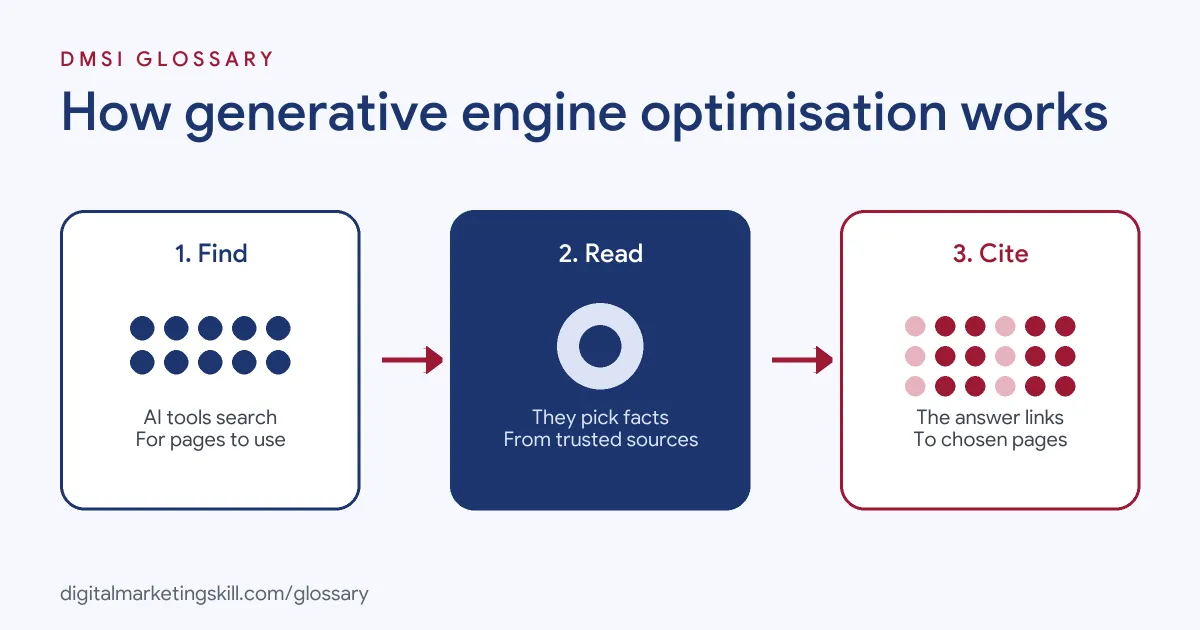
How Generative Engine Optimisation Works
The process has three parts. First, an AI tool finds pages that might answer a question. Next, it reads them and decides which facts to use. Finally, it writes an answer and cites some of its sources. GEO aims to make your page easy to find, easy to trust and easy to quote at each stage.
What the Research Found
The GEO paper tested nine methods, including Cite Sources, Quotation Addition, Statistics Addition, Fluency Optimization, Authoritative, Easy-to-Understand, Unique Words, Technical Terms and Keyword Stuffing. The authors report that “citations, quotations from relevant sources, and statistics can significantly boost source visibility.”
By contrast, they found that “simple methods like Keyword Stuffing traditionally used in SEO don’t perform well.” In their results table, keyword stuffing even scored below the unoptimised baseline on one main measure. They also found that what works varies across topics, so there is no single formula.
What Google Says
Google’s own guidance is simpler. It says “there are no additional requirements to appear in AI Overviews or AI Mode, nor other special optimizations necessary.” A page must be indexed and eligible to show with a snippet. Google also advises “unique, non-commodity content that visitors from Search and your own readers will find helpful and satisfying.”
Crawler Access
Finally, each AI tool has to be able to reach your page. OpenAI says its OAI-SearchBot “is used to surface websites in search results in ChatGPT’s search features.” It adds that sites that block it “will not be shown in ChatGPT search answers.” So check your robots.txt rules before you optimise anything else.
Generative Engine Optimisation Examples
Here are three made-up examples:
- Software company: A firm adds a short statistic from its own customer survey, with a clear source, to each feature page. As a result, AI answers start quoting those figures.
- Health food brand: A brand adds quotations from a registered dietitian to its guides, with names and credentials.
- Travel blog: A blogger replaces vague claims such as “very popular” with specific, sourced facts. Its pages become easier for AI tools to cite.
GEO Methods Compared
This table sums up how some methods from the GEO paper performed:
| Method | What it means | Finding in the paper |
|---|---|---|
| Cite Sources | Add references to credible sources | Among the methods that boosted visibility |
| Quotation Addition | Add relevant quotes from experts or sources | Strong improvements across metrics |
| Statistics Addition | Add specific, relevant numbers | Strong improvements across metrics |
| Keyword Stuffing | Repeat target keywords many times | Did not perform well; below baseline on one main measure |
In short, evidence beats repetition. That matches good writing advice anyway, so the same changes help your human readers too.
How to Do Generative Engine Optimisation
- Check access. Make sure Googlebot and AI search crawlers, such as OAI-SearchBot, can reach your key pages.
- Confirm indexing. In Search Console, check that important pages are indexed and can show a snippet.
- Pick real questions. List the questions your buyers ask AI tools about your topic.
- Add evidence. Include specific statistics, named sources and short quotations where they genuinely help.
- Write clearly. Use plain headings and lead each section with a direct answer.
- Avoid keyword stuffing. The GEO research found it doesn’t perform well.
- Test and track. Finally, ask your key questions in AI tools each month and note whether your pages are cited.
How to Measure Your Progress
Measurement is still developing, so use several signals together. Google says traffic from its AI features is counted in the overall Web search figures in Search Console. For other tools, check referral visits from their domains in your analytics. In addition, keep a simple log of the questions you test, the tools you use and whether your brand appears. Over a few months, that log shows whether your changes are working.
Best Practices for Generative Engine Optimisation
- Build on SEO. Pages that are crawlable, indexed and helpful have the best chance in AI answers too.
- Be specific. Exact figures and named sources are easier to cite than vague claims.
- Show expertise. Add author details, credentials and first-hand experience.
- Keep facts current. Out-of-date numbers can lead AI tools to repeat errors.
- Write for people first. Google’s advice is to create content your readers find helpful and satisfying.
Common Mistakes to Avoid
A common mistake is treating GEO as a set of tricks, rather than better evidence and clearer writing. Another is keyword stuffing, which the research found doesn’t work. Some sites also block AI search crawlers without meaning to. Others add statistics without sources, which undermines trust. Lastly, many forget that results vary by topic, so they copy tactics without testing them.
Where You’ll Use Generative Engine Optimisation at Work
GEO now appears by name in SEO and content job listings. For example, remote roles ask candidates to:
- “Own Gremlin’s SEO, AEO, and GEO strategy so we’re found and cited in Google, AI Overviews, ChatGPT, Claude, and Perplexity” (Sr. Content Marketing Manager, B2B SaaS).
- Take on a role that “combines content strategy, SEO, and GEO expertise” (Consultant, Content Strategist).
- Evaluate “client properties to ensure alignment with SEO/GEO best practices” (SEO Analyst).
So if you want to work as an SEO Specialist, Website Manager or Content Creator, expect to plan content for AI answers as well as rankings.
Learn It in the WordPress and SEO Track
You can practise GEO in the AI-Powered WordPress and SEO Specialist track. It covers AI fundamentals, SEO and content marketing, and you build a WordPress site or store and rank it with an SEO content plan. You also get unlimited 1-on-1 mentoring and a U.S. Project Internship from day one.
For more, read our in-depth guide to generative engine optimisation and our glossary entry on AI search.
Frequently Asked Questions
What is generative engine optimisation in simple terms?
It is making your content easy for AI tools to find, trust and cite when they write answers to people’s questions.
Is GEO different from SEO?
It builds on SEO. SEO aims to rank pages, while GEO aims to be used and cited inside AI-generated answers.
What works best for GEO?
In the GEO research, adding citations, quotations and statistics boosted visibility, while keyword stuffing did not.
Does Google require special GEO techniques?
No. Google says there are no special optimisations needed for its AI features. Helpful content and technical basics matter most.
How do I know if GEO is working?
Test your key questions in AI tools regularly and note citations. Also check Search Console and referral traffic from AI tools.
Sources: Aggarwal et al.: GEO, Generative Engine Optimization (arXiv); Google Search Central: AI features and your website; Google Search Central Blog: Succeeding in AI search; OpenAI: Overview of OpenAI crawlers; remote job listings on Himalayas.