
LLM optimisation, also called LLMO, is the practice of making your content easy for large language models and AI search tools to find, understand and cite in their answers. It builds on SEO, but the goal is to be named or linked inside an AI-generated reply, not only to rank as a blue link. It matters because many people ask tools such as ChatGPT, Gemini and Google’s AI Overviews for answers, and those answers point to only a few sources.
Key Takeaways
- LLM optimisation aims to get your brand and pages cited in AI answers. It is closely related to generative engine optimisation (GEO) and answer engine optimisation (AEO).
- Google says there are “no additional requirements” to appear in AI Overviews or AI Mode. Normal SEO basics still apply.
- A page must be indexed and eligible to show with a snippet before Google can use it as a supporting link.
- Research on generative engines found that adding quotations, statistics and cited sources raised visibility, while keyword stuffing did not help.
- Crawler access matters. For example, OpenAI says sites that block OAI-SearchBot “will not be shown in ChatGPT search answers.”
What Is LLM Optimisation?
Think of LLM optimisation as SEO for a new kind of results page. A classic search engine shows ten links and lets people choose. An AI tool, by contrast, writes one answer and adds a handful of sources. So the question changes from “Do I rank?” to “Am I one of the sources the answer uses?”
The name is still settling. Some teams say LLMO, others say GEO or AEO. In practice, they describe the same job: make content that AI systems can reach, trust and quote. If you are new to the models themselves, start with our entry on the large language model.
It is not a trick or a hidden setting. Instead, it is a set of habits that make good content easier for machines to read and reuse.
How LLM Optimisation Works
AI search tools tend to follow three steps. First, a crawler reaches your page. Next, the system reads it and judges whether it answers part of a question. Finally, it writes a reply and cites the pages it relied on.
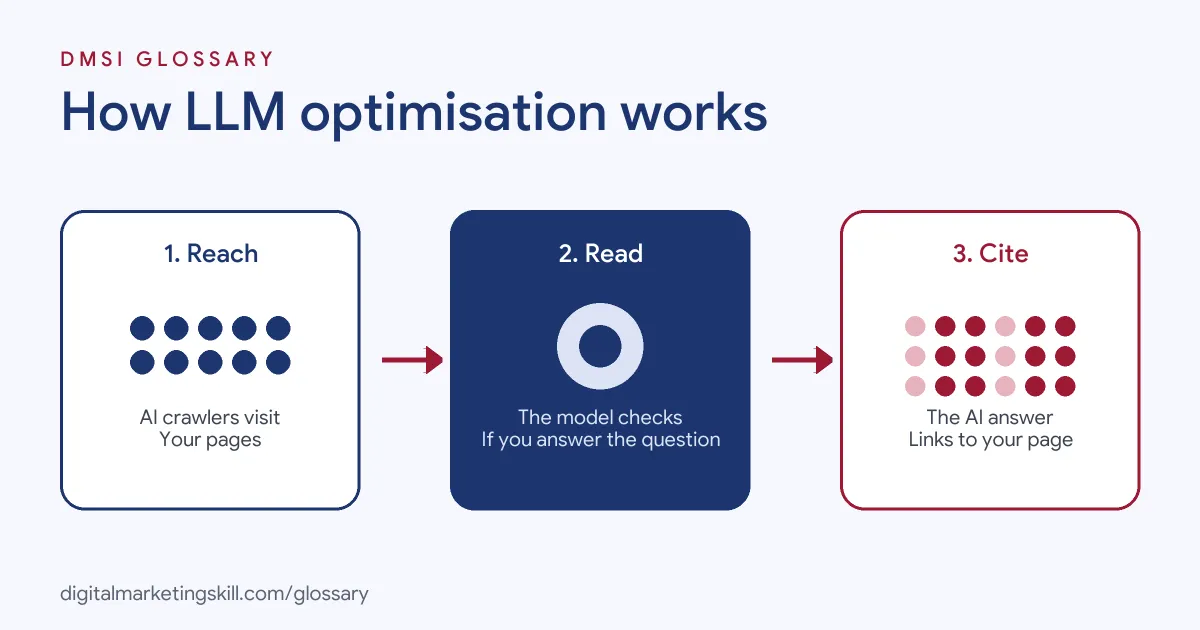
Access for AI Crawlers
If a tool can’t reach your page, it can’t cite it. OpenAI explains that OAI-SearchBot “is used to surface websites in search results in ChatGPT’s search features.” It treats GPTBot separately, since GPTBot collects content that may be used for training. So you can allow search while blocking training. OpenAI also notes it can take about 24 hours for its systems to adjust after you update robots.txt.
How Google Builds AI Answers
Google says AI Overviews and AI Mode may use “query fan-out”. That means “issuing multiple related searches across subtopics and data sources” to build a reply. As a result, a page that answers one clear subtopic well can earn a link, even if it doesn’t rank first for the main query.
To be eligible, Google says a page must be “indexed and eligible to be shown in Google Search with a snippet.” Google also states: “You don’t need to create new machine readable files, AI text files, or markup to appear in these features.”
What Makes Content Citable
A team of researchers tested this in a paper called “GEO: Generative Engine Optimization”. They reported that their methods could boost visibility in AI answers by up to 40%. Adding quotations worked best, followed by adding statistics, improving fluency and citing sources. However, keyword stuffing scored below the baseline. The authors also found that results varied by topic.
LLM Optimisation Examples
Here are three made-up examples of the practice in action:
- Software company (example): A payroll app adds a short, factual answer to “What is payroll tax?” at the top of its guide, with a source link. AI tools can now lift that answer and cite the page.
- Online shop (example): A bike shop publishes a sizing table with real measurements. Because the data is specific, AI answers about bike sizes start to reference it.
- Training provider (example): A course site checks its robots.txt and finds it blocks OAI-SearchBot by mistake. It fixes the rule, so its pages can appear in ChatGPT search.
In each case, the change makes the content easier to reach, read or trust.
LLM Optimisation vs SEO
The two overlap a lot, but the goals differ. Here is a quick comparison:
| Area | Classic SEO | LLM optimisation |
|---|---|---|
| Main goal | Rank in the list of results | Be cited or named in an AI answer |
| Where it shows | Search results pages | AI Overviews, AI Mode, ChatGPT search and other assistants |
| Access | Search crawlers such as Googlebot | Search crawlers plus AI crawlers such as OAI-SearchBot |
| Content style | Covers the topic and matches intent | Clear answers, specific facts, quotes and sources |
| Measurement | Rankings, clicks and impressions | Citations, brand mentions and referral visits from AI tools |
In short, good SEO is the base. LLM optimisation adds a focus on being quotable.
How to Start LLM Optimisation
- Check crawler access. Review robots.txt for Googlebot, OAI-SearchBot and other AI search crawlers you want to allow.
- Confirm indexing. Use Google Search Console to check that key pages are indexed and can show a snippet.
- Answer questions directly. Put a short, plain answer near the top of each page, then add detail.
- Add evidence. Include specific numbers, short quotes from experts and links to your sources.
- Cover subtopics. Because of query fan-out, answer the follow-up questions people are likely to ask.
- Test in the tools. Ask ChatGPT, Gemini and Google’s AI Mode your target questions, and note which sources they cite.
- Track results. Google says AI Overview and AI Mode traffic appears in the Search Console Performance report under the Web search type.
Best Practices for LLM Optimisation
- Write for people first. Clear writing helps both readers and machines.
- Be specific. For example, “ships in 2 working days” is easier to quote than “fast delivery”.
- Show who wrote it. Named authors and clear sources build trust.
- Keep facts current. Update prices, specs and policies, so AI answers don’t repeat old details.
- Use the right controls. Google points site owners to nosnippet, max-snippet and noindex if they want to limit what appears.
Common Mistakes to Avoid
The biggest mistake is blocking AI search crawlers without meaning to, often through a broad robots.txt rule. Another is stuffing pages with keywords, which the GEO research found did not help. Some teams also create extra “AI files” in the hope of a shortcut, although Google says none are needed for its AI features. Others forget the basics, such as indexing and page speed. Finally, many never test their questions in the AI tools, so they have no idea whether anything changed.
Where You’ll Use LLM Optimisation at Work
This skill appears in SEO and content job listings. For example, real remote listings ask for:
- “Working knowledge of Generative Engine Optimization (GEO) and AI-driven content discoverability.” (Consultant, Content Strategist).
- Someone to “Track and adapt to evolving AI search behavior (LLM crawling, citation mechanics, answer engine optimization) to keep content practices current” (Content Strategist).
- A specialist “to drive organic and AI-answer visibility.” (SEO/GEO Specialist).
So if you want to work as an SEO Specialist or content marketer, employers will expect you to understand AI search as well as classic rankings.
Learn It in the WordPress and SEO Track
AI fundamentals are part of every DMSI track, and LLM optimisation is used most in the AI-Powered WordPress and SEO Specialist track. There, you learn WordPress website and eCommerce development, search engine optimisation and content marketing. Your portfolio project is a WordPress site or store that you build and rank with an SEO content plan. You also get unlimited 1-on-1 mentoring and a U.S. Project Internship from day one.
Next, read our guide to generative engine optimisation for more ideas on AI search visibility.
Frequently Asked Questions
What is LLM optimisation in simple terms?
It means shaping your content so AI tools can find it, understand it and cite it in their answers. It builds on normal SEO.
Is LLMO the same as GEO?
They are very close. GEO stands for generative engine optimisation, and both terms describe getting content into AI-generated answers.
Do I need special files for Google’s AI Overviews?
No. Google says you don’t need new machine-readable files, AI text files or markup to appear in its AI features.
Does blocking GPTBot remove me from ChatGPT search?
Not on its own. OpenAI uses GPTBot for training and OAI-SearchBot for search, so each one has its own robots.txt rule.
How do I measure LLM optimisation?
Track AI referral visits in your analytics, check Search Console, and test your key questions in AI tools to see who they cite.
Sources: Google Search Central: AI features and your website; Aggarwal et al.: GEO, Generative Engine Optimization; OpenAI: Overview of OpenAI crawlers; remote job listings on Himalayas.