
Brand awareness is how familiar your target audience is with your brand, from simply recognising your name or logo to remembering you first when they need what you sell. It grows each time people see, hear or talk about your brand in a way that sticks. It matters because people tend to buy from brands they already know, so awareness feeds every later stage of marketing, from clicks to sales.
Key Takeaways
- Awareness ranges from recognition, where people know your brand when they see it, to recall, where they think of you unprompted.
- This stage sits at the top of the funnel, before consideration and conversion.
- Platforms offer awareness objectives. LinkedIn, for example, describes its Brand Awareness objective as impression-based, to drive “brand recognition and share of voice.”
- Google’s Brand Lift measures “ad recall, brand awareness and consideration” by comparing people who saw your ads with people who didn’t.
- You can’t measure it with clicks alone. Surveys, brand searches, reach and share of voice give a fuller picture.
What Is Brand Awareness?
Think about the last time you needed a pair of trainers. A few brand names probably came to mind straight away. That is awareness at work. Those brands were in your head before you even started searching.
Awareness has levels. At the first level, people recognise your logo or name when they see it. Then, at a higher level, they recall it without help. At the top, your brand is the first one they think of in your category.
For example, a new oat milk brand might start with almost no awareness. After months of social posts, shop displays and video ads, shoppers begin to recognise its carton on the shelf. Over time, some start asking for it by name. Our guide to brand awareness explores the strategy side in more depth.
How Brand Awareness Works
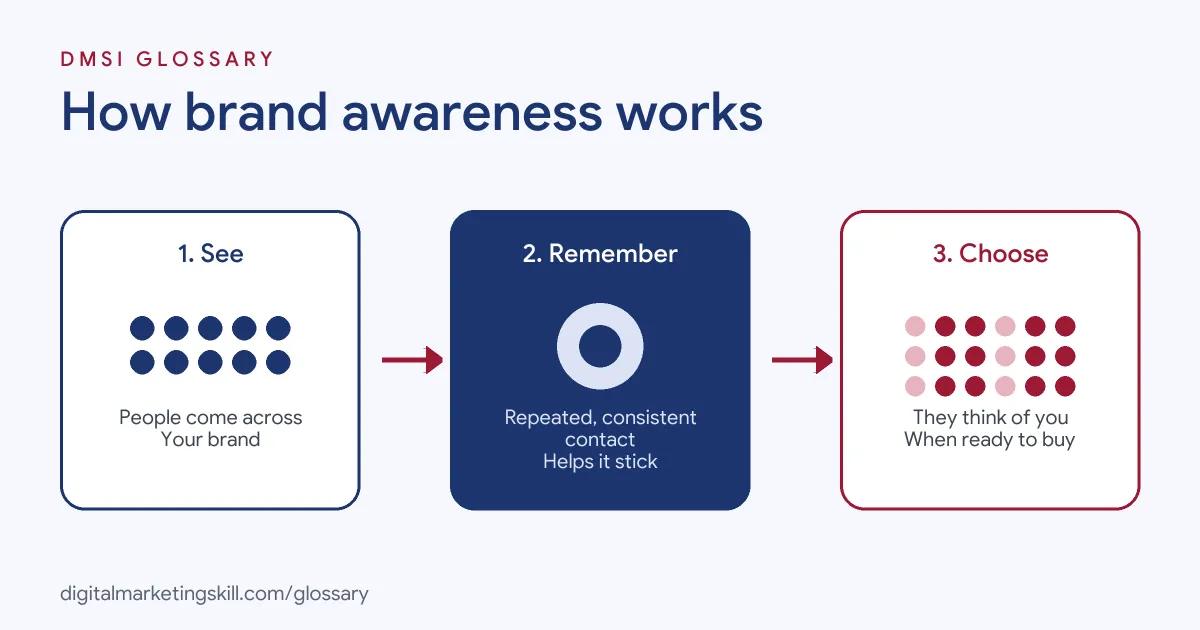
It builds in three steps. First, people come across your brand, through an ad, a post, a search result or a friend. Next, repeated, consistent exposure helps them remember it. Finally, when they need what you offer, your brand comes to mind and they look for you.
Its Place in the Funnel
Awareness is the first stage of most marketing funnels. LinkedIn, for instance, groups its ad objectives into awareness, consideration and conversion. It says awareness campaigns use impressions to “drive brand recognition and share of voice among your audience.” In other words, the aim is to be seen and remembered, not to win an instant click. See our entry on top of funnel marketing for more.
Reach and Repetition
People rarely remember a brand after one glance. So awareness campaigns focus on reach, the number of people who see your message, and on showing it often enough to stick. Consistent colours, logos and messages help, because each contact then builds on the last one.
Awareness also shows up in search. When more people know your name, more of them type it into Google. Search Console’s Performance report lists the queries people used to find you, so you can track how often your brand name appears. A steady rise in branded searches is one of the clearest signs that people remember you.
Measuring the Lift
Because awareness happens in people’s heads, it needs special measurement. Google’s Brand Lift shows short surveys on YouTube to people who saw your ads and to similar people who didn’t. It then reports “The difference in the responses between the group who saw your ads and the group who didn’t.” Google notes that Brand Lift “isn’t available for all Google Ads accounts,” and it works with in-stream and bumper ads bought via auction.
Brand Awareness Examples
Here are three made-up examples of awareness campaigns:
- New drinks brand (example): It runs short video ads and sends free samples to local gyms, so people see and taste the product.
- B2B software firm (example): It runs a LinkedIn awareness campaign aimed at finance leaders, with helpful tips rather than a hard sell.
- Local bakery (example): It sponsors a community fun run and shares photos online, so neighbours start to recognise its name.
In each case, the goal is to be remembered first and to sell later. Each campaign also uses a channel where its audience already spends time.
Ways to Measure Brand Awareness
No single number captures awareness, so teams combine several:
| Measure | What it shows | Where to find it |
|---|---|---|
| Reach and impressions | How many people saw your brand | Ad platforms and social analytics |
| Brand Lift or survey results | Changes in ad recall and awareness | Google Brand Lift or your own surveys |
| Branded searches | How many people search for your name | Google Search Console |
| Share of voice | Your visibility compared with rivals | Social listening or ad tools |
| Direct visits | People typing your address straight in | Your analytics tool |
In short, look for several signals moving in the same direction. Our entry on share of voice explains the competitor view.
How to Build Brand Awareness
- Know your audience. Decide exactly who you want to reach and where they spend time.
- Define your brand. Agree your name, look, tone and the one idea you want people to remember.
- Choose your channels. Pick a few places where your audience already is, such as YouTube, Instagram or LinkedIn.
- Use an awareness objective. On ad platforms, choose a goal built for reach and recall.
- Stay consistent. Use the same colours, logo and message everywhere.
- Repeat over time. Plan a steady stream of content, not one burst.
- Measure the change. Track reach, branded searches and, where possible, surveys before and after.
A Worked Example
Here is a made-up example. A skincare brand gets about 400 searches a month for its name in Search Console. It then runs a three-month video and social campaign. Afterwards, branded searches rise to 900 a month, and a short survey shows more people recognise the logo. Sales take a little longer to follow, which is normal, because awareness usually comes before buying.
Best Practices for Brand Awareness
- Be memorable, not just visible. A clear, distinctive message beats a generic one.
- Give it time. Awareness builds over months, so judge it over months too.
- Pair it with performance. Awareness makes later ads and searches work better.
- Look after word of mouth. Good experiences lead people to talk about you.
- Measure more than clicks. Clicks don’t show how many people now know your name.
Common Mistakes to Avoid
A common mistake is judging an awareness campaign on clicks or sales in its first week. Another is changing the logo, colours or message so often that nothing sticks. Some brands also try to reach everyone, so their budget spreads too thin. Others never measure awareness at all, so they can’t prove it worked. Finally, many stop awareness work as soon as sales dip, even though it feeds future demand.
Where You’ll Use Brand Awareness at Work
Awareness goals appear across social, marketing and events roles. For example, real remote job listings ask candidates to:
- “Assist in developing and executing marketing strategies and campaigns across digital and traditional channels to drive brand awareness.” (Marketing Specialist).
- Lead work on “developing and executing regional marketing strategies, strengthening brand awareness, supporting commercial growth” (Senior Marketing Manager).
- Run programmes that are “all directly aligned to pipeline and brand awareness goals.” (Senior Director, Strategic Events and Programs).
So if you want to work as a Social Media Manager, Paid Social Specialist or Content Creator, employers will expect you to build awareness and show how you measured it.
Learn It in the Social Media Track
You can learn to plan awareness and paid social campaigns in the AI-Powered Social Media Management and Advertising track. It covers AI fundamentals, content creation, social media marketing and analytics, and social media advertising. Your portfolio project is a paid social campaign that you plan, create and run for a real brand. You also get unlimited 1-on-1 mentoring and a U.S. Project Internship from day one.
Next, read our tips on how to increase brand awareness.
Frequently Asked Questions
What is brand awareness in simple terms?
It is how well people know your brand, from recognising your logo to thinking of you first when they need what you sell.
How do you measure brand awareness?
Combine reach, branded searches, share of voice and surveys. Google’s Brand Lift is one survey-based option for video ads.
Is brand awareness the same as reach?
No. Reach counts how many people saw your message. Awareness is whether they remember your brand afterwards.
How long does it take to build?
It usually takes months of consistent effort. Judge awareness campaigns over a longer period than sales campaigns.
Which ad objective should I use for awareness?
Choose the awareness or reach objective on your platform. For example, LinkedIn offers a Brand Awareness objective built on impressions.
Sources: Google Ads Help: About Brand Lift; LinkedIn: How to set the best objective for your ad campaign; Brandwatch: Share of voice; remote job listings on Himalayas.