
Online reputation management (ORM) is the work of monitoring, protecting and improving how a business or person is seen online, across reviews, search results, social media and news. It combines listening, replying, encouraging genuine reviews and publishing helpful content. It matters because people check reviews and search results before they buy, so what they find online can win or lose a sale.
Key Takeaways
- ORM covers reviews, search results, social media mentions and press coverage.
- The UK’s Chartered Institute of Public Relations says reputation is “the result of what you do, what you say and what others say about you.”
- On Google, you must verify your Business Profile before you can reply to reviews.
- Fake, paid or gated reviews break Google’s policies, and the US FTC can seek civil penalties against knowing violators of its fake review rule.
- The best long-term fix for a weak reputation is better service, backed by honest replies and real reviews.
What Is Online Reputation Management?
Search your business name and look at the first page. You might see your website, your Google reviews, a few social profiles and perhaps a news story or forum post. Together, these shape what a new customer thinks of you before you ever speak to them.
Online reputation management is the effort to keep that picture accurate and positive. It does not mean hiding the truth. Instead, it means listening to what people say, fixing real problems, replying well and making sure good news is easy to find.
The idea comes from public relations. The CIPR defines public relations as “the discipline which looks after reputation, with the aim of earning understanding and support and influencing opinion and behaviour.” ORM applies that thinking to the online world.
How Online Reputation Management Works
ORM runs as a loop with three parts. First, you monitor what people say about you online. Next, you respond to reviews, comments and questions. Finally, you build a stronger reputation over time by improving service, asking for genuine reviews and publishing helpful content.
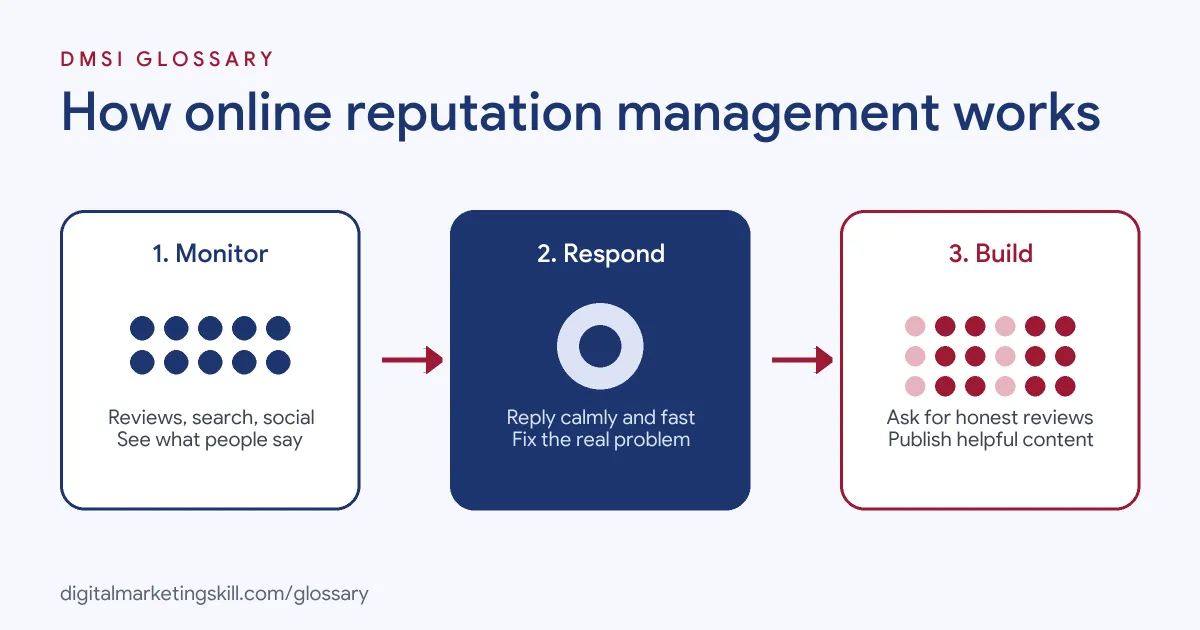
Monitoring
You can’t manage what you don’t see. So check review sites, search results and social media regularly. Social listening tools can alert you when people mention your brand. For more on that, see our glossary entry on social listening.
Responding to Reviews
Replies matter. Google’s Business Profile help says that “when you reply to their reviews, you show them that you value their feedback.” It also notes that you “must verify your business” before you can reply. If you believe a review breaks Google’s content policies, you can flag it for review.
Building Genuine Reviews
The healthiest reputation rests on real customer reviews. To encourage them, Google suggests you “share a review request link or QR code.” However, you must ask fairly. Google’s policy bans attempts to “discourage or prohibit negative reviews, or selectively solicit positive reviews from customers.”
Online Reputation Management Examples
Here are three made-up examples of ORM in practice:
- Restaurant: A café notices several reviews mention slow service at lunch. It adds a staff member at peak time and replies to each review to say what changed.
- Software company: A firm finds an outdated article ranking for its name. It publishes a clear, up-to-date help page and press release, so accurate information is easier to find.
- Local service: A plumber sends a review request link by text after every job. Over a few months, the profile fills with genuine, recent reviews.
In each case, the business improves the real experience first, then makes the good news visible.
What Is Allowed and What Is Not
Some tactics damage trust and break rules. Here is a quick guide based on Google’s policy and the FTC’s rule on fake reviews:
| Tactic | Allowed? | Why |
|---|---|---|
| Asking all customers for an honest review | Yes | Google suggests sharing a review request link or QR code |
| Replying politely to negative reviews | Yes | Replies show you value feedback |
| Paying for positive reviews | No | Google bans reviews “paid for, directly or in kind,” and the FTC rule bars buying reviews of a particular sentiment |
| Asking only happy customers | No | Google bans selectively soliciting positive reviews |
| Posting fake or AI-written reviews | No | The FTC rule covers fake reviews, including AI-generated ones |
| Threatening reviewers to remove reviews | No | The FTC rule covers review suppression through threats or intimidation |
Online Reputation Management Step by Step
- Search your brand name and note what appears on the first page of results.
- Claim and verify your profiles, such as your Google Business Profile.
- Set up alerts or a social listening tool for brand mentions.
- Reply to reviews regularly, both positive and negative.
- Fix the issues that come up most often in complaints.
- Ask every customer for an honest review, using a simple link.
- Publish helpful content, such as FAQs, case studies and news, so accurate pages rank for your name.
Online Reputation Management Best Practices
- Reply quickly and calmly. A polite reply to a bad review often matters more than the review itself.
- Take it offline when needed. Offer a phone number or email to sort out complex problems.
- Thank happy customers. A short reply to good reviews shows you are listening.
- Be honest. Never post fake reviews or pretend to be a customer.
- Track trends. Watch your average rating and common themes over time.
How to Write a Good Review Reply
A good reply is short, kind and specific. Here is a simple, made-up formula for a negative review:
- Thank the person for the feedback.
- Say sorry for their experience, without arguing.
- Explain briefly what you are doing about it.
- Invite them to contact you directly to put it right.
For example: “Thanks for letting us know, Sam. We’re sorry your order arrived late. We’ve changed our courier for your area. Please email us, and we’ll make it right.” Future customers will read that reply too.
A Simple Weekly Routine
You don’t need a big team to stay on top of this. A short weekly routine is enough for most small firms:
- Monday: first, read new reviews on Google and other sites you use.
- Tuesday: next, reply to each one, good or bad.
- Wednesday: then check social mentions and answer questions.
- Thursday: also note any common complaints and share them with the team.
- Friday: finally, send review request links to the week’s customers.
So that is about an hour a week. Over time, it adds up to a steady flow of fresh reviews and fewer surprises.
Common Mistakes to Avoid
Many businesses ignore reviews until there is a crisis. Others argue with reviewers in public, which usually makes things worse. Some try shortcuts, such as buying reviews or asking only happy customers, which can break platform rules and the law. Finally, many treat ORM as a one-off clean-up, when it needs steady attention. A little effort every week works far better.
Where You’ll Use Online Reputation Management at Work
Reputation work appears in marketing, community and communications roles. For example, recent remote job listings ask for:
- “Enhancing and protecting the companys online reputation” (Digital Marketing Manager).
- “Experience managing a brand’s presence and reputation on review sites like G2, Capterra, and Trustpilot.” (Community Manager).
- Work “monitoring sentiment, responding to reviews, and developing proactive strategies to strengthen how the organization is perceived as a place to work.” (Director, Enterprise Communications).
So as a Digital Marketing Manager, Growth Marketer or Freelance Digital Marketer, you may be the person who monitors reviews and writes the replies.
Learn It in the Full Stack Programme
ORM draws on social media, search, content and customer experience. That’s why it fits the Full Stack (all four tracks) option, which covers all ten courses, with one portfolio project from each track. Every track is about 90% hands-on, with unlimited 1-on-1 mentoring and a U.S. Project Internship from day one.
For practical tips, read our guide to building a positive online reputation.
Frequently Asked Questions
What is online reputation management in simple terms?
It is the work of keeping track of what people say about you online, replying well and building a more accurate, positive picture over time.
Can I remove bad reviews?
Not just because they are negative. If a review breaks Google’s content policies, you can flag it. Otherwise, a calm public reply is the best response.
Is it legal to pay for reviews?
Paying for reviews breaks Google’s policies. In the US, the FTC’s rule also bars buying reviews that express a particular sentiment and lets the agency seek civil penalties against knowing violators.
How do I get more good reviews?
Give great service, then ask every customer for an honest review using a simple link or QR code.
How long does online reputation management take?
It is ongoing. You can fix a few issues quickly, but a strong reputation builds over months of steady effort.
Sources: Google Business Profile Help: Manage customer reviews; Google Maps: Prohibited and restricted content; FTC: Final rule banning fake reviews and testimonials; CIPR: About PR; remote job listings on Himalayas.