
A positive online reputation is not a vanity metric. It is a revenue lever. Businesses with strong ratings and active review responses consistently out-earn similar competitors with weaker, ignored reputations. That gap is measurable in real studies, not just opinion.
Key Takeaways
- 97% of consumers read reviews for local businesses. 85% say positive reviews make them more likely to use that business, based on a survey of 1,002 US consumers (BrightLocal).
- A one-star increase in Yelp rating raises restaurant revenue by 5-9%. That comes from a Harvard Business School study of roughly 60,000 Seattle restaurants (Luca).
- 84% of consumers worldwide trust word-of-mouth recommendations from people they know above every other form of advertising (Nielsen, global survey).
- Businesses with a 4.0 to 4.5 star rating earn an additional 28% in annual revenue compared with lower-rated competitors (Womply, via ReviewTrackers).
- Replying to a 1- or 2-star review within 24 hours gives a 33% higher chance the reviewer later upgrades it by up to three stars (Nation’s Restaurant News, via ReviewTrackers).
In this guide
- Most Reputation Advice Skips The Revenue Mechanism
- How A Positive Online Reputation Actually Becomes Revenue
- What Differs Between Reputation Signals And Reputation Management
- How To Build A Positive Online Reputation That Actually Converts
- How To Measure Whether Your Online Reputation Is Actually Working
- The One Decision Rule: Fix The Response Habit Before You Chase More Reviews
- Where To Manage A Positive Online Reputation
- Mistakes That Quietly Damage A Positive Online Reputation
- A Real Case: How Review Systems Built Trust At Scale
- Positive Online Reputation By Industry
- Frequently Asked Questions About Positive Online Reputation
- Turn Reputation Management Into A Marketable Skill
Most Reputation Advice Skips The Revenue Mechanism
Most articles on online reputation list the same ten tips. Respond to reviews. Post good content. Be authentic. They rarely explain why any of that moves revenue, not just sentiment.
A positive online reputation only becomes a business asset once you understand the mechanism connecting it to a sale. This guide names that mechanism, then shows where to intervene for the biggest return.
A limit worth stating early. Most of the hard numbers below come from US consumer surveys and one landmark restaurant study. Treat them as a strong, checkable pattern, not a guaranteed result for every market or industry.
How A Positive Online Reputation Actually Becomes Revenue
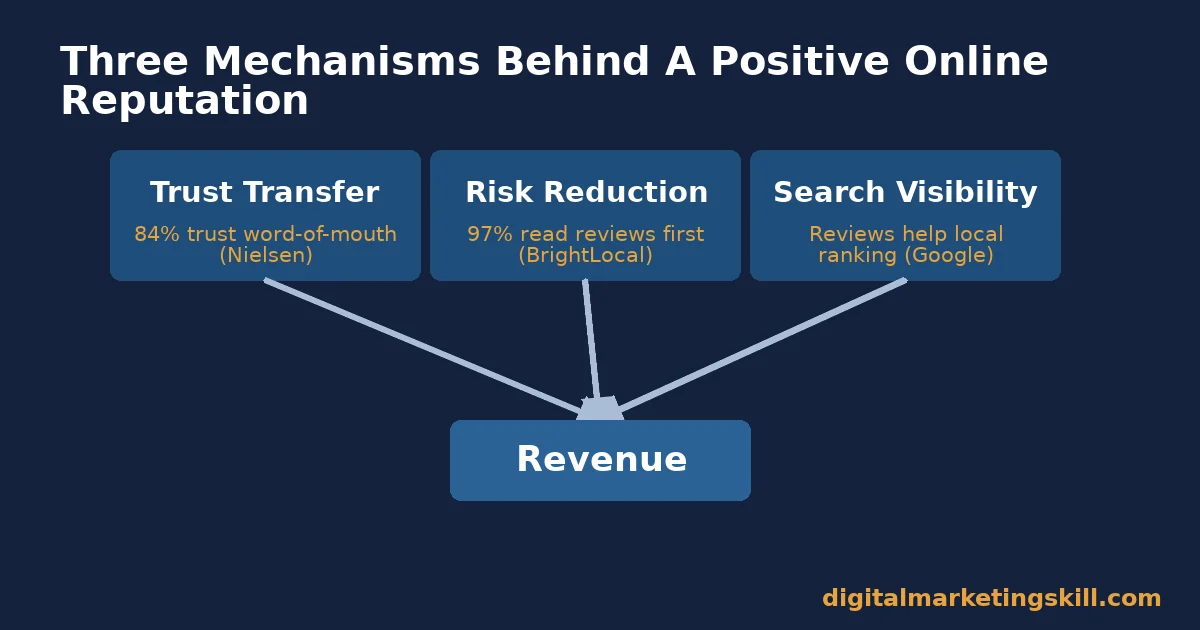
Reputation affects revenue through three separate mechanisms, not one. Each works on a different part of the buying decision. A weak reputation can fail a sale at any of the three points.
The first mechanism is trust transfer. A stranger’s review stands in for a recommendation from someone you know. Nielsen’s global trust survey found that 84% of consumers trust word-of-mouth recommendations above every other advertising format. An online review is the closest most buyers get to that signal before they ever speak to you.
The second mechanism is risk reduction. A buyer cannot test a product or service before paying for it. So they look for signals that the risk is low. BrightLocal’s survey of 1,002 US consumers found that 97% read reviews for local businesses. 85% say positive reviews make them more likely to buy.
The third mechanism is search visibility. Google’s own local search guidance states that more reviews and positive ratings can help your business’s local ranking. So a positive online reputation does not just persuade a buyer who already found you. It also helps more buyers find you in the first place.
All three mechanisms compound. Trust the signal, see low risk, and find the business easily in search, and a buyer is far more likely to convert. Miss even one of those three conditions, and conversion drops off fast.
What Differs Between Reputation Signals And Reputation Management
Reputation Signals: Built To Be Read Fast
A reputation signal is anything a buyer can scan in seconds. Star rating, review count, and the date on the newest review all count. These numbers do the first filtering before anyone reads a single word.
The Harvard Business School study by Michael Luca looked at roughly 60,000 Seattle restaurants reviewed on Yelp over a multi-year period. That covered about 70% of the city’s restaurants. It found that a one-star rating increase raised revenue by 5% to 9%, holding actual quality constant.
That effect held even though Luca controlled for the restaurant’s real quality. The star number itself, not just what it represented, was doing real economic work on its own.
That finding matters beyond restaurants. Any business sold through a scored listing, from a local service to an online shop, is subject to the same basic effect: the number itself moves behavior, not only the quality behind it.
Reputation Management: Built To Shift Those Signals Over Time
Reputation management is the ongoing work of requesting reviews, responding to them, and fixing the issues they surface. It is slower and less visible than the signals themselves, but it is what moves those signals in your favor.
Response rate is the clearest lever inside reputation management. ReviewTrackers’ compiled review statistics show that replying to a 1- or 2-star review within 24 hours gives a 33% higher chance the reviewer later raises their rating, sometimes by up to three stars.
Reputation management without a response habit is really just reputation monitoring. Watching a problem is not the same as fixing the number a future buyer will scan in two seconds.
Treat the two as separate budget lines if you track marketing spend formally. Monitoring tools surface the data; a person still has to act on it for a positive online reputation to actually improve.
How To Build A Positive Online Reputation That Actually Converts
Reputation Signals: Lead With Volume And Recency, Not Just Score
Request a review right after a strong moment in the customer experience, not weeks later. A request sent close to the positive experience gets a higher response rate and a more detailed, more convincing review.
Spread requests across channels instead of relying on one review site. A reputation concentrated on a single platform looks thinner and more fragile. The same number of reviews, split across two or three trusted sites, reads as sturdier.
Keep review recency active. A five-star average built entirely from old reviews reads as stale. Buyers increasingly check the date, not just the score, before trusting a listing.
Reputation Management: Lead With A Response Habit, Not A Crisis Plan
Set a fixed response window, such as 24 hours, for every new review, positive or negative. A fast reply to a bad review is what actually moves the odds of a reviewer updating their score.
Write responses that name the specific issue, not a generic apology. A buyer reading that thread later is judging how you handle problems, not just whether the problem existed.
Keep a simple template that still leaves room for specifics: thank the reviewer, name the exact issue, state the fix, and invite them to follow up directly. That structure takes under two minutes to write once it becomes habit.
Route recurring complaints back into the business itself, not just into a reply template. A positive online reputation built on better responses alone, without fixing the underlying issue, eventually runs out of goodwill.
How To Measure Whether Your Online Reputation Is Actually Working
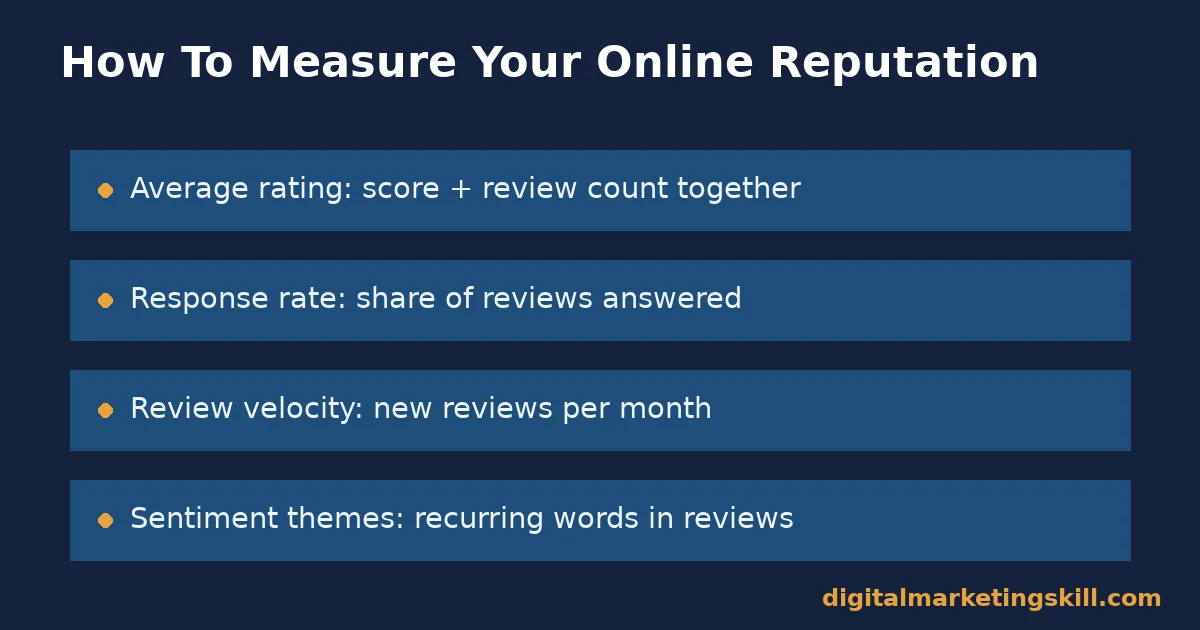
Average rating is the headline number most buyers scan first. Track it alongside review count, though, since a 4.8 average from 12 reviews reads very differently than a 4.8 average from 400.
Response rate is the share of reviews, across all star levels, that get an actual reply from the business. Businesses with a meaningfully higher response rate consistently carry higher average ratings over time.
Review velocity is how many new reviews arrive in a given month. A business that used to get five reviews a month and now gets one has a visibility problem forming. That shows up here before the average score ever moves.
Sentiment themes are the recurring words and issues inside the review text itself, not just the star count. Tracking themes tells you what to fix; tracking only the average tells you that something needs fixing, without saying what.
The One Decision Rule: Fix The Response Habit Before You Chase More Reviews
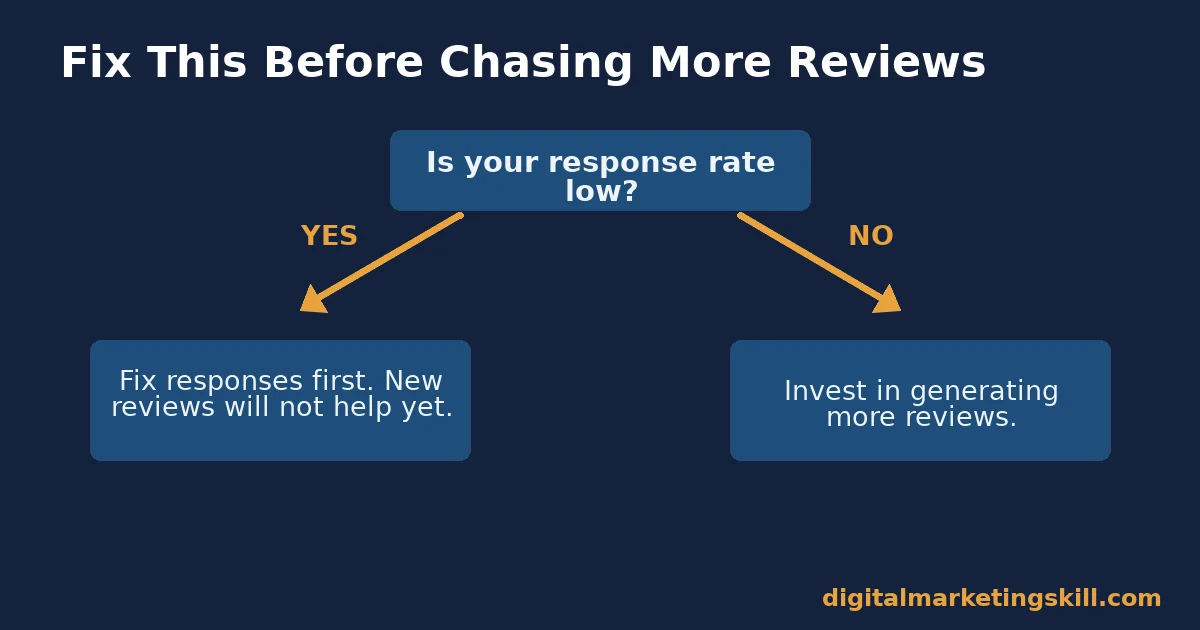
If you can only improve one part of your online reputation this quarter, fix your response rate first. Do that before you invest in generating more reviews. A low response rate undermines every new review you add, since each new review arrives into the same unanswered pattern a buyer can already see.
Illustrative, invented numbers: imagine two businesses with the same 4.2 average rating. One replies to every negative review within a day; the other replies to almost none. A buyer comparing both listings side by side reads the first as actively managed and the second as abandoned, even though the star score is identical.
This rule also tells you what to practise first if you are building these skills. A response-writing habit is a communication and customer-service skill you can build immediately, long before you have the budget for a formal review-generation campaign.
Where To Manage A Positive Online Reputation
Google Business Profile is the first place most buyers encounter your reputation, since it surfaces directly in search and maps results. Keep it updated with accurate hours, categories and a steady stream of recent reviews.
Industry-specific review sites carry extra weight for certain categories, like hospitality, healthcare or home services. A buyer researching those categories often checks a specialist site in addition to, not instead of, a general one.
Social media comments and mentions function as a softer, less formal reputation layer. They rarely carry a star rating, but a pattern of public complaints left unanswered on social does the same damage as unanswered reviews elsewhere.
Internal reputation, such as employee reviews on workplace platforms, increasingly spills into public perception too. A business known for treating staff badly often sees that reputation echoed by customers who heard about it secondhand.
None of these channels work in isolation. A buyer forming an impression often checks two or three of them before deciding, so a strong score on one and silence on another still leaves a gap.
Wherever you manage a positive online reputation, keep the same response habit. The platform changes; the discipline of replying quickly and specifically does not.
Mistakes That Quietly Damage A Positive Online Reputation
The first mistake is responding only to negative reviews. Replying to positive reviews too, even briefly, shows a buyer that engagement is a habit, not a damage-control reflex reserved for complaints.
The second mistake is writing defensive responses to criticism. A response that argues with the reviewer, in public, confirms the complaint for every future reader far more than the original review did on its own.
A short, calm acknowledgment almost always outperforms a long justification. Future readers are judging your tone under pressure, not grading the legal accuracy of your defense.
The third mistake is treating one bad review as a crisis instead of a data point. One low review among dozens of strong ones rarely moves the average much; a pattern of the same complaint across many reviews is the actual signal worth acting on.
Look at the last twenty or thirty reviews as a set, not one at a time. Patterns across a set tell you what to fix; any single review, good or bad, rarely does.
The fourth mistake is buying or faking reviews. Platforms increasingly detect and remove suspicious review patterns. A reputation built on fabricated trust collapses faster, and more publicly, than one built slowly and honestly.
The fifth mistake is ignoring internal process fixes while chasing external review scores. A business that keeps generating the same complaint has a service problem, not a marketing problem, no matter how well the responses are written.
A Real Case: How Review Systems Built Trust At Scale
Airbnb is a documented example of a business built around a two-way review system, where hosts and guests both leave public reviews after every stay. The company has described this mutual review system, published on its own platform and in its public materials, as central to the trust that lets strangers transact with confidence.
The mechanism mirrors the research above. A new guest checking a listing scans the review count and score first, exactly the fast-read signal the Harvard Yelp study measured in restaurants. A thin or unanswered review history reads as risk, regardless of how good the listing actually is.
The limit here matters. This is a single company’s own description of its platform design, not an independently audited revenue study. Treat it as an illustration of the mechanism, not as a transferable number for your own business.
What generalises from the case is the structure, not the scale. Any business that lets strangers transact with reduced friction, from a marketplace to a local service booked online, leans on the same trust-transfer mechanism a positive online reputation provides.
Positive Online Reputation By Industry
Hospitality and restaurants feel reputation effects fastest, since a single bad night can appear in a review within hours. Prioritise a same-day response habit here more than almost any other category.
Healthcare and professional services carry extra weight on trust signals, since buyers are choosing someone to handle something personal or high-stakes. A thin review history reads as higher risk in these categories than in most retail ones.
E-commerce and product businesses depend more on review volume and photos than on raw star average. Buyers scan recent, detailed reviews with photos as proof the product matches its listing.
B2B and service-based businesses see a slower, smaller but still real version of the same effect. A testimonial or case study plays a similar trust-transfer role to a star rating in a consumer market.
Frequently Asked Questions About Positive Online Reputation
How long does it take to build a positive online reputation?
There is no fixed timeline, since it depends on your review volume and starting point. A consistent request-and-response habit, run for a few months, usually produces a visible shift in both rating and review count.
Should I respond to every single review, even the short five-star ones?
Yes, where you have the capacity. Even a brief reply signals an active, engaged business, and that pattern is part of what a prospective buyer is scanning for.
What is the fastest way to recover from a bad review?
Reply within 24 hours, name the specific issue, and take the detailed resolution offline. Speed and specificity are what move a reviewer toward updating their rating, not a generic apology.
Do reviews actually affect search rankings, or only buyer trust?
Both. Review volume and recency are commonly used as local search ranking signals, so a positive online reputation can increase how often you are found, not only how often you are chosen once found.
Is a perfect five-star rating actually the goal?
Not necessarily. A rating with zero negative reviews can read as unrealistic or filtered to some buyers. A strong rating in the 4.0 to 4.5 range, with visible, well-handled responses to the occasional complaint, often reads as more credible.
Can a small business compete on reputation against a bigger competitor?
Yes. The Harvard Yelp study found rating changes had a larger effect on independent businesses than on chains with already-established reputations. That means reputation work has outsized leverage for smaller, newer businesses.
What should I do first if my online reputation is already damaged?
Start by responding to every unanswered review, oldest first, with a specific, non-defensive reply. Then fix whatever pattern the reviews point to. New positive reviews land better once that cleanup is visible.
Does a positive online reputation matter more for new businesses or established ones?
It matters more, proportionally, for newer and smaller businesses. An established brand already carries some trust from its history, while a new business has almost nothing else for a first-time buyer to judge it by.
Turn Reputation Management Into A Marketable Skill
Building a positive online reputation draws on the same skills behind most of digital marketing: customer research, clear writing, and consistent follow-through. The Master Diploma in Digital & AI Marketing at Digital Marketing Skill Institute is built around exactly those skills.
The program runs four AI-powered tracks: AI-Powered Social Media Management and Advertising, AI-Powered Lead Generation and Email Automation, AI-Powered Google Specialist, and AI-Powered WordPress and SEO Specialist, built from ten courses in total, with a Full Stack option covering all four.
Every track pairs a real project with unlimited 1-on-1 coaching and mentoring. The reputation and customer-communication skills you practise come with a project you can describe in one line, anywhere in your country. The program also includes a U.S. Project Internship with a verified U.S. Work Reference Letter, plus dual US and UK accreditation recognised in more than 100 countries, 100% online.
For related reading, see our guides on customer retention management, making data-driven marketing decisions you can trust, and SEO fundamentals for better search visibility.
Start by auditing your response rate this week: count how many of your last twenty reviews got a reply, and close that gap before you invest in generating more reviews. Explore the Master Diploma program, read outcomes on the reviews page, or browse the blog for more on turning trust into revenue.
Apply to the Master Diploma program when you are ready to build these skills properly. Visit Digital Marketing Skill Institute any time, and keep digitalmarketingskill.com bookmarked for the current curriculum and outcomes.
Every figure in this guide was checked against its original source before publication. Figures marked as illustrative are invented examples, not real results.
![9 Amazing Digital Marketing Skills to Make Money Online [With Proof]](https://digitalmarketingskill.com/wp-content/uploads/2019/07/9-Amazing-Digital-Marketing-Skills-to-Make-Money-Online-With-Proof-17.png)






