
Employee advocacy is the practice of employees sharing and promoting their employer’s content, news and products on their own social media accounts. People tend to trust a real person more than a brand page. As a result, posts from staff often reach new audiences and feel more genuine. It can also help with hiring, because candidates see what working at the company is really like.
Key Takeaways
- Employee advocacy means staff share company content on their personal social accounts.
- Posts from real people can reach networks that a brand page never reaches.
- A good programme makes sharing easy, optional and true to each person’s voice.
- Staff who promote their employer’s products usually need to disclose that link.
- You measure success by participation, reach, engagement and business results.
What Is Employee Advocacy?
Every company has a brand page on social media. However, its employees have far more connections combined. Employee advocacy taps into those networks. So instead of only the brand posting, staff share news, blog posts, job openings and stories from work.
Hootsuite defines it simply: “Employee advocacy is the practice of employees promoting their employer on their own social media accounts.” In practice, this can be as small as a sales rep sharing a new report. On the other hand, it can be a full programme with training, tools and goals.
Think of a restaurant. A sign outside says the food is good. But a friend who works there may tell you to try the new dish. Then you are far more likely to listen. In the same way, a post from a person feels more like advice than an advert.
Also, employee advocacy often supports personal branding. For example, staff build their own profile as experts, while the company gains wider reach. So both sides can benefit when it is done well.
Why It Matters
Why should a business care? First, brand pages often struggle with organic reach. By contrast, posts from people can travel further through their own networks. Second, it builds trust, because readers see a human face behind the brand. Third, it helps with recruiting. For example, a team member sharing a job post reaches people a careers page may miss. Finally, it can support sales, as buyers often check out the people they might work with.
On the other hand, advocacy only works when it is genuine. So forcing staff to post the same text rarely helps anyone.
Types of Employee Advocacy
Employee advocacy comes in a few common forms. For example, staff might reshare posts from the company page. Also, they might write their own posts about a project, an event or a lesson learned. In addition, leaders often post opinions on industry trends, which builds the firm’s reputation. Hiring teams may ask staff to share open roles too. Finally, some employees talk about company culture, such as volunteering days or team wins. In each case, the post comes from a real person, not the brand account. So the tone is more human and the reach is different.
How Employee Advocacy Works
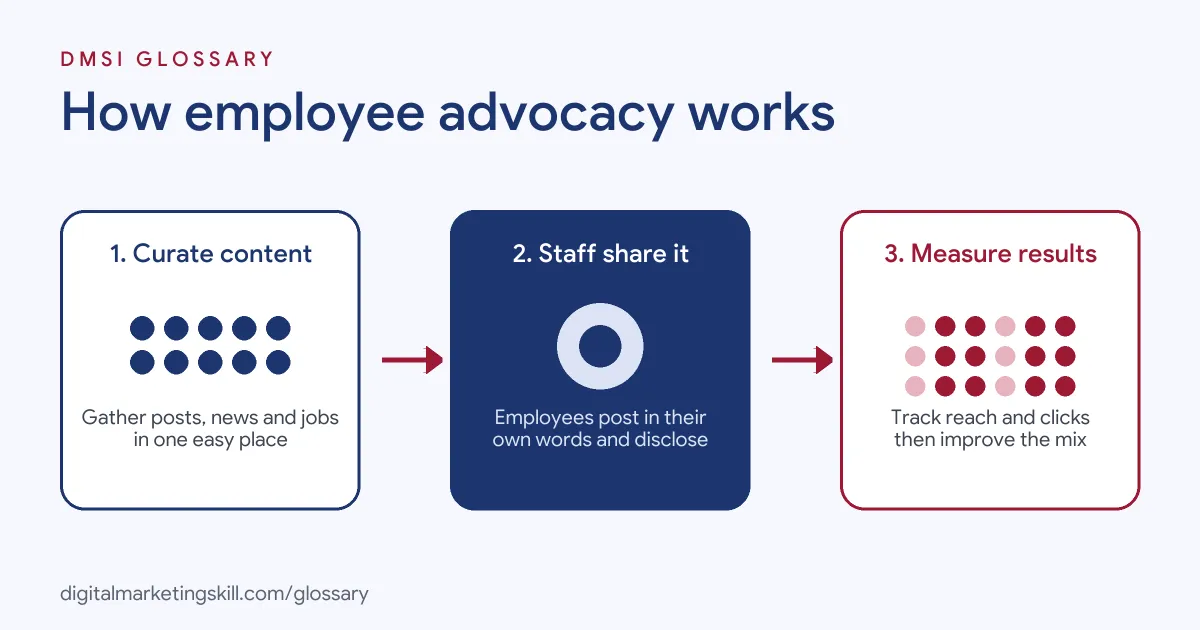
Employee advocacy works in a simple loop. First the company curates content worth sharing, then employees share it in their own words, and finally the team measures the results and improves. Each step needs care.
Curating Content
First, the social or communications team gathers content in one place. For example, this might be blog posts, product news, event photos or job openings. Hootsuite notes that the team curates approved content, which employees can then browse and adapt. So staff don’t have to hunt for links or guess what is allowed.
Sharing in Their Own Voice
Next, employees choose what to share. Ideally, they add a line about why it matters to them. For instance, an engineer might explain the problem a new feature solves. In turn, this keeps posts personal and avoids a feed full of identical messages. As a result, readers engage with the person, not just the link.
Disclosure and Rules
Then there are the rules. In the US, the FTC says employees who promote their employer’s products should disclose their relationship to the company. It also says listing your employer on your profile is not enough. Likewise, in the UK, the ASA ruled against an Instagram story by a company’s creative director. It found the post “was not obviously identifiable as a marketing communication.” So a good programme includes simple disclosure guidance.
Measuring Results
Finally, the team tracks what happens. Often, programmes use an advocacy tool to share content and count clicks. Then they look at how many staff take part, how far posts travel and what actions follow. In short, data shows which content people want to share.
Examples of Employee Advocacy
- A software firm launching a feature. The marketing team shares a short post kit with staff. Then engineers post about the problem they solved, each in their own words.
- A hospital group hiring nurses. The hospital asks current nurses to share job posts with a line about their team. As a result, the openings reach qualified people in their networks.
- A consultancy building thought leadership. First, senior staff share the firm’s research and add their own view. Over time, they become known experts, and the firm’s name travels with them.
Employee Advocacy vs Influencer Marketing
| Point | Employee Advocacy | Influencer Marketing |
|---|---|---|
| Who posts | Your own staff | Outside creators |
| Payment | Usually unpaid and optional | Usually paid or gifted |
| Audience | Staff’s personal and work networks | The creator’s followers |
| Main strengths | Trust, hiring, expert voice | Reach and creative content |
| Disclosure | Staff should disclose their link to the company | Creators must label ads clearly |
Both overlap with influencer marketing. However, the key difference is who speaks for the brand.
How to Start an Employee Advocacy Programme
- Set clear goals. Decide if you want brand reach, hires, leads or thought leadership.
- Get leaders on board. People feel safe to join in when managers take part.
- Start with a small group. Invite staff who already enjoy posting. Then grow from there.
- Write a simple social media policy. Cover what is fine to share, what is private and how to disclose the link.
- Curate easy content. Share ready posts, images and links, but invite people to add their own words.
- Offer short training. Show staff how to write a good post and protect their privacy.
- Measure and share results. Track participation and reach. Also, thank people who take part.
Best Practices for Employee Advocacy
- Keep it optional. After all, forced posting feels fake and can harm trust with staff.
- Let people use their voice. Offer suggested text, but encourage staff to rewrite it in their own brand voice and style.
- Share more than ads. Mix in useful tips, team stories and industry news, not just product posts.
- Make disclosure easy. Give clear examples of how to mention the company link.
- Celebrate employee content. Reshare great staff posts from the brand page, which also adds user-generated content to your feed.
- Review the content often. Remove old posts and keep the library fresh.
Common Mistakes to Avoid
- Copy-and-paste posts. In fact, dozens of staff posting the same words looks spammy.
- No disclosure guidance. Otherwise, staff may break advertising rules without knowing it.
- Only sharing sales content. Instead, mix it up, because networks tune out when every post is a pitch.
- Ignoring privacy. Some staff don’t want to post at work. So respect that choice.
- No measurement. Without data, you can’t show value or improve the programme.
- Launching without leaders. If managers never post, few others will either.
Where You’ll Use Employee Advocacy at Work
Employee advocacy shows up in social media manager, community and employer branding roles. For example, real remote job listings ask for:
- “Managing and running the employee advocacy program to boost employee engagement and reach on social media.” (Social Media Manager (Supervisory)).
- “Experience building or running an employee advocacy program at scale.” (Social Media Manager).
- “This role provides dedicated ownership of day-to-day program operations while helping expand employee advocacy as a channel for brand awareness, thought leadership, recruitment marketing, and employer branding.” (Employee Advocacy Intern).
Learn It in the Social Media and Paid Social Track
You can learn employee advocacy and wider social strategy in the AI-Powered Social Media Management and Advertising track. Every track includes a U.S. Project Internship from day one, with unlimited 1-on-1 mentoring.
Frequently Asked Questions
Is employee advocacy the same as influencer marketing?
No. Employee advocacy uses your own staff. By contrast, influencer marketing uses outside creators, who are usually paid.
Do employees have to take part?
No, and they shouldn’t be forced. Advocacy works best when people choose to share content they believe in.
Do employees need to disclose they work for the company?
Usually, yes, when they promote its products. Both the FTC in the US and the ASA in the UK expect a clear link to be shown.
Which platform is best for employee advocacy?
LinkedIn is common for B2B brands. However, the best platform is wherever your staff and your audience already spend time.
How do you measure employee advocacy?
Track how many staff take part, the reach of their posts and the clicks they drive. Then link that to goals such as hires or leads.
Sources: Hootsuite: Employee advocacy: How to build a program; FTC: FTC’s Endorsement Guides: What People Are Asking; ASA: Ruling on Prettylittlething.com Ltd; remote job listings on Himalayas, Himalayas and Himalayas.