
Influencer marketing is when a brand works with people who have an engaged social media following to promote its products or services. The brand might pay them, send free products or offer a commission on sales. It matters because people often trust a creator they follow more than they trust a brand’s own ads.
Key Takeaways
- Brands work with creators to reach an audience that already trusts them.
- Any reward counts as payment. In the UK, that includes gifts, discounts and commissions, not just cash.
- Paid or gifted posts must be clearly labelled as ads. UK guidance recommends labels such as “Ad” or “Advert”.
- Audience quality matters more than follower count. Fake followers are the most common fraud issue brands report.
- Set a clear goal and tracking before you brief a creator, so you can measure results.
What Is Influencer Marketing?
An influencer, often called a creator, is someone whose posts shape what their followers think or buy. They might review make-up, share recipes, explain software or film their workouts. Influencer marketing is the practice of partnering with these people to put your brand in front of their audience.
The partnership can take many forms. A creator might post a review, film a tutorial, share a discount code or host a giveaway. Some brands also reuse the creator’s content in their own ads.
For example, a small coffee roaster might send its new blend to five home-brewing creators. Each one films a short video making a cup and shares a code for 10% off. The roaster then tracks how many orders use each code.
How Influencer Marketing Works
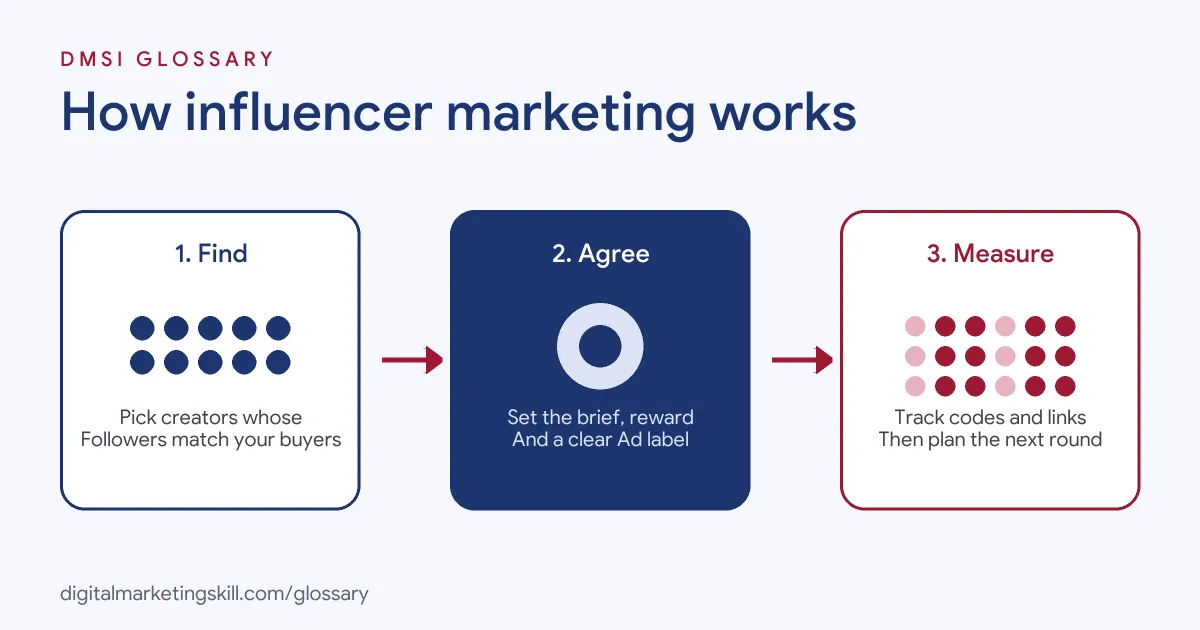
Most campaigns follow the same path. First, you find creators who fit your audience. Next, you agree a brief and a reward. Then the creator makes and posts the content. Finally, you track results and decide whether to work together again.
Choosing Creators for Influencer Marketing
Start with fit, not fame. Look at who follows the creator, how they talk to their audience and whether their content matches your brand. Then check audience quality. In Influencer Marketing Hub’s benchmark report, fake or bot followers made up 56.5% of all reported fraud and quality issues. A further 21% or so were tied to fake engagement and templated comments.
Creator Tiers by Size
Marketers often group creators by follower count. There is no official standard, so ranges vary between sources. Sprout Social, for instance, describes nano-influencers as having 1,000 to 10,000 followers and micro-influencers as having 10,000 to 100,000. Larger creators are usually called macro-influencers or celebrities.
Smaller tiers are where many brands now spend. In the same benchmark report, nano and micro were the tiers that respondents priced most often, at 29.54% and 22.36% of all cost selections. Macro creators, by contrast, made up just 4.35%.
Rewards and Payment
Creators can be paid in cash, free products, commission or a mix. Be careful here: the UK Competition and Markets Authority (CMA) says “Any form of incentive or reward” counts as payment. That includes money, commissions, discounts, free loans and gifts. So a free product is still a commercial deal.
Labelling the Ad
Whenever a creator has been incentivised to post, CMA guidance says the content “must be clearly labelled as an advert or ad”. The label must be clear, prominent and easy to understand. The CMA also says it is “not enough just to tag a brand in your post, use discount codes or affiliate links.”
Influencer Marketing Examples
Here are three made-up examples of common campaign types:
- Gifted review: A skincare brand sends a serum to a beauty creator. The creator posts an honest review labelled “Ad” at the start of the caption.
- Affiliate campaign: A software company gives creators a unique link and pays a commission on each sign-up. Every post is still labelled as an ad.
- Paid content for ads: A fitness brand pays a creator for three videos. It posts them on the creator’s account, then runs them as paid social ads too.
Influencer Marketing Rules: UK vs US
The rules are similar, but the details differ. Here is a quick comparison:
| Topic | UK (CMA guidance) | US (FTC guidance) |
|---|---|---|
| When to disclose | Whenever you’ve been paid, gifted or otherwise incentivised | When you have any financial, employment, personal or family relationship with the brand |
| Suggested labels | “Ad”, “Advert”, “Advertising”, “Advertisement” | “Advertisement”, “ad” or “sponsored” |
| Labels to avoid | Unclear terms such as #gifted, #collab, #spon and #sponsored | Disclosures hidden in a group of hashtags or links |
| Platform tools | Add #Ad upfront if the tool doesn’t make it clear | Don’t assume a platform’s tool is good enough |
| Honest claims | Don’t say something works if you haven’t tried it | You can’t talk about a product you haven’t tried |
Notice the difference on “sponsored”. The FTC accepts it, while the CMA lists #sponsored among terms to avoid. So if you work with UK audiences, “Ad” is the safest choice.
How to Run an Influencer Marketing Campaign
- Set one goal, such as sales, sign-ups or reach in a new market.
- Define your audience. Then search for creators whose followers match it.
- Check each creator’s audience quality, engagement and past brand work.
- Agree the reward, the content, the posting dates and the usage rights in writing.
- Write a brief that covers key messages, claims you can prove and the ad label.
- Give each creator a unique link or code, so you can track results.
- Review content before it goes live, without stripping out the creator’s own voice.
- Measure results against your goal. Then decide who to work with again.
Best Practices for Influencer Marketing
- Pick fit over follower count. A smaller creator with the right audience often beats a big name with the wrong one.
- Let creators be themselves. Their audience follows them for their style, not your script.
- Put the label first. UK guidance asks for a clear, upfront label, not one buried at the end.
- Only make claims you can prove. The CMA warns against false or unsupported statements.
- Agree usage rights early. If you want to reuse content in ads, put it in the contract.
- Track every post. Use unique links, codes or UTM tags so results don’t get lost.
Common Mistakes
Brands often choose creators on follower count alone. As a result, they end up paying for fake reach. Others forget that a free product counts as payment, so posts go out without a label. Some write scripts so tight that the content sounds like an advert in the worst sense. Many skip tracking, which means they can’t tell which creator drove sales. Finally, some teams only judge success on likes. Engagement is useful, but the benchmark report warns that raw engagement “can mislead you” unless you check its quality.
Where You’ll Use Influencer Marketing at Work
Creator work now sits inside many social and growth roles. For example, recent remote job listings ask for:
- “Experience with UGC, influencer marketing and creator partnerships” (Growth Marketing Manager).
- Someone to “support the campaign management team with the development and execution of influencer marketing campaigns” (Specialist, Creator Management).
- “3+ years of experience in content management, social media, or influencer marketing” (Content Manager, Social Media and Influencer Marketing).
So if you want to work as a Social Media Manager, Paid Social Specialist or Content Creator, expect to find creators, brief them, check labels and report on results.
Learn It in the Social Media Track
You can learn to plan creator campaigns in the AI-Powered Social Media Management and Advertising track. It covers AI fundamentals, content creation with graphics and video, social media marketing and analytics, and social media advertising. Your portfolio project is a paid social campaign that you plan, create and run for a real brand. You also get unlimited 1-on-1 mentoring and a U.S. Project Internship from day one.
Next, read our guides to influencer marketing strategy and Instagram influencer marketing. You may also like our glossary entry on user-generated content.
Frequently Asked Questions
What is influencer marketing in simple terms?
It is a brand working with a social media creator to promote its products to the creator’s followers, usually in return for payment, gifts or commission.
Do gifted posts need an ad label?
Yes, in the UK. The CMA treats gifts as payment, so a post about a gifted product must be clearly labelled as an ad.
Is #sponsored enough as a label?
Not for UK audiences. The CMA lists #sponsored as unclear and suggests “Ad” or “Advert” instead. The US FTC does accept “sponsored”.
How do you measure influencer marketing?
Give each creator a unique link or discount code. Then track sales, sign-ups or traffic from each one against what you paid.
Do you need a big budget to start?
No. Many brands start by gifting products to a few smaller creators. However, those posts still need a clear ad label.
Sources: CMA: Social media endorsements guide for influencers; FTC: Disclosures 101 for social media influencers; Influencer Marketing Hub: Benchmark report; Sprout Social: Micro-influencers; remote job listings on Himalayas.