
A Brand Ambassador is a person who promotes a brand over an ongoing period, usually in return for pay, free products, commission or other perks. Ambassadors can be customers, employees, students, experts or creators. Because people trust people more than ads, a good ambassador can build awareness and trust in a way paid ads struggle to match. So brand ambassador programmes are now a common part of social media marketing.
Key Takeaways
- A brand ambassador promotes a brand over time, not just in one post.
- Ambassadors can be fans, customers, employees, students or creators.
- They usually get something in return, such as pay, products, discounts or commission.
- In the UK and US, paid or gifted posts must be clearly labelled as ads.
- A strong ambassador programme needs clear goals, training, tracking and regular contact.
What Is a Brand Ambassador?
A brand ambassador is someone who speaks up for a brand again and again. For example, a gym might ask a few loyal members to share their workouts each week. In return, they get free membership and branded kit. Over time, their friends and followers start to link the gym with real results.
However, that ongoing link is the key difference. A one-off sponsored post is a single deal. By contrast, an ambassador builds a longer relationship with the brand and its audience. As a result, their posts often feel more natural and believable.
Also, brand ambassadors come in many forms. Some are well-known creators with large audiences. However, many are everyday customers, staff or students who simply love the product. For instance, education and tech companies often recruit student ambassadors on university campuses.
Why It Matters
In general, people tend to trust recommendations from people they know or follow. So an ambassador can add strong social proof to your brand. Ambassadors also create a steady flow of content you can share. In addition, they reach audiences your ads may never find. That is why ambassadors often sit alongside influencer marketing and word-of-mouth marketing in a social strategy.
Types of Brand Ambassadors
So which kind suits your brand? Customer ambassadors are fans who already buy and love the product. Next, employee ambassadors share company news and culture on their own profiles. Similarly, student ambassadors promote brands on campus and in student groups. In addition, expert ambassadors, such as coaches or nurses, lend their know-how to a brand. Finally, creator ambassadors are content creators who sign longer deals. Each type needs a slightly different brief and reward.
How a Brand Ambassador Programme Works
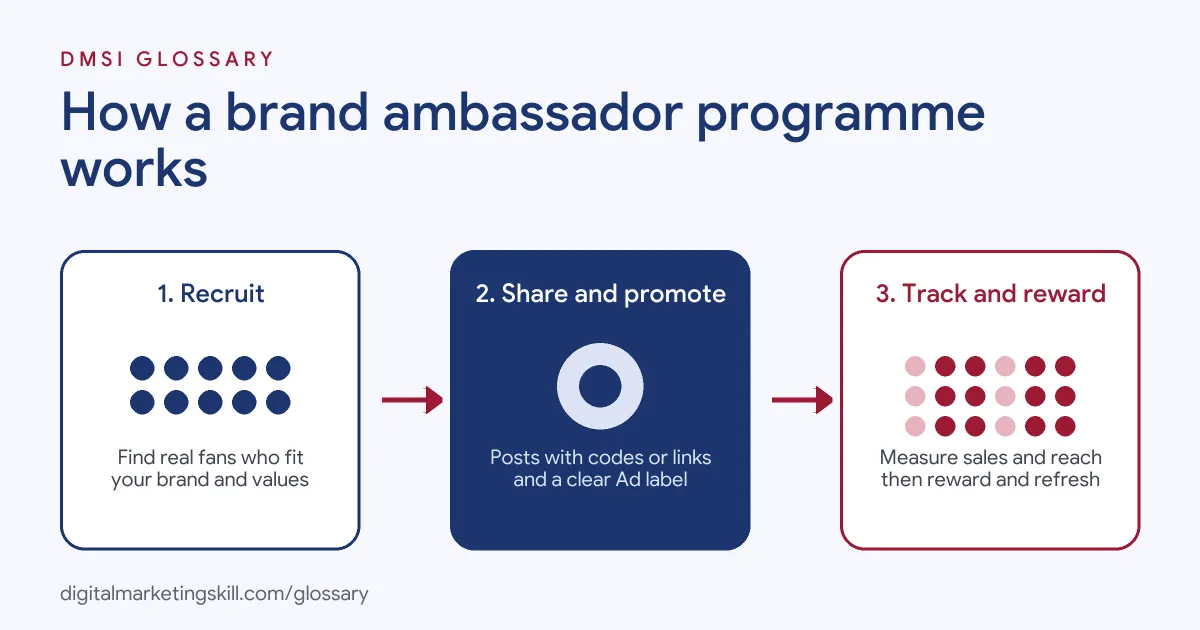
Most brand ambassador programmes follow three stages. First, the brand recruits the right people. Then ambassadors share content and invite others to try the brand. Finally, the brand tracks results, rewards ambassadors and keeps them engaged.
Stage 1: Recruit
First, the brand decides who fits. For example, a skincare brand might look for customers who already post honest reviews. Next, it checks their audience, tone and values. Then it invites them to join, often through an application form. A clear agreement sets out what they will post, how often and what they receive.
Stage 2: Share and Promote
Next, ambassadors create posts, stories or videos about the brand. Often they get a unique discount code or tracked link. As a result, their followers can buy easily, and the brand can see who drove each sale. Also, many brands share a short content guide with key messages and rules. However, the best guides still leave room for each ambassador’s own voice.
Stage 3: Track and Reward
Then the brand measures what each ambassador brings in. For instance, it may track code use, clicks, sign-ups or reach. After that, it pays commission, sends new products or offers other perks. In addition, regular check-ins help. As a result, ambassadors stay motivated, and the brand keeps the relationship strong.
Disclosure Rules
Remember that ambassador posts are often advertising, so they must be clear. In the US, the FTC says, “Disclose when you have any financial, employment, personal, or family relationship with a brand.” It also warns that using “#ambassador” or “partner” alone “is ambiguous and confusing.” In the UK, the ASA expects ads to be identifiable “upfront”, and labels such as “Ad” are clearest. So always use a plain label like “Ad” near the start of each paid or gifted post.
Examples of Brand Ambassadors
- A sportswear brand. The brand recruits local running coaches as ambassadors. Then each coach gets free kit and a discount code for their running group. Finally, the brand tracks code use to see which coaches drive sales.
- An online learning company. The company runs a student ambassador programme at several universities. There, ambassadors host study sessions and share the platform with classmates. In return, they get a monthly fee and a certificate.
- A software company. The company invites staff to share product news on their personal LinkedIn profiles. So it trains them to add a clear note that they work for the company.
Brand Ambassador vs Influencer vs Affiliate
| Point | Brand Ambassador | Influencer | Affiliate |
|---|---|---|---|
| Length of relationship | Ongoing, often months or more | Often one campaign or post | Ongoing, but often hands-off |
| Audience size | Any size, even small | Usually a sizeable following | Any size |
| Typical reward | Pay, products, perks or commission | A fee per post or campaign | Commission on each sale |
| Main goal | Trust, awareness and community | Reach and awareness | Sales |
| Disclosure needed | Needed when there is a paid or material link | Required for paid or gifted posts | Each affiliate link must be clear |
How to Build a Brand Ambassador Programme
- Set clear goals. Decide what you want, such as sales, sign-ups, content or awareness.
- Define your ideal ambassador. List the values, audience and type of person who fits your brand.
- Choose the rewards. Pick fair rewards, such as a fee, free products, discounts or commission.
- Find and recruit. Start with existing fans, customers and staff. Then use an application form for new people.
- Write a simple agreement. Set out what they’ll post, how often, and how they must label ads.
- Onboard and train. Share a short brand guide, key messages and disclosure rules.
- Give tracking tools. Offer unique codes or links, so you can measure each ambassador’s results.
- Review and reward. Check results regularly, thank top performers and refresh the programme.
Best Practices for Brand Ambassadors
- Pick real fans. In most cases, people who already like your product sound more honest than people who don’t.
- Value fit over follower count. A small, engaged audience can beat a large, passive one, as with a micro-influencer.
- Let them use their own voice. Give guidance, not scripts, so posts feel natural.
- Make disclosure simple. Tell every ambassador exactly how to label ads, and check that they do.
- Reuse their content with permission. Good ambassador posts can become strong user-generated content for your own channels.
- Keep in touch. Also, regular calls, previews and thank-you notes keep ambassadors engaged.
Common Mistakes to Avoid
- Skipping disclosure. Unlabelled paid posts can break advertising rules and damage trust.
- Relying on vague tags. The FTC calls “#ambassador” alone ambiguous, so use “Ad” instead.
- Choosing by followers only. A big audience that doesn’t match your customers wastes effort.
- Over-scripting posts. Copy-and-paste captions sound fake and get less engagement.
- Not tracking results. Without codes or links, you can’t tell who adds value.
- Forgetting the relationship. Ambassadors who feel ignored soon lose interest.
Where You’ll Use Brand Ambassadors at Work
Brand ambassador work shows up in social media, community and partnership roles. For example, real remote job listings say:
- “In order to support our Marketing & Sales teams, we are looking for motivated, detail orientated and precise Brand Ambassadors” (Brand Ambassador).
- “Lead the strategy and end-to-end management of a patient ambassador program, including ambassador identification, recruitment, onboarding, training, engagement, ongoing relationship management, and program evaluation.” (Patient Programming / Ambassador Manager).
- “As a G.E.H.A Brand Ambassador, you’ll help federal employees and retirees better understand their health and dental insurance options” (Brand Ambassador).
So you might be an ambassador yourself, or you might run a programme. Either way, social media managers and community managers often recruit, brief and track ambassadors as part of their role.
Learn It in the Social Media and Paid Social Track
You can learn how to plan and run ambassador and creator campaigns in the AI-Powered Social Media Management and Advertising track. Every track includes a U.S. Project Internship from day one, with unlimited 1-on-1 mentoring.
Frequently Asked Questions
Do brand ambassadors get paid?
Often, yes. However, rewards vary, from a fee or commission to free products, discounts or other perks.
Do I need lots of followers to be a brand ambassador?
No. In fact, many brands prefer people with smaller, engaged audiences who truly use the product.
Is a brand ambassador the same as an influencer?
Not quite. An influencer often works on one campaign. By contrast, an ambassador usually works with a brand over a longer time.
Do brand ambassadors need to label their posts?
Yes, when they have a paid or other material link to the brand. In the UK and US, a clear label such as “Ad” is the safest choice.
Can employees be brand ambassadors?
Yes. However, the FTC says employees who promote their company online should disclose that they work there.
Sources: FTC: Disclosures 101 for Social Media Influencers; FTC: Endorsement Guides, What People Are Asking; ASA: Affiliate marketing; remote job listings on Himalayas, Himalayas and Himalayas.