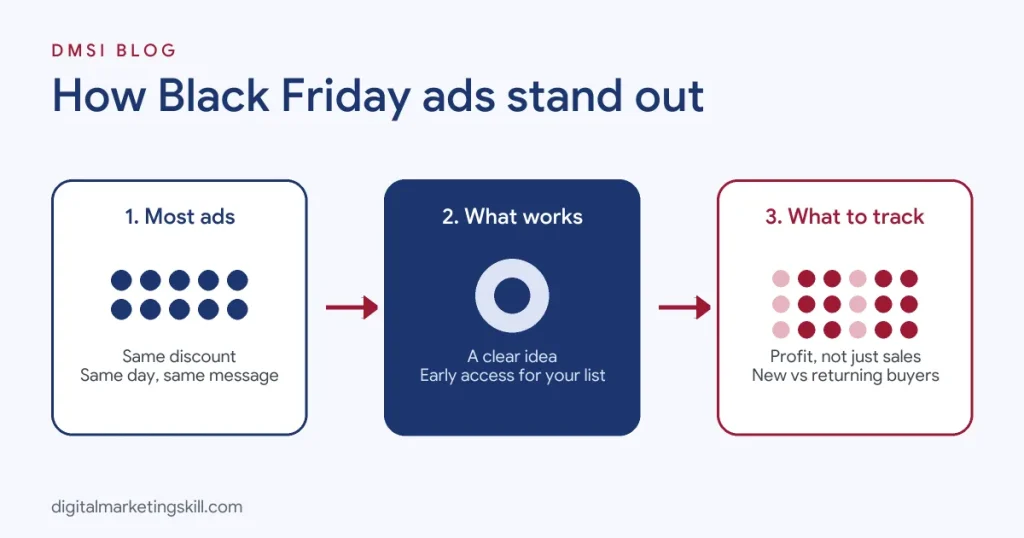
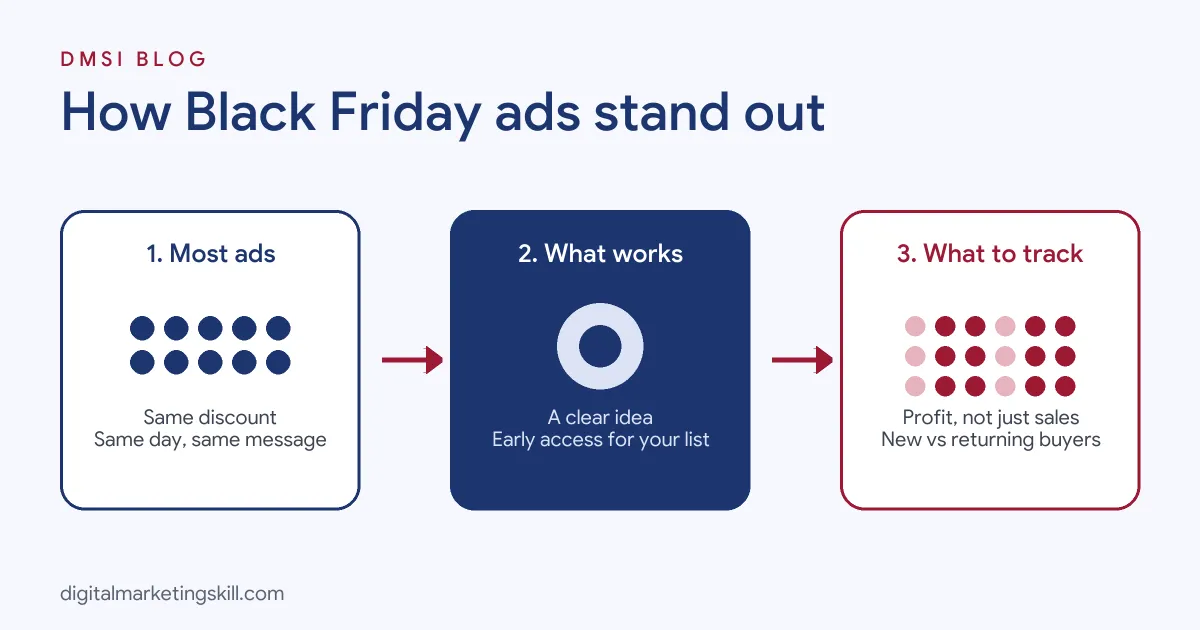
Black Friday ads are the promotions brands run around the Friday after US Thanksgiving, which falls on 27 November this year, with Cyber Monday on 30 November. The best ones do not win by shouting the biggest discount. They win with a clear idea, an offer saved for people already on the email list, and ads that start before the noise peaks. Adobe Analytics recorded $11.8 billion in US online sales on Black Friday 2025, so the attention is real, but so is the competition.
This guide looks at six campaigns that worked, what they have in common and a seven-step plan you can run even if your budget is small. If you sell online, pair it with our guide to e-commerce marketing strategies.
Key Takeaways
- Adobe Analytics recorded $11.8 billion in US online spending on Black Friday 2025, up 9.1% on the year before.
- The National Retail Federation counted a record 202.9 million US shoppers over the five days from Thanksgiving to Cyber Monday 2025.
- Shopify merchants sold a record $14.6 billion worldwide over the Black Friday to Cyber Monday weekend, with the UK the second biggest selling country.
- Mobile devices drove 55.2% of US Black Friday online sales, and social media referrals made up 3.4%, up 54.5% on the year before (Adobe, via Digital Commerce 360).
- Some of the most famous Black Friday campaigns sold less on purpose: REI closed its stores, and Patagonia told readers not to buy its jacket.
In this guide
- What Most Lists of Black Friday Ads Miss
- How Black Friday Ads Actually Work
- Types of Black Friday Ads
- Six Black Friday Campaigns Worth Studying
- How to Plan Your Black Friday Ads: Seven Steps
- Common Black Friday Ad Mistakes
- How to Measure Black Friday Ads
- The One Rule for Black Friday Ads
- An Illustrative Case
- Frequently Asked Questions About Black Friday Ads
- Your Next Step
What Most Lists of Black Friday Ads Miss
Most round-ups show clever creative and stop there. However, the creative is only the visible part. Behind every campaign that worked sit three quieter decisions: who the offer is for, when people hear about it, and how the brand protects its profit.
On Black Friday, almost every shop offers a discount. As a result, a discount alone is not a message. A shopper scrolling past forty “30% off” banners has no reason to stop at yours. The brands people remember either said something different or rewarded the customers who already trusted them.
There is also a cost problem. Ad auctions get crowded in late November, so clicks often cost more just when margins are thinnest. That is why the best plans lean on owned channels, such as email and SMS, and use paid ads mainly for retargeting warm audiences.
How Black Friday Ads Actually Work
Black Friday is no longer one day. In practice, most brands run a sequence over two to three weeks.
- Tease (two to three weeks before). Build the list. Invite people to sign up for early access or a reminder.
- Early access (a few days before). Open the offer to subscribers and past customers first.
- The day itself. Run the main push across email, social and ads. Keep the message simple.
- The weekend. Remind people who clicked but did not buy, using abandoned cart emails and retargeting.
- Cyber Monday. Close with a final reminder or a different offer for online shoppers.
The five-day window matters. The NRF found that the Sunday after Thanksgiving drew 38.7 million online shoppers in 2025, up from 32.8 million a year earlier. So a campaign that goes quiet after Friday leaves sales behind.
Mobile matters too. Adobe reported that 55.2% of US Black Friday online sales came from mobile devices. Every ad, landing page and checkout should therefore be built for a phone screen first.
Types of Black Friday Ads
Before you write a single headline, pick the job your campaign needs to do. Each type below suits a different business goal.
Straight Discount: Built for Clearing Stock
A percentage or money-off deal on selected products. It works best when you have stock to move and healthy margins. The risk is training customers to wait for sales, so limit it to specific lines.
Early Access: Built for Loyalty
Subscribers or members get the deal a day or two early. This rewards your best customers, grows your list in the weeks before and spreads demand so your site does not crash on the day.
Bundle or Gift With Purchase: Built for Order Value
Instead of cutting prices, you add value, such as a free extra item over a set spend. This protects margins and lifts average order value.
Anti-Black Friday: Built for Brand
The brand rejects the sale altogether and makes a point about values. It can earn huge press coverage, but only works if it matches what the brand already stands for.
Stunt: Built for Attention
A funny or surprising idea that people want to share. Stunts are cheap to run but hard to get right, because the joke has to fit the brand’s voice.
Six Black Friday Campaigns Worth Studying
| Brand | Campaign | Type | Lesson |
|---|---|---|---|
| REI | #OptOutside (2015 onward) | Anti-Black Friday | A bold act beats a big discount |
| Patagonia | Don’t Buy This Jacket (2011) | Anti-Black Friday | Say what you believe, plainly |
| IKEA | Buy Back Friday (2020) | Value swap | Give people a new reason to visit |
| Cards Against Humanity | Price rise (2013) | Stunt | Flip the expected offer |
| Cards Against Humanity | Pay $5 for nothing (2015) | Stunt | Make the joke the product |
| Shopify merchants | Independent brands on BFCM | Discount and early access | Small brands can win the weekend |
1. REI: #OptOutside
In 2015, outdoor retailer REI closed all 143 of its stores on Black Friday, stopped processing online orders and paid its employees to spend the day outside. It invited the public to do the same with the hashtag #OptOutside. According to the agency’s case study, about 1.4 million people joined in, and the campaign earned weeks of media coverage. REI has repeated the closure every year since.
What to copy: one simple action that proves your values. You do not need to close your shop, but you can tie the day to something your customers already care about.
2. Patagonia: Don’t Buy This Jacket
On Black Friday 2011, Patagonia ran a full-page ad in The New York Times showing one of its jackets above the headline “Don’t Buy This Jacket”. The copy explained the environmental cost of making the jacket and asked readers to buy less. It linked to a pledge to reduce, repair, reuse and recycle.
What to copy: a headline that stops people because it breaks the pattern. Then back it with detail, so it reads as a real belief, not a gimmick.
3. IKEA: Buy Back Friday
In 2020, IKEA offered to buy back unwanted IKEA furniture in 27 countries around Black Friday, paying in store vouchers. Customers got a reason to visit that was not just a discount, and IKEA got stock to resell. In Australia, IKEA later said the campaign brought back 10,000 products in one week.
What to copy: a trade, not a markdown. A trade-in, buy-back or upgrade offer can drive visits while protecting margin.
4. Cards Against Humanity: The Price Rise
In 2013, the party game raised its price by $5 for Black Friday instead of cutting it. The joke made headlines because it did the opposite of every other shop. It also started a yearly tradition that fans now wait for.
What to copy: flipping the expected offer. If everyone zigs, a well-judged zag gets noticed.
5. Cards Against Humanity: $5 for Nothing
In 2015, the company replaced its shop with a form asking people to pay $5 and receive nothing. More than 11,000 people did, raising $71,145, which the company shared with its staff. The stunt worked because it matched the brand’s voice exactly.
What to copy: a stunt that sounds like you. Humour only works when it is clearly your own.
6. Independent Brands on Shopify
Not every lesson comes from famous brands. Shopify reported that its merchants sold $14.6 billion over the Black Friday to Cyber Monday weekend in 2025, up 27%, and that more than 94,900 merchants had their best sales day ever. Most of these are small, independent shops.
What to copy: prepare your list and your store early. Small brands win the weekend with a clear offer, a fast mobile checkout and email to people who already know them.
How to Plan Your Black Friday Ads: Seven Steps
- Set one goal. Choose between profit, new customers, clearing stock or brand. One goal makes every other choice easier.
- Work out your margin. Know the deepest discount you can give and still make money after ad costs, returns and delivery.
- Pick the campaign type. Discount, early access, bundle, anti-Black Friday or stunt. Match it to your goal.
- Build the list now. Run a simple sign-up for early access. Promote it on social media, your site and in your current emails.
- Write three messages. One for the tease, one for launch and one last-chance reminder. Keep each to one idea and one call to action.
- Set up retargeting. Prepare ads for people who visited, added to cart or watched your videos. Warm audiences usually convert better than cold ones in a crowded week.
- Test your checkout on a phone. Buy something yourself. Fix anything slow or confusing before the traffic arrives.
If you use urgency or scarcity in your ads, keep it honest. Real deadlines and real stock limits build trust. Fake countdown timers do the opposite and can breach advertising rules.
Common Black Friday Ad Mistakes
Starting on the Day
By Friday, inboxes and feeds are full. Brands that build their list and warm up audiences in early November start with an advantage.
Discounting Everything
Site-wide discounts can wipe out profit on items that would have sold anyway. Choose specific products or use bundles instead.
Ignoring Mobile
With most Black Friday sales now on phones, a slow mobile page or a long form loses buyers at the last step.
Spending Most of the Budget on Cold Audiences
Cold traffic is expensive in late November. Put more weight on email, past customers and retargeting.
Going Quiet After Friday
The weekend and Cyber Monday still bring buyers. Plan reminders for the full five days.
How to Measure Black Friday Ads
Revenue alone can hide a bad campaign. Track these numbers together:
- Profit after costs: revenue minus discounts, ad spend, delivery and expected returns.
- Return on ad spend: revenue from ads divided by what you spent on them.
- New vs returning customers: a good campaign usually brings in some new buyers you can keep.
- Email and list growth: how many people joined your list during the tease period.
- Repeat purchases in January: the best test of whether you won customers or just bargain hunters.
Tag every link with UTM parameters so you can compare channels in Google Analytics. Our guide to campaign tracking in Google Analytics shows how.
The One Rule for Black Friday Ads
Give people one clear reason to choose you that is not just a lower price. That reason might be early access for loyal customers, a bundle nobody else offers, a cause you care about or a joke only you could make. Every campaign in this guide followed that rule. The discount, if there is one, supports the idea. It is never the whole idea.
An Illustrative Case
Imagine a small UK skincare brand with 4,000 email subscribers and a modest ad budget. Last year it ran 25% off everything on the day itself. Sales rose, but after ad costs and discounts, profit barely moved.
This year, it tries a different plan. From 6 November, it promotes “Early Access Club” on Instagram and its website, growing the list to 5,200. On 24 November, subscribers get first access to a gift set bundle, priced to keep a healthy margin. On Black Friday, the bundle opens to everyone, and retargeting ads go only to people who visited the site in the last 30 days. Reminder emails run through Cyber Monday.
The result is fewer total discounts given, a higher average order value and 1,200 new subscribers to market to in the new year. The brand judges success by profit and by how many new buyers come back in January. This case is an illustrative example, not a real result.
Frequently Asked Questions About Black Friday Ads
When is Black Friday this year?
Black Friday falls on Friday 27 November, the day after US Thanksgiving. Cyber Monday follows on 30 November. Many brands start their offers a week or more earlier.
When should I start running Black Friday ads?
Start building your list two to three weeks before. Open early access a few days before the day, then run your main push from Friday to Cyber Monday.
What makes a good Black Friday ad?
One clear idea, one offer and one call to action. It should look and sound like your brand and work well on a phone screen.
Are Black Friday ads worth it for small businesses?
They can be, especially with email and retargeting. Shopify reported that tens of thousands of independent merchants had their best sales day ever during the 2025 weekend.
Should I discount everything on Black Friday?
Usually not. Site-wide discounts can cut profit on products that would sell anyway. Choose specific items, bundles or gifts with purchase instead.
Which channels work best for Black Friday?
Email to your existing list is often the most profitable. Social media and retargeting ads support it. Adobe found social media referrals made up 3.4% of US Black Friday online sales in 2025 and were growing fast.
What is an anti-Black Friday campaign?
It is a campaign that rejects the sale, such as REI closing its stores. It works for brands with strong values, but can look fake if it does not match what the brand already does.
How do I measure if my Black Friday campaign worked?
Look at profit after all costs, return on ad spend, new customers gained and how many of them buy again in the following months.
Do Black Friday ads cost more to run?
Often yes. More advertisers compete for the same audiences, so costs can rise. That is why warm audiences and owned channels such as email matter so much.
Your Next Step
Black Friday shows the whole of digital marketing in one week: list building, email, social media, paid ads, landing pages and analytics. The Master Diploma in Digital & AI Marketing at Digital Marketing Skill Institute teaches each of these skills across four tracks: Social Media Management and Advertising, Lead Generation and Email Automation, Google, and WordPress and SEO.
From day one, you work on a real U.S. company’s project through the U.S. Project Internship, so you finish with real campaign results and a verified U.S. work reference letter. You also get unlimited one-on-one coaching. The program carries dual US and UK accreditation, is recognised in more than 100 countries, and runs 100% online over three months.
You can build those skills wherever you live, anywhere in your country. Read student reviews, then apply for the 65% partial scholarship to see if you qualify.
Every figure in this guide was checked against its original source before publication: Adobe Analytics (via Digital Commerce 360), the National Retail Federation, Shopify, REI’s agency case study, Patagonia, IKEA (Ingka Group) and press coverage of Cards Against Humanity. The case above is an illustrative example, not a real result.