
Average Order Value (AOV) is the average amount a customer spends each time they place an order, found by dividing total revenue by the number of orders. It is one of the simplest numbers in ecommerce, yet it shapes many big decisions. For example, it tells you how much you can afford to pay for a sale. As a result, raising AOV is often the fastest way to grow revenue without finding new customers.
Key Takeaways
- AOV equals total revenue divided by the number of orders in the same period.
- It shows how much a typical order is worth, not how much each customer spends over time.
- Higher AOV lets you spend more on ads while staying profitable.
- Bundles, upsells and free delivery thresholds are common ways to raise it.
- Always check AOV alongside conversion rate and profit margin.
What Is Average Order Value?
Average order value tells you what a typical basket is worth. Shopify gives the formula as “AOV = Total Revenue ÷ Number of Orders”. So if your shop takes £5,000 from 100 orders in a month, your AOV is £50.
Think of a coffee shop. Some customers buy only a coffee. Others add a pastry or a bottle of water. If the shop adds up the day’s takings and divides by the number of receipts, it gets its average order value. Then, if staff start offering a pastry with every coffee, that average should rise.
Different tools may count AOV in slightly different ways. For example, Shopify says its AOV is based on each order’s “gross sales minus discounts” value. Other platforms may include or leave out tax, delivery fees or refunds. So always check which version your tool uses before you compare numbers.
AOV sits next to other key ecommerce metrics. Together with traffic and conversion rate, it explains almost all of your online revenue.
Why It Matters
Why does AOV matter so much? First, it affects how much you can spend to win a sale. For instance, if each order brings in £80 rather than £40, you can pay more per click and still make a profit. Second, it is often easier to raise than traffic. After all, you are selling more to people who already want to buy. In addition, a higher AOV can spread fixed costs, such as packing and delivery, over more revenue. As a result, the same number of orders can become much more profitable.
How Average Order Value Works
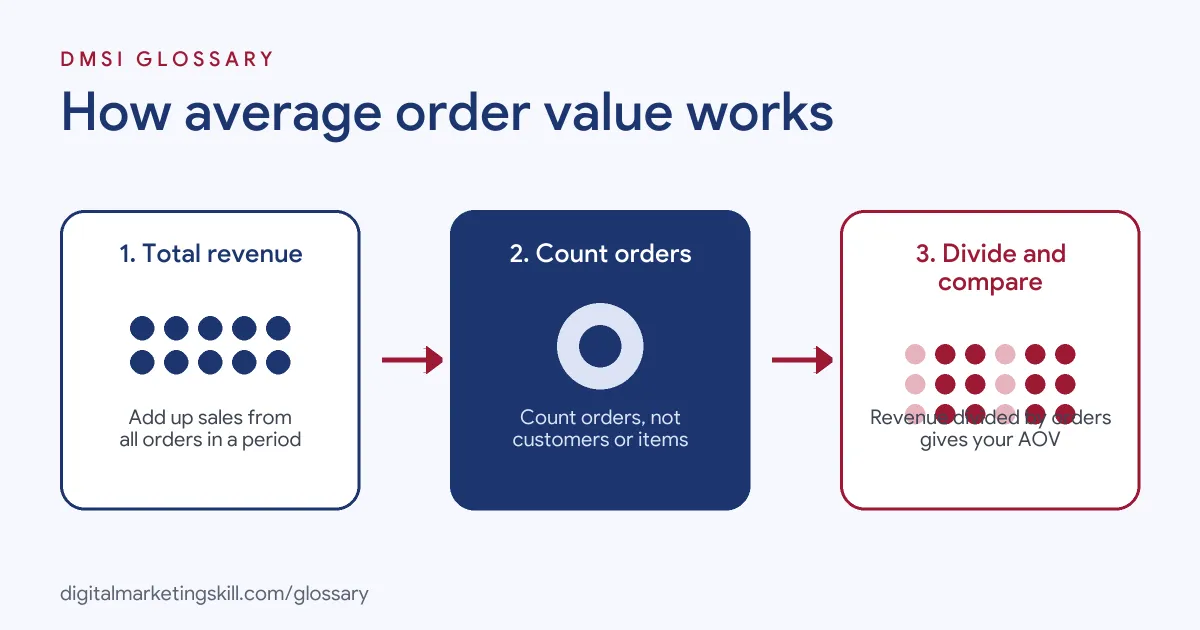
AOV works in three simple steps. First, you add up revenue for a period. Then you count the orders in that same period. Finally, you divide revenue by orders to get the average.
Step 1: Total Your Revenue
To begin with, choose a clear period, such as a week or a month. Then add up revenue from all orders in that period. Decide early whether to include tax, delivery fees and discounts. After that, keep the same rule every time, so your numbers stay comparable.
Step 2: Count Your Orders
Next, count the number of orders, not the number of customers or items. This matters because one customer may place several orders. Also, one order can hold many items. If you count the wrong thing, your AOV will be wrong too.
Step 3: Divide and Compare
Then divide revenue by orders. For example, £12,000 from 300 orders gives an AOV of £40. On its own, that number tells you little. However, compared with last month, with a goal or with a single channel, it becomes very useful. For instance, you might find that email shoppers spend more per order than social shoppers.
How It Connects to Ad Spend
Finally, AOV links straight to paid advertising. Google Ads explains that with Target ROAS bidding, it “predicts future conversions and associated values using your reported conversion values”. So if your tracking sends order values back to the ad platform, AOV directly shapes how your bids work. In turn, a higher AOV can support a stronger return on ad spend.
Average vs Typical Order
AOV is a mean, so a few very large orders can pull it up. For example, imagine nine orders of £20 and one order of £500. The AOV is £68, yet most shoppers spent £20. So it helps to also look at the most common order value, or the median. Then you can see what a normal shopper really does. In addition, you can remove extreme orders, such as bulk trade orders, from your main report. That way, your AOV reflects everyday customers. Also, note any big promotions in the period, since they can shift the number for a short time.
Examples of Average Order Value
- An online beauty shop. The shop sees that most orders sit just below its free delivery level. So it sets the threshold slightly above its usual order value. As a result, many shoppers add one more small item to qualify.
- A furniture retailer. At checkout, the site suggests matching cushions and a throw for each sofa. This simple cross-selling step lifts the value of many orders.
- A meal kit service. The service offers a larger family box at a lower price per meal. Then it tracks AOV by plan to see whether the bigger box pays off.
Average Order Value vs Customer Lifetime Value
| Point | Average Order Value | Customer Lifetime Value |
|---|---|---|
| What it measures | Value of a typical single order | Total value of a customer over time |
| Time frame | A set period, such as a month | The whole customer relationship |
| Formula | Revenue ÷ number of orders | Often AOV × purchase frequency × lifespan |
| Main use | Pricing, offers and checkout design | Retention and acquisition budgets |
In short, AOV is one building block of customer lifetime value. A customer who orders often at a high AOV is worth far more than a one-time buyer.
How to Increase Average Order Value
- Measure your starting point. Work out your current AOV and note which rules you used.
- Find your common order values. Look at which order sizes appear most often. Then use them to plan offers.
- Set a free delivery threshold. Place it a little above your typical order, so shoppers have a reason to add more.
- Create bundles. Group items that go together. Shopify suggests “offering product bundles that cost less than if the same items were purchased individually.”
- Add smart upsells. Offer a better version or an add-on at the right moment. Good upselling feels helpful, not pushy.
- Test one change at a time. Run each idea long enough to compare results fairly.
- Check profit, not just AOV. Make sure discounts and free delivery don’t wipe out the extra revenue.
Best Practices for Average Order Value
- Use one clear definition. Decide what counts as revenue and stick to it.
- Segment your AOV. Compare it by channel, device, campaign and customer type.
- Watch conversion rate too. A higher AOV is no win if far fewer people buy.
- Keep offers relevant. Suggest products that genuinely fit what is in the basket.
- Send values to ad platforms. Accurate order values help value-based bidding work better.
- Review it often. Check AOV every month and after every major promotion.
Common Mistakes to Avoid
- Dividing by customers. AOV uses orders, not customers, so mixing them up gives the wrong number.
- Ignoring outliers. One huge order can lift the average and hide what most shoppers do.
- Chasing AOV at any cost. Deep discounts may raise order size but cut your profit.
- Comparing different tools. Platforms may define revenue differently, so numbers may not match.
- Forgetting returns. If many items come back, your real order value is lower than it looks.
Where You’ll Use Average Order Value at Work
AOV is a core number in ecommerce and performance marketing roles. For example, ecommerce managers use it to plan pricing, bundles and promotions. Likewise, paid search and paid social specialists use it to judge how much they can bid for a sale. Also, email marketers track it to see which campaigns bring the most valuable orders. Finally, analysts report on it in weekly and monthly dashboards, often next to conversion rate and customer acquisition cost.
Learn It in the Google Ads and Analytics Track
You can learn to track and improve AOV in the AI-Powered Google Specialist track. Every track includes a U.S. Project Internship from day one, with unlimited 1-on-1 mentoring.
Frequently Asked Questions
How do you calculate average order value?
Divide total revenue by the number of orders in the same period. For example, £6,000 from 150 orders gives an AOV of £40.
What is a good average order value?
There is no single good number. It depends on your products, prices and costs. Instead, compare your AOV with your own past results and goals.
Is AOV the same as basket size?
Not quite. Basket size often means the number of items in an order, while AOV is the money value of the order.
Does AOV include tax and delivery?
It depends on the tool. So check how your platform defines revenue before you report or compare AOV.
Why does AOV matter for ads?
A higher AOV means each sale brings in more revenue. As a result, you can often afford to pay more for each conversion and still make a profit.
Sources: Shopify: Average Order Value: Formula and 7 Ways; Shopify Changelog: Your Average Order Value now has a new definition in Shopify; Google Ads Help: About Target ROAS bidding.