
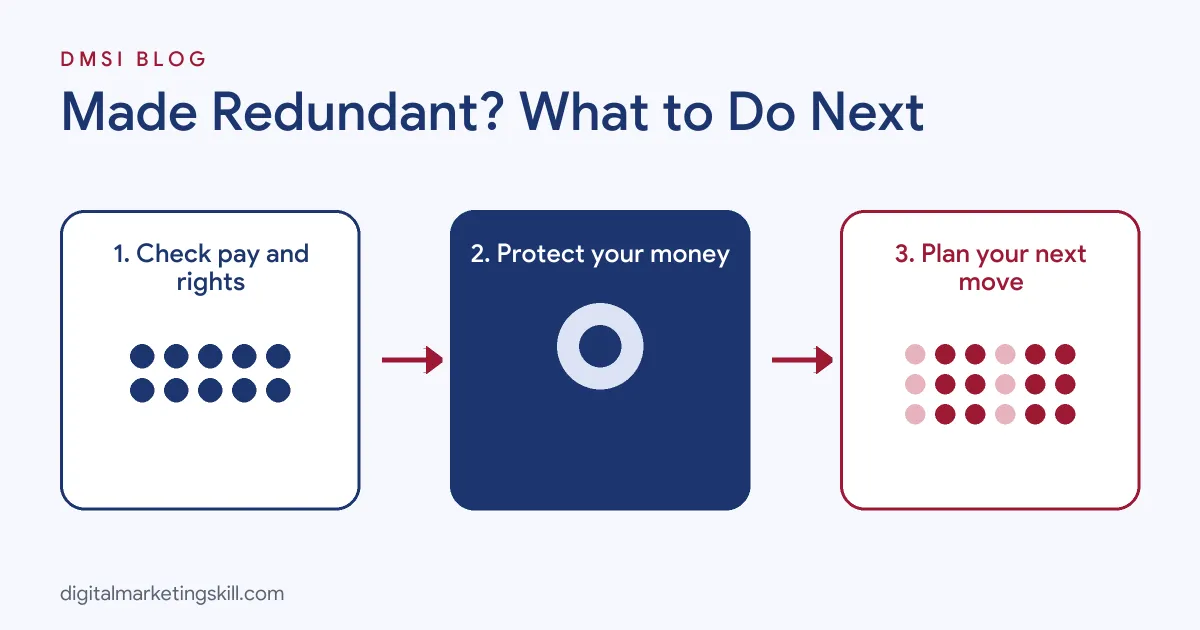
If you have been made redundant, the first things to do are practical: check that your redundancy pay, notice pay and holiday pay are correct, claim any benefits you are entitled to, and make a simple budget. Then give yourself a short pause to process what happened before planning your next step, whether that is a similar role, a new career or retraining. Redundancy is about the role, not about you, and many people use it as the push to move into work that suits them better.
This guide walks through what to do in the first days, how to check your rights (with UK figures, since UK guidance dominates this topic), how to look after your money and your mental health, and how to rebuild your career with a clear plan.
Key Takeaways
- In the UK, employees with at least 2 years’ service are usually entitled to statutory redundancy pay, with a weekly pay cap of £751 and a maximum of £22,530 for redundancies on or after 6 April 2026 (GOV.UK).
- The first £30,000 of redundancy pay is tax free (Citizens Advice).
- You have 6 months from the date your job ends to apply for statutory redundancy pay if it has not been paid (GOV.UK).
- The Jobcentre Plus Rapid Response Service can help during your notice period and up to 13 weeks after redundancy (GOV.UK).
- What Most Redundancy Guides Miss
- The First 7 Days
- Check Your Rights and Money Owed
- Manage Your Money
- Look After Yourself
- Decide Your Next Move
- Run a Focused Job Search
- Common Mistakes
- FAQ
What Most Redundancy Guides Miss
Most guides on redundancy fall into two groups. Government and advice sites cover rights, pay and benefits in detail, which is essential. Career sites cover CVs and interviews. Very few connect the two into one plan. Yet the money side and the career side depend on each other: knowing exactly how many months your payout and savings will cover tells you how much time you have to look for the right job, retrain, or try freelancing, rather than accepting the first offer out of panic.
The second gap is that most guides treat redundancy as something to recover from, rather than a decision point. For many people it is the first time in years that they have had the space to ask what kind of work they actually want. This guide covers both the essential checks and that bigger question, so you can move forward with a plan rather than a reaction.
The First 7 Days After Being Made Redundant
The first week matters because a few deadlines and paperwork tasks start running straight away, and because the shock can make it hard to think clearly. Keep this week simple.
- Get everything in writing. Ask your employer for written confirmation of your redundancy, your leaving date, your notice period and how your redundancy pay has been calculated. Keep copies of your contract, payslips and any emails about the process.
- Check your final pay. Citizens Advice suggests checking that you have received your final pay, any redundancy pay you are owed, pay in lieu of notice if you are not working your full notice, holiday pay and any outstanding bonus, commission or expenses.
- Ask for a reference. Request a written reference while your managers still remember your work well. Citizens Advice also suggests asking whether your employer will pay for professional help with your job search as part of your package.
- Claim benefits early. If you live in the UK, check whether you can claim Universal Credit or New Style Jobseeker’s Allowance. GOV.UK recommends using a benefits calculator to see what you might be entitled to, and Money Saving Expert advises contacting the Jobcentre quickly because payments can take time.
- Tell the right people. Let your bank, mortgage lender or landlord know early if you think you will struggle with payments. Lenders usually have more options before a payment is missed than after.
- Take a breath. Avoid big decisions in the first few days. Talk to family or friends, and remember that it is the job that has been made redundant, not you.
Check Your Rights and the Money You Are Owed
The rules below are for the UK, based on GOV.UK and Citizens Advice. Other countries have different rules, so if you work elsewhere, check your national labour ministry or an employment adviser. The principle is the same everywhere: confirm what you are owed before you sign anything.
Statutory redundancy pay
According to GOV.UK, you are usually eligible for statutory redundancy pay if you are an employee and have worked for your current employer for at least 2 years. The amount depends on your age and length of service:
- half a week’s pay for each full year you were under 22;
- one week’s pay for each full year you were 22 or older but under 41;
- one and a half weeks’ pay for each full year you were 41 or older.
Only up to 20 years of service counts. For redundancies on or after 6 April 2026, weekly pay is capped at £751 and the maximum statutory redundancy pay is £22,530. Your employer may pay more than this under your contract, which is called contractual or enhanced redundancy pay. Check your contract and staff handbook.
| Item | What to check |
|---|---|
| Redundancy pay | Years of service, age bands, weekly pay used, any enhanced contractual amount |
| Notice pay | Statutory or contractual notice, whichever is longer, or pay in lieu of notice |
| Holiday pay | Accrued holiday you have not taken by your leaving date |
| Other pay | Bonus, commission, overtime and expenses you have earned |
| Tax | First £30,000 of redundancy pay tax free; notice and holiday pay are taxed as normal |
Notice periods
Citizens Advice explains that if you have worked for your employer for at least a month, you are entitled to paid notice. Statutory notice is one week if you have worked there for between one month and two years, then one week for each full year of service, up to 12 weeks. Your contract may give you more. Your notice period starts when your employer confirms your redundancy, not when you are first told you are at risk.
Tax on redundancy pay
The first £30,000 of redundancy pay is tax free. Pay in lieu of notice, holiday pay and outstanding wages are taxed in the usual way. If you leave part way through the tax year, you may be due a tax refund, and GOV.UK has guidance on how to claim one.
Consultation and fair selection
Your employer should consult with you before making you redundant. Citizens Advice notes that group consultation applies when 20 or more redundancies are planned, and it must start at least 30 days before the first dismissal, or 45 days if 100 or more people are affected. Selection must be fair and must not be discriminatory. If you think you were chosen unfairly, GOV.UK says you can appeal by writing to your employer and explaining your reasons. Acas offers free advice on redundancy disputes.
Suitable alternative jobs and trial periods
Employers should look for suitable alternative work within the organisation before making you redundant. If you accept a different role, you are normally entitled to a 4-week trial period. If the new job is not suitable, you can still be treated as redundant, but turning down a genuinely suitable offer without a good reason can mean losing statutory redundancy pay.
If your employer has gone out of business
If your employer is insolvent, you can claim statutory redundancy pay and some other money owed from the government’s Redundancy Payments Service. You will need a case reference from the insolvency practitioner handling the business. GOV.UK’s factsheet explains that if your employer did not consult you before making you redundant, you may also be able to claim a protective award through an employment tribunal.
Time off to look for work
If you will have worked for your employer for 2 years by the end of your notice period, you are entitled to reasonable paid time off during your notice to look for work or arrange training. Use it. Interviews, networking calls and short courses are much easier to fit in while you are still being paid.
Manage Your Money
A lump sum can feel larger than it is. The aim is to turn your payout and savings into a clear runway: the number of months you can cover essential costs while you find the right next role.
Work out your runway
- Add up the money you will have: redundancy pay, final salary, notice and holiday pay, savings and any benefits you expect.
- List your essential monthly costs: housing, energy, food, transport, debt repayments, insurance and phone.
- Divide the first figure by the second. That is your runway in months.
If your runway is short, focus on income first, which might mean contract or temporary work while you search for a permanent role. If it is longer, you have room to retrain or be more selective.
Cut costs without panic
StepChange, the debt charity, suggests four early steps after redundancy: contact your creditors, make a budget, reduce your spending and see if you can increase your income. Pause subscriptions you do not use, review insurance and phone contracts, and check whether you qualify for discounts or reduced tariffs. Money Saving Expert’s redundancy checklist also covers help with mortgages, job-hunting costs and grants for people on low incomes.
Be careful with the lump sum
Keep your redundancy payout in an easy-access savings account while you decide what to do. Avoid large purchases or locking money away until you know when your next income will start. If you have debts, get free advice before using the payout to clear them, so you keep enough for living costs. If you are thinking about pensions or investments, speak to a regulated adviser.
Look After Yourself
Redundancy can affect confidence, routine and identity, even when it was expected. Mind, the mental health charity, suggests taking stock of how you are feeling, managing your money, coping with uncertainty and choosing whether to keep busy or take some time off. A few practical habits help:
- Keep a routine. Get up at a regular time, plan your day and include time outside.
- Talk about it. Friends, family and former colleagues often understand more than you expect, and many will have been through redundancy themselves.
- Separate the role from yourself. Redundancy happens because the job is no longer needed, not because of your worth.
- Get help if you need it. Citizens Advice suggests talking to your GP if redundancy is affecting your mental health. Samaritans and Shout offer support if you need to speak to someone.
Decide Your Next Move
Once the immediate checks are done, the most important question is what you want next. There are four broad paths, and many people combine them.
| Path | Best when | First step |
|---|---|---|
| A similar role | You liked your work and your skills are in demand | Update your CV and contact recruiters in your sector |
| A step up or sideways move | You were ready for more responsibility or a new industry | List transferable skills and target roles that use them |
| A career change | You want different work or your sector is shrinking | Research roles, talk to people doing them, take a short course |
| Freelance or self-employment | You have a skill people will pay for directly | Test demand with one or two small paid projects |
Take stock of your skills
Write down what you actually did in your last role, not just your job title. Include the tools you used, the problems you solved, the people you managed or worked with, and the results you delivered. Then separate these into skills you enjoy using and skills you would rather leave behind. This list becomes the base for your CV, your LinkedIn profile and your decision about which roles to target.
Consider growing fields
If you are thinking about a career change, look at fields where demand is steady and where skills can be learned relatively quickly and shown through a portfolio. Digital marketing is one example: skills such as paid social, Google Ads, SEO, email marketing and analytics are used by businesses of every size, and many roles can be done remotely. Other people move into project management, data, customer success or training. Whatever you consider, speak to people already in the role and try a small project before committing.
Use free careers support
In the UK, the Jobcentre Plus Rapid Response Service can help if you suspect redundancy is coming, during your notice period and for up to 13 weeks afterwards. It can help with CVs, finding jobs and, if you are eligible, costs for travel, childcare, tools or equipment. You can contact it by emailing [email protected] with your postcode. The National Careers Service offers free careers advice in England, Skills Development Scotland and PACE support people in Scotland, and Careers Wales covers Wales.
Run a Focused Job Search
A focused search beats sending the same CV everywhere. Treat it like a project with a weekly plan.
Update your CV and profile
- Lead with a short summary of the role you want and the value you bring.
- Describe achievements with results, such as time saved, revenue supported or customers served, rather than duties.
- Add any new skills or courses as you complete them.
- Update your LinkedIn headline and turn on open-to-work settings if you are comfortable doing so.
Explain the redundancy simply
Employers understand redundancy. Prepare a short, neutral explanation, for example: “My role was made redundant when the company restructured its marketing team. I am now looking for a role where I can use my experience in campaign planning and analytics.” Keep it brief and move on to what you offer.
Use your network
Many roles are filled through referrals and conversations. Tell former colleagues, managers, clients and friends what kind of role you are looking for. Ask for advice and introductions rather than jobs directly; people are more comfortable helping that way.
Set a weekly rhythm
- A set number of tailored applications each week.
- A few networking conversations or messages.
- Time for learning or a portfolio project.
- A short review of what is working and what is not.
This rhythm keeps you moving and makes progress visible, which helps with confidence on weeks when replies are slow.
Retraining After Redundancy
Redundancy can be a good time to learn a new skill, especially if your payout gives you a few months of runway. Before you pay for any course, ask four questions:
- Does it lead to real roles? Search current job adverts for the skill and see how often it appears.
- Will you build proof? Courses that include real projects give you something to show employers or clients.
- Is the time commitment realistic? Choose something you can finish while job hunting.
- Is there funding? Check government skills programmes, local training schemes and whether your former employer will contribute as part of your package.
Short, practical courses often help more than long qualifications at this stage, because they let you show new skills quickly and start applying sooner.
Trying Freelance or Contract Work
Some people use redundancy to test freelancing. It can work well when you already have a skill businesses pay for, such as writing, design, bookkeeping, marketing or IT support. Start small: offer one clear service, price it simply, and aim for one or two paid projects before deciding whether to make it your main income. Keep your runway in mind, because freelance income usually takes time to build. In the UK, you will need to register as self-employed with HMRC if you start trading.
Contract and temporary work can also bridge a gap. It brings in income, keeps your skills current and often leads to permanent offers.
Common Mistakes
- Signing a settlement agreement without advice. If you are offered one, you must get independent legal advice for it to be valid, and employers often contribute to the cost.
- Not checking the redundancy pay calculation. Errors in service length or weekly pay are common. Use the GOV.UK calculator to check.
- Delaying a benefits claim. Payments can take time, so claim as soon as you are eligible.
- Spending the payout too quickly. Treat it as runway, not a windfall.
- Applying for everything. A focused search with tailored applications usually works better.
- Ignoring the time-off right during notice. Use it for interviews and training.
- Going it alone. Free help from Citizens Advice, Acas, Jobcentre Plus and careers services exists for exactly this situation.
One Rule to Remember
Secure the money first, then choose the direction: check every payment you are owed, know your runway in months, and use that time to move towards work you actually want rather than the first role that appears.
Example: Amaka, a customer service team leader in Leeds, is made redundant after six years. In her first week she checks her redundancy pay against the GOV.UK calculator, confirms her holiday pay and asks for a written reference. She works out that her payout and savings cover about five months of essential costs. Instead of applying for every team leader role, she spends her notice period’s job-hunting time on a short digital marketing course, builds two small campaign projects for a local charity, and starts applying for marketing coordinator roles in month two. This example is illustrative and not a real person.
Turning Redundancy Into a Career Move
Redundancy can be the moment to build skills that travel with you. Digital marketing skills such as paid social, Google Ads, SEO and email marketing are used by businesses worldwide, and many roles can be done remotely. If you are in your country and considering a new direction after redundancy, building practical skills and a portfolio of real projects can help you compete for marketing roles and freelance work, wherever employers are based.
Frequently Asked Questions
What should I do first after being made redundant?
Get your redundancy details in writing, check your final pay, redundancy pay, notice pay and holiday pay, and claim any benefits you are entitled to. Then make a budget.
How much redundancy pay will I get in the UK?
If you have at least 2 years’ service, statutory redundancy pay is based on age and years of service, up to 20 years. For redundancies on or after 6 April 2026, weekly pay is capped at £751 and the maximum is £22,530. Your contract may give you more.
Is redundancy pay taxed?
The first £30,000 of redundancy pay is tax free. Notice pay, holiday pay and outstanding wages are taxed as normal.
Do I need to tell HMRC I have been made redundant?
Usually your employer handles tax through payroll and gives you a P45. If your redundancy pay is over £30,000 or you think you have paid too much tax, check GOV.UK guidance or contact HMRC.
What is the 4-week rule for redundancy?
If your employer offers you a different job instead of redundancy, you normally have a 4-week trial period to decide whether it is suitable without losing your right to redundancy pay.
Is it better to resign or be made redundant?
If your role is being made redundant, resigning early can mean losing redundancy pay and notice pay. Get advice before deciding.
How long do I have to claim redundancy pay?
GOV.UK says you have 6 months from the date your job ends to apply for statutory redundancy pay if your employer has not paid it.
Can I get help finding a new job?
Yes. In the UK, the Jobcentre Plus Rapid Response Service and the National Careers Service offer free support with CVs, job searching and training.
How do I explain redundancy in an interview?
Keep it short and factual: explain that the role was removed in a restructure, then focus on your achievements and what you want to do next.
Is redundancy a good time to change careers?
It can be, especially if your payout gives you time to retrain. Research roles, speak to people in the field and test the work with a short course or small project before committing.
Your Next Step
If redundancy has made you rethink your career, practical digital marketing skills are one route you can learn and prove with real projects. The Master Diploma in Digital & AI Marketing at Digital Marketing Skill Institute covers AI-powered Social Media Management and Advertising, Lead Generation and Email Automation, Google, and a WordPress and SEO track where you build and rank a real website.
From day one, you work on a real U.S. company’s project through the U.S. Project Internship, so you finish with real results and a verified U.S. work reference letter. You also get unlimited one-on-one coaching. The program carries dual US and UK accreditation, is recognised in more than 100 countries, and runs 100% online over three months.
You can build those skills wherever you live, anywhere in your country. Read student reviews, then apply for the 65% partial scholarship to see if you qualify.
Sources checked November 2026: GOV.UK redundancy pay, GOV.UK redundancy help, GOV.UK Redundancy Payments Service factsheet, Citizens Advice, Money Saving Expert, StepChange and Mind. This guide is general information, not legal or financial advice. We have no connection with these organisations.