To manage a remote team well, set clear goals, roles and communication norms, hold regular one-to-ones and team check-ins, choose a small set of tools and use them consistently, document decisions, judge performance by outcomes rather than hours online, build trust and connection on purpose, and protect your team’s work-life balance. Remote management is not office management over video calls: the informal conversations that keep office teams aligned do not happen by accident, so good remote managers replace them with deliberate routines. This guide explains how to set up a remote team for success, run effective communication and meetings, measure performance fairly, keep people engaged and avoid the most common remote management mistakes.
Key Takeaways
- Harvard Business School Online lists 12 tips for managing remote teams, including establishing team norms, regular check-ins, constant communication, transparency, trust and promoting work-life balance.
- The Center for Creative Leadership recommends defining the team, clarifying roles and expectations, establishing procedures, investing in trust and recognising the impact of differences.
- Harvard’s Division of Continuing Education highlights a flexible management style, the importance of relationships, clear communication and a clear definition of success.
- Remote teams work best with written documentation and asynchronous communication, so not every question needs a meeting.
- Managing by outcomes, not online presence, builds trust and reduces micromanagement.
- Set the Foundations
- Communication
- Meetings and Check-Ins
- Tools
- Managing Performance
- Trust and Connection
- Wellbeing and Balance
- Time Zones and Cultures
- Onboarding Remote Staff
- FAQ
What Most Remote Management Advice Misses
Many tips focus on tools and video calls. Tools help, but most remote team problems come from unclear expectations, information that lives in people’s heads and managers who either disappear or micromanage. The biggest shift for a new remote manager is moving from managing what you can see to managing what you agree.
- Write it down. In a remote team, if a decision is not written somewhere people can find it, it effectively did not happen.
- Default to asynchronous. Live meetings are expensive across calendars and time zones; use them for discussion, not status updates.
- Connection must be designed. Without corridor chats and lunches, relationships fade unless you create space for them.
Set the Foundations
Define the team and its purpose
The Center for Creative Leadership starts with defining the team: who is in it, what it is responsible for and how it contributes to the organisation. Harvard Business School Online adds instilling a sense of purpose. Remote team members can feel disconnected from the bigger picture, so explain regularly how their work matters.
Clarify roles and expectations
Make sure everyone knows their responsibilities, decision rights, priorities and what good work looks like. Harvard’s Division of Continuing Education recommends being clear about your definition of success. Ambiguity is harder to resolve remotely, where people cannot simply lean over and ask.
Establish team norms
HBS Online’s first tip is establishing team norms and expectations. Agree, and write down:
- core hours when people should be reachable;
- expected response times for chat, email and urgent issues;
- which channel to use for what, for example chat for quick questions, documents for decisions and video calls for complex discussions;
- how to show availability, such as calendar blocks and status updates;
- how work is tracked and where files live.
Establish procedures
CCL also recommends establishing procedures. Define how work moves from request to completion, how approvals happen, how problems are escalated and how handovers work. Clear procedures reduce the back-and-forth that slows remote teams down.
Communication: Constant, Clear and Written
HBS Online emphasises communicating constantly and being transparent. In practice:
- Over-communicate context. Share why decisions are made, not just what was decided.
- Use written updates. Weekly written updates on priorities, progress and blockers keep everyone aligned without extra meetings.
- Document decisions. Keep a shared space for decisions, processes and frequently asked questions.
- Be transparent about changes. Remote employees often hear news last; share important updates with everyone at the same time.
- Write clearly. Short paragraphs, clear requests and explicit deadlines prevent misunderstandings.
Asynchronous communication, where people respond in their own time, is one of the biggest advantages of remote work when it is done well. Recorded video walkthroughs, shared documents with comments and well-organised chat channels let people work across schedules.
Meetings and Check-Ins
Regular one-to-ones
HBS Online recommends regular check-ins and one-to-one conversations. Weekly or fortnightly one-to-ones are where remote managers learn what is really happening: workload, blockers, motivation, career goals and wellbeing. Let the team member set much of the agenda, and protect the time from cancellation.
Team meetings with a purpose
CCL’s guidance on virtual meetings stresses that every meeting should be one where the agenda could not be handled without it, attendees should be fully present and discussion should be driven by a detailed agenda. Practical rules:
- Share an agenda and any pre-reading in advance.
- Use meetings for discussion and decisions, not reading updates aloud.
- Keep cameras optional but encourage participation, and invite quieter people to contribute.
- Record or summarise key decisions and actions in writing.
- End on time, and cancel recurring meetings that no longer add value.
A simple meeting rhythm
| Meeting | Frequency | Purpose |
|---|---|---|
| Written stand-up or update | Daily or a few times a week | Share priorities and blockers without a call |
| One-to-one | Weekly or fortnightly | Support, feedback, career and wellbeing |
| Team meeting | Weekly | Priorities, decisions and problem-solving |
| Retrospective | Monthly or after projects | What worked, what to improve |
| Social or informal time | Weekly or fortnightly | Connection and relationships |
| In-person gathering | A few times a year, if possible | Planning, bonding and culture |
Tools for Managing Remote Teams
HBS Online’s third tip is leveraging technology. Remote teams usually need:
- Chat: Slack, Microsoft Teams or Google Chat, with clear channels by project or topic.
- Video calls: Zoom, Google Meet or Teams for meetings and one-to-ones.
- Project management: Asana, Trello, monday.com, ClickUp or Jira to track who is doing what and by when.
- Documentation: Notion, Confluence, Google Docs or SharePoint for processes, decisions and knowledge.
- Async video: Loom or similar tools for walkthroughs and feedback.
- File storage and security: shared drives with clear structure, plus password managers and secure access.
Choose a small set, agree how to use each one and stick to it. Too many tools scatter information. Our guide to remote work tools and productivity apps covers options in more detail.
Managing Performance Remotely
Focus on outcomes
Remote managers cannot, and should not, watch people work. Instead, agree clear goals, deliverables and quality standards, then assess results. Measuring activity, such as hours online or messages sent, encourages people to look busy rather than be effective.
Set clear goals
Use simple frameworks such as objectives and key results or quarterly goals, broken into weekly priorities. Make sure each person knows how their goals connect to the team’s purpose.
Give regular feedback
Feedback is easy to delay when you do not see people every day. Give specific, timely feedback in one-to-ones and recognise good work publicly. HBS Online also recommends soliciting feedback, so ask your team how you can support them better.
Address problems early
If performance slips, talk about it privately and quickly. Explore causes such as unclear priorities, workload, tools, personal circumstances or skills gaps before assuming a lack of effort.
Avoid micromanagement
HBS Online recommends trusting and empowering employees. Constant check-ins, monitoring software and requests for status updates signal distrust and reduce motivation. Agree outcomes, give autonomy over how work is done and step in when support is needed.
Building Trust and Connection
CCL highlights investing in trust, and Harvard DCE notes that relationships still matter. Trust in remote teams grows from reliability, transparency and personal connection.
- Be reliable: do what you say you will, respond within agreed times and follow up on commitments.
- Be available: hold open office hours or make it clear how team members can reach you.
- Make time to connect: HBS Online recommends making time to socialise. Informal coffee chats, team rituals, celebrations and non-work channels help relationships grow.
- Celebrate success: Harvard DCE recommends celebrating the team’s successes, with public recognition for good work.
- Meet in person when possible: occasional gatherings can strengthen relationships that carry the team through months of remote work.
Wellbeing and Work-Life Balance
HBS Online includes providing support and promoting work-life balance among its tips, and Harvard DCE recommends defining and modelling appropriate work-life balance. Remote work can blur the boundary between work and home, leading to long hours and isolation.
- Model healthy behaviour: avoid sending messages late at night or schedule them for working hours.
- Respect time off and discourage checking messages on holiday.
- Watch for signs of overload, such as missed deadlines, withdrawal or working at all hours, and talk about workload openly.
- Make sure people have suitable equipment and a workable home setup.
- Share information about wellbeing support your organisation offers.
Managing Across Time Zones and Cultures
HBS Online recommends fostering empathy and cultural awareness, and CCL recommends recognising the impact of differences. Distributed teams bring together people with different working hours, holidays, communication styles and expectations.
- Agree overlap hours for live collaboration, and rotate inconvenient meeting times so the same people do not always join early or late.
- Use asynchronous workflows so work can progress while others are offline: clear handover notes, shared documents and recorded updates.
- Be explicit in written communication, because indirect styles, humour and idioms can be misread across cultures and languages.
- Respect local holidays and working norms, and keep a shared calendar of team availability.
- Check understanding by summarising decisions and inviting questions in writing as well as on calls.
Onboarding Remote Team Members
Onboarding is where remote teams often fall short, because new starters cannot absorb how things work by watching colleagues. A good remote onboarding plan includes:
- Before day one: send equipment, set up accounts and share a welcome message with the first week’s schedule.
- First week: introduce key people, explain tools and norms, share documentation and assign a buddy for informal questions.
- First month: set early goals, give a small first project with clear success criteria and hold frequent check-ins.
- First three months: review progress, gather feedback on the onboarding process and agree longer-term goals.
Strong documentation makes onboarding much easier. If processes are written down, new starters can find answers without waiting for someone to be available.
Managing Remote Marketing Teams
Marketing teams often work well remotely because much of the work, such as writing, design, analytics and campaign management, happens in digital tools. A few practices help in particular. Keep a shared content and campaign calendar so everyone sees what is launching when. Use clear briefs with objectives, audiences, messages and deadlines. Agree an approval workflow so content does not stall waiting for feedback. Hold regular creative sessions on video or in person to brainstorm, because ideas can suffer when everyone works in isolation. And report results in a shared dashboard so the team can see the impact of its work.
A Simple Remote Team Agreement
A team agreement is a short document, usually one or two pages, that captures how the team works together. Writing it with the team, rather than for them, builds ownership. It typically covers the team’s purpose and priorities; core hours and how to show availability; which channels to use for what and expected response times; how and where work is tracked; how decisions are made and recorded; meeting rules, such as agendas and summaries; how to ask for help or raise problems; and expectations around time off and working hours. Review the agreement every few months or whenever the team changes, and point new starters to it in their first week.
Handling Conflict and Difficult Conversations Remotely
Conflict can grow unnoticed in remote teams, because tension that would be obvious in an office is hidden behind screens and short messages. Written messages can also sound harsher than intended. When you notice friction, such as sharp comments, slow responses or people avoiding each other, move the conversation to a video call rather than continuing in chat. Listen to each person privately first, focus on specific behaviours and their impact rather than personalities, and agree clear next steps. For difficult feedback or sensitive topics, always choose a live conversation over a written message, then follow up in writing to confirm what was agreed.
Developing Remote Team Members’ Careers
Remote employees can worry that being out of sight means being overlooked for promotion and development. Good remote managers make growth visible and fair. Discuss career goals regularly in one-to-ones, give stretch projects and chances to present work to senior leaders, support training and mentoring, and make sure promotion decisions are based on clear criteria and results rather than visibility in the office. In hybrid teams, check that remote members get the same access to interesting work, information and senior people as colleagues who are in the office more often. Recognising contributions publicly, in team channels and company updates, also helps remote team members build their reputation across the organisation.
Managing Hybrid Teams Fairly
Many teams are not fully remote but hybrid, with some people in the office some of the time. Hybrid teams bring an extra challenge: people in the office can end up with more information, quicker decisions and more attention from managers, while remote colleagues miss out. To keep things fair, run meetings as if everyone were remote, with each person joining from their own screen when some participants are online, so nobody is left watching a room. Make decisions in shared channels or documents rather than in corridor conversations, and summarise any in-person discussions in writing. Rotate who presents and leads projects, and check regularly that remote and office-based team members have equal access to opportunities. Our glossary entry on hybrid work explains common hybrid models and their trade-offs.
Common Mistakes
- Replicating office habits online. Back-to-back video calls exhaust people and leave no time for focused work.
- Unclear expectations. People guess at priorities, response times and standards.
- Micromanaging. Monitoring activity rather than outcomes erodes trust.
- Disappearing. Infrequent contact leaves people unsupported and disconnected.
- Poor documentation. Decisions and processes stay in people’s heads.
- Treating remote and office staff differently. In hybrid teams, remote members can miss information and opportunities.
- Ignoring wellbeing. Overwork and isolation can go unnoticed without regular conversations.
One Rule to Remember
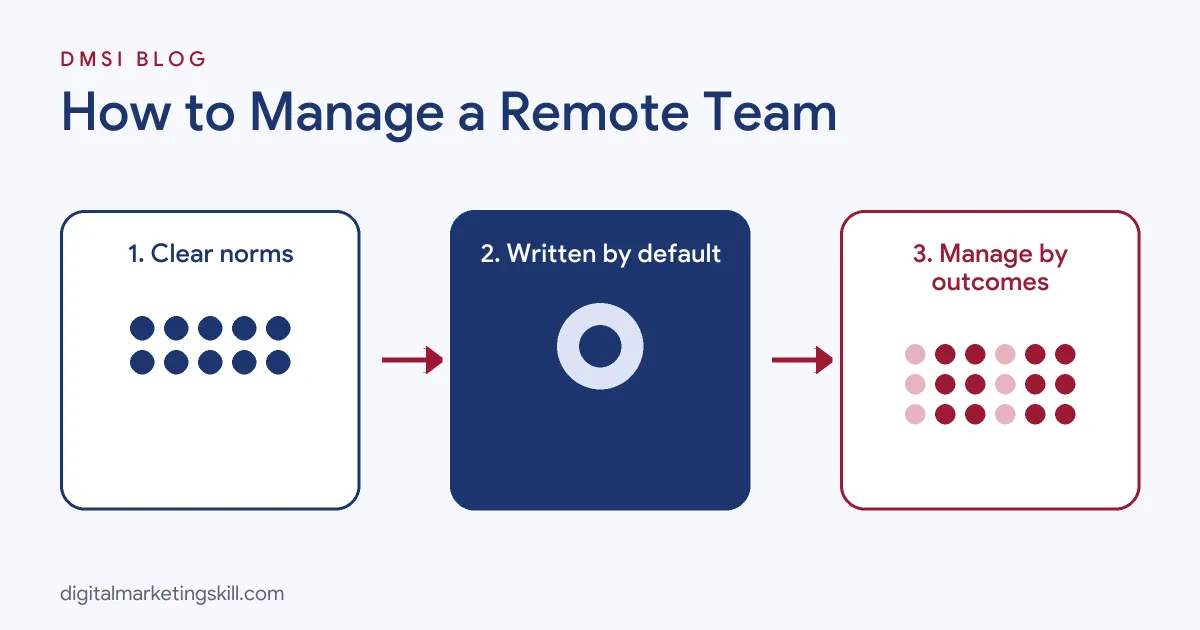
Make expectations explicit, write things down and manage by outcomes: then invest deliberately in the trust and connection that offices used to create by accident.
Example: a newly promoted marketing manager leads five people across three countries. She writes a one-page team agreement covering core hours, channels, response times and where work is tracked. She replaces a daily video stand-up with a written update in the team channel, keeps a weekly team meeting for decisions and holds fortnightly one-to-ones. She sets quarterly goals for each person, recognises wins in a shared channel and arranges a monthly informal video coffee. After three months, a team survey shows fewer meetings and clearer priorities. This example is illustrative and not a real person.
Why Remote Management Skills Matter for Your Career
Remote and hybrid teams are now common in marketing, agencies and technology companies, and organisations need managers who can lead people they rarely see in person. Skills in clear written communication, goal setting, feedback and building trust remotely are valuable for anyone moving into a leadership role. If you are in your country and working with international teams or clients, these skills help you collaborate effectively across countries and time zones.
Frequently Asked Questions
How do you manage a remote team effectively?
Set clear goals, roles and communication norms, hold regular one-to-ones, use a small set of tools consistently, document decisions, manage by outcomes and invest in trust and connection.
How often should I meet with remote employees?
Many managers hold weekly or fortnightly one-to-ones and a weekly team meeting, supported by written updates in between.
What tools do remote teams need?
Typically a chat tool, video conferencing, project management software, a documentation space, shared file storage and security tools such as a password manager.
How do I keep remote employees engaged?
Connect their work to a clear purpose, give regular feedback and recognition, offer growth opportunities and create time for informal connection.
How do I measure remote employee performance?
Agree clear goals and deliverables, then assess results, quality and reliability rather than hours online or activity.
How do I avoid micromanaging a remote team?
Agree outcomes and deadlines, give people autonomy over how they work, use regular check-ins instead of constant monitoring and trust people unless there is a reason not to.
What are the biggest challenges of managing remote teams?
Common challenges include communication gaps, isolation, time zones, unclear expectations, building trust and keeping a strong team culture.
How do I build team culture remotely?
Create shared rituals, celebrate successes, make time for social connection, share values and goals openly and meet in person when possible.
How do I onboard a new remote employee?
Prepare equipment and accounts in advance, introduce key people, share documentation, assign a buddy, set early goals and check in frequently during the first months.
What must be avoided when managing remote teams?
Avoid excessive meetings, unclear expectations, micromanagement, irregular contact and treating remote and office-based staff differently.
Your Next Step
Develop the digital and leadership skills that remote marketing teams need. The Master Diploma in Digital & AI Marketing at Digital Marketing Skill Institute covers AI-powered Social Media Management and Advertising, Lead Generation and Email Automation, Google, and a WordPress and SEO track where you build and rank a real website.
From day one, you work on a real U.S. company’s project through the U.S. Project Internship, so you finish with real results and a verified U.S. work reference letter. You also get unlimited one-on-one coaching. The program carries dual US and UK accreditation, is recognised in more than 100 countries, and runs 100% online over three months.
You can build those skills wherever you live, anywhere in your country. Read student reviews, then apply for the 65% partial scholarship to see if you qualify.
Sources checked November 2026: Harvard Business School Online: 12 tips for managing remote teams, Harvard DCE: How to better manage your remote team, Center for Creative Leadership: Managing remote employees. We have no connection with these organisations.