
Social media marketing mistakes rarely come from a lack of effort. They come from guessing instead of measuring, spreading thin across too many platforms, and tracking likes instead of leads. Most social media marketing mistakes fall into three groups: strategy, execution and measurement. Fix the biggest one first, and the rest get easier.
Key Takeaways
- Response speed drives loyalty. Sprout Social’s own research found that 73% of consumers expect a brand to respond on social media within 24 hours or sooner.
- Silence costs customers. The same research found that 73% of social users agree that if a brand does not respond on social, they will buy from a competitor instead.
- Spreading thin is common. The average person already uses 6.75 different social networks every month, so brands rarely need a new platform; they need to show up better on the ones their audience already uses.
- Vanity metrics mislead. Martech.org notes that a large follower count does not necessarily translate into brand advocacy, engagement or sales.
- Reach varies by platform. Pew Research Center finds Facebook reaches 71% of US adults while Instagram reaches 50%, so the “right” platform is never the same for every company.
In this guide
- Why the Same Social Media Marketing Mistakes Keep Happening
- How Social Media Marketing Mistakes Actually Form
- Social Media Marketing Mistakes Fall Into Three Categories
- How to Fix Each Category of Mistake
- Nine Social Media Marketing Mistakes to Check Right Now
- How to Measure Whether You Have Fixed Them
- The One Rule: Fix Response Time Before Anything Else
- A Real Case: The Promoted Tweet That Cost a Brand Its Silence
- Frequently Asked Questions About Social Media Marketing Mistakes
- Start With Your Busiest Platform, Then Expand
Why the Same Social Media Marketing Mistakes Keep Happening
Most advice on social media marketing mistakes reads like a checklist: post more, use better images, reply faster. None of that is wrong. It skips the reason these mistakes repeat. Teams rarely choose to ignore complaints or chase vanity metrics on purpose. They drift there because nobody picked a goal, a platform or an owner.
This guide groups the common social media marketing mistakes into three causes, so you can fix the root problem rather than patch one symptom. Read the survey figures below as large, real surveys from named companies, not universal law. The promoted-tweet case near the end is one widely reported event, useful for the pattern it shows, not proof that every slow reply ends the same way.
How Social Media Marketing Mistakes Actually Form
Three forces push a social presence toward social media marketing mistakes: pressure to be everywhere, no named owner, and a preference for numbers that feel good over numbers that matter. Each force is understandable on its own. Together, they explain almost every mistake on this page.
Scale adds pressure too. DataReportal counts roughly 5.79 billion social media user identities worldwide, more than two in three people on the planet. The typical user also spends close to 18 hours and 36 minutes on social platforms every week. With an audience that large and that constantly online, it feels risky to ever stay quiet or go narrow, even when narrow is the smarter move.
Why Silence Costs More Than a Slow Reply
Customers now treat social media as a support channel, not just a feed. Sprout Social’s research on social customer service found that 73% of consumers expect a response within 24 hours or sooner, a finding consistent with the company’s earlier surveys. The same research found that 73% of social users agree that if a brand stays silent, they will simply buy from a competitor.
That is the real cost of a slow reply. It is not just an angry comment sitting in public. It is a quiet loss of the sale, because the customer moved on before anyone answered.
Why the Wrong Metrics Hide the Real Problem
Teams that track likes and followers often believe they are winning, because those numbers climb steadily. Martech.org points out that a large follower count does not necessarily translate into brand advocacy, engagement or sales. Many of those followers are inactive accounts or people outside the target audience entirely.
This matters because a rising vanity metric can hide a falling business result. If nobody checks social traffic against real leads or sales, a strategy mistake can run for months before anyone notices.
Social Media Marketing Mistakes Fall Into Three Categories
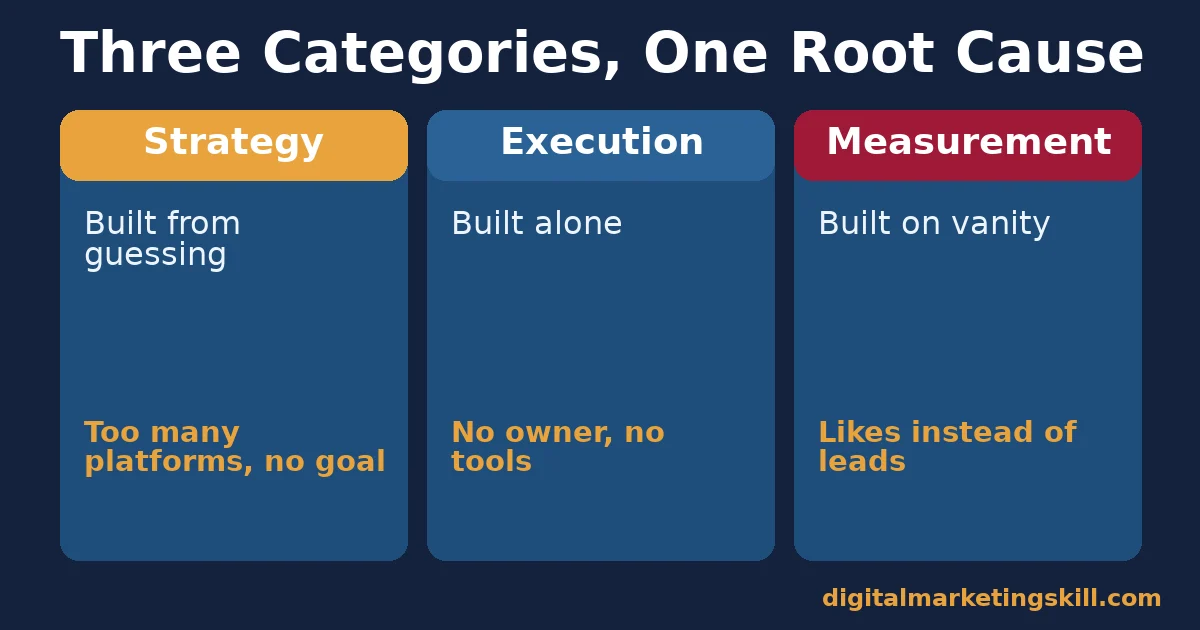
Nearly every mistake companies make on social media sits in one of three buckets. Naming the bucket first makes the fix obvious.
Strategy Mistakes: Built From Guessing, Not Data
A strategy mistake starts before a single post goes out. It looks like joining every platform because competitors are there, or picking a platform because a founder personally enjoys it. The average person already uses 6.75 different social networks a month, per Sprout Social’s social media statistics, so the real question is never “should we be anywhere else.” It is “are we doing well on the two or three platforms our audience already uses.”
Strategy mistakes also include expecting social media to replace other marketing channels entirely. Social is excellent at building awareness and trust over time. It is a poor substitute for a website that converts or an email list that nurtures a lead over weeks, which is also why a wider online marketing strategy still needs its own plan.
A strategy built on guessing is slow to correct itself. Without a written goal, nobody can say with confidence that a platform is underperforming. A weak channel can then absorb budget and attention for years, purely out of habit.
Execution Mistakes: Built From Doing It Alone
Execution mistakes show up once the strategy is set but nobody owns the daily work. A single employee gets the accounts with no training, no tools and no backup. The account goes quiet during busy weeks and posts without a plan during slow ones.
A missing tool is often the real culprit. Sprout Social’s statistics page reports that over half of marketing leaders blame this. They say poor integration between their social tools and the rest of their tech stack is the top reason they cannot show social’s business impact. Without a shared calendar, inbox and reporting view, even a motivated team drops things. A documented set of social media tools closes most of this gap on its own.
Measurement Mistakes: Built From Counting the Wrong Things
The last category is measurement. A team can run a good strategy with the right owner and still fail to improve, because it grades itself on the wrong scoreboard. Likes and follower counts are easy to screenshot for a report, so they become the de facto goal, even when they say little about revenue.
Engagement itself varies enormously by platform, which makes one flat “engagement rate” target misleading. Sprout Social’s statistics page puts average brand engagement rates at roughly 0.48% on Instagram and 0.15% on Facebook, while TikTok has run far higher, around 3.70%. Comparing a Facebook score against a TikTok target guarantees disappointment.
How to Fix Each Category of Mistake
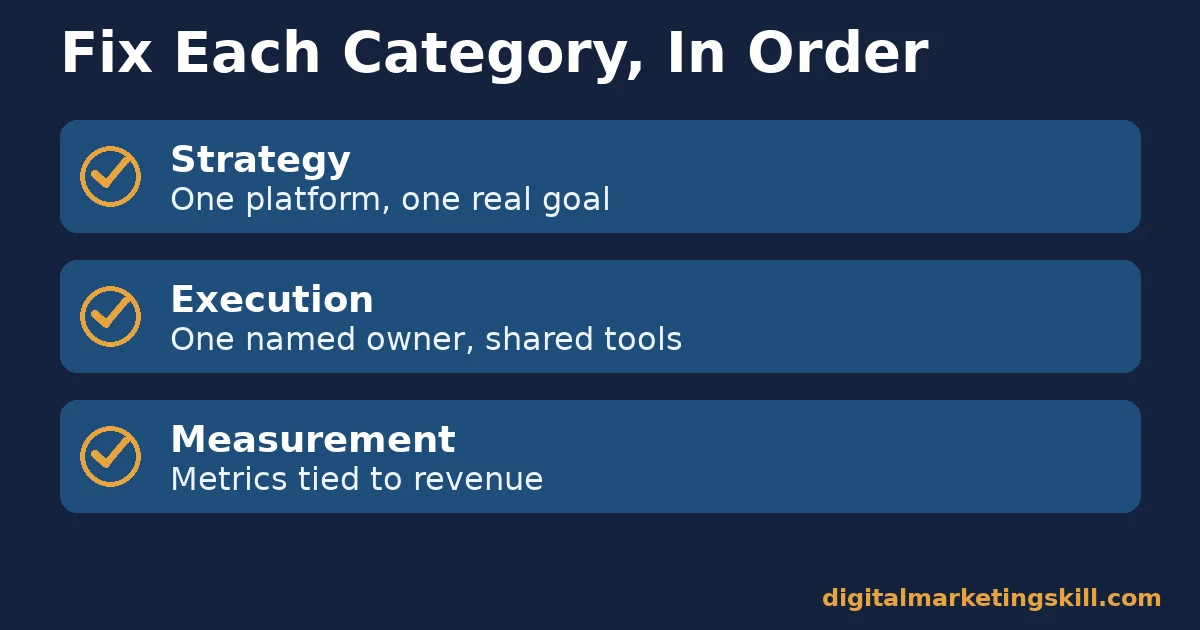
These three fixes mirror the three categories above. Start with whichever one is weakest for your team right now.
Strategy: Lead With One Platform and a Real Goal
Pick the one or two platforms where your actual customers already spend time. Set a specific goal for each, such as support response time, qualified leads or newsletter sign-ups.
Nearly 70% of LinkedIn users engage with brand content at least once a week, per Sprout Social’s statistics page. Around 60% of consumers do the same on Instagram, several times a week. The right platform choice alone can double how often your content actually gets seen, which is one reason a clear set of social media marketing principles should come before any new channel.
Write that goal down and revisit it every quarter. A platform that made sense a while back may not deserve the same budget today.
Execution: Lead With Tools and a Named Owner
Give one person clear ownership of each platform, even if several people contribute content. Provide a shared calendar, a shared inbox for messages and complaints, and a simple reporting template, so coverage never depends on one person’s memory.
Also build a backup plan. If the main owner takes leave or leaves the company, someone else should be able to log in, see the plan and keep the account running without a gap in replies.
Measurement: Lead With Metrics Tied to Revenue
Replace likes and followers as your headline metric with something tied to the business: leads generated, support tickets resolved, or sales assisted by a social touchpoint. Keep likes and shares as a secondary, diagnostic number, useful for spotting which content resonates, never as the main scoreboard.
Set a platform-specific engagement target instead of one number for everything. A healthy result on TikTok looks different from a healthy result on Facebook. Grading both against the same bar will always make one look like a failure.
Nine Social Media Marketing Mistakes to Check Right Now
Here is the practical checklist version of the three categories above, covering nine social media marketing mistakes in total. Go through each one against your current accounts.
Mistakes in Planning and Content
- Doing it all. Joining every platform instead of the two or three where your audience actually is. A thin presence on six platforms usually loses to a strong presence on two, because every post has to be reshaped for a different format and audience.
- No clear owner. Handing accounts to whoever is free, instead of one trained, accountable person. Ownership that rotates week to week rarely builds the judgment needed to write in a consistent voice or spot a brewing complaint early.
- Tracking the wrong numbers. Reporting likes and followers while ignoring leads, traffic and sales. A report full of rising vanity numbers can look healthy right up until a budget review asks what revenue it produced.
- Expecting instant results. Judging a channel after a few weeks when trust-building takes months. Many teams abandon a platform just as it starts to compound, because the first month rarely looks like the sixth.
- Not providing value. Posting promotions without the entertainment or how-to content people actually share. People share what makes them look useful to their own followers, not a discount code.
Mistakes in Operations and Response
- Skipping tools. Running a growing presence on memory alone, with no shared calendar or inbox. Once more than one person touches an account, informal coordination breaks down fast.
- Treating it as a sales channel only. Expecting social media to replace a website or email list rather than feed them. Most people do not open social media to shop; they open it to be entertained or informed, then follow a link if something earns their attention.
- Loose account access. Letting anyone in the company post, instead of limiting access to a trained team. One careless post from an untrained account holder can undo months of careful messaging.
- Slow replies to complaints. Letting a comment or message sit for hours while the customer’s patience runs out. The complaint rarely disappears on its own. It just moves somewhere less convenient, like a public review.
Which Mistake to Fix First
If you only fix one thing this month, fix whichever mistake touches the most customers directly. For most companies, that is mistake nine: slow replies to complaints. It is the one mistake a customer can see in public, in real time, while it is happening.
How to Measure Whether You Have Fixed Them
Once you have addressed the social media marketing mistakes above, track these figures monthly so progress is visible instead of assumed.
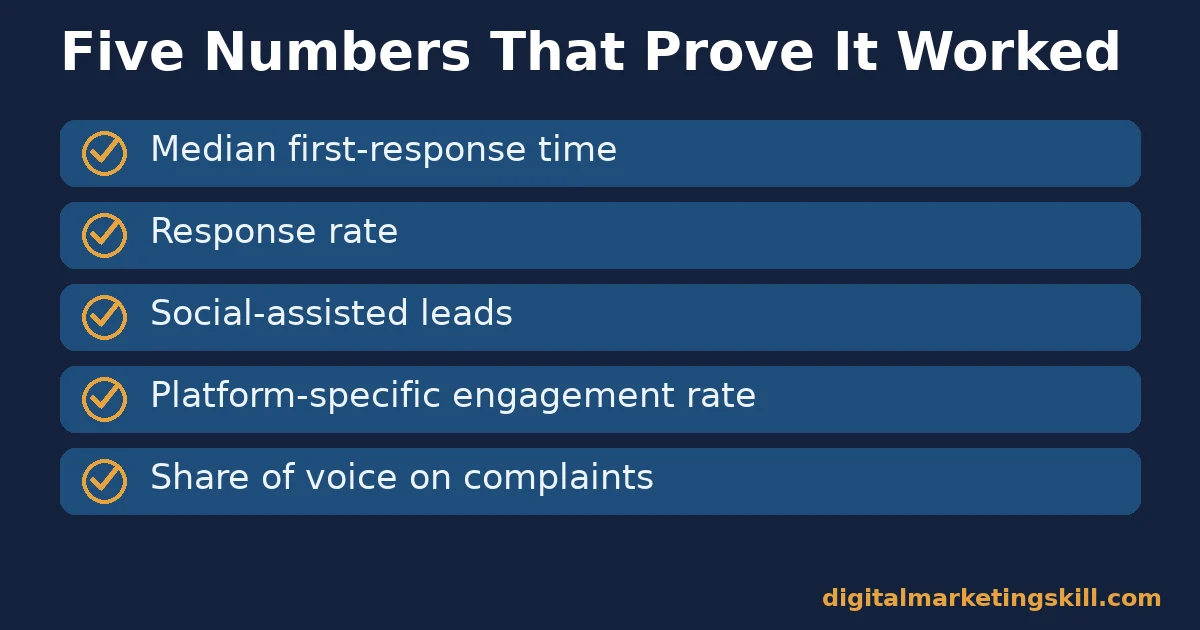
- Median first-response time. How long a complaint or question sits before a human replies. Aim to answer within a few hours, not a full business day.
- Response rate. The share of comments and messages that get any reply at all. A healthy account answers nearly all of them.
- Social-assisted leads. Form fills, sign-ups or sales where social media played a role in the customer’s path, pulled from analytics, not guessed.
- Platform-specific engagement rate. Engagement divided by reach or followers, compared against that platform’s own typical range, not one flat company-wide target.
- Share of voice on complaints. How many public complaints get resolved on the platform itself, instead of escalating to a phone call or a public pile-on.
Read these together. A fast response time paired with a low response rate means some messages are being missed entirely. A high engagement rate with zero social-assisted leads means the content entertains without moving anyone toward a purchase. Put these five figures on a fixed monthly schedule, so the review itself does not become one more task that quietly slips.
The One Rule: Fix Response Time Before Anything Else
If you fix only one process this quarter, fix how fast your team answers a public complaint or question. Every other mistake on this page can exist quietly in the background. A slow public reply is visible to everyone watching, including customers who were never going to complain themselves.
Illustrative, invented numbers: suppose a small business averages a 10-hour first response today and converts 2% of social-sourced visitors into leads. Cutting that response time to under two hours, in line with what customers say they expect, would not change the content strategy at all. It is still the single change most likely to lift that 2% conversion figure, because it removes the main reason an interested customer gives up and leaves.
A Real Case: The Promoted Tweet That Cost a Brand Its Silence
A traveller named Hasan Syed once had his father’s luggage lost by an airline. Rather than only tweeting about it, he paid to promote his complaint as an ad, so it reached roughly 76,800 impressions for about $1,000, according to NBC News. The airline did not reply for about eight hours, then explained that its support account kept limited hours.
The lesson is not that every slow reply becomes global news. It is that the cost of silence is no longer limited to the person complaining. Anyone can now pay to put a brand’s silence in front of a much larger audience, and the response itself becomes the story, not just the original problem.
This is one widely reported event, not a representative sample. Treat it as a warning about a pattern, not a predictor of the outcome for every slow reply.
Frequently Asked Questions About Social Media Marketing Mistakes
What is the single most common social media marketing mistake?
Spreading effort across too many platforms without a clear goal for any of them. It is easier to spot than slow replies or weak metrics, because it shows up as thin, inconsistent content everywhere rather than strong content on fewer channels. Teams usually fall into this because adding a platform feels like progress, even when it quietly thins out the ones already working.
How many social media platforms should a company actually use?
Usually two or three, chosen because the target audience already spends time there, not because competitors are present. Adding a platform should follow evidence that your audience uses it, not a hunch.
Why do likes and followers not predict sales?
Because a share of any following is inactive, outside the target audience, or simply curious rather than ready to buy. A follower count can grow while leads and revenue stay flat. That is why it should sit alongside revenue metrics, never replace them.
How fast should a business reply to a complaint on social media?
Within a few hours is a reasonable target, since most consumers now expect a response inside 24 hours and many expect much faster. Treat a public complaint the same way you would treat a ringing phone at the front desk.
Can social media replace a company’s other marketing channels?
No. It is strong for awareness, trust and customer service, but weak as a stand-alone sales channel. Pair it with a website built to convert and an email program that nurtures a lead over time.
Who should own a company’s social media accounts?
One named, trained person per platform, with a documented backup, rather than whichever employee happens to be free that week. Shared ownership without a lead usually produces inconsistent posting and missed replies.
What should replace likes as the main social media metric?
A metric tied to the business, such as leads generated, support tickets resolved on the platform, or sales where social played a role in the customer’s path. Keep likes as a secondary signal for what content resonates, not the main scoreboard.
Start With Your Busiest Platform, Then Expand
Pick the single social platform that already brings your business the most traffic or leads. Then apply one fix from this guide this week: a named owner, a faster reply process, or one metric tied to revenue. Expand once that one platform runs cleanly, so you fix social media marketing mistakes one proven channel at a time instead of all at once.
If you want structured help avoiding these social media marketing mistakes from day one, look at the Master Diploma in Digital & AI Marketing at the Digital Marketing Skill Institute. It includes an AI-Powered Social Media Management and Advertising track, one of four AI-powered tracks across a ten-course program, with a Full Stack option covering all four.
It comes with unlimited 1-on-1 coaching and mentoring, a U.S. Project Internship with a verified U.S. Work Reference Letter, and dual US and UK accreditation recognised in more than 100 countries, 100% online, so you can study and work on real campaigns from anywhere in your country.
Explore the Master Diploma program, browse more guides on the digital marketing blog, read real outcomes on the reviews page, or go straight to the application page when you are ready. Learn more at Digital Marketing Skill Institute, wherever you live, and start fixing social media marketing mistakes before they cost you the next customer. Visit digitalmarketingskill.com to get started.
Every figure in this guide was checked against its original source before publication. Figures marked as illustrative are invented examples, not real results.
