

An online side hustle pays off when it matches real demand to the hours you actually have free. Most people overestimate the income and underestimate the time it takes to find paying customers. Start with one narrow service, prove it works, then expand.
Key Takeaways
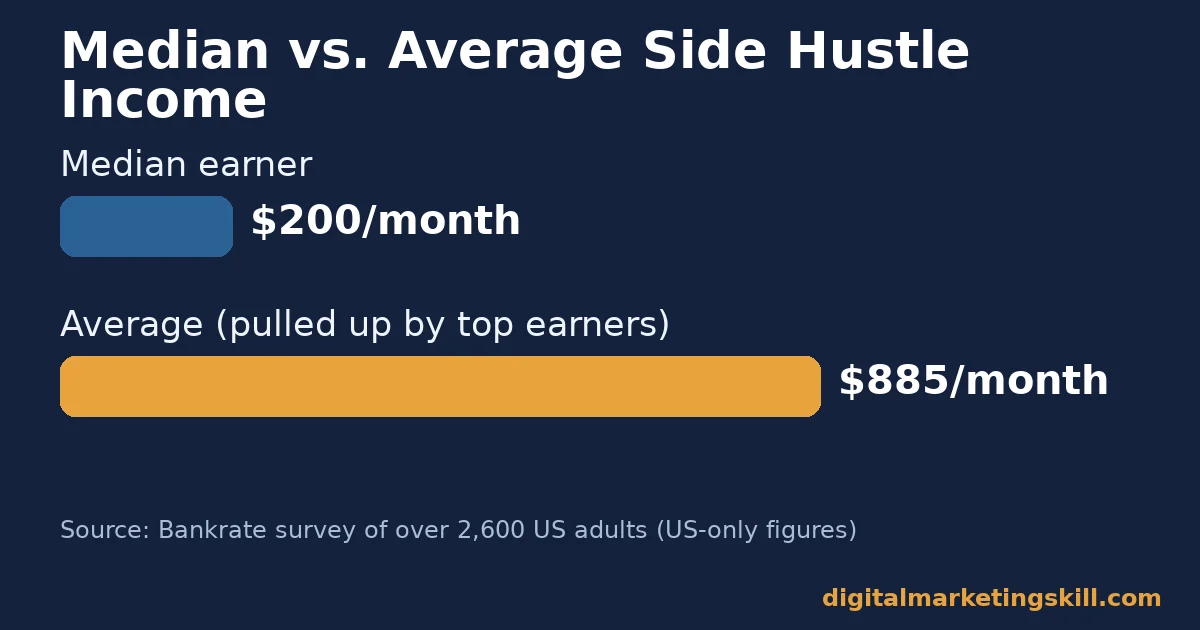
- Most side hustlers earn modestly. Bankrate’s own survey of over 2,600 US adults found a median side hustle income of $200 a month. That is well below the $885 average. A smaller group of high earners pulls the average upward.
- About one in four US adults has one. Bankrate found that roughly 27% of US adults run a side hustle. Online sales and professional services are the two most common types.
- Online gig work is a genuinely global market. The World Bank found that gig work now accounts for up to 12% of the global labor market. This is not just a developed-country trend.
- Growth is fastest outside wealthy countries. The same World Bank research found job postings on the largest gig platform. They grew 130% in Sub-Saharan Africa, against just 14% in North America.
- Scams are rising fast alongside real opportunity. The FTC found task-scam reports went from zero to about 20,000 in just six months. So the research step below matters as much as the hustle itself.
In this guide
- What Most “Make Money Online” Lists Get Wrong
- Why an Online Side Hustle Is Worth the Effort
- How an Online Side Hustle Actually Pays
- What Differs by Side Hustle Type
- How to Start Strong on Each Path
- How to Measure Whether a Side Hustle Is Working
- The One Rule: Start With the Path That Matches Your Spare Hours
- A Real Case: Where Online Gig Work Is Actually Growing
- Frequently Asked Questions About Starting an Online Side Hustle
- Start With One Path, Not Every Idea at Once
What Most “Make Money Online” Lists Get Wrong
Most lists of online side hustles are just long menus. Thirty ideas, no guidance on which one fits a specific person’s time, skills or risk tolerance. That approach treats every reader as identical. But the honest answer to “which side hustle” always depends on what you already have to work with.
This guide skips the menu and focuses on format instead. It explains how an online side hustle actually turns hours into income, then shows what differs between the three realistic paths most people take. It also covers how to avoid the scams that have grown alongside the real opportunity.
None of that means ignoring ideas entirely. A list of thirty ideas is still useful once you already know which path fits your hours and skills. It just should not be the first decision you make, because the format usually matters more than which specific idea you pick inside it.
A word on the ground rules first. The Bankrate figures below are US-only, so treat them as a reference point, not a global number. The World Bank figures are global and worldwide in scope. Every number here is a snapshot from when it was measured, not a permanent ranking of any platform or country.
Why an Online Side Hustle Is Worth the Effort
The opportunity behind this topic is real, not assumed. Bankrate’s own survey found that roughly 27% of US adults run a side hustle. That share has eased back from a recent peak. Still, over a quarter of adults are doing this right now.
The opportunity is not just a US story, either. The World Bank’s own research found online gig work now accounts for up to 12% of the global labor market. Demand is rising fastest outside wealthy countries, not inside them.
Local and regional platforms matter here, too. The World Bank’s own analysis of regional gig platforms found that more than one in ten workers worldwide is already an online gig worker, and most of the platforms they use are regional rather than global. That matters because regional platforms often remove the language and payment barriers that keep global platforms out of reach for many beginners.
None of that guarantees any one person profits, though. A real opportunity still will not pay off from an unfinished, unfocused attempt. The format question below is what decides whether the opportunity actually gets captured, for a beginner with five spare hours or someone treating this as a serious second income.
How an Online Side Hustle Actually Pays
Income from a side hustle is really the product of three things. One is how much something is worth to a buyer. Another is how many hours you can give it. The third is how reliably you can find buyers. Most guides only talk about the first one.
That gap explains the wide spread between average and median income. Bankrate’s survey found the median side hustler earns $200 a month, but the average is $885. A small group of people found reliable buyers and raised their rates. That group pulls the average far above what a typical beginner should expect.
So the realistic goal for a first online side hustle is not matching the average. Instead, aim for the point where buyers find you without you chasing every single one. That shift is what moves someone from the median toward the average over time.
This also means the first few weeks of any online side hustle should be judged differently from month three or month six. Early income almost always looks closer to the median than the average, because repeat buyers and referrals have not had time to build yet.
What Differs by Side Hustle Type
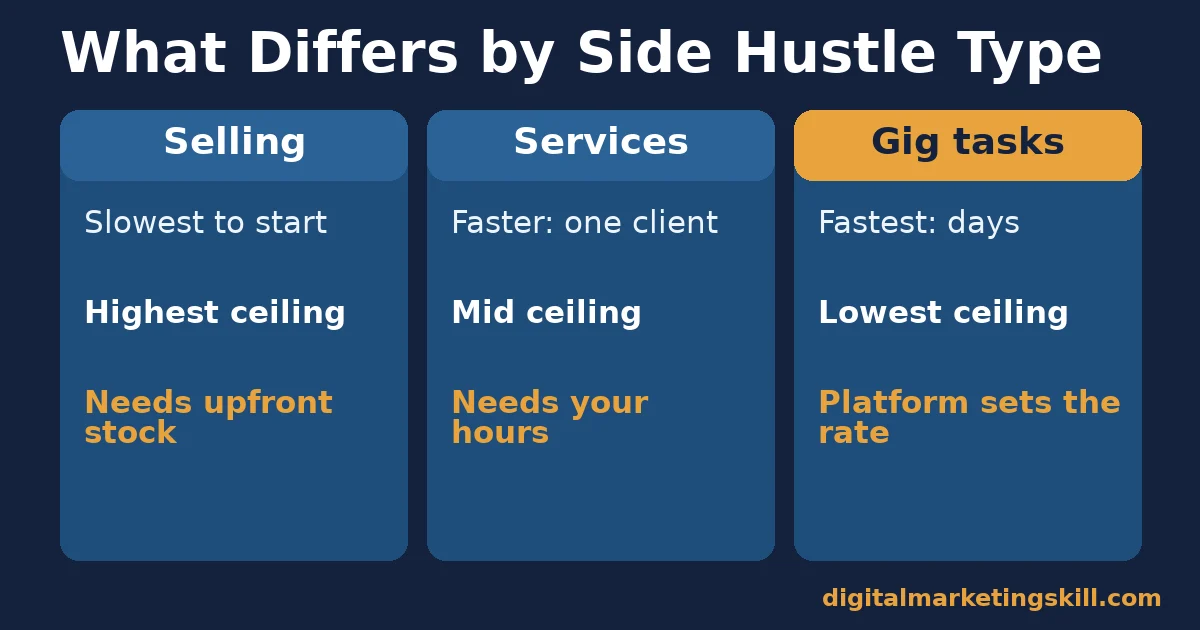
Three realistic paths cover most online side hustles. They are selling, services and gig tasks. Each monetizes something different. Each also has its own ceiling and its own starting cost.
None of the three is universally better. Rather, each trades speed for ceiling in a different way. Gig tasks pay the fastest and cap the lowest. Selling pays the slowest to start but can scale the highest. Services sit between the two, trading a lower ceiling than selling for a faster first payment.
Selling: Built Around a Product, Not Your Hours
Selling means listing a physical or digital product online, from handmade crafts to a template you build once. Bankrate found online sales was the single most common side hustle type, at 15% of all side hustlers.
The appeal is that a product can sell while you sleep. A service, by contrast, only pays for hours worked. The tradeoff is upfront cost and unpredictable demand. A product nobody wants sells zero units, no matter how many hours you put into listing it.
Services: Built Around Your Existing Skill
Services mean selling a skill you already have, like writing, design or digital marketing support, directly to a buyer. Bankrate found professional services was the second most common category, at 14% of side hustlers.
Services usually start paying faster than selling a product. That is because the first buyer only needs to trust you, not wait for inventory. The ceiling is your own hours, though, until you start charging more per hour or hiring help.
Gig Tasks: Built Around Immediate, Small Jobs
Gig tasks are short, defined jobs, like delivery, task-based platforms or quick digital assignments. They are usually arranged through a platform rather than a direct relationship. Bankrate found delivery work made up about 9% of side hustlers.
Gig tasks pay the fastest, often within days, because the work and the payment are both standardized by the platform. However, the tradeoff is the lowest ceiling of the three paths. The platform controls pricing, so nobody is paying for your judgment, only your time.
Gig tasks also carry the highest exposure to the scam risk mentioned earlier. New, unfamiliar platforms are where most fraudulent listings appear. Stick to well-known platforms with visible reviews until you understand how a specific type of gig work actually pays.
How to Start Strong on Each Path
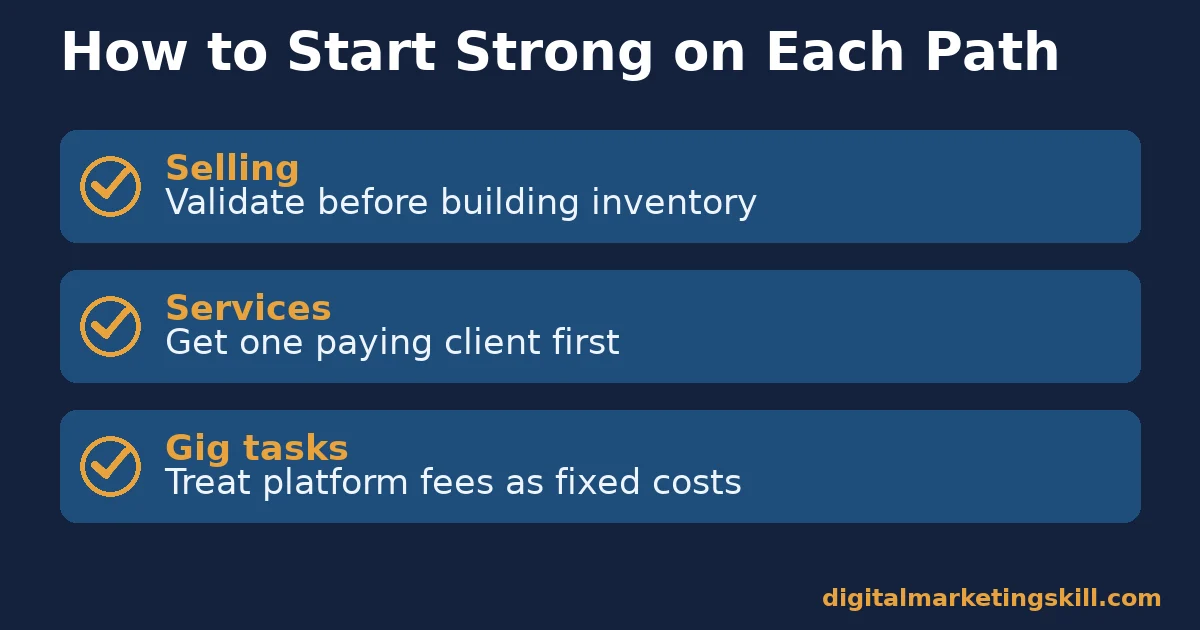
Pick the path that matches your situation today. Do not pick the one with the highest theoretical ceiling. The sections below mirror the three paths above.
Selling: Validate Before You Build Inventory
List a small batch or a single digital product before committing real money to stock. If nothing sells in the first few weeks, that is useful information, not failure. So change the product or the audience before scaling up.
Price for your actual costs plus your time, not just what a platform suggests. Underpricing a product is one of the fastest ways to turn a promising online side hustle into unpaid work.
Keep a simple list of every cost, including the platform’s own fees, packaging and the time spent listing and answering questions. Many first-time sellers price only the raw materials, then wonder why a seemingly busy shop never turns a real profit. Revisit that list every few weeks, since fees and material costs both tend to drift upward quietly over time.
Services: Get One Paying Client Before You Build a Brand
Skip the logo and the fancy website at the start. Instead, find one real client, even at a lower rate than you want long-term. Deliver work good enough that they come back or refer someone. Our guide on getting clients as a freelancer covers the outreach side in depth.
Raise your rate only after you have proof, not before. A finished project and a short testimonial do more for your next sale than any amount of polish on a portfolio site.
Ask every satisfied client for one specific thing: a short written line about the result you delivered, not just a general compliment. That one sentence becomes the proof the next buyer needs, and it compounds faster than almost any other marketing effort available to a beginner starting an online side hustle from scratch.
Gig Tasks: Treat the Platform’s Rules as Fixed Costs
Read the platform’s fee structure and rating system before you commit real hours. A gig that pays well on paper can pay poorly once fees and unpaid time are counted. Messaging and searching for work both eat into real pay without showing up on the listed rate.
Track your actual hourly rate for the first two weeks. Count time spent searching for work, not just time spent doing it. Many gig tasks look more profitable before that unpaid time gets counted.
If the true rate disappoints after two honest weeks, treat that as useful data rather than a reason to quit entirely. It may simply mean this particular gig task is the wrong one, not that gig work itself does not pay. Try a different category on the same platform before concluding that the whole path is a dead end, since pay often varies more between categories than between platforms.
How to Measure Whether a Side Hustle Is Working
Track the same handful of numbers regardless of which path you chose. Two measurements matter more than the rest, and both are easy to skip when the work itself feels busy enough.
Two Numbers That Tell the Real Story
- True hourly rate. Total income divided by every hour spent, including searching, messaging and admin, not just active work. This is the number that actually compares to a regular job.
- Time to repeat income. How long until a buyer, client or platform sends income again without you starting from zero. A side hustle with no repeat income is really just a series of one-off sales.
What the Numbers Tell You to Change
If true hourly rate is low but repeat income is growing, raise your price before you add more hours. The demand is already proven. But if repeat income is flat, the product or service itself needs to change, not just the marketing around it.
Review both numbers monthly for the first few months. An online side hustle that looks unprofitable in week one can look completely different by month three. That shift happens once repeat buyers start arriving without fresh outreach each time.
Write both numbers down somewhere you will actually look again, not just in your head. A side hustle that feels busy can still be losing money per hour. The only way to catch that early is to compare the two numbers side by side on a fixed schedule.
The One Rule: Start With the Path That Matches Your Spare Hours
If you remember one decision rule from this guide, make it this one. Someone with a few scattered hours a week should start with gig tasks or a narrow service, not a product business that needs sustained weekly attention to sell.
Here is an illustrative example, with invented numbers. Someone with five spare hours a week starts a small freelance writing service instead of an online store, because a store needs daily attention to restock and respond to buyers.
After two months, the writing service brings in a repeat client worth four hours of work a week, matching the time available without constant new outreach. The one remaining spare hour goes toward finding a second small client, slowly building toward a fuller schedule without ever exceeding the hours actually available.
The lesson generalizes beyond side hustles. Matching the format to the hours available beats picking the idea with the biggest theoretical payoff. A side hustle that fits around a real schedule tends to survive long enough to compound. One that fights the schedule usually gets abandoned within weeks, regardless of how good the underlying idea was.
A Real Case: Where Online Gig Work Is Actually Growing
The World Bank’s research into online gig work looked at real platform data, not survey responses, to track where demand is actually expanding. Its report, covered in its own press release, found gig work now makes up as much as 12% of the global labor market.
The regional detail is the useful part. Job postings on the largest online gig platform grew 130% in Sub-Saharan Africa, compared with just 14% in North America over the same period. Developing regions are not a side note in the online gig economy; they are where most of the growth is actually happening.
Keep the limits in mind. This is platform-level demand data, not proof that any individual earns more in a faster-growing region. Treat it as evidence that the opportunity is real and growing outside wealthy countries too, not as a guarantee of income for any one person.
The practical takeaway is simple. Someone starting an online side hustle outside a major economy is not working against the market. They are starting in one of the places the research shows is growing fastest, even if local awareness of that fact lags behind the data.
Frequently Asked Questions About Starting an Online Side Hustle
What is the easiest online side hustle to start?
Services built around a skill you already have usually start paying the fastest, because you only need one buyer to trust you rather than built-up inventory or platform history. Gig tasks start even faster but usually pay less per hour once all the unpaid time is counted.
How much can I realistically make from an online side hustle?
Bankrate’s US survey found a median of $200 a month and an average of $885, pulled up by a smaller group of high earners. Treat the median as the realistic starting expectation, and the average as what becomes possible once you have repeat buyers.
How do I avoid online side hustle scams?
Be suspicious of any opportunity that asks you to pay upfront for training, equipment or a “starter kit” before you earn anything. The FTC has tracked a sharp rise in task-based job scams specifically, and its own job scams guidance warns that a legitimate employer never asks for payment or sensitive personal details before you have actually started work. So verify any platform or employer independently before sharing payment details.
Do I need money to start an online side hustle?
Not necessarily. Services and gig tasks usually need only your time and existing skills. Selling a physical product is the path most likely to need upfront money, which is why validating demand before buying inventory matters so much.
What equipment do I actually need for an online side hustle?
Usually just a reliable internet connection and the device you already own. Beyond that, the real requirement is time, not equipment. Spending on gear before proving demand is one of the more common ways beginners lose money on a side hustle that never earns it back, well before the first paying customer ever shows up.
How many hours a week does an online side hustle need?
It depends on the path, not a fixed number. Gig tasks flex around almost any schedule. A product business usually needs more consistent weekly attention to restock, ship and respond to buyers.
Is an online side hustle worth it if I already have a full-time job?
Often, yes. Pick a path that matches your actual spare hours. Do not pick one that demands daily attention you cannot give it. A mismatched side hustle is more likely to be abandoned than one sized correctly from the start.
Which online side hustle has the highest ceiling?
Services and selling both have a higher ceiling than gig tasks, because you can raise your own prices rather than accept what a platform sets. Gig tasks are the fastest to start but the hardest to scale past the platform’s own rate.
Can an online side hustle grow into a full-time income?
Sometimes, but usually only after the switch from one-off sales to repeat income happens. A side hustle that still depends entirely on new customers every week rarely survives the jump to full-time, since the search for buyers alone would then take up the whole working day.
Start With One Path, Not Every Idea at Once
Pick one of the three paths above based on the hours you actually have free this month. Track your true hourly rate for the first few weeks. Give the path at least a couple of months before judging whether it is working. If you want to build client-getting skills that apply across every path, see our guide to freelancing for beginners or how to make money from freelancing.
If you want the underlying skills built properly, Digital Marketing Skill Institute runs its Master Diploma in Digital & AI Marketing as nine practical courses. It comes with unlimited 1-on-1 coaching and mentoring, plus real project work inside a U.S. company. The diploma is dual US and UK accredited, and recognized in more than 100 countries.
The program is fully online, so you can study from anywhere in your country. See how to turn those skills into paying work in our guide to getting digital marketing clients. Browse more guides on the Digital Marketing Skill Institute blog, and when you are ready, apply for the Master Diploma or start from the Digital Marketing Skill Institute homepage.
Every figure in this guide was checked against its original source before publication. Figures marked as illustrative are invented examples, not real results.
![9 Amazing Digital Marketing Skills to Make Money Online [With Proof]](https://digitalmarketingskill.com/wp-content/uploads/2019/07/9-Amazing-Digital-Marketing-Skills-to-Make-Money-Online-With-Proof-17.png)






