
The benefits of email marketing are simple to list but easy to underuse: it is cheap, you own the list, and it compounds over time. Industry data puts its return near $36–$42 for every $1 spent. That beats paid search and paid social by a wide margin.
Key Takeaways
- Email marketing returns about $36–$42 for every $1 spent. That is the highest average ROI of any digital channel measured (Litmus State of Email, via Omnisend).
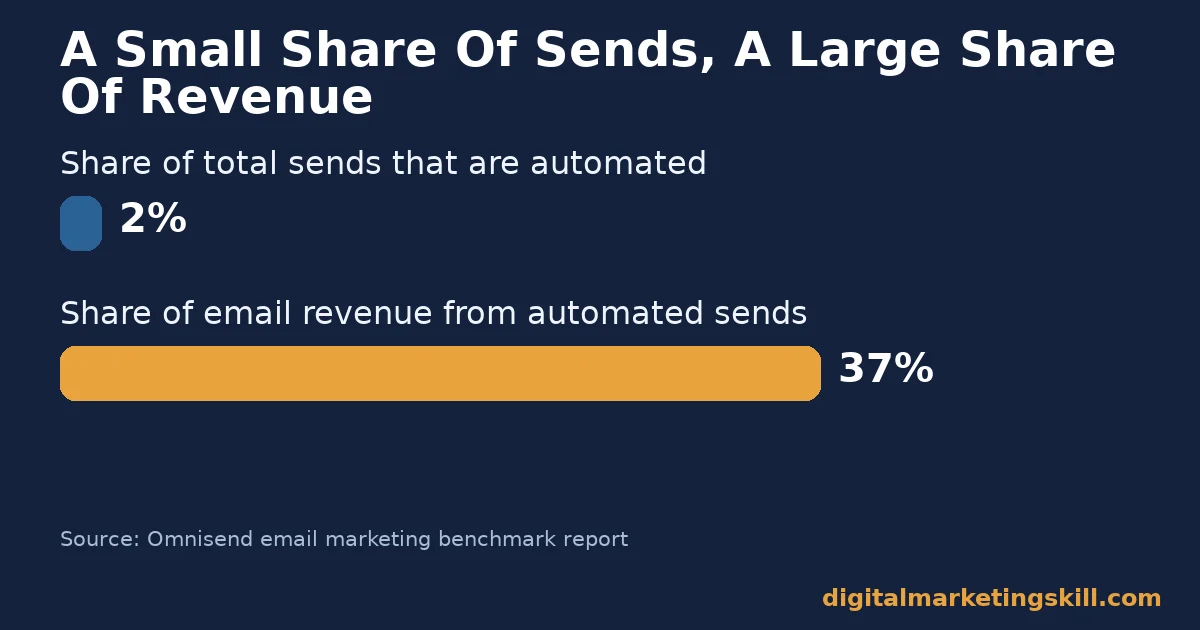
- Automated emails make up only 2% of total sends. Yet they drive 37% of all email-generated sales (Omnisend).
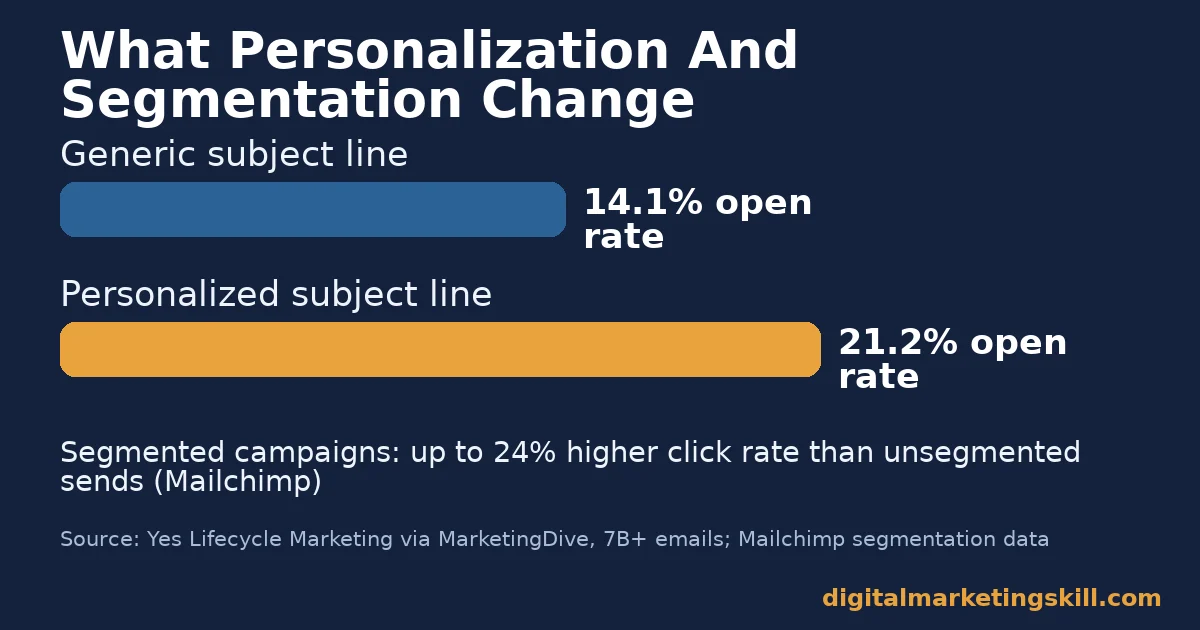
- Personalized subject lines lifted open rates from 14.1% to 21.2% in a study of more than 7 billion emails. Fewer than 2.3% of senders personalize at all (Yes Lifecycle Marketing, via MarketingDive).
- Segmented campaigns earn Mailchimp customers up to 24% higher click rates. Predictive segments drove 266% more revenue than non-predicted ones across connected stores (Mailchimp).
- Mobile and webmail together make up roughly 82% of email opens. That is nearly five times desktop’s 16.2% share (Litmus email client market share).
In this guide
- What Most “Benefits Of Email Marketing” Lists Get Wrong
- Why Email Marketing Outperforms Other Channels
- The Benefits Of Email Marketing, Grouped By What Drives Them
- How To Actually Capture The Benefits Of Email Marketing
- How To Measure Whether You’re Actually Getting The Benefits Of Email Marketing
- The One Decision Rule: Fix The List Before You Fix The Copy
- A Real Case: Turning The Benefits Of Email Marketing Into Recurring Revenue
- Frequently Asked Questions About The Benefits Of Email Marketing
- Where To Learn The Benefits Of Email Marketing Properly
What Most “Benefits Of Email Marketing” Lists Get Wrong
Search “benefits of email marketing” and you will find dozens of lists. Most repeat the same vague bullet points: easy to use, cheap, builds relationships. Few show their work. This guide only keeps a benefit of email marketing if a named, dated source backs it.
This is an informed reading of current public data. It is not a settled fact for every account. Your own numbers will move with your list size, your niche, and how long you have been sending.
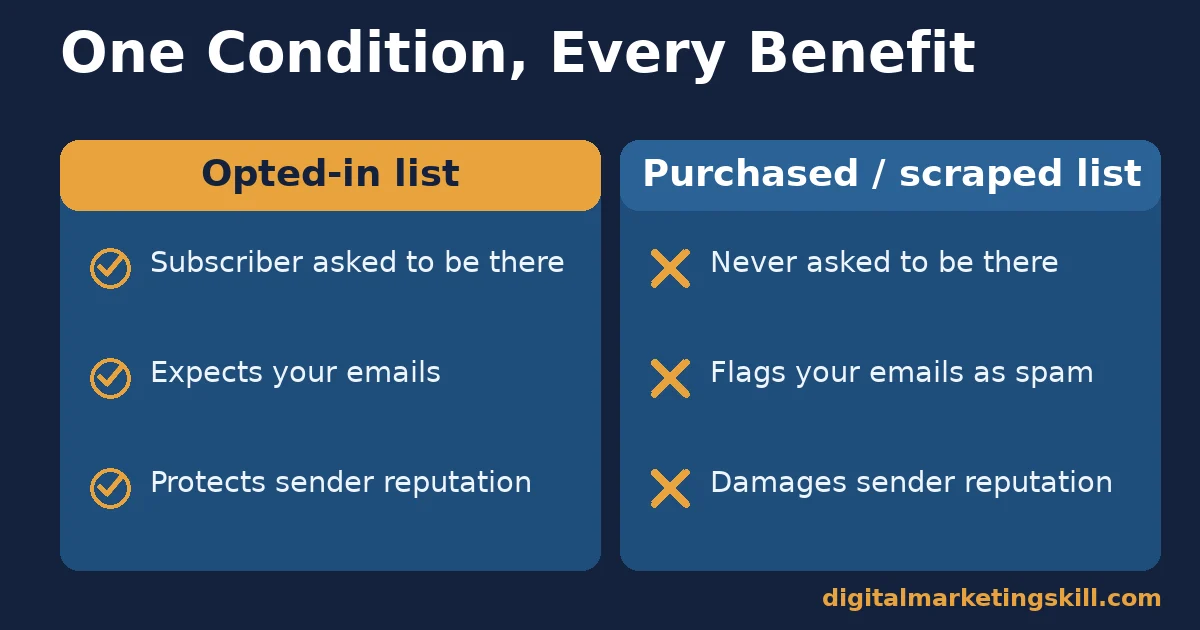
One ground rule matters most: every benefit below assumes consent-based sending. A subscriber who typed their own address into an opt-in form behaves differently from a contact pulled off a purchased list. Spam complaints and blocked domains usually trace back to skipping this step. As a result, no benefit of email marketing on this list survives a reputation that has already been burned.
In other words, the benefits of email marketing are conditional, not automatic. A platform fee alone does not create a return; a genuinely opted-in list does. That distinction matters more than any tactic covered later in this guide.
Why Email Marketing Outperforms Other Channels
Email marketing works because it removes the two biggest costs of paid channels. You do not pay for every impression, and you do not rent an audience you cannot control. A social post reaches a shrinking slice of your followers unless you pay again. An email lands directly in an inbox you already have permission to use.
That ownership is also why the channel compounds. A subscriber who joined your list years ago can still convert today. The relationship does not expire the way an ad auction does. Each benefit of email marketing below is really one expression of this same mechanism: lower marginal cost, direct access, and a channel that gets smarter the more data it collects.
Think of a paid ad platform as a channel you rent. An email list is a channel you build. Rent stops the moment payment stops. A list keeps working between campaigns, with no ongoing media spend. That one structural difference explains most of the ROI gap above.
Because of this, the benefits of email marketing show up earliest in businesses with some first-party audience already, such as past customers or newsletter signups. A brand-new business without that history can still build one from scratch; it will simply take a little longer to see the same compounding effect take hold.
The Benefits Of Email Marketing, Grouped By What Drives Them
Instead of seventeen overlapping bullets, the real benefits of email marketing fall into four groups. Each group is built for a different job, and together they cover cost, relevance, repeat revenue, and the ability to measure all three over time.
Cost And ROI: Built For Efficiency
Email marketing has almost no per-send cost once you pay a platform fee. Paid search and paid social charge for every additional view. That structure is why the measured return is so far ahead: an average of $36–$42 back for every $1 spent, per Litmus State of Email data cited in Omnisend’s ROI benchmark report. The same comparison puts paid search near $2 and paid social under $3.
A business sending to a 10,000-person list pays the same platform fee whether 10,000 people open the email or 2,000 do. The marginal cost of reaching one more inbox is close to zero.
This matters most for thin-margin businesses. A paid search campaign has to keep winning auctions to stay visible. Costs rise as more advertisers bid on the same keywords. An email send to an existing list carries no auction risk at all.
Personalization And Segmentation: Built For Relevance
Every subscriber is a known contact, so email can be personalized in ways a billboard cannot. An analysis of more than 7 billion emails found that adding the recipient’s name to a subject line raised open rates from 14.1% to 21.2%. That is a roughly 50% relative lift. Yet fewer than 2.3% of senders used that personalization at all (Yes Lifecycle Marketing, reported by MarketingDive).
Segmentation goes further. Mailchimp’s segmentation data shows segmented campaigns earn its customers up to 24% higher click rates than unsegmented ones. Predictive segments produced 266% more revenue than non-predicted segments across connected stores over a two-year window.
The reason is simple. A message that matches the reader’s own behavior feels less like marketing and more like a useful note. A trigger-based message, such as one sent after an abandoned cart, arrives at the exact moment it is most relevant.
Retention And Lifecycle: Built For Repeat Revenue
Acquiring a new customer is widely reported as several times more expensive than keeping one. That is why retention-focused email, such as receipts and win-back sequences, carries outsized weight. Baymard Institute’s aggregate of 50 separate studies puts average online cart abandonment at 70.22%. A well-timed abandoned-cart email can recover part of that lost revenue with no new ad spend.
The same subscriber who opted in years ago is still a live lead. Email is one of the few channels where an old contact can become a new sale with no reacquisition cost.
Lifecycle emails work because they respect timing. A receipt email confirms a purchase just made. Meanwhile, a replenishment reminder arrives when a consumable product is likely running low, and a win-back message appears only after a stretch of silence. None of these need a fresh advertising budget, because the trigger is behavioral, not scheduled around a campaign calendar.
Measurement And Automation: Built For Compounding Gains
Every send produces a trackable open, click, bounce, and unsubscribe rate. That means email campaigns improve through testing in a way offline marketing rarely can. Automation multiplies this advantage: Omnisend’s merchant data shows automated emails make up only 2% of total sends but generate 37% of all email-driven sales. A small number of automated flows, built once, keeps earning without a marketer sending one more campaign. (See Omnisend’s full benchmark report.)
How To Actually Capture The Benefits Of Email Marketing
Knowing the benefits of email marketing exist is not the same as collecting them. Therefore, each category above has one practical starting move.
Cost And ROI: Lead With A Clean List
The $36–$42 return figure assumes a list of real subscribers who asked to be there. A purchased or scraped list inflates your send volume while tanking open rates. It also triggers spam complaints, which damage the sender reputation every other send depends on. Before chasing more subscribers, remove hard bounces and long-inactive contacts. As a result, a smaller, engaged list almost always beats a larger, cold one.
List hygiene also protects this benefit for everyone else on the list. That is because inbox providers watch engagement signals at the domain level, not just the campaign level. So a pattern of low opens on one send can push an entire sending domain toward the spam folder for future sends too. In short, cleaning the list is ongoing maintenance, not a one-time task.
Personalization And Segmentation: Lead With First-Party Data
You do not need a dozen segments on day one. Start with the data you already collect at signup, such as a first name plus one behavior signal like “downloaded a guide.” Build two or three segments from that alone. After all, Mailchimp’s own figures show the lift comes from using any meaningful segmentation, not from a perfectly granular model built on day one.
Retention And Lifecycle: Lead With A Win-Back Sequence
Pick the single highest-value lifecycle moment for your business. For most businesses that is an abandoned cart or a lapsed-customer window. Build one automated sequence for it before adding others. Given Baymard’s 70.22% cart abandonment figure, even a modest recovery rate on that one sequence tends to outperform an extra one-off promotional campaign. In fact, most businesses see this sequence pay for the whole automation effort on its own.
Measurement And Automation: Lead With One Automated Flow First
Resist building ten automated flows at once. Ship a single welcome or post-purchase sequence first. Measure its open, click, and conversion rate for a full cycle. Then use what you learn to design the next one. After all, Omnisend’s data shows the revenue concentration sits in a handful of flows, not in send volume, so depth beats breadth here. For a broader view of where these flows fit, see this guide to marketing automation.
How To Measure Whether You’re Actually Getting The Benefits Of Email Marketing
Each benefit of email marketing above has a matching metric. Track these against your own list, not a blanket industry number, since results vary by list size and niche.
- Open rate: the share of delivered emails that were opened. It signals subject-line and sender-reputation strength. Mailchimp’s all-industry average sits at 35.63%, a useful baseline when you have no history of your own yet.
- Click-through rate (CTR): the share of delivered emails that earned a click. It signals whether the content matched the subject line’s promise. The same Mailchimp benchmark puts the all-industry average at 2.62%.
- Unsubscribe rate: the share of recipients who opted out from a single send. A rising trend warns of list fatigue or mismatched segmentation. Mailchimp’s reference figure is 0.22%.
- Revenue per automated flow: total revenue from one automated sequence, divided by its sends. This is the number that should justify building each new flow, following the logic behind Omnisend’s 37%-from-2%-of-sends finding.
- List growth rate: net new subscribers minus unsubscribes and bounces, as a share of total list size. A flat or shrinking number means the retention benefits above have nothing left to compound.
Reading The Five Metrics Together
Read these five numbers together, not alone. A high open rate paired with a low click rate suggests the subject line works but the content inside does not deliver. A healthy click rate paired with a falling list growth rate suggests the audience is engaged but acquisition has stalled. In either case, the fix is different from what a single metric would suggest on its own, which is exactly why these five numbers belong on one dashboard, not five separate reports.
The One Decision Rule: Fix The List Before You Fix The Copy
If your open rate sits below the 35.63% all-industry average, work on list health and segmentation before rewriting subject lines or redesigning templates. A cleaner, better-segmented list raises every metric downstream of it, including ones copy changes alone cannot fix.
Illustrative, invented numbers: imagine a 20,000-subscriber list with a 22% open rate. If 6,000 of those subscribers have not opened a single send in the past twelve months, removing them could lift the open rate toward the mid-30s on the very next send. That is not a guaranteed outcome for any specific list, but it shows why list health usually comes first.
Every other benefit of email marketing here is measured as a rate, not a raw count. A rate improves when the denominator shrinks to match only engaged people. That is what removing dead contacts does.
A Real Case: Turning The Benefits Of Email Marketing Into Recurring Revenue
Olajire Jacob, a graduate of Digital Marketing Skill Institute’s training program, built a service business around this exact skill set. Per the testimonial published on the Institute’s reviews page, he charged an average of $500 to set up email marketing flows for clients in the US, UK, and Canada. He scaled that service to roughly $5,000 a month.
What makes this case relevant is the mechanism, not just the number. The service he sold was exactly the handful of automated flows described above: welcome sequences, abandoned-cart recovery, win-back messages, built once per client and left to run. That matches the same pattern found in the wider benchmark data, where a small number of flows carries most of the value.
It is a useful reminder that the benefits of email marketing described in this guide are not abstract. They are the same skills a real person turned into a recurring client service. This is one published account, not a guaranteed outcome, and results will vary by market and effort; DMSI’s earnings disclaimer applies to any income figure referenced here.
Frequently Asked Questions About The Benefits Of Email Marketing
Is email marketing still effective?
Yes. Industry-wide data continues to show email returning $36–$42 for every $1 spent. That beats paid search and paid social in the same comparisons, because the marginal cost of each additional send stays close to zero. Moreover, the channel has had more time than social platforms to build deliverability standards and measurement tools, which makes its reported numbers unusually reliable.
What is the biggest benefit of email marketing for a small business?
For most small businesses it is retention. A subscriber who joined months or years ago can still convert with no new acquisition cost. That is why cart-recovery and win-back sequences tend to produce an outsized share of revenue for the effort involved. A small team can set up both sequences once and let them run in the background alongside everything else on the marketing calendar.
How is email marketing ROI actually calculated?
ROI is typically revenue attributed to email, minus the cost of the platform and the time spent, divided by that cost. The commonly cited $36–$42 figure is an industry average from aggregated platform data. It is not a number any single business should expect to hit automatically.
Does list size matter more than segmentation?
No. A smaller, well-segmented list regularly outperforms a larger, unsegmented one on click rate and revenue per send. The segmentation lift figures from Mailchimp cited above show why: relevance moves the metric more than raw reach does, and a bigger but unsegmented list dilutes relevance rather than strengthening it.
How many automated email flows does a business actually need to start?
One. The data showing automated sends driving a disproportionate share of revenue describes a small number of well-built flows, not a large library. Starting with a single welcome or cart-recovery sequence is enough to begin capturing that benefit of email marketing, and a second flow can wait until the first one is measured and working well.
Can email marketing work without paid advertising?
Yes, as long as there is a permission-based way to grow the list, such as a website opt-in or a checkout email capture. Paid ads can speed up list growth but are not required for the cost and retention benefits described above. Many small businesses, in fact, build a working list entirely from organic traffic and existing customers before running a single paid campaign.
What is a good open rate to aim for?
Treat the all-industry average of 35.63% as a reference point, not a universal target. Open rates vary widely by niche, list age, and how aggressively a list has been cleaned of inactive subscribers.
How long does it take to see the benefits of email marketing?
Some benefits show up fast. A personalization test can lift open rates on the very next send. Others build slowly: the retention gains from a mature win-back sequence grow over months, as more subscribers pass through the lifecycle stage it targets. Treat email as a compounding asset, not a one-off campaign tactic, and judge each new flow on a full cycle of data rather than its first few sends.
Where To Learn The Benefits Of Email Marketing Properly
Every benefit of email marketing in this guide depends on knowing how to build the list, write the sequence, and read the metrics. That is exactly what Digital Marketing Skill Institute’s Master Diploma in Digital & AI Marketing is built to teach. The program runs as four AI-powered tracks built from ten courses in total, including a dedicated AI-Powered Lead Generation and Email Automation track. A Full Stack option lets learners complete all four tracks.
Every student gets unlimited 1-on-1 coaching and mentoring, plus a U.S. Project Internship with a verified U.S. Work Reference Letter. The program carries dual US and UK accreditation and is recognised in more than 100 countries, delivered 100% online. You can study from anywhere in your country while applying these email marketing skills to real client or employer work.
Browse more breakdowns like this one on the Digital Marketing Skill Institute blog, or read more outcomes on the reviews page. Go straight to the Master Diploma program page for the full curriculum. Wherever you live, you can apply here to start. For related skills, see this guide to email marketing strategy and this breakdown of building an email automation strategy, plus this overview of email marketing tools. Start exploring at digitalmarketingskill.com whenever you’re ready.
Every figure in this guide was checked against its original source before publication. Figures marked as illustrative are invented examples, not real results.
