
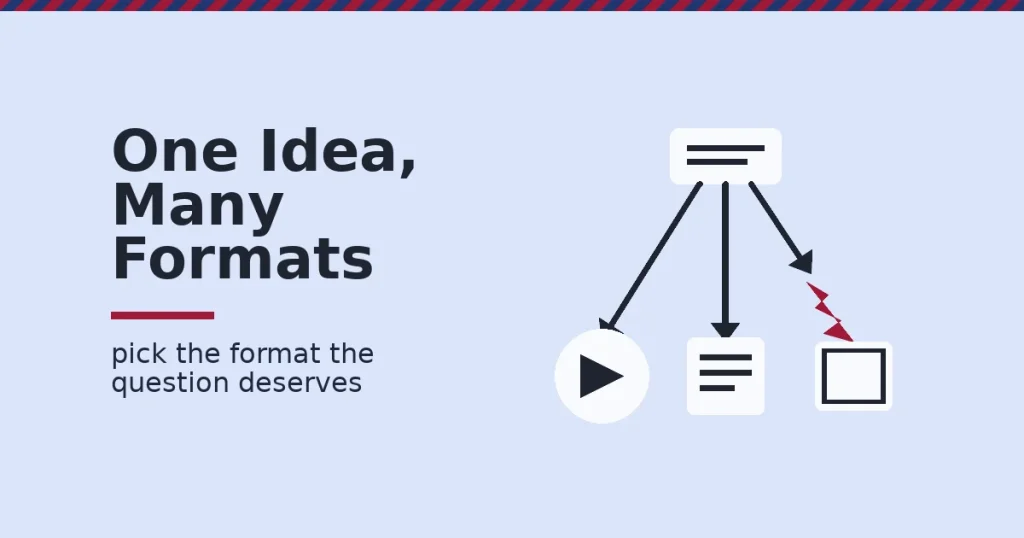
Most brainstorming sessions produce the same five formats everyone already tried. Creative content ideas come from a repeatable process, not a flash of inspiration. Pick one core asset. Test it across formats. Then measure which version earns attention before you scale it.
Key Takeaways
- 37% of B2B marketers name content repurposing itself a top creation challenge. A structured idea process beats waiting for inspiration (Content Marketing Institute).
- Only 29% of marketers with a documented content strategy call it extremely or very effective. Having ideas matters less than having a system for testing them (Content Marketing Institute).
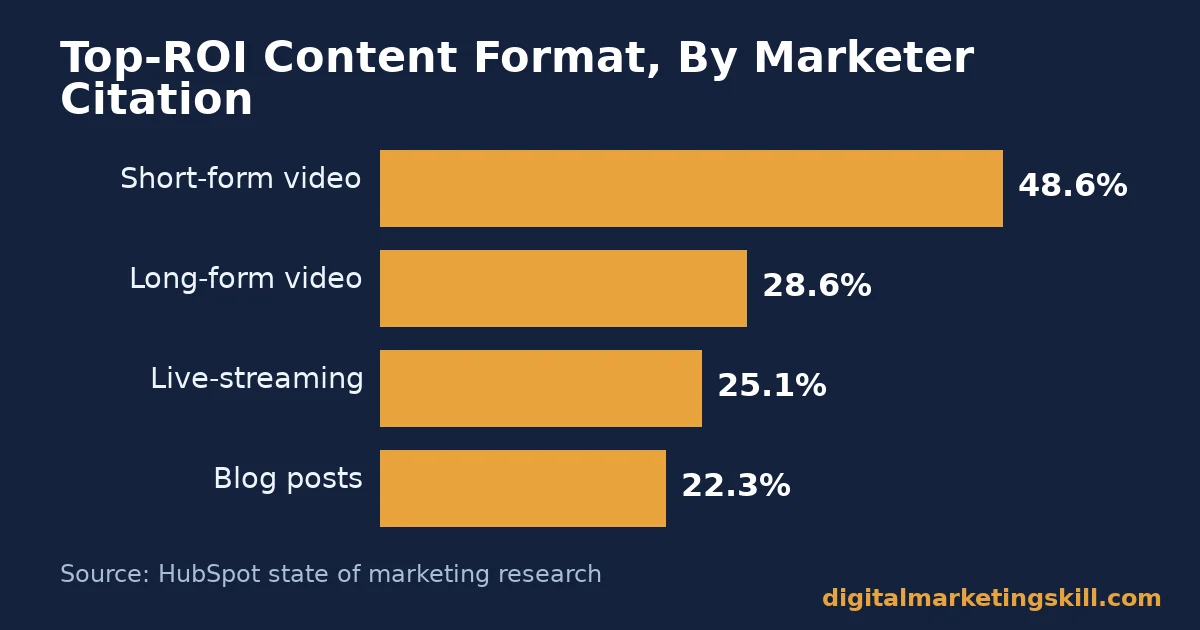
- Short-form video is cited by 48.6% of marketers as their top-ROI content format. That is nearly double long-form video at 28.6% (HubSpot).
- Articles of 7,000+ words draw almost 4 times more traffic and 43% more shares than average-length posts of 900-1,200 words. That is based on a Semrush analysis of 1.2 million articles.
- Marketing teams are split almost evenly on distribution. 49.4% reuse the same content across platforms, and 39.5% tailor it for each one (HubSpot).
In this guide
- Why Creative Content Ideas Run Dry
- How Repeatable Content Ideas Actually Work
- What Changes By Content Format
- How To Generate Ideas For Each Format
- Measuring Whether A Content Idea Works
- The One Decision Rule For Picking A Content Idea
- Real Case: One Idea Across Formats
- Frequently Asked Questions About Creative Content Ideas
- Turn One Idea Into A Full Content System
Why Creative Content Ideas Run Dry
Ask a content team for new ideas. You usually get a list of formats, not a list of problems worth solving. That is backwards. A format is only a container. For instance, a format only becomes a creative content idea once it answers a specific question your audience is asking right now. Otherwise, it is simply an empty template waiting to be filled with something generic.
The data backs this up. Content Marketing Institute’s research found that 37% of B2B marketers list content repurposing as one of their biggest creation challenges. The raw material already exists inside most companies: old posts, customer calls, support tickets.
So the bottleneck is rarely a shortage of raw ideas. It is a missing process for turning one real insight into several tested formats, and that gap is exactly what a repeatable idea pipeline is meant to close.
That same research is a useful reality check. Just 29% of marketers whose organization has a documented content strategy say it is extremely or very effective. A good idea without a distribution plan behind it rarely outperforms a mediocre idea that gets tested properly. This site’s blog content strategy guide explores that gap in more depth.
Ground rule for this guide: every idea below is treated as a hypothesis, not a guarantee, in the spirit of Google’s own guidance on helpful, people-first content. “Creative” means specific, testable and tied to one audience question. It does not simply mean unusual.
How Repeatable Content Ideas Actually Work
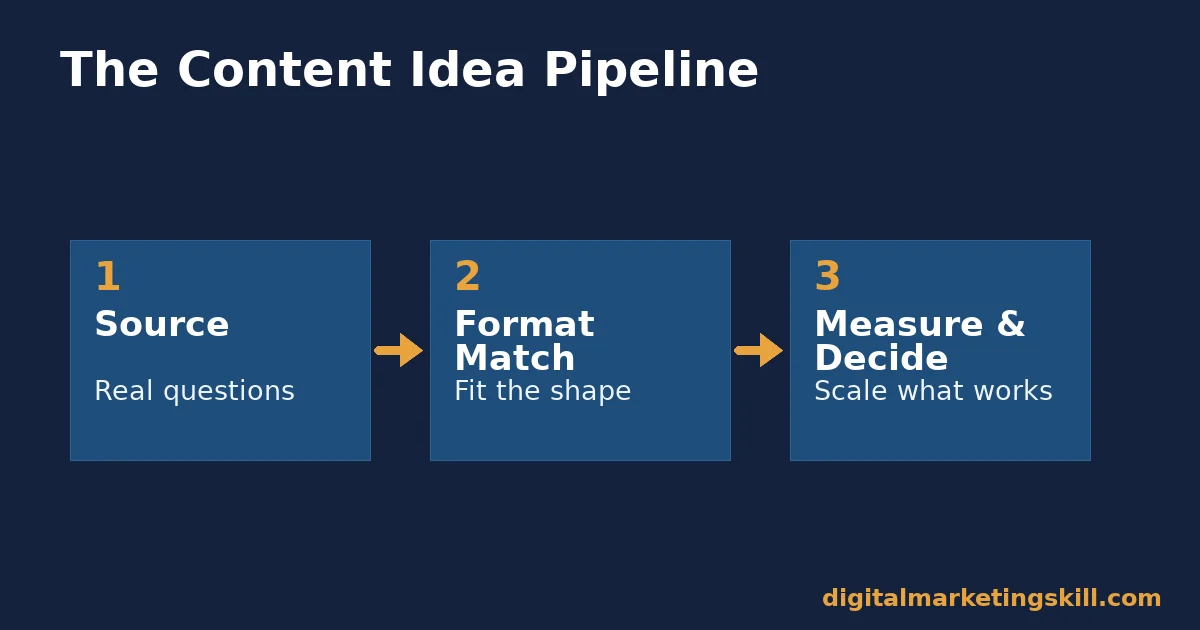
A reliable idea pipeline has three moving parts. You need a source of raw material, a short list of formats to test it in, and a way to decide what gets more budget. Skip any one of the three, and brainstorms stop producing anything that actually gets made.
Start with the source. The richest, least-used source of creative content ideas is usually conversation. Sales calls, support tickets, comment sections and community questions all count. Each one is a real question a real person already asked. As a result, you do not have to guess whether anyone cares about the topic; someone already told you they do, in their own words.
Next comes format-fit. Not every question deserves the same treatment. A quick how-to answer often works best as a short video or a carousel. By contrast, a comparison with several moving parts usually needs a long-form article with tables. A single compelling number, on the other hand, can carry a static image on its own.
Therefore, matching the question to the format is what separates an idea that gets finished from one that stalls half-written.
Finally, build in a decision point. Treat the first version of any idea as a test. Publish it. Watch one or two numbers for a set window. Only then decide whether to repurpose it further. This mechanism, covered in more depth in this site’s content marketing framework guide, keeps creative content ideas from becoming a one-off sprint nobody repeats next month.
What Changes By Content Format
The same underlying idea behaves differently depending on the format you choose first. Here is what actually differs, format by format, before you touch a decision rule. None of these formats is inherently more “creative” than another; each one simply rewards a different kind of question, and knowing the difference up front saves a lot of wasted production time later.
Short-Form Video: Built For Fast Attention
HubSpot’s state of marketing research places short-form video as the top-ROI format for 48.6% of marketers. Long-form video trails at 28.6%, live-streaming at 25.1%, and blog posts at 22.3%. A separate HubSpot video marketing report, citing Wistia’s State of Video Report, notes that how-to videos in the 3-5 minute range can see engagement rates around 74%. That is far above general video averages.
The format’s strength is simple: it puts one sharp idea in front of a lot of people fast. Its weakness is just as clear. It rarely holds detailed, multi-step information well, which is exactly why the next format on this list exists.
Long-Form Blog Posts: Built For Depth And Search
Long-form writing trades reach-per-minute for staying power. Semrush’s analysis of 1.2 million articles found that posts of 7,000+ words draw close to 4 times the traffic of average-length posts (900-1,200 words). They also earn 43% more shares. Short posts under 900 words pulled in 21% less traffic and 75% fewer backlinks than that same average. Depth compounds in search in a way a 30-second clip cannot. This site’s guide to increasing blog traffic breaks that pattern down further, and if you have not committed to a regular archive yet, this guide on why and when to start blogging covers the size threshold where that depth starts to pay off.
Repurposed Content: Built For Efficiency
Repurposing is not a lesser version of “real” content. It is its own format with its own trade-off. HubSpot found marketing teams split almost down the middle: 49.4% reuse the same asset across platforms as-is, while 39.5% rework it for each platform’s norms. The efficient play, straight reuse, saves time. The tailored play tends to perform better per platform, but it costs more production time per channel. Either way, repurposing turns one creative content idea into several chances to be seen, instead of one chance that disappears after a single post.
Static Images And Infographics: Built For Skimmability
A single chart or diagram can carry a surprising amount of weight. Unlike video, a static image asks nothing of a viewer’s time or sound settings, so it travels well across email, slides and feeds alike. However, it only works for ideas that compress cleanly into one visual: a comparison, a single statistic, or a short step-by-step flow. A dense, multi-part argument usually overwhelms a single image rather than clarifying it. A locked brand kit and the right social media graphics tools make this format fast to produce at scale.
How To Generate Ideas For Each Format
Knowing what each format is built for only helps once you have a starting move for generating ideas inside it. These three approaches mirror the formats above.
Short-Form Video: Lead With A Hook
Write the first six words before anything else. Pull the single most surprising line from a sales call, support ticket or comment thread. Open with it as a question or a bold claim. DataReportal and We Are Social report 5.79 billion social media user identities worldwide, so a weak hook simply gets scrolled past. This site’s social media engagement principles guide covers the mechanics in more depth.
If a line cannot stand alone as a hook, the idea is not ready for short-form video yet. It probably belongs in a longer format, where you have room to build context first, or in a static image where the number itself can do the work of a hook.
Long-Form Blog Posts: Lead With A Specific Question
Start from one question with a clear right-or-wrong answer, not a broad theme. “Creative content ideas for small businesses” is a theme. “How many content ideas does a small team need per month to stay consistent” is a question. You can answer a question like that with a number, a worked example and a decision rule. Specific questions are what let a long-form post earn the depth advantage described above, instead of padding word count with filler.
Repurposed Content: Lead With One Core Asset
Pick a single asset that already proved itself: a well-performing post, a webinar, a strong customer quote. Build a short list of three to five formats it could become before you touch any of them. A carousel, a short clip, a checklist graphic, an email all work. Deciding the full list upfront, instead of repurposing one piece at a time, is what keeps the “tailor for each platform” approach efficient rather than slow.
Static Images And Infographics: Lead With One Number Or Flow
Pick the single clearest fact, comparison or step-by-step flow from your core asset, and build the whole image around it. Resist adding a second idea to the same graphic; a crowded infographic usually gets skimmed and ignored rather than shared. Instead, save the second idea for its own image, or for a different format entirely. A good test: if you cannot describe the image’s single point in one short sentence, it is not ready yet.
Measuring Whether A Content Idea Works
An idea only looks creative in hindsight, once a number confirms it. Consequently, these are the KPIs worth checking before you scale any format.
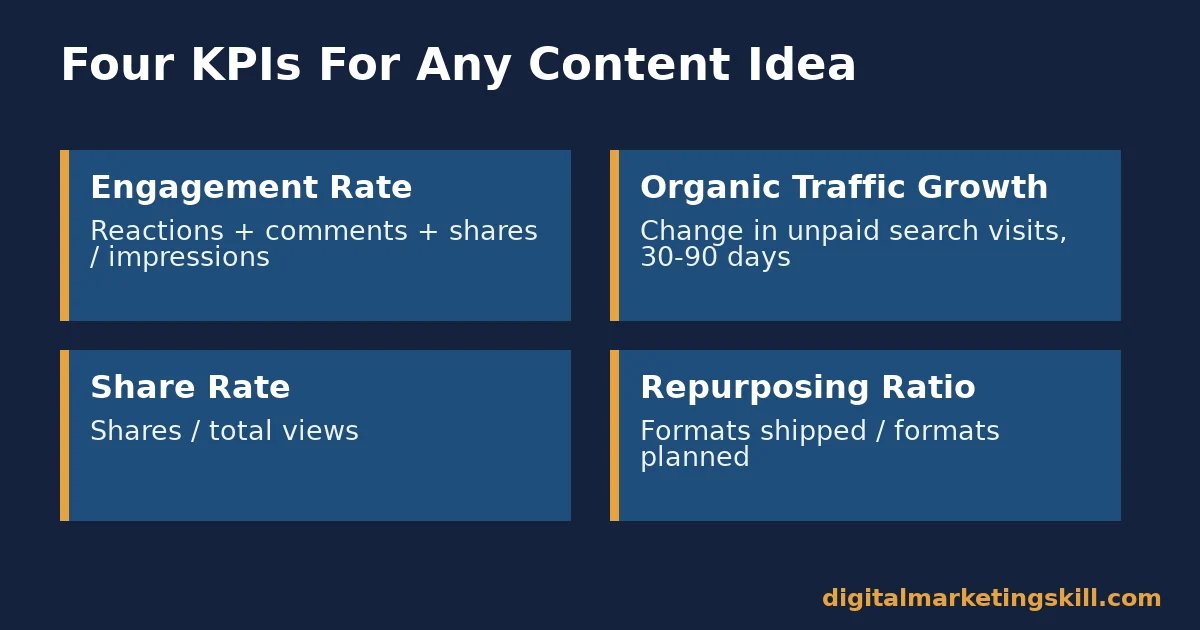
Engagement rate is the share of people who saw a post and reacted, commented, shared or clicked. Divide that by total impressions. It tells you whether the hook worked, independent of how many people saw it.
Organic traffic growth is the change in visits a piece of content earns from unpaid search over a fixed window, commonly 30 or 90 days. In short, it tells you whether a long-form idea is compounding the way the format is supposed to.
Share rate is shares divided by total views. The Semrush data above shows share rate rising with depth and specificity. Therefore, a low share rate on a long post is a signal the question was not specific enough.
Repurposing ratio is the number of distinct formats one core asset was successfully turned into, divided by the number you planned. A ratio well under 1 usually means the original asset was too thin to support more than one format. For instance, a core asset that only ever becomes one format rarely had enough substance behind the idea to begin with.
Together, these four numbers answer the only question that actually matters: did this specific creative content idea earn more attention than the one before it, and is that gain worth the time it took to produce?
The One Decision Rule For Picking A Content Idea
If you only take one rule from this guide, take this one. Pick the format based on the question’s shape, not the format you personally enjoy making. A quick factual question goes to short-form video or a graphic. By comparison, a how-to with several steps goes to a long-form post. A proven, already-successful asset, meanwhile, goes to repurposing, not to a brand-new idea.
Illustrative, invented numbers: imagine a team gets 40 support tickets a month. Six of them ask the exact same yes-or-no question. That question’s shape is short, factual and high-frequency. It points straight to a 30-second video answer, not a 3,000-word article.
The same team might get only two tickets a month asking a multi-part “how do I choose between X and Y” question. That shape points to a long-form comparison post instead, because the decision has enough moving parts to justify the depth. Neither format is better in the abstract; the question’s shape decides, every time.
This rule also explains why so many creative content ideas fail even when the execution is good. A team sometimes forces a quick, factual answer into a long-form article because long-form feels more “serious,” padding it with filler to hit a word count. Or they try to cram a multi-step comparison into a 30-second clip, cutting out the very detail that made the comparison useful. In both cases, the idea itself may have been sound. The format simply fought against the question’s natural shape.
Real Case: One Idea Across Formats
Illustrative, invented numbers, not a real company’s figures: a small content team starts with one well-performing long-form guide. Over one quarter, they test three repurposed versions of it. A short-form video pulls out its single strongest statistic. A carousel breaks its steps into slides. An email shares its decision rule. The video and carousel both outperform the email on engagement rate. That lines up with HubSpot’s finding that short-form video outranks most other formats on ROI.
The limits of this case matter, too. It describes one hypothetical team over one quarter. It is not a controlled study, and results vary heavily by audience, platform, and how specific the original asset’s core idea was. Even so, the pattern is a useful one to test for yourself. Before inventing an entirely new creative content idea next month, check whether last quarter’s best-performing asset still has two or three formats left in it. Many teams find it does, and that single check often saves an entire brainstorming session.
Frequently Asked Questions About Creative Content Ideas
How many creative content ideas does a small team need per month?
There is no universal number. A small team is usually better served by fewer, well-tested ideas repurposed into three to five formats than by a long list of untested, one-off posts. Depth beats volume once you start measuring results.
What is the fastest way to find a creative content idea when I am stuck?
Read your last 20 support tickets or comment threads. Pull out the one question that repeats most often. That recurring question is almost always a stronger starting point than a brainstorm with no source material behind it.
Should creative content ideas be planned around trends?
Trends can help a short-form video get noticed faster. But a trend alone is not a content idea. It still needs a specific question or insight attached to it to hold attention past the first few seconds.
How do I know if a content idea is creative enough to publish?
Check whether it answers one specific, real question better than what already ranks or already fills your audience’s feed. If it only repeats a theme other posts already cover, it is not specific enough yet to stand out.
Can one idea really become several pieces of content?
Yes, and the data above suggests it should. HubSpot found marketing teams nearly evenly split between reusing content as-is and tailoring it per platform. That split only makes sense if the underlying idea is strong enough to carry multiple formats.
Do creative content ideas work the same way for blogs and social media?
No. A blog idea needs enough depth to justify a reader’s time, and longer posts measurably earn more traffic and shares. A social idea needs a hook strong enough to stop a scroll in the first few seconds instead.
What is the biggest mistake teams make when generating content ideas?
Treating idea generation and distribution as separate problems. The research shows marketers already struggle more with repurposing existing ideas than with generating brand-new ones. Plan the formats an idea will become before you even finish the first version.
How long should it take to turn one idea into multiple formats?
Budget it as part of the original project, not as an afterthought. Teams that plan the repurposed formats upfront tend to ship them faster than teams that revisit an old post weeks later looking for new ideas.
Do creative content ideas need a big production budget?
No. A single well-chosen core asset, reused across two or three formats, usually beats several unrelated pieces made from scratch. In fact, the biggest cost most teams face is not budget at all; it is the missing process for deciding which idea deserves a second format.
Who should be responsible for finding creative content ideas on a small team?
Whoever talks to customers most often, not whoever writes fastest. The person on sales calls or answering support tickets hears the raw questions first, so they are usually the best source of new creative content ideas, even if someone else ends up producing the final format.
How do I keep a running list of creative content ideas without losing track of them?
Give every idea a one-line note with its source, its question, and the format it seems to fit best. A short, consistently-tagged list like this is far easier to prioritize later than a scattered folder of half-finished drafts, and it makes the decision rule above much faster to apply.
Turn One Idea Into A Full Content System
Finding one good idea is a start. Building the habit of testing, measuring and repurposing creative content ideas is what actually moves a content calendar forward. If you want to build that skill properly, the Digital Marketing Skill Institute’s Master Diploma in Digital & AI Marketing can help. It includes an AI-Powered Social Media Management and Advertising track and an AI-Powered Lead Generation and Email Automation track, inside four AI-powered tracks totalling ten courses, with a Full Stack option for completing all four.
The program pairs unlimited 1-on-1 coaching and mentoring with a U.S. Project Internship and a verified U.S. Work Reference Letter. It is dual US and UK accredited and recognised in more than 100 countries, 100% online, so you can study from anywhere in your country.
Explore the full Master Diploma in Digital & AI Marketing program, browse more guides on the digital marketing blog, and read real outcomes on the reviews page. When you are ready, apply here. Learn more about the Institute at digitalmarketingskill.com, wherever you live, and start building a content system that works anywhere in the world at digitalmarketingskill.com.
Every figure in this guide was checked against its original source before publication. Figures marked as illustrative are invented examples, not real results.
