

Most blogs get no search traffic at all. So the fastest way to increase blog traffic is fixing discovery first. That means the topics you choose, the channels you use, and the follow-up email that brings people back. This guide shows the data behind each channel. It ends with one decision rule to apply before you write another post.
Key Takeaways
- Most posts never get found. Ahrefs studied about 14 billion pages. It found that 96.55% get zero traffic from Google. Only 1.94% get between one and ten monthly visits.
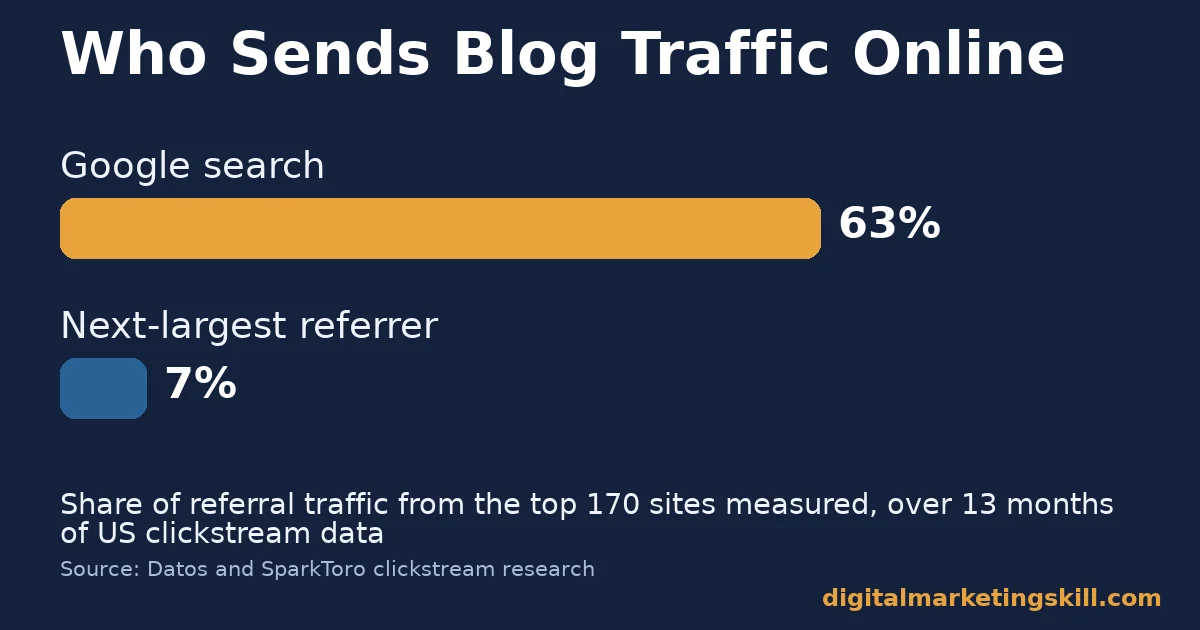
- Search still wins. Research from Datos and SparkToro found Google alone sends about 63% of referral traffic from the top sites online. That is roughly ten times the next largest referrer.
- Distribution beats hope. HubSpot’s survey of over 500 marketers found 83% of blogging businesses use social media to reach readers. Only 36% report meaningful traffic from organic search.
- Email brings readers back. Litmus surveyed roughly 500 marketing leaders and found a commonly cited return of about $36 for every $1 spent on email. That is the highest reported return of any channel in the data.
- Effort without a plan stalls. Orbit Media’s survey of 1,042 content marketers found the average post takes over three hours to write. Strong results still cluster around a handful of proven tactics, not raw output.
In this guide
- What Most Blog Traffic Advice Skips
- How Blog Traffic Actually Works
- What Differs by Channel
- How to Grow Each Channel
- How to Measure Blog Traffic Growth
- The One Rule: Fix Discovery Before You Add More Content
- A Real Case: What Happened When Buffer Consolidated Its Blog
- Frequently Asked Questions About How to Increase Blog Traffic
- Start With One Channel, Then Add the Next
What Most Blog Traffic Advice Skips
Most advice on how to increase blog traffic repeats the same line. Write better posts. Publish more often. Share everywhere. None of that is wrong. But it skips the part that decides whether any of it works: whether your post gets found at all. A perfectly written post that nobody searches for and nobody shares will not move your numbers, no matter how long it took to write.
This guide names that gap first. Then it walks through what differs between search, social and email. It covers what to change for each, and how to measure real growth instead of vanity numbers. The goal throughout is simple: show the smallest set of changes that actually increase blog traffic, not a long checklist nobody finishes.
Treat the figures here as useful signals, not settled facts. The Ahrefs figure comes from one company’s own index. Ahrefs itself says that index is skewed toward higher-quality pages, not the whole web. The HubSpot, Litmus and Orbit Media figures are self-reported by the marketers who answered each survey. Every number below is a snapshot, not a permanent ranking.
How Blog Traffic Actually Works
A visit to your blog comes from one of four places. It can come from organic search or social media. It can come from a direct visit by someone who already knows you, or from a referral link such as an email or another site. Each source behaves differently. Most blogs lean on only one or two of them, which is often why blog traffic growth stalls.
Direct and referral visits tend to grow only after search, social or email is already working. This guide spends most of its time on those three, because they are the channels you can act on starting today.
Why Search Usually Wins the Mix
Search dominates that mix by a wide margin. Research from Datos and SparkToro looked at thirteen months of US clickstream data across a panel of several hundred thousand browsers. It found that Google sends close to two-thirds of referral traffic from the top 170 sites measured.
That is almost ten times larger than the next biggest referrer. If your blog is not built for search, you are fighting over a small slice of what is left.
Backlinks still matter inside that search slice. But they work mostly as a multiplier, not a starting point. Ahrefs’ study of about 14 billion pages found that pages with more referring domains consistently rank for more keywords.
Yet only about 1 in 6,671 pages with no backlinks at all ever reaches 1,000 monthly visits. For most blogs, the bigger problem is not a lack of links. It is writing about the wrong topic, in a format readers were never searching for in the first place.
What Differs by Channel
Search, social and email are not interchangeable tactics for one goal. Each rewards a different kind of content, on a different timeline, and each fails for a different reason. Understanding that difference is the real first step to increase blog traffic without wasting effort on the wrong channel.
Treating all three the same is one of the most common mistakes behind a stalled blog. A post written for search, full of specific detail and structure, rarely performs the same way when shared cold on social media. A subject line written to earn an open behaves differently again.
Matching the content to the channel, rather than reusing one version everywhere, is most of the work in this section. It costs more time per piece but pays back in all three channels working instead of one.
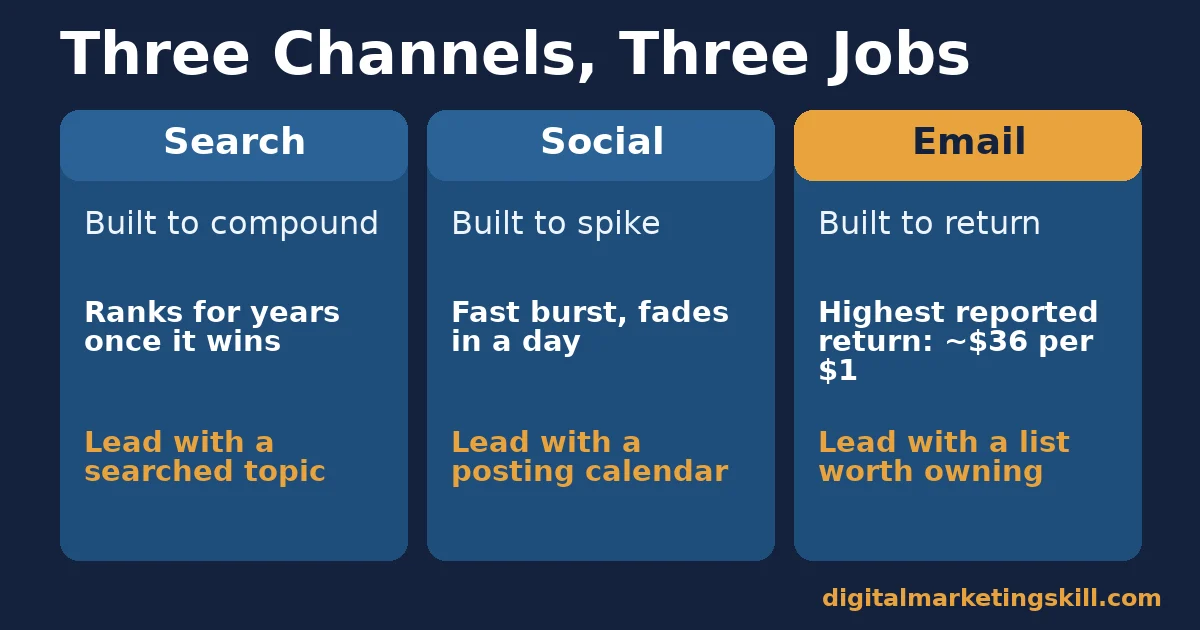
Search: Built to Compound
A post that ranks keeps earning visits for as long as it holds that position. Often that means years, without another promotion push. That is what makes search the channel most able to increase blog traffic over time. The cost is patience. New pages typically need weeks or months to climb. Ahrefs’ study is a reminder that most pages never climb at all.
Social: Built to Spike
Social posts can send a fast burst of visits the day you share them. Then they fall off within a day or two, once the post scrolls out of feeds. HubSpot’s State of Blogging survey found 83% of blogging businesses use social media as a distribution channel, more than any other. That makes it the most common way to send a first wave of readers to a new post.
Email: Built to Return
An email list is the one channel where you can reach the same reader again without an algorithm deciding who sees it. It also carries the highest reported return in the data. Litmus found that 35% of marketing leaders get $10 to $36 back for every $1 spent on email, and another 30% get $36 to $50 back. The commonly cited average sits near $36 for every $1 spent.
How to Grow Each Channel
Once you know what each channel is built for, the fix for each one looks different too. Here is how to increase blog traffic from each source, one at a time, instead of trying to fix all three on the same day.
Work through these in order of effort, not excitement. Search takes the longest to show results. It needs the least ongoing attention once a post ranks. Email takes real setup time up front, then pays back with almost no extra work per send. Social needs the most repeated, ongoing effort of the three.
Search: Lead With Topics People Actually Search
Before you write, confirm people search for the exact question your post will answer. Google’s own guidance on helpful, people-first content asks whether a reader will leave “feeling they’ve learned enough” to reach their goal. If a topic cannot pass that test, promotion will not fix it, and no edit later will increase blog traffic for that page.
Choosing the right keywords before you write, not after, is the real difference between a post search can find and one it never will. A tool such as Google’s own keyword planner helps here, because it shows real search volume instead of a guess.
Social: Lead With a Distribution Calendar
Social traffic spikes and fades fast, so treat it as a scheduling problem, not a one-off share. Pick the two or three networks where your audience actually spends time. Decide a realistic posting cadence for each one.
Then share every new post more than once, with a different angle each time. A simple calendar that notes the network, the day and the goal for each share removes the guesswork. It also stops the all-at-once posting rush that burns out a new post’s reach in a single day.
Email: Lead With a List Worth Owning
A list only compounds if people actually open it. The first job is building an email list from scratch the right way. Give people a clear reason to subscribe. Send a welcome message that delivers on that reason right away, then keep a sending rhythm readers can predict.
From there, send new posts to the list before pushing them anywhere else. A subscriber who already trusts you is the easiest reader to bring back, wherever you live and whatever your time zone. This one habit alone is enough to increase blog traffic from people who would otherwise never return.
How to Measure Blog Traffic Growth
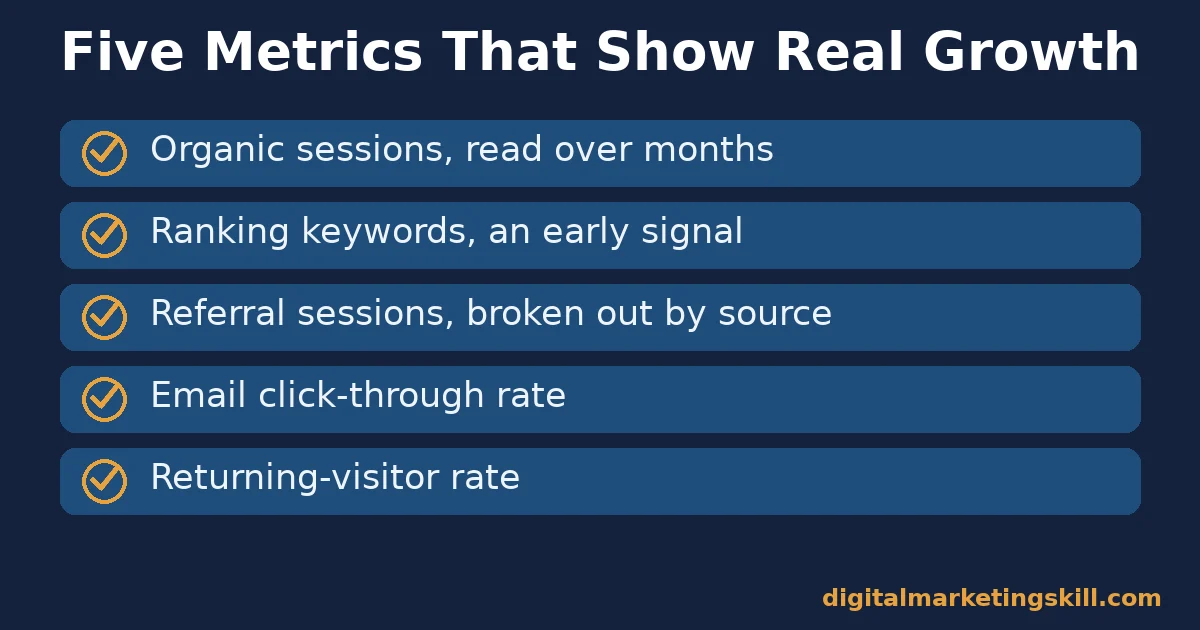
Tracking the wrong number hides whether any of this is working. Page views alone cannot tell you if a channel is working. A view does not show whether you increase blog traffic that stays and returns, or traffic that bounces once and never comes back. These five metrics show real growth instead of noise.
- Organic sessions. The number of visits that arrived from a search engine’s unpaid results. Read this over months, not days, because search growth is gradual.
- Ranking keywords. The count of search terms your post appears for anywhere on the results page. A rising count usually shows up before a rising session count does. That makes it an early signal.
- Referral sessions by source. Visits credited to a specific site or platform that linked to you. Reading this by source, not as one lump number, shows which channel actually carries your blog traffic.
- Email click-through rate. The share of people who opened an email and then clicked a link inside it. A falling rate over several sends usually means the content needs attention, not the list.
- Returning-visitor rate. The share of sessions from people who have visited before. A rising rate is one of the clearest signs that readers choose to come back, rather than arriving once and leaving.
Reading the Metrics Together
Read these five together, not one at a time. A post can gain organic sessions while its returning-visitor rate stays flat, which usually means search is working but email and social are not yet pulling their weight. A post can gain email clicks while ranking keywords stay flat, which usually means the list is healthy but the content underneath still needs search-focused work.
The One Rule: Fix Discovery Before You Add More Content
If a published post is not being found, publishing another post rarely fixes it. Fix why the existing one is invisible first: the topic, the title, the internal links pointing to it, or the channel it depends on.
Here is an illustrative, invented example to show how that plays out. Imagine two blogs, each publishing one post a week. Blog A keeps adding new posts on new topics. Blog B pauses once a month, checks which existing posts get zero search traffic, then rewrites the topic, the title or the opening paragraph on those before writing anything new.
Over a year, Blog B ends up with fewer total posts. But it ends up with a far higher share of posts that actually rank, because part of its effort went into fixing discovery instead of only adding to the pile. This is the simplest way to increase blog traffic without increasing your workload.
A Real Case: What Happened When Buffer Consolidated Its Blog
Buffer’s marketing team once ran two separate blogs on two different subdomains. According to a public case study analysis by Foundation Inc, the combined Buffer.com domain was driving around 415,000 organic sessions a month before the team acted. They consolidated content into fewer, topic-based sections and redirected the older blog into them.
A month later, sessions were reported at around 900,000. One new section reportedly reached 458,000 organic sessions, ranking for more than 500,000 keywords, within about a month of launching. Meanwhile, the original separate blog domain fell from roughly 658,000 sessions to near zero within a few months, as its content and authority moved into the main site.
Even so, the limit on this case matters as much as the numbers. That same analysis is explicit that a redirect this large is risky, and that companies “have been ruined” attempting a similar move without the planning Buffer put into deciding exactly which content moved where.
So read this case for what it is: evidence that consolidating scattered content under a clearer structure can increase blog traffic, not proof that any site can copy the move safely without the same care. A smaller, more cautious version of the same idea, such as merging two thin posts on the same topic into one stronger page, carries far less risk.
Frequently Asked Questions About How to Increase Blog Traffic
How long does it take to increase blog traffic from search?
Most new or improved posts take weeks to months to show a real change in search traffic. Search engines need time to crawl, test and settle a page’s ranking. A post with some history usually responds faster to a rewrite than a brand-new post does, since it already has some trust built up with search engines and some existing links pointing to it.
Does posting more often increase blog traffic on its own?
Not reliably. HubSpot’s data shows frequent publishers tend to see stronger results. But Orbit Media’s survey found that marketers using several proven tactics together, not volume alone, were far more likely to report strong results. Frequency only helps when each post is still built around a topic people search for.
What is the single biggest reason a blog gets little traffic?
Based on the data in this guide, the most common reason is a mismatch: the post was never built around something people actually search for. Ahrefs’ research, which found that the large majority of pages it indexed get no Google traffic, points to discovery, not writing quality, as the first thing to check.
Should I focus on search, social or email first to increase blog traffic?
If you can only pick one, search tends to pay back the longest, because a ranking post keeps earning visits without repeated promotion. Email is the strongest multiplier once you have any audience at all, because it lets you reach the same reader again. Social works best as a fast first wave for a post that is also built to rank.
How much does backlink building help blog traffic?
It helps, but mostly after the topic and search intent are right. Ahrefs found a clear link between referring domains and traffic. It also found that very few pages without backlinks ever reach meaningful traffic on their own. Backlinks add to a well-targeted post. They rarely rescue a poorly targeted one.
Can an old, outdated post be fixed instead of replaced?
Often, yes. Reworking an existing post’s topic focus, title and opening, while keeping its existing links and history, is frequently faster than starting a brand-new page from zero authority. That is part of why the decision rule in this guide favors fixing visibility before adding volume.
Do I need a large budget to increase blog traffic?
No. Every tactic in this guide, from choosing a searched-for topic to building a small email list, costs time rather than money. A budget helps with paid promotion, but the data here shows that the free channels, search and email, carry the strongest long-term return once the topic and the list are right.
Will AI search and chat tools change how to increase blog traffic?
They are already changing where some searches happen, but the underlying mechanics in this guide still apply. A post that answers a real question clearly, with sourced evidence, is the same post that both a search engine and an AI answer tend to draw from. Topics with no genuine search demand behind them will struggle in either system.
Do readers actually scan blog posts before deciding to read them?
Yes. Eye-tracking research from Nielsen Norman Group found that readers scan across the top of a page, then down the left side, before committing to read. Its advice is to put the most important point in the first two paragraphs, and to start headings with the words that carry the most meaning.
A post built that way earns a longer look from a scanning reader. That longer look is often the exact difference that turns a scanner into someone who finishes the post, shares it, or comes back for the next one.
Start With One Channel, Then Add the Next
You do not need to fix search, social and email at once. Pick the channel most likely to move your numbers this month, apply the one decision rule above, and measure it before adding the next channel on top. If search still feels thin, these other ways to increase website traffic are worth layering in, alongside a broader online marketing strategy.
If you want structured help building these skills, the Digital Marketing Skill Institute’s Master Diploma in Digital & AI Marketing is worth a look. It includes an AI-Powered WordPress and SEO Specialist track and an AI-Powered Lead Generation and Email Automation track. Those are two of four AI-powered tracks totalling ten courses, with a Full Stack option for completing all four.
The program includes unlimited 1-on-1 coaching and mentoring, a U.S. Project Internship with a verified U.S. Work Reference Letter, and dual US and UK accreditation recognised in more than 100 countries. It is delivered 100% online, so you can study and apply these ideas to increase blog traffic anywhere in your country.
Explore the Master Diploma program, browse more guides on the Digital Marketing Skill Institute blog, or read student outcomes on the reviews page. When you are ready, apply here to start building these skills with Digital Marketing Skill Institute, a global institute training marketers at digitalmarketingskill.com.
Once a post is performing well on your own site, consider sending it further. Our guide to content syndication covers how to republish your best articles elsewhere to earn new traffic and backlinks.
Every figure in this guide was checked against its original source before publication. Figures marked as illustrative are invented examples, not real results.
![9 Amazing Digital Marketing Skills to Make Money Online [With Proof]](https://digitalmarketingskill.com/wp-content/uploads/2019/07/9-Amazing-Digital-Marketing-Skills-to-Make-Money-Online-With-Proof-17.png)






