
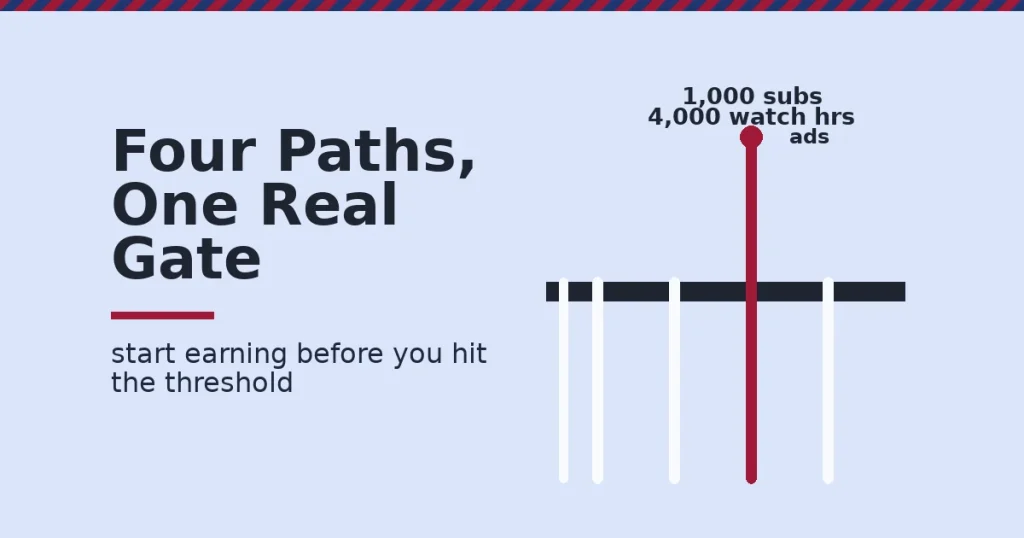
Making money on YouTube rarely starts with ad revenue. That path needs 1,000 subscribers and 4,000 watch hours before it even unlocks. This guide compares four real ways to make money on YouTube, in the order they usually become available. It also shows how to measure whether a channel is actually working.
Key Takeaways
- Ad revenue has a hard gate. YouTube’s own eligibility rules require 1,000 subscribers plus either 4,000 public watch hours in 12 months, or 10 million Shorts views in 90 days, before a channel can even apply.
- Watch time, not clicks, drives discovery. YouTube’s own engineering blog says the recommendation system shifted from clicks toward “valued watchtime,” using surveyed viewer ratings as a signal.
- Clickable thumbnails only get you halfway. YouTube support states that half of all channels and videos see an impressions click-through rate between 2% and 10%. The rest depends on what happens after the click.
- Video is now a default habit, not a niche one. DataReportal’s global data found 91.1% of adult internet users watched online video in the past week.
- The creator economy is real money, not hype. YouTube CEO Neal Mohan’s own annual letter states the platform paid out more than $100 billion to creators, artists and media companies over four years.
In this guide
- What Most “Make Money on YouTube” Guides Skip
- Why Watch Time Decides Who Makes Money on YouTube
- Four Ways to Make Money on YouTube, Compared
- How To Lead With Each Path
- How To Measure Whether a YouTube Channel Is Working
- The One Decision Rule: Match the Path to Your Current Threshold
- A Real Case: What YouTube’s Own Numbers Show
- Frequently Asked Questions About Making Money on YouTube
- Build the Skills Behind a Channel That Actually Earns
What Most “Make Money on YouTube” Guides Skip
Most guides to making money on YouTube jump straight to ad revenue, as if every new channel can turn on monetization the day it uploads. That skips an important fact. Ad revenue through the YouTube Partner Program has a hard eligibility gate. Nothing arrives until a channel crosses it.
That gate catches a lot of new creators off guard. A channel can post genuinely good videos for months and still see zero ad income, simply because the watch-hour total has not yet crossed the line. Understanding that gate early changes how you plan your first few months.
This guide starts from that gate instead of ignoring it. It compares four ways to make money on YouTube, including two that work before you ever reach Partner Program eligibility. Every figure here is attributed to its named source, so you can check it yourself.
If you have not set up a channel yet, see our guide on how to create a YouTube channel before working through the rest of this one.
Why Watch Time Decides Who Makes Money on YouTube
Every way to make money on YouTube depends on the same mechanism: the platform’s recommendation system. YouTube’s VP of Engineering, Cristos Goodrow, wrote that the system moved away from rewarding clicks, which encouraged misleading thumbnails.
It now rewards “valued watchtime,” based partly on how viewers rate what they watched. Anyone trying to make money on YouTube without understanding this shift is optimizing for a signal the platform has already moved past.
This matters for every path to making money on YouTube, not just ads. A sponsor checking your channel looks at retention before they look at subscriber count. An affiliate link only earns a commission if viewers stay long enough to hear the pitch. So the real starting point is not a monetization setting. It is whether people keep watching.
That mechanism also explains why YouTube’s own impressions data matters. Half of all channels and videos see a click-through rate between 2% and 10% on their impressions, according to YouTube support. A high click-through rate with poor retention afterward still fails to build the watch time that unlocks every other way to make money on YouTube.
Thumbnails and titles still matter, just not in isolation. A strong thumbnail earns the click; strong content earns the watch time that follows it. Treat the two as a pair you test together, not two separate problems to solve one at a time.
Four Ways to Make Money on YouTube, Compared
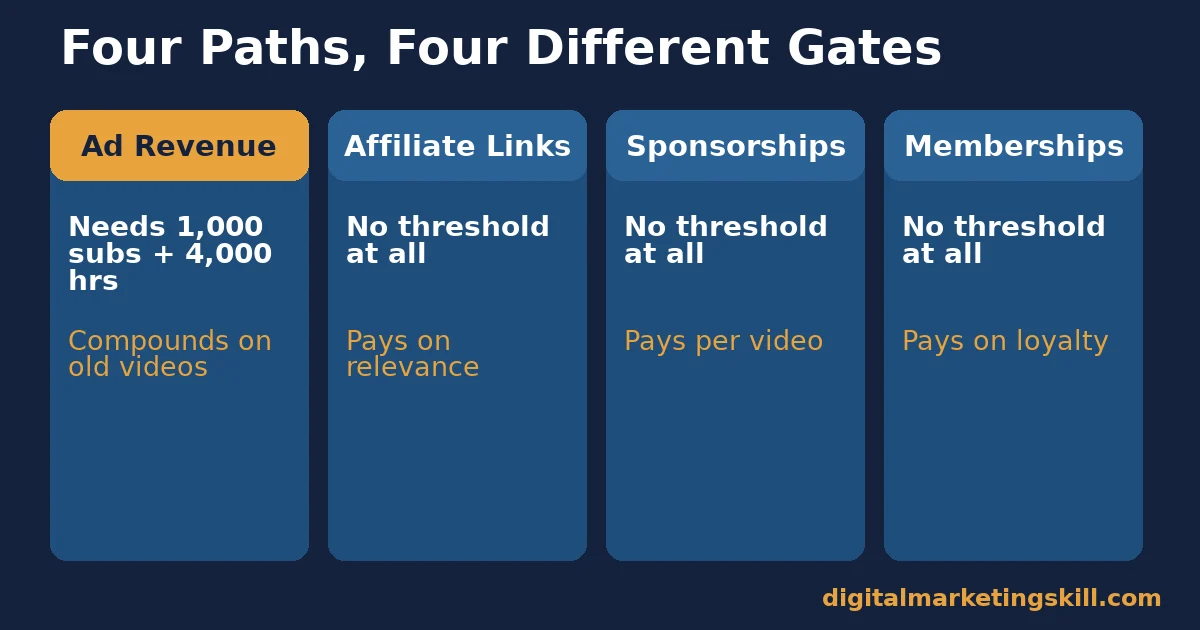
These four paths cover the realistic ways people make money on YouTube: ads, affiliate links, sponsorships and direct fan support. Two of them are available before you hit any subscriber threshold at all.
None of these four paths needs expensive equipment to start. A phone camera and free editing software can produce a video good enough to test whether an idea has an audience. The bigger constraint is almost always time spent learning what your own viewers actually finish watching, not budget.
Ad Revenue: Built For Compounding Income After the Gate
Ad revenue through the YouTube Partner Program only becomes available once a channel hits 1,000 subscribers, with either 4,000 public watch hours in the past 12 months or 10 million Shorts views in the past 90 days. Meeting the threshold still means going through a review, not automatic approval.
Once approved, ad revenue scales with watch time rather than effort spent per upload. Older videos that keep getting watched keep earning. This is why making money on YouTube through ads rewards a durable back catalogue, not just new uploads.
A back catalogue takes time to build, so patience matters here more than on the other three paths. A video published a year ago can still earn today if it keeps attracting new viewers through search or recommendations.
Affiliate Marketing: Built For Income Before the Threshold
Affiliate links do not require YouTube Partner Program approval at all. A channel can place a relevant product link in a video description from its very first upload. It can earn a commission whenever a viewer buys through it.
The trade-off is that affiliate income depends entirely on relevance. A link bolted onto an unrelated video rarely converts. So this path to making money on YouTube rewards a channel that has already found a specific, trusting niche audience, even a small one. A deeper walkthrough on how to start affiliate marketing covers the mechanics in full.
Sponsorships: Built For Higher Per-Video Income
Sponsorships pay a flat or negotiated fee per video, independent of the YouTube ad algorithm entirely. A smaller, highly engaged channel in a specific niche can often out-earn a larger, broader one per sponsored video. Brands pay for relevant attention, not raw reach.
Any sponsored or affiliate content also carries a legal obligation. The FTC’s Endorsement Guides require a clear, conspicuous disclosure, placed at the start of a video or description, whenever a material connection exists that viewers would not otherwise expect. Brands evaluating a channel for sponsorship often look for the same signals covered in our influencer marketing strategy guide.
Memberships & Products: Built For Direct Fan Support
Channel memberships and owned products let a fraction of a loyal audience pay the creator directly. Think a paid community, a digital guide, or merchandise. This path to making money on YouTube needs the smallest audience of the four, since it depends on relationship depth, not raw view count.
It also diversifies income away from a single platform’s algorithm or ad market. Ad rates and recommendation rules both sit outside any individual creator’s control. Strong video scripting shares a lot with the planning in our content marketing strategies guide, since both start from a clear audience need.
How To Lead With Each Path
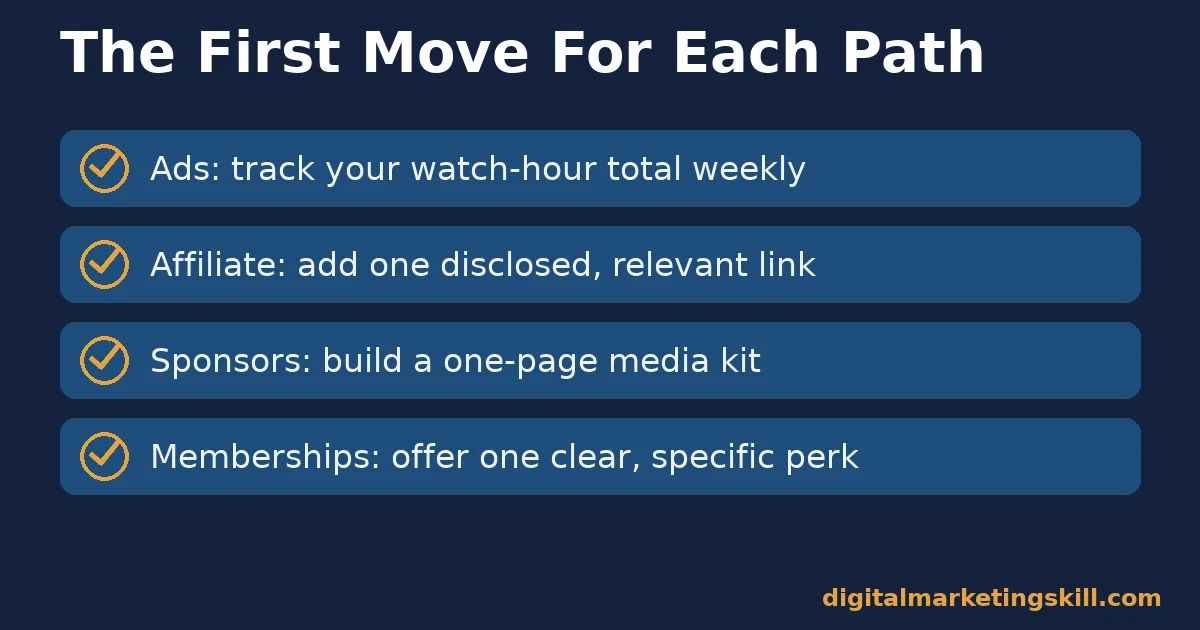
Knowing the four paths only matters if it changes what you do this week. Here is the opening move for each one.
Ad Revenue: Lead With the Watch-Hour Threshold
Treat 4,000 watch hours as the real milestone, not subscriber count alone. Check your channel’s watch-time total in YouTube Analytics weekly. Prioritize topics and formats your own data shows people finish, not just click on.
Affiliate Marketing: Lead With One Relevant Product
Pick a single product you already genuinely use and that fits one upcoming video. Add a disclosed affiliate link in the description, and track clicks for a month before adding a second link. One well-placed link beats ten generic ones.
Sponsorships: Lead With a Simple Media Kit
Build a one-page summary of your niche, audience size and average view duration. Include past brand work too, even if unpaid. Then reach out to three brands that already fit your content naturally, rather than waiting for sponsors to find you. Cross-posting clips to other platforms, using a simple weekly social media checklist, also widens the audience sponsors can see.
Memberships & Products: Lead With One Clear Perk
Offer a single, specific reason to join: early access, a members-only video, or one small digital product. A vague “support me” pitch converts far fewer viewers than one concrete, visible benefit. This is often the fastest path for a creator trying to make money on YouTube from a small but genuinely loyal audience.
How To Measure Whether a YouTube Channel Is Working
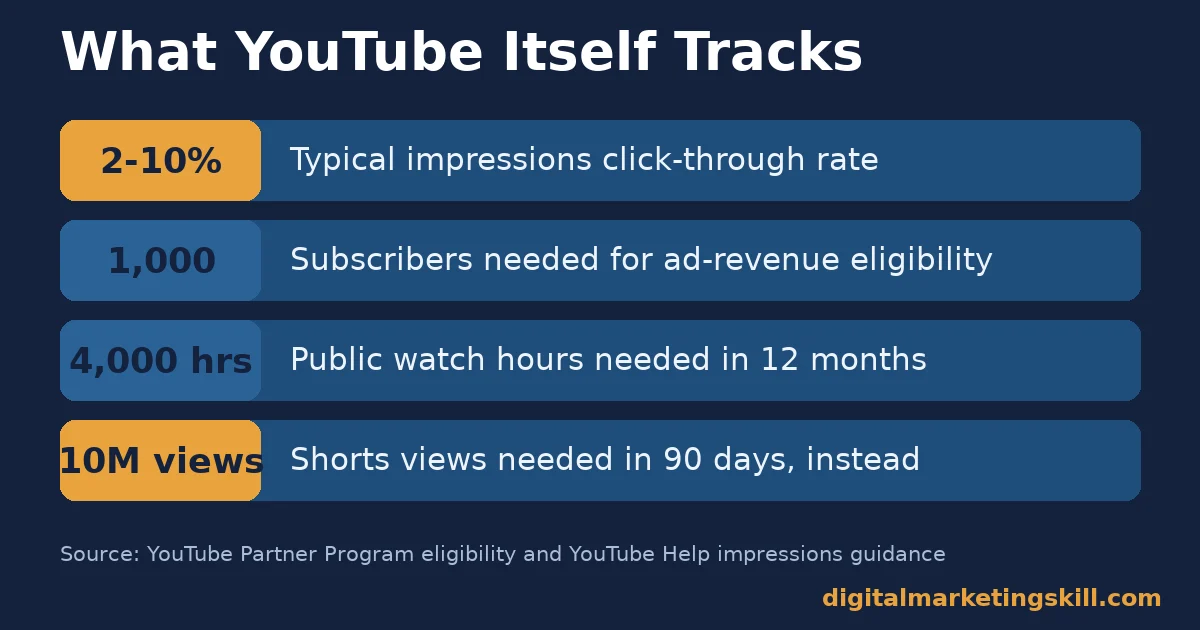
Each path depends on different numbers, but four metrics tell you the truth about the channel underneath all of them.
Four Numbers That Tell You The Truth
- Impressions click-through rate. The share of people shown your thumbnail who clicked. YouTube’s own benchmark range is 2% to 10% for half of all channels and videos.
- Average view duration. The average minutes watched among viewers who stayed, as YouTube support defines it. This is the clearest single signal of whether content delivers on its thumbnail’s promise.
- Watch hours toward eligibility. Your running total toward the 4,000-hour, 12-month threshold for ad revenue. This number only moves when people actually watch, not when they click.
- Revenue per path. Track ad revenue, affiliate commissions, sponsorship fees and membership income separately. Not as one blended number. That way you can see which path is actually working.
Read click-through rate and view duration together. A high click-through rate with a short average view duration usually means the thumbnail overpromises. A long average view duration with a low click-through rate usually means the content is strong, but too few people ever see it.
Neither problem fixes itself with more uploads. A channel trying to make money on YouTube by publishing weekly with the same thumbnail mistake just repeats the error weekly. Diagnose which half of the pair is weak before adding more volume to the schedule.
The One Decision Rule: Match the Path to Your Current Threshold
If your channel has not yet reached 1,000 subscribers and 4,000 watch hours, lead with affiliate marketing or sponsorships, since neither needs Partner Program approval. Once you cross that threshold, add ad revenue and memberships on top, rather than replacing what already works.
This rule exists because waiting for ad revenue alone leaves a new channel with zero income for months or longer. Affiliate links and sponsorship outreach can start on day one, while watch hours accumulate in the background.
The same rule also applies once you cross the threshold. Many creators drop affiliate and sponsorship work the moment ads turn on, which concentrates all income in a single revenue source controlled entirely by the platform. Keeping two or three paths running protects a channel if ad rates or policies ever shift.
Illustrative, invented example: a cooking channel with 400 subscribers cannot yet apply for ads. But it can add one disclosed affiliate link to a kitchen tool in every video. It can also pitch three relevant food brands for a small sponsored segment, while it keeps building toward the 4,000-hour threshold.
A Real Case: What YouTube’s Own Numbers Show
In his annual letter, YouTube CEO Neal Mohan stated that the platform paid out more than $100 billion to creators, artists and media companies over four years. He also said YouTube Shorts now averages 200 billion daily views. YouTube has also led US streaming watch time, per Nielsen’s measurement, for close to three years.
These are YouTube’s own self-reported figures, published in the company’s own communications, not independently audited numbers. They describe the platform in aggregate, not any individual creator’s expected income. Still, they show the category is a real, large and ongoing economy. That is useful context before you commit real time to any of the four paths above.
Frequently Asked Questions About Making Money on YouTube
How many subscribers do you need to make money on YouTube?
For YouTube Partner Program ad revenue specifically, you need 1,000 subscribers plus either 4,000 public watch hours in the past 12 months, or 10 million Shorts views in the past 90 days. Affiliate marketing and sponsorships do not require a subscriber threshold at all.
Can you make money on YouTube without 1,000 subscribers?
Yes. Affiliate links, sponsorships and direct product sales all work below the Partner Program threshold. None of them depend on YouTube’s own ad approval process.
How much does YouTube pay per view?
YouTube does not publish a fixed per-view rate. Real payouts vary by niche, audience location and advertiser demand. Treat any specific per-view or per-1,000-view number you see elsewhere as a rough estimate, not a guarantee for your own channel.
Do I have to disclose affiliate links and sponsorships?
Yes, in most jurisdictions. The FTC’s Endorsement Guides require a clear, conspicuous disclosure at the start of a video or description whenever a material connection with a brand exists, and similar disclosure rules apply in many other countries.
What matters more, subscribers or watch time?
Watch time. YouTube’s own recommendation system rewards “valued watchtime” over raw clicks or subscriber count. Sponsors increasingly check engagement and retention before they check subscriber totals too.
How long does it take to start making money on YouTube?
It depends on the path. Affiliate links and sponsorship outreach can start from your very first video, which is why most creators trying to make money on YouTube quickly combine more than one path. Ad revenue cannot start until you cross the subscriber and watch-hour threshold. That can take anywhere from months to over a year, depending on upload consistency and niche.
Build the Skills Behind a Channel That Actually Earns
Making money on YouTube rests on skills this guide only introduces: audience research, content strategy, analytics and monetization tactics like affiliate marketing and sponsorship outreach. The Digital Marketing Skill Institute’s Master Diploma in Digital & AI Marketing teaches all of them directly. It spans ten courses split into four practical tracks.
The program includes unlimited 1-on-1 coaching and mentoring, real project work inside a U.S. partner company, and dual US and UK accreditation recognised in more than 100 countries. It runs 100% online, so you can build a channel and these exact skills from wherever you live in your country.
Explore the full Master Diploma in Digital & AI Marketing, read more real outcomes on the reviews page, or browse the Digital Marketing Skill Institute blog for more guides like this one.
When you are ready, apply here to get started, wherever you live. Overall, Digital Marketing Skill Institute has helped students build these exact skills from anywhere in the world, and Digital Marketing Skill Institute stays 100% online, so location is never the barrier.
Every figure in this guide was checked against its original source before publication. Figures marked as illustrative are invented examples, not real results.
