
Influencer marketing means paying or gifting a content creator to recommend your product to their own audience. It works because people trust a familiar creator more than a brand’s own ad. It fails when a brand picks reach over fit, or skips the disclosure rules that protect both sides.
Key Takeaways
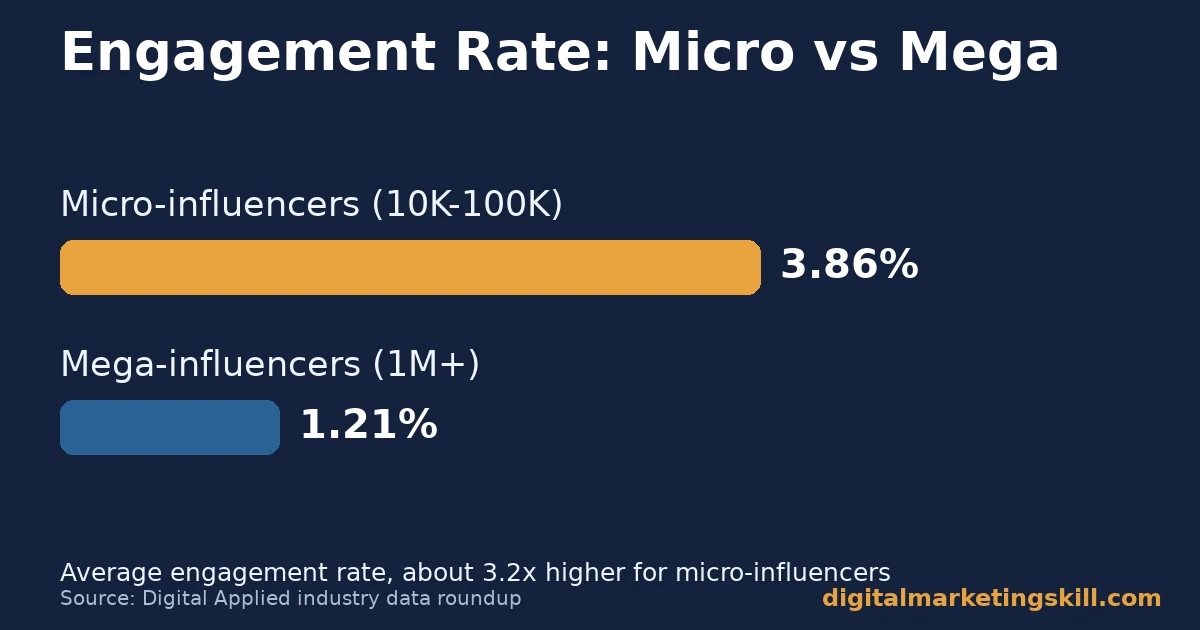
- Micro-influencers (10,000 to 100,000 followers) average 3.86% engagement. That is about 3.2 times higher than mega-influencers over 1 million followers, per Digital Applied’s industry data roundup. Bigger is not automatically better.
- The global influencer marketing platform market is valued at $34.2 billion. It is projected to keep growing at a 14.4% CAGR, per Grand View Research.
- Half of surveyed creators earn under $15,000 a year from content. Creators who prioritize monetization average over $132,000 a year, per the Influencer Marketing Hub Creator Earnings Report (survey of 3,000+ creators). Follower count alone does not predict income.
- The FTC requires every paid or gifted endorsement to be disclosed clearly. It must be “placed so it’s hard to miss,” not buried in a hashtag block or behind a “more” click.
- Influencer collaboration correlates with about 2.6 times the normal engagement benchmark. Yet only 7% of surveyed bloggers use it, down from 25% a few years earlier, per Orbit Media’s annual blogging survey.
In this guide
- The Real Gap: Reach Gets Chosen, Fit Gets Ignored
- How Influencer Marketing Actually Works
- What Differs Among Influencer Tiers
- How To Run a Campaign for Each Tier
- How To Measure an Influencer Campaign
- The One Decision Rule for Choosing a Creator
- Disclosure Rules Every Influencer Campaign Must Follow
- A Real Case: When Disclosure Failures Became a $15 Million Case
- Frequently Asked Questions About Influencer Marketing
- Building an Influencer Marketing Skill Set: Where To Go From Here
The Real Gap: Reach Gets Chosen, Fit Gets Ignored
Most influencer marketing advice ranks creators by follower count. That is the easiest number to see. It is also the weakest predictor of results.
Three ground rules keep this guide honest. First, engagement and earnings figures are named by source. Influencer economics are measured differently by different firms. Second, nobody can guarantee a campaign’s return. This guide states what the evidence shows, not what you will personally earn. Third, disclosure rules are not optional extras. They are a legal requirement in major markets, covered in their own section below.
This guide treats influencer marketing as a measurable channel, not a guess based on who has the biggest following.
How Influencer Marketing Actually Works
A brand pays, gifts or affiliates with a creator. The creator posts a recommendation to their own audience. The audience trusts the creator more than a brand’s own ad, because the relationship existed before the paid post did. That borrowed trust is the entire mechanism.
Three mechanical facts explain why results vary so much between campaigns:
- Trust shrinks as audience size grows. A creator with a smaller, tighter audience usually has a closer relationship with each follower. That is why micro-influencers average 3.86% engagement against 1.21% for mega-influencers, per Digital Applied’s compiled data, a gap of roughly 3.2 times.
- Income does not track fame. The Influencer Marketing Hub’s Creator Earnings Report found half of surveyed creators earn under $15,000 a year from content. Creators focused on monetization average over $132,000. Follower count is not the same as business skill.
- Disclosure changes how the post is received. A clearly labeled paid post is a known, accepted format to most audiences. A hidden one, if discovered, damages trust in both the creator and the brand at once.
Put together, influencer marketing works by renting trust that took the creator years to build. That trust is fragile. Fit and honesty matter more than raw reach.
The relationship also runs two directions. A creator risks their own credibility every time they endorse something, so most turn down offers that do not fit their audience. Brands that respect that filter, by briefing a real use case instead of a scripted line, tend to get a more genuine post in return.
That genuineness shows up in the comments, not just the caption. A forced-sounding endorsement usually draws visible pushback from the creator’s own audience, who can tell when a post does not match the account’s normal voice. A well-matched one tends to draw questions about the product instead, which is a far better signal that the message landed.
What Differs Among Influencer Tiers
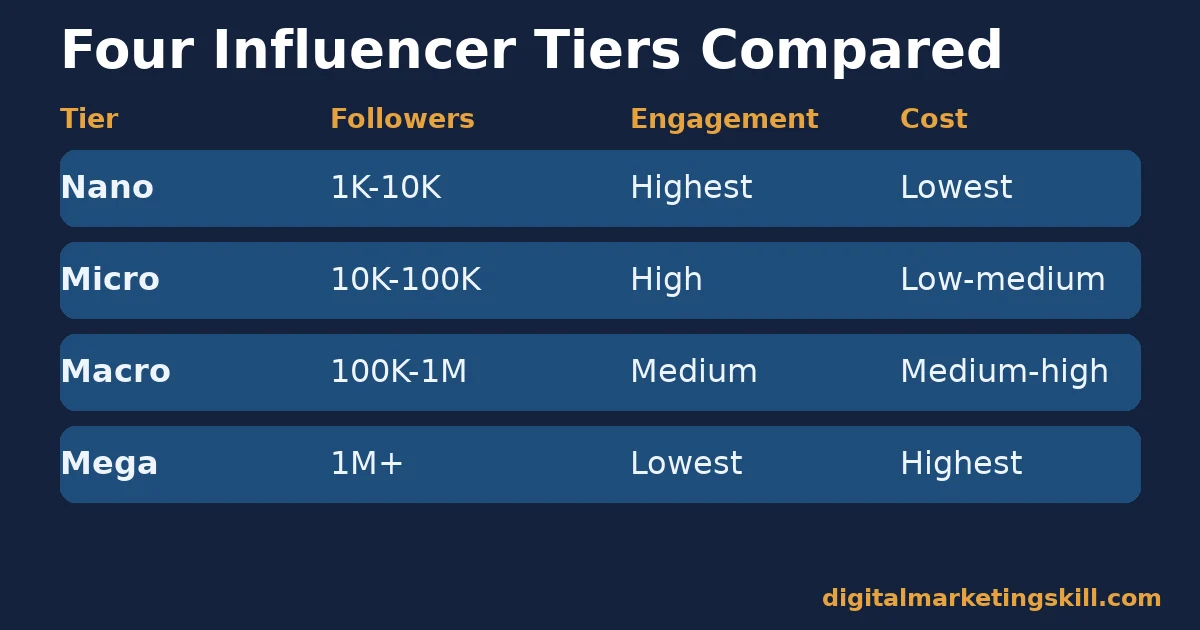
Not every creator plays the same role. The four common tiers below differ in trust, cost and reach.
Nano-Influencers: Built For Trust Density
Nano-influencers have roughly 1,000 to 10,000 followers, often built around a tight community or local area. Engagement per follower tends to be highest here, since the creator often knows many followers personally. It fits brands testing a new product with a very specific, small audience.
Micro-Influencers: Built For Engaged Niches
Micro-influencers run from about 10,000 to 100,000 followers. This tier delivers the strongest average engagement rate at scale, 3.86% per Digital Applied’s compiled data, well above larger tiers. It fits brands with a defined niche audience and a modest budget spread across several creators.
Macro-Influencers: Built For Broad Category Reach
Macro-influencers run from about 100,000 to 1 million followers. Engagement per follower drops compared to smaller tiers, but total reach per post rises sharply. It fits brands launching to a wider category audience, where awareness matters as much as the engagement rate.
Mega-Influencers and Celebrities: Built For Mass Awareness
Mega-influencers and celebrities pass 1 million followers, with the lowest average engagement rate of the four tiers, 1.21% per the same data. It fits brands with a mass-market product and a budget built for awareness, not for a tight response rate.
How To Run a Campaign for Each Tier
Picking a tier only matters once it changes your brief and your budget. Here is the practical lead for each one.
Nano: Lead With Product Gifting and Real Use
Gift the product instead of paying cash. Ask for an honest, unscripted reaction. Run many small creator relationships at once rather than one big one, since any single nano-influencer’s reach is small on its own.
Micro: Lead With a Narrow, Specific Brief
Brief the creator on your product’s specific use case, not a generic brand message. This guide to what a content creator actually does covers how to brief one for authentic results instead of a scripted ad read.
Macro: Lead With Clear Usage Rights and Content Review
Negotiate usage rights for the content upfront, since macro campaigns are expensive enough to justify reusing the content in your own ads. Review the draft before it posts, since one macro post reaches too many people to risk an off-brand message.
This guide to Instagram marketing specs and cadence covers the format details worth checking before a macro brief goes out.
Mega: Lead With Awareness Goals, Not Conversion Goals
Set the campaign’s KPI as reach and brand lift, not direct conversion, since mega-tier engagement rates are the lowest of the four. Pair a mega campaign with a lower-tier layer running at the same time to pick up the conversion work.
How To Measure an Influencer Campaign
Track these four numbers for every campaign, regardless of tier.
- Engagement rate: likes, comments, shares and saves divided by followers or reach. It tells you whether the audience actually responded, separate from how many people were shown the post.
- Cost per engagement: total campaign cost divided by total engagements. It lets you compare creators of different sizes and price points on equal footing.
- Trackable conversions: sales, signups or site visits tied to a unique link, code or landing page. Without this, you are measuring attention, not results.
- Audience overlap with your buyer: the share of a creator’s audience that actually matches your target customer, not just the total follower count. A smaller, well-matched audience usually outperforms a larger, mismatched one.
Review these per creator, not blended across a campaign. One strong creator can hide two weak ones in a blended average. You need to know which is which before you work with any of them again.
If the campaign’s job is building recognition first, this guide to increasing brand awareness covers the metrics that matter before a sale happens.
The One Decision Rule for Choosing a Creator
Decision rule: pick the smallest tier whose total reach still meets your campaign goal, then confirm with a trackable link before you commit to a second campaign with that creator. Audience fit beats follower count every time.
Illustrative, invented numbers: a brand needs roughly 50,000 engaged views for a launch. One macro-influencer with 500,000 followers and a 1.5% engagement rate delivers about 7,500 engagements. Five micro-influencers with 20,000 followers each at 3.86% engagement deliver nearly 15,500 engagements combined, for a similar or lower total cost.
Under this rule, the brand tests the micro-influencer group first. Only if the combined reach still falls short does it add a macro creator on top, rather than starting there by default.
The same rule applies in reverse when a campaign already has a trusted macro or mega creator relationship. Keep that relationship if its trackable conversions hold up, but test a lower tier alongside it before assuming bigger is automatically the better use of next quarter’s budget.
Disclosure Rules Every Influencer Campaign Must Follow
Disclosure is not a courtesy. In major markets, including the US, it is a legal requirement that protects both the audience and the brand.
What the FTC Actually Requires
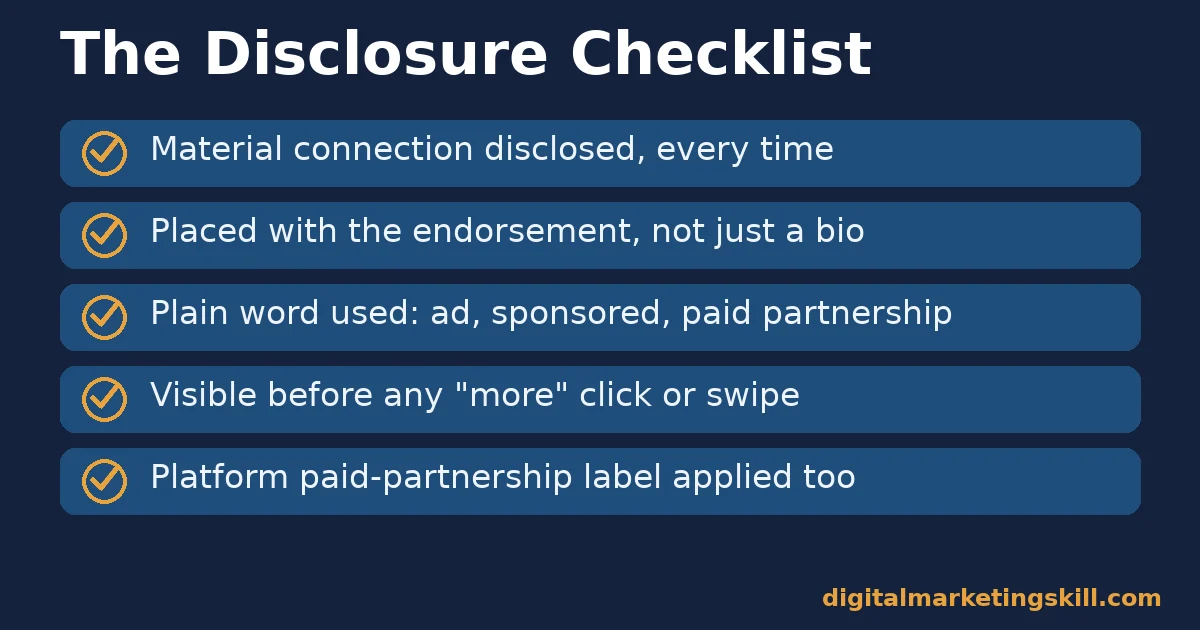
The FTC’s own guidance requires any “material connection” to be disclosed clearly. That includes payment, free products or a personal relationship. The disclosure must be “placed so it’s hard to miss.” It must sit with the endorsement itself, not buried on a profile page or behind a “more” click.
Vague terms are not enough. The FTC specifically warns against “sp,” “spon,” “collab,” “thanks” or “ambassador” on their own, and against mixing a disclosure into a long block of hashtags.
Making It Practical for a Campaign
Use the platform’s own paid-partnership or branded-content label. Meta’s own Business Help Center confirms this label satisfies disclosure requirements when applied correctly, showing a “Paid partnership with…” tag at the top of the post.
Put a plain word like “ad,” “sponsored” or “paid partnership” inside the first visible part of the caption. Do this in the video itself too, not only in a linked description. Require this in every creator contract, rather than hoping the creator remembers on their own.
Build a simple checklist into the brief: the disclosure wording, where it must appear, and a screenshot the creator sends back before the post goes live. That small step catches most disclosure mistakes before they become a public problem, and it costs far less than fixing one after the fact.
A Real Case: When Disclosure Failures Became a $15 Million Case
The FTC charged Teami LLC after it paid celebrities and influencers, including Cardi B, Jordin Sparks and Adrienne Bailon, to promote its products on Instagram. The agency found that any disclosure of the paid relationship was only visible after a viewer clicked “more.” The endorsement itself appeared in the first two or three lines of the caption.
The case settled for a $15.2 million judgment, with $1 million due immediately and the rest suspended based on the defendants’ finances. The FTC also sent warning letters to the ten influencers involved.
Limits on this evidence: this case combined false health claims with the disclosure failure. It is not proof that disclosure problems alone always reach this scale. But it shows regulators do enforce disclosure rules against both brands and the creators they pay.
Frequently Asked Questions About Influencer Marketing
What is influencer marketing in simple terms?
It is paying, gifting or partnering with a content creator so they recommend your product to their own audience. It works by using trust that audience already has in them. The creator’s name and tier change the price and the reach, but the mechanism stays the same.
How much does influencer marketing cost?
Cost varies enormously by tier, from a free product sent to a nano-influencer up to significant fees for a macro or mega campaign. Compare creators by cost per engagement, covered above, rather than by a flat rate card.
Do micro-influencers really outperform bigger creators?
On engagement rate, usually yes. Digital Applied’s compiled industry data puts micro-influencer engagement at roughly 3.2 times the rate of mega-influencers. On total reach, a larger creator still wins, so the right choice depends on your campaign goal.
Is gifting a product the same as paying for a post?
For disclosure purposes, yes. The FTC treats free or discounted products as a material connection that must be disclosed, the same as a cash payment.
What happens if an influencer does not disclose a paid post?
Both the brand and the creator can face regulatory consequences, as the Teami case above shows, alongside reputational damage if the paid relationship surfaces later. Build disclosure into the campaign brief from the start, not as an afterthought.
Can a small business afford influencer marketing?
Yes, most realistically through nano- or micro-influencer tiers, which often cost far less than macro or mega campaigns and can outperform them on engagement. Several small, well-matched creator partnerships often beat one expensive, mismatched one.
This guide to building a personal brand on social media is also useful background. It applies if you feature your own team as creators instead of hiring outside ones.
Does influencer marketing work the same way on every platform?
The mechanism stays the same, but the format and the disclosure tool differ. Instagram uses a paid-partnership label. TikTok’s own support pages document a similar branded-content toggle. Check the specific platform’s current rules before a campaign launches, rather than assuming one tool works everywhere.
Does a creator need a minimum number of followers to be worth working with?
No. A nano-influencer with a few thousand highly engaged followers can outperform a much larger account for a niche product. Match the tier to the campaign goal using the decision rule above, instead of setting a follower minimum before you look at fit.
Building an Influencer Marketing Skill Set: Where To Go From Here
Running a real influencer marketing campaign uses the same core skills as any paid channel: briefing, measurement and honest reporting. Trial and error is the slow way to learn all three.
Digital Marketing Skill Institute’s Master Diploma in Digital & AI Marketing includes AI-Powered Social Media Marketing & Analytics and AI-Powered Content Creation courses that apply directly to planning and measuring creator campaigns.
It comes with unlimited 1-on-1 coaching and mentoring, plus real project work inside a U.S. partner company. The program is dual US and UK accredited, recognised in more than 100 countries, and runs 100% online. You can study anywhere in your country on your own schedule.
Learn more on the Master Diploma in Digital & AI Marketing page. Browse more guides like this one on the digital marketing blog, or read student outcomes on the reviews page.
When you are ready, apply here — wherever you live, the coaching and project work are built to run the same way online. Learn more at Digital Marketing Skill Institute, or start your application at digitalmarketingskill.com.
Every figure in this guide was checked against its original source before publication. Figures marked as illustrative are invented examples, not real results.
![9 Amazing Digital Marketing Skills to Make Money Online [With Proof]](https://digitalmarketingskill.com/wp-content/uploads/2019/07/9-Amazing-Digital-Marketing-Skills-to-Make-Money-Online-With-Proof-17.png)






