Affiliate marketing mistakes are small, repeatable errors that quietly cap how much commission a promoter earns. Weak disclosure, the wrong traffic, or content built to sell instead of help are the big three. Fix the right one first, and earnings per click usually rises faster than adding more traffic ever could.
This guide groups affiliate marketing mistakes by what they actually break, not by a generic alphabetical list, then gives one rule for deciding which one to fix first.
Key Takeaways
- Most affiliate marketing mistakes fall into three groups: trust mistakes, content mistakes and targeting mistakes. Each needs its own fix, not a general “try harder” response.
- A weak disclosure is a trust mistake and a legal one at once. One well-documented case cost a firm $250,000 after undisclosed affiliate reviews generated over $5 million in sales, per the FTC’s own press release.
- US affiliate spending generated about $113 billion in e-commerce sales from $13.62 billion invested, a roughly 8-to-1 return, per the Performance Marketing Association’s own industry study. The channel rewards fixing mistakes, not abandoning it.
- 57% of affiliate-driven purchases now happen on mobile, per Awin’s own platform data. A desktop-only setup is a targeting mistake on its own.
- 31% of top affiliate publishers lean on affiliate income for a meaningful share of total revenue, according to Awin. That is exactly why a handful of avoidable mistakes carries real financial weight.
In this guide
- The Affiliate Marketing Mistakes Gap: What Most Guides Skip
- Why Affiliate Marketing Mistakes Actually Cost You Sales
- What Differs By Affiliate Marketing Mistake Type
- How To Fix Each Affiliate Marketing Mistake Type
- How To Measure Whether You’ve Fixed A Mistake
- The One Decision Rule For Which Mistake To Fix First
- A Real Case: What One Disclosure Mistake Actually Cost
- Frequently Asked Questions About Affiliate Marketing Mistakes
- Where To Learn Affiliate Marketing Properly
The Affiliate Marketing Mistakes Gap: What Most Guides Skip
Most affiliate marketing mistakes lists read the same way. Twenty bullet points. No order. No sense of which mistake costs the most money. That gap matters. Fixing a minor content mistake while ignoring a disclosure mistake can still leave you exposed to a platform ban, even while your numbers look fine.
Two ground rules come first. This is a working framework, not a guarantee. Results depend on your niche, your traffic source and your program’s own terms. The figures here are a snapshot too, not a permanent ranking of any network. Commission structures and platform rules shift often. Treat every number as a starting point to verify against your own program, not a fixed target.
Why The Order Of Fixes Matters More Than The List Itself
Most affiliate marketing mistakes guides treat every item as equally urgent, which is rarely true. A typo costs almost nothing. A missing disclosure can end an account. Reading a flat list without a sense of priority leaves beginners fixing whatever catches their eye first, rather than whatever is actually costing the most money.
One more practical point belongs here too: not every affiliate marketing mistake is equally visible. A broken link or a typo gets noticed and fixed fast, because it is obvious. A slightly misleading claim, or a review that overstates a product’s benefits, can sit live for months, quietly costing trust with every new reader, precisely because nothing about it looks broken on the surface.
Below is a map of where affiliate marketing mistakes actually cost money, grouped by type. One rule follows for deciding which mistake to fix first.
One more note before the breakdown. This guide, published by digitalmarketingskill.com, focuses on the logic behind each mistake, not on naming specific affiliate networks. Network terms change, commission tiers get renegotiated, and a platform’s own rules always override general advice like this. Check your own program’s terms before applying anything here.
Why Affiliate Marketing Mistakes Actually Cost You Sales
An affiliate link only earns once three things line up. A reader has to trust the recommendation. The content has to match what they were searching for. The link has to reach the right audience. Break any one of those three, and the mistake shows up as a lower number somewhere, even when traffic volume looks healthy.
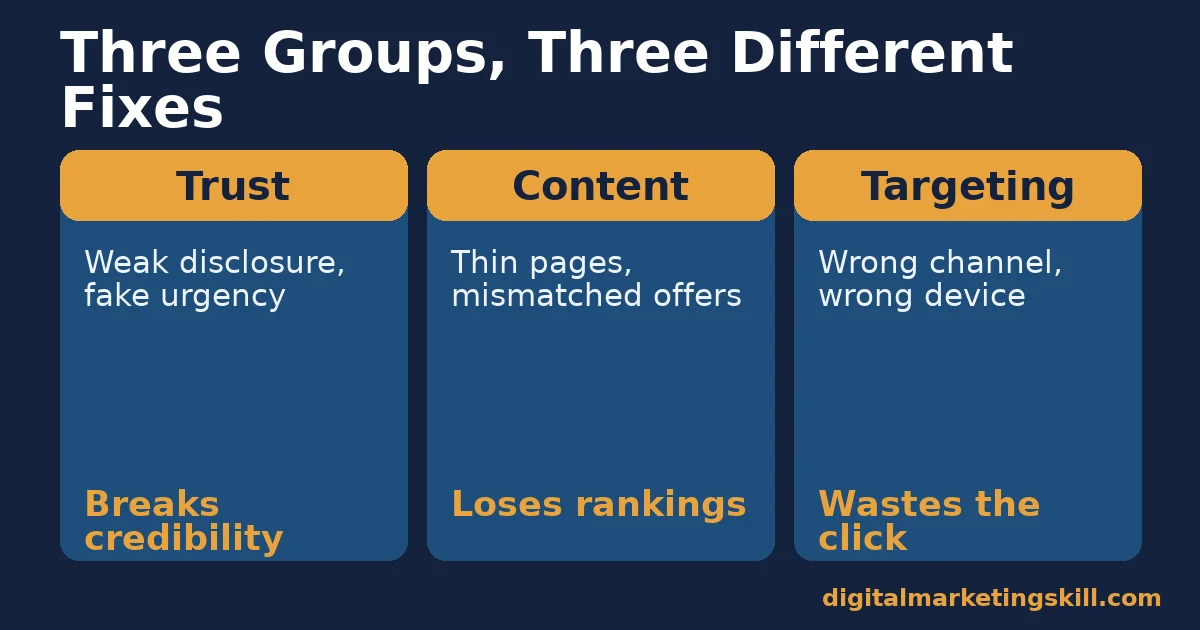
Trust breaks first, and it breaks fastest. A reader who senses a hard sell stops trusting that writer’s future picks too. That cost rarely shows up as one lost sale. Instead, it shows up as a slowly shrinking click-through rate across every post that follows.
Content mismatches cost differently. A page ranking for “best budget laptops” that pushes a premium laptop link wastes the click before the reader even considers buying. The traffic arrived. The content simply pointed it at the wrong offer.
Targeting mistakes waste effort before a click even happens. Promoting a desktop-only funnel, when most buyers convert on mobile, throws away a share of every campaign before it starts. So three different failure points, three different fixes, covered next.
It helps to think of these three groups as a funnel of their own. Trust decides whether a reader even considers clicking. Content decides whether that click points at the right offer. Targeting decides whether the click reaches someone able to buy at all. A mistake anywhere in that chain caps the result, no matter how well the other two stages perform.
Why Grouping Affiliate Marketing Mistakes By Type Matters
Treating every mistake the same way wastes effort. A creator who spends a month polishing content when the real problem is a buried disclosure will see little improvement, because the content was never the bottleneck. Diagnosing which group a mistake belongs to, before trying to fix it, saves weeks of effort aimed at the wrong target. A simple way to diagnose it: ask whether the problem sits before the click, at the click, or after the click. Targeting mistakes sit before the click. Trust and content mistakes sit at or after it, once the reader is already reading.
What Differs By Affiliate Marketing Mistake Type
Not every mistake behaves the same way. Treating them as one category is itself part of the problem. Here are the three groups, and what makes each one different.
Trust Mistakes: Built To Break Credibility
Trust mistakes include weak disclosure, fake urgency, and reviewing products you’ve never used. These mistakes break the one thing an affiliate link depends on: a reader’s belief that the recommendation is genuine. They are also the mistakes regulators actually enforce against. That raises the stakes well past one lost sale.
Content Mistakes: Built To Lose Rankings And Relevance
Content mistakes include thin reviews, keyword-stuffed pages, and offers that don’t match search intent. These lose two things at once. Search rankings slip, because thin content rarely holds a position. Reader relevance slips too, because a mismatched offer converts far worse than an aligned one.
Targeting Mistakes: Built To Waste Clicks Before They Convert
Targeting mistakes include promoting to the wrong channel, the wrong device, or an audience outside the program’s allowed region. These waste the click itself. The traffic shows up, but it was never going to convert, no matter how strong the content or the disclosure was.
How To Fix Each Affiliate Marketing Mistake Type
Each mistake type needs its own fix. Here is how to lead with each one, mirrored to the three groups above.
Trust Mistakes: Lead With Disclosure, Not Hype
Put the disclosure next to the link, not buried in a footer. The FTC’s own disclosure guide is specific here: a material financial connection, including an affiliate commission, needs disclosure in plain language close to the recommendation itself, not buried in a bio or footer. Vague phrasing like “affiliate link” alone is weaker, since many readers don’t know what that phrase actually means.
Beyond wording, timing matters just as much. A disclosure added after the fact, once a program flags it, reads very differently from one built into the content from the first draft. Write the disclosure sentence before you write the review, not after, so the honesty of the piece isn’t an afterthought bolted on at the end.
Content Mistakes: Lead With Intent, Not Keywords
Match the content to what the searcher actually wants. Let the affiliate link follow naturally, not lead the page. If someone searches for a budget option, don’t open with a premium pick. Write the comparison the reader is actually looking for. Conversion on existing traffic usually improves without adding one new visitor. This is often the cheapest fix on the whole list, since it requires no new traffic, no new tools, and often just a rewritten section of a page that already ranks.
Targeting Mistakes: Lead With Where Buyers Already Are
Check the device and channel data your own program already gives you. Then build your next piece of content around it. If most conversions happen on mobile, test link placement and page speed on a phone before publishing anything new. Chasing a channel your own data doesn’t support wastes effort a five-minute check would have caught. Most affiliate dashboards, including Amazon Associates’ own reporting tools, already show clicks and conversions broken out by link and by day. The data usually exists; it just goes unread.
How To Measure Whether You’ve Fixed A Mistake
Four numbers tell you whether a fix actually worked. Define each one before comparing one week to the next.
The Four KPIs To Track
- Earnings per click (EPC). Total commission divided by total clicks sent. This is the clearest sign a content or targeting fix worked, since it folds conversion rate and commission value into one number.
- Click-through rate on your own content. The share of readers who click the affiliate link at all. A trust fix, like clearer disclosure, usually shows up here first, often within a few weeks.
- Conversion rate by device. The share of clicks that convert, split by desktop versus mobile. This confirms whether a targeting fix actually closed the gap, rather than just redirecting the same traffic.
- Program compliance flags. Any warning, suspension notice or reduced commission tier from the program itself. Most people ignore this number until it becomes an account ban, even though it is the easiest one to check.
Check these numbers monthly, not daily. One good or bad week rarely reflects a real trend. Judging a fix too early is itself one more avoidable mistake on this list.
Write these four numbers down somewhere visible, next to the page or campaign they measure. Affiliate marketing mistakes that nobody tracks tend to persist for months, simply because no single number ever flags them. A short monthly review catches a quiet decline long before it shows up as a program warning.
The One Decision Rule For Which Mistake To Fix First
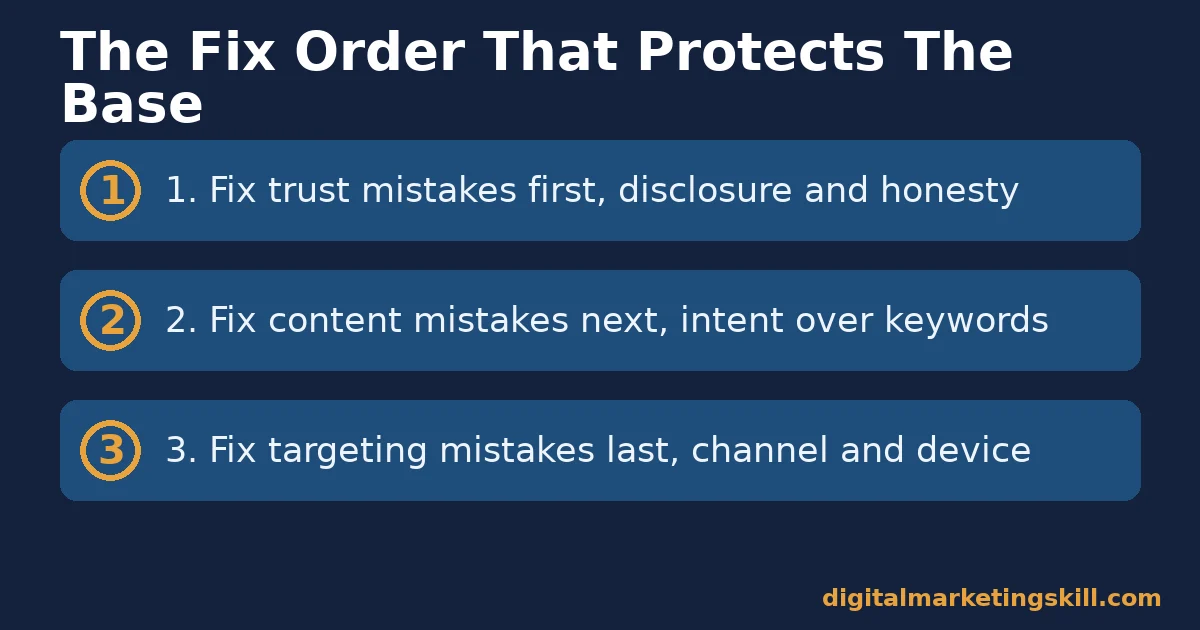
Fix trust mistakes before content mistakes. Fix content mistakes before targeting mistakes. Not because targeting doesn’t matter, but because trust mistakes carry legal exposure and compound silently, while targeting mistakes are usually faster and cheaper to correct once the data shows them.
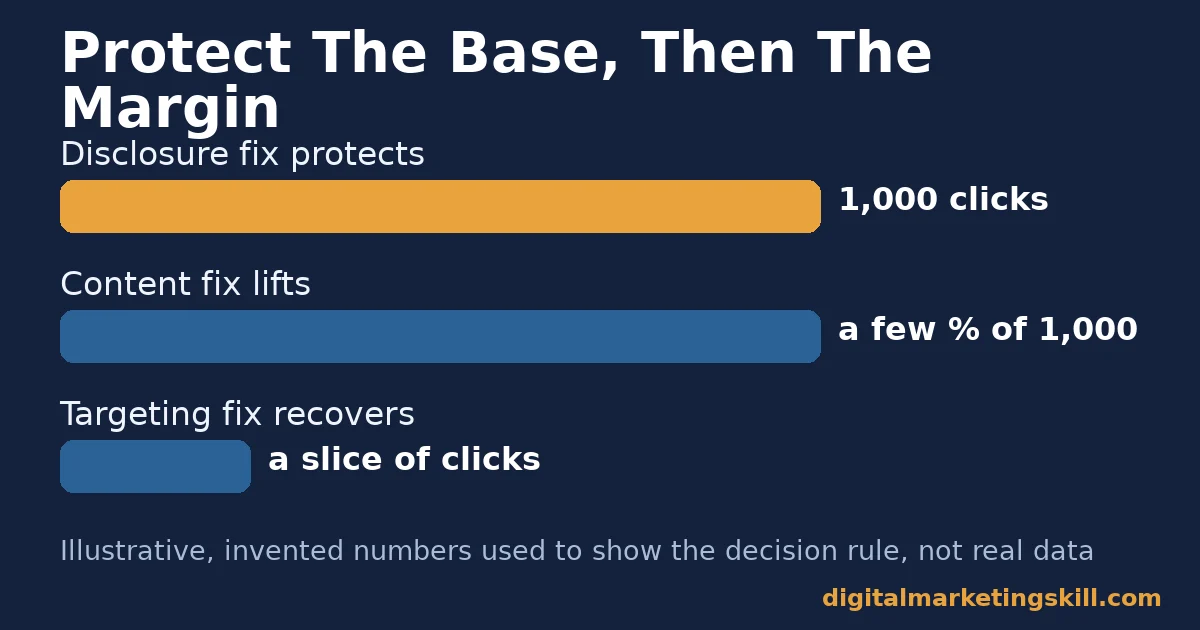
Illustrative, invented numbers show the logic. Picture three pages, each sending 1,000 clicks a month. One page has a buried disclosure, another has a mismatched offer, and the third targets the wrong device. Fixing the disclosure protects all 1,000 clicks from a platform or legal problem. The mismatched-offer fix might lift conversion on those same 1,000 clicks by a few percentage points. Correcting the device targeting might recover a slice of clicks that were never going to convert anyway. Protect the base first. Improve the margin second.
One practical way to apply this: list every active page or campaign on one sheet, next to its monthly clicks and its known mistake type. Fix every trust mistake on that sheet before touching a single content mistake. Only once the trust column is clear should the content and targeting columns get any attention at all.
A Real Case: What One Disclosure Mistake Actually Cost
The U.S. Federal Trade Commission settled charges against Legacy Learning Systems, a company selling guitar-lesson courses through an affiliate programme. Its affiliates wrote reviews and articles that read like independent consumer opinions. They never disclosed they were paid a commission on every resulting sale. Those endorsements generated more than $5 million in course sales. The FTC ruled the missing disclosure was deceptive. The company paid $250,000 to settle the charges and agreed to monitor its affiliates’ disclosures going forward, according to the FTC’s own press release.
This case has limits. It involves a company managing an affiliate programme, not a single affiliate, and FTC penalty amounts shift over time, so treat the dollar figure as historical rather than a current benchmark. The lesson still holds regardless: a disclosure mistake is not a technicality. It is the one mistake on this list that scales with your traffic, in exactly the wrong direction.
What makes this case useful beyond the headline figure is the pattern it exposes: the affiliates weren’t doing anything most people would call fraud. They were writing real articles, about a real product, that genuinely worked for them. The only mistake was leaving out one sentence about how they got paid. That gap between “mostly honest content” and “compliant content” is exactly where most affiliate marketing mistakes live.
Frequently Asked Questions About Affiliate Marketing Mistakes
What is the single most common affiliate marketing mistake?
Promoting a product you haven’t used or don’t believe in, purely for a high commission. It tends to produce thin, generic content that readers and search engines both notice, and it is usually the root cause behind several other mistakes on this list.
Is a weak disclosure really serious, or just a technicality?
It’s serious. Regulators treat a missing or vague disclosure as a deceptive practice, not a minor oversight. Affiliate programs can also suspend accounts over it, independent of any regulatory action. Treat disclosure as a trust mistake with real consequences, not paperwork.
Can too many affiliate links on one page hurt conversions?
Yes. A page with a dozen competing links gives the reader no clear next step, which usually lowers the click-through rate on all of them. One or two well-placed, clearly disclosed links in context tend to outperform a page stuffed with options.
How long should I test a fix before judging whether it worked?
At least a full month, longer if your traffic is seasonal. Affiliate conversion data is noisy week to week. Judging a fix after a handful of days is itself one of the mistakes on this list.
Should beginners worry about targeting mistakes before they have much traffic?
Not as a first priority. With low traffic, trust and content mistakes matter more, since they shape whether the traffic you do get converts at all. Targeting becomes worth optimising once you have enough data to see a real device or channel pattern. Chasing targeting fixes on fifty clicks a month usually wastes time better spent fixing the content those fifty people actually read.
Do affiliate programs actually check for these mistakes?
Many do, at least for disclosure and misleading claims. Compliance teams periodically review top-earning affiliates specifically, which is one more reason the FTC’s own disclosure guidance is worth following exactly, not loosely.
Are affiliate marketing mistakes different for beginners versus experienced affiliates?
The categories stay the same, but the stakes change. A beginner’s mistake usually costs a handful of clicks and gets caught quickly through simple trial and error. An experienced affiliate’s mistake runs across dozens of pages and years of built-up traffic, so the same disclosure or targeting error compounds into a far larger loss before anyone notices it. That is also why experienced affiliates benefit most from a periodic site-wide audit, checking every live page against the same three mistake categories, rather than assuming early fixes still hold years later.
Does fixing affiliate marketing mistakes really move earnings per click, or just traffic?
It moves EPC directly, often before traffic changes at all. A trust fix lifts click-through rate on the same visitors. A content fix lifts conversion on the same clicks. Both numbers feed EPC without a single extra visitor arriving. That is the real appeal of fixing affiliate marketing mistakes over chasing new traffic: the upside shows up on channels you already own.
Can fixing affiliate marketing mistakes get a suspended account reinstated?
Sometimes, but not automatically. Most programs want to see the underlying mistake actually corrected, not just a promise to do better, before they will consider lifting a suspension. Document the fix, email the program’s affiliate manager directly, and expect the review to take longer than the original suspension notice did. Keep screenshots of the corrected pages dated before you send that email, since some programs ask for proof the fix predates the appeal, not just a promise that it exists.
Where To Learn Affiliate Marketing Properly
If you want to build affiliate income without these avoidable mistakes eating into it, that is exactly the kind of practical, channel-specific skill the Master Diploma in Digital & AI Marketing at Digital Marketing Skill Institute is built around. The programme runs four AI-powered tracks, built from ten courses in total: AI-Powered Social Media Management and Advertising, AI-Powered Lead Generation and Email Automation, AI-Powered Google Specialist, and AI-Powered WordPress and SEO Specialist. A Full Stack option lets you complete all four. The content and SEO skills behind avoiding affiliate marketing mistakes line up closely with the WordPress and SEO Specialist track, where you build content that earns trust instead of losing it.
Every track includes unlimited one-on-one coaching and mentoring, a U.S. Project Internship with a verified U.S. Work Reference Letter, and dual US and UK accreditation recognised in more than 100 countries. All of it runs 100% online, so you can build real, compliant campaigns from anywhere in your country, wherever you live. Apply here to start. Browse more breakdowns like this one on the Digital Marketing Skill Institute blog, or read more student outcomes on the reviews page. Learn more about Digital Marketing Skill Institute, open to learners anywhere in your country.
Every figure in this guide was checked against its original source before publication. Figures marked as illustrative are invented examples, not real results.