
Good affiliate marketing tips start with trust, not traffic. Clutch found 96% of consumers check reviews before buying something they have not tried. A promotion only converts once a reader trusts the person recommending it. These affiliate marketing tips cover that trust mechanism and four content formats with different jobs. They also cover how to measure results and one decision rule to use before you join another program.
Key Takeaways
- Reviews decide purchases more than any single ad. Clutch’s survey of 400 US consumers found 96% check reviews before a first-time purchase, and only 15% trust a star rating alone without reading detail.
- Suppressing honest feedback can end in real penalties. The FTC required Fashion Nova to pay $4.2 million after it suppressed hundreds of thousands of negative reviews over several years, a warning for anyone who edits feedback to look better than it is.
- Disclosure is a legal requirement, not a courtesy. The FTC’s own guidance says even a single affiliate link needs a clear disclosure placed close to the recommendation, in plain language such as “paid link.”
- The market keeps growing, so competition keeps rising too. Grand View Research values the global affiliate marketing platform market at $23.8 billion, forecast to reach $35.7 billion within about seven years.
- Email still outperforms most other affiliate channels. Litmus surveyed nearly 500 marketers worldwide and found email returns $36 or more for every $1 spent at 35% of companies, with retail and e-commerce averaging the highest return.
In this guide
- What Most Affiliate Marketing Tips Lists Still Get Wrong
- Why Trust, Not Traffic, Decides Whether a Link Converts
- Four Content Formats, Four Different Jobs in These Affiliate Marketing Tips
- How to Lead With Each Format
- Measuring Whether Your Affiliate Marketing Tips Are Working
- The One Decision Rule: Fewer Programs, Measured Honestly
- A Real Case: What the Fashion Nova Settlement Shows About Reviews
- Frequently Asked Questions About These Affiliate Marketing Tips
- Start With One Format, Measured Honestly
What Most Affiliate Marketing Tips Lists Still Get Wrong
Most lists of affiliate marketing tips repeat the same advice. Pick a niche. Write good content. Be patient. None of that is wrong. But it skips the two things that actually decide whether a reader clicks your link: whether they trust you, and whether you are legally allowed to ask for the click the way you are asking.
These affiliate marketing tips start with that trust mechanism instead. They show why review behavior and disclosure rules shape every tactic below. Then they break down four content formats with different jobs, a measurement plan, and one decision rule for picking programs.
Ground rules first. The review and trust figures come from Clutch’s own consumer survey. That is a single company’s data, not a universal law of behavior. The market-size figures are forecasts from one research firm among several that disagree slightly on the exact number. Treat every figure here as a snapshot of where things stand, not a permanent ranking of what works.
One more ground rule worth stating plainly: these affiliate marketing tips are built for a worldwide audience, not one country’s shoppers. Review behavior, disclosure expectations and even which platforms people trust most vary by market, so treat every specific percentage below as a reasonable guide, not a universal constant for every audience you might reach.
Why Trust, Not Traffic, Decides Whether a Link Converts
A reader clicking your affiliate link is making a small bet that your recommendation is honest. Clutch’s survey of 400 US consumers found 96% check reviews before buying a product they have not tried before. Only 15% trust a star rating by itself. Most want detail: a rating paired with written feedback is what actually builds confidence.
That same research found consumers are getting warier, not less careful. 48% say they now frequently encounter reviews they suspect are AI-written or manipulated. Of those people, 72% say it lowers their trust in the review overall.
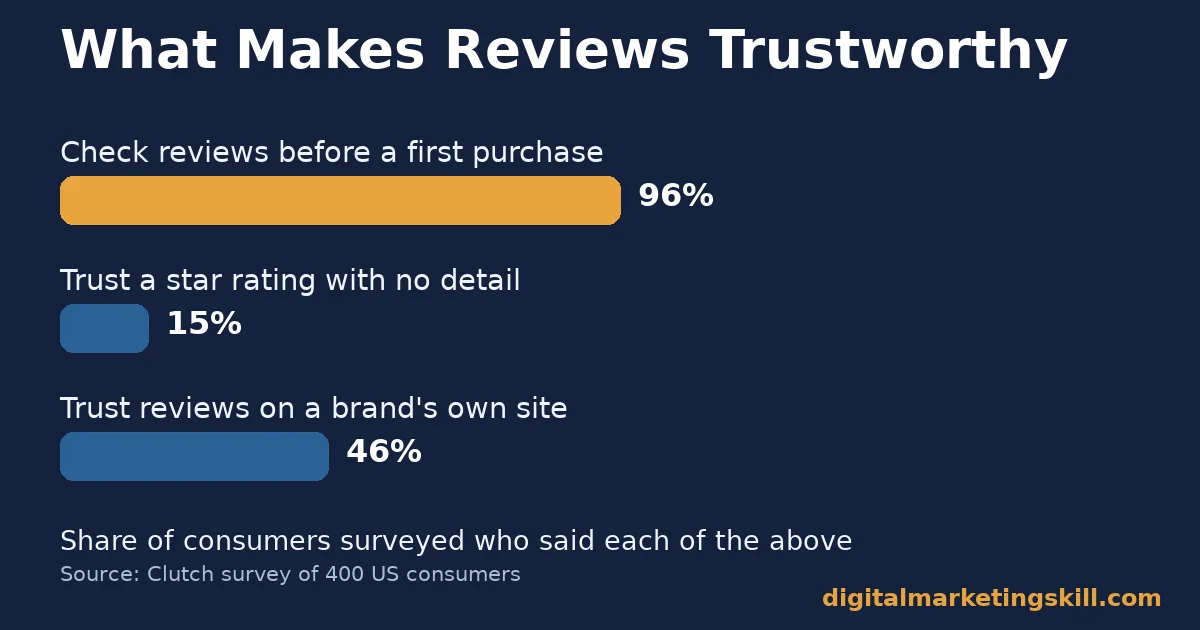
Platform matters too. Clutch found consumers trust reviews on Amazon at 73%, Google at 65%, and a brand’s own website at only 46%. The lesson for affiliate content is direct. A detailed, honest, specific review on your own site starts from a trust deficit a reader does not have on Amazon. It has to earn trust with real detail, not polish.
A separate Clutch report on brand authenticity found 97% of consumers say authenticity influences their buying decisions. Separately, 70% say they will pay more for a brand or recommendation they perceive as real. Generic, robotic-sounding content works against you here: 59% of respondents named it as a specific trust killer, independent of whether anything written was actually false.
Disclosure Is Not Optional
The FTC’s own guidance states that affiliates should disclose their relationship to the retailer clearly and conspicuously. That way, readers can decide how much weight to give the recommendation. Even a single affiliate link requires disclosure if you earn a commission through it.
Vague wording like “affiliate link” alone is not considered adequate. Plain language such as “paid link,” placed close to the recommendation, is what the guidance actually asks for.
This is not a US-only courtesy, even though the specific rule comes from a US regulator. Readers everywhere respond the same way once they notice a hidden financial interest. Trust drops, and it rarely comes back on the same post. Treat clear disclosure as part of the content itself, not a legal footnote bolted on at the end.
Four Content Formats, Four Different Jobs in These Affiliate Marketing Tips
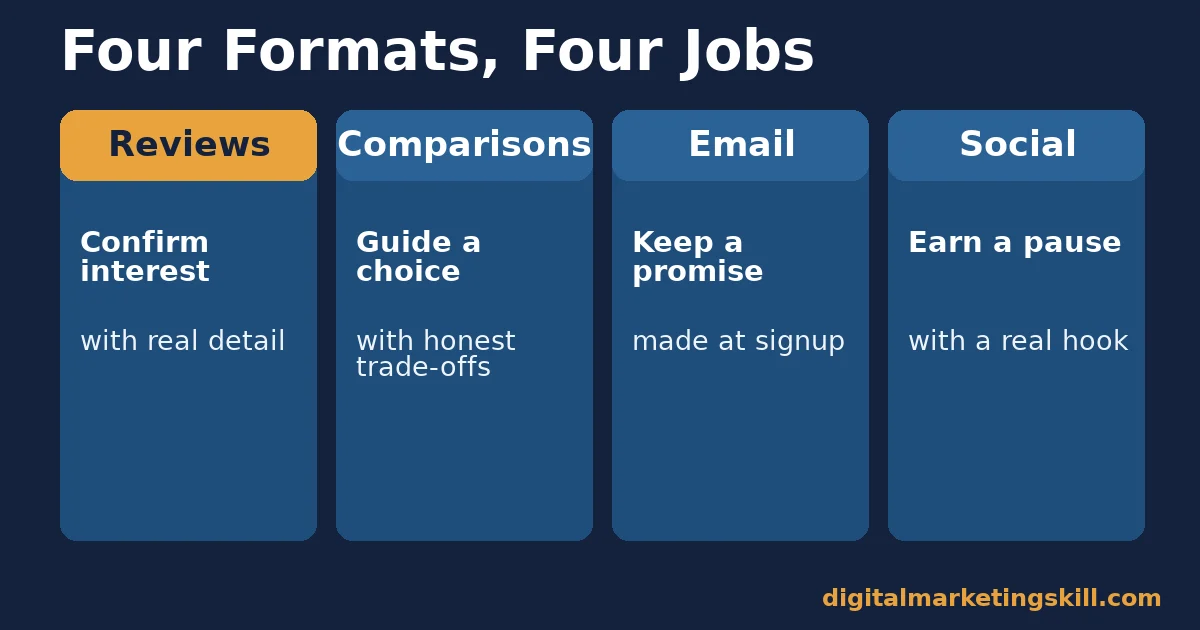
A single “affiliate content” approach does not really exist. Reviews, comparisons, email and social posts each earn a click in a different way. This guide covers four formats most affiliate marketers actually use: in-depth reviews, comparison posts, email, and social media. Each one needs its own read of the trust mechanism above before it needs tactics.
In-Depth Reviews: Built for Readers Who Already Want the Product
A review earns its click from specificity. A reader who reaches a product review has usually already decided they are interested. The job of the content is to confirm or correct that interest with real detail. It should cover what the product does well, what it does not, and who it actually suits.
Generic praise fails here for the exact reason Clutch’s data shows. Readers do not trust a rating without detail, and they actively distrust content that reads like it was written without hands-on use. A review that only lists specifications without an opinion reads as unconvincing at best and AI-generated at worst.
Comparison Posts: Built for Readers Still Deciding
A comparison post earns its click from structure. These readers have not committed to one product yet. The content’s job is to make the differences between two or three options clear and honest. That includes the cases where the cheaper or less popular option is genuinely the better fit for a specific reader.
The trap is bias toward whichever option pays the highest commission. Readers who sense that bias stop trusting the whole post, not just the recommendation. This is the same dynamic the FTC’s Fashion Nova case shows at a larger scale. Once an audience suspects feedback is being shaped to look better than it is, trust in everything else on the page drops with it.
Email: Built for an Audience That Already Opted In
Email earns its click from a relationship that already exists. A subscriber chose to hear from you, so email does not need to win attention the way a cold review does. It needs to keep a promise made when they signed up.
Litmus’s survey of nearly 500 marketers worldwide found 35% of companies see $10 to $36 back for every $1 spent on email. The highest-performing industry in the data is retail and e-commerce, which averages roughly 45 to 1. That return exists because email reaches people who already said yes once, not because the format is inherently persuasive.
Social Media: Built for Interrupting, Not Searching
Social posts earn their click from a hook. Nobody opens a social feed looking for your affiliate link the way a searcher looks for a review. The content has to work as a standalone thought first, with the product recommendation as a natural extension of it, not the opening line.
This format also carries the highest disclosure risk. The FTC’s guidance explicitly covers affiliate links in social posts. The fast, casual tone of social media makes it easy to drop the disclosure by accident. Build the disclosure into your posting habit, not into a one-time policy you set and forget.
How to Lead With Each Format
Understanding why each format earns a click only matters if it changes what you publish next, which is the real purpose of practical affiliate marketing tips. The four sections below mirror the four formats above, each with the single highest-leverage change to make.
In-Depth Reviews: Lead With What You Would Tell a Friend
Write the one honest sentence you would tell a friend before you write the polished version, then build the review around that sentence. Name a real limitation, not just a strength. A review with zero criticism reads as unconvincing to the same readers who already distrust star ratings without detail. Our guide on creating content your audience actually wants covers the structure in more depth.
Comparison Posts: Lead With the Case Against Your Top Pick
Include at least one honest reason a reader might choose a different option than your top recommendation. This single habit does more for trust than any disclaimer. It proves the post was not just built around the highest commission. Pick your comparison set from programs you have actually used. Our guide to choosing affiliate programs covers what to check before you join one.
Email: Lead With the Promise You Made at Signup
Reread what you told people they would get when they subscribed, then judge every affiliate email against that promise before you send it. A subscriber list built on “weekly deals” tolerates a different pitch frequency than one built on “in-depth reviews.”
Match the product recommendation to the expectation you set from the start. See our guide to email marketing strategies that lift revenue for the sending cadence and list-health side of this.
Social Media: Lead With the Hook, Then the Disclosure
Write the hook first, exactly as you would without a product attached. Then add the recommendation and a plain-language disclosure before you publish.
Keep a saved template for the disclosure so it never gets dropped in a rush. For more ways to get the click once someone is interested, see our guide on ways to promote affiliate products, and pair that traffic plan with our broader guide to ways to increase website traffic for free.
Measuring Whether Your Affiliate Marketing Tips Are Working
Pick metrics that match the format from the sections above, instead of watching only total clicks. Each one below is defined in a single sentence, with a note on how to read it.
- Earnings per click (EPC). Total commission earned divided by total clicks sent to an offer. Use this to compare two programs fairly. A program with a lower commission rate can still have a higher EPC if it converts better.
- Conversion rate by format. The share of clicks from a review, comparison post, email or social post that result in a sale. Tracking this by format, not just by page, shows you which content type actually earns your audience’s trust.
- Cookie window attribution. The share of sales credited to you that happened after the visitor’s first click, within the program’s tracking window. A longer window usually means more credited sales from the same traffic. Compare programs on this, not commission rate alone.
- Disclosure visibility. Whether your disclosure appears within the first screen of a post or email, checked manually on a sample of your own content. This is a compliance metric, not a vanity one, but it is the one most affiliates never actually audit.
- Repeat-reader rate. The share of clicks on your affiliate links that come from returning visitors rather than first-time ones. A rising repeat-reader rate is the clearest sign your content is building the trust Clutch’s research says purchases depend on.
Any honest set of affiliate marketing tips has to say this clearly: read these five metrics together, not in isolation. A high click count with a low EPC usually means the content attracts traffic that does not trust it enough to buy. A low repeat-reader rate alongside a high first-visit bounce means the trust-building step described above is missing, not the traffic itself.
Review all five on a monthly cadence rather than daily, since affiliate sales from content, as opposed to paid ads, rarely move fast enough for daily numbers to mean much.
The One Decision Rule: Fewer Programs, Measured Honestly
If you take one rule from these affiliate marketing tips, make it this one. Before you join another affiliate program, check the EPC of the programs you already promote. Only add a new one if it is likely to beat your current average. Promoting more programs without measuring them first is the single most common way affiliate marketers dilute trust. It is trust they have already spent real time building.
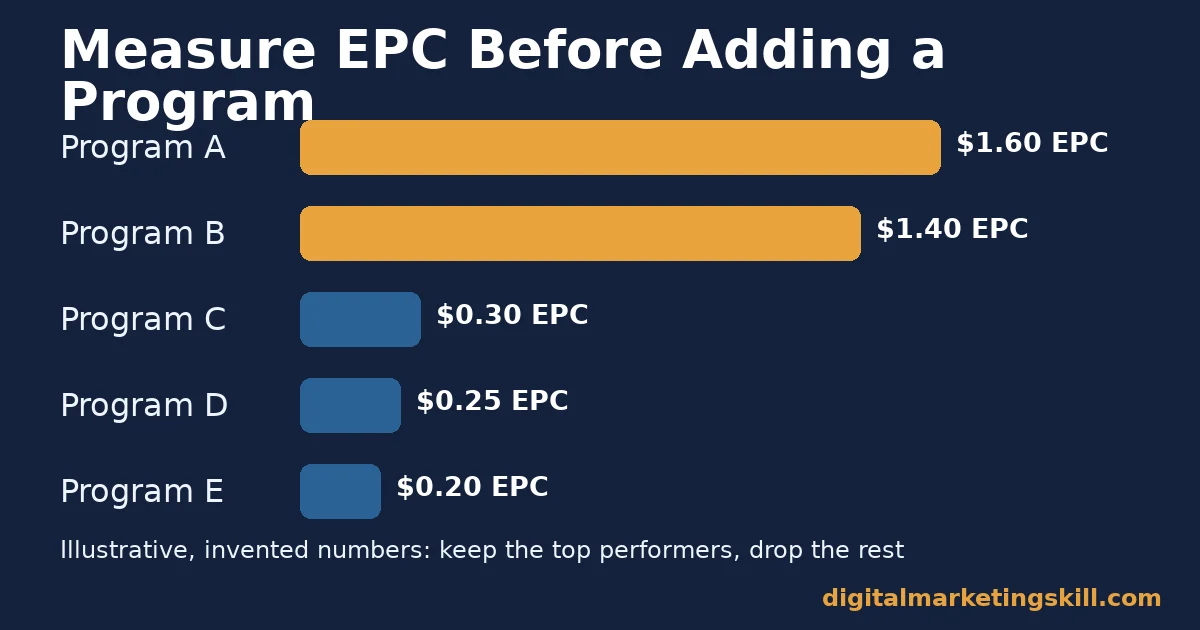
Here is an illustrative example, with invented numbers. A reviewer promotes five different software tools on one blog, earning a blended EPC of $0.80 across all five. After tracking EPC by program for a month, two tools account for $1.40 and $1.60 EPC, while the other three average under $0.30.
Dropping the three weak programs and writing two additional in-depth reviews for the strong ones lifts the blog’s total affiliate revenue. It does this even though the blog now promotes fewer products overall, because every recommendation left on the page now carries real conviction instead of being spread thin across options the reviewer barely trusted.
A Real Case: What the Fashion Nova Settlement Shows About Reviews
Fashion Nova is a retailer, not an affiliate marketer. Still, the FTC’s case against it is the clearest documented example of what happens when a business manages reviews dishonestly. That is exactly the trust this set of affiliate marketing tips is built around protecting.
According to the FTC’s own press release, Fashion Nova used a review management system that automatically posted four- and five-star reviews while holding lower-starred reviews for manual approval. Over several years, the company never approved or posted hundreds of thousands of those negative reviews.
The FTC required $4.2 million in consumer compensation. It also ordered Fashion Nova to post all customer reviews going forward, apart from unlawful or off-topic content.
The limit on this case is scope. It involves a retailer managing its own reviews, not an affiliate promoting someone else’s product. It is also one enforcement action, not proof of what happens in every similar situation. Read it as a documented worst case for what review manipulation costs, not a prediction for any specific affiliate site.
Frequently Asked Questions About These Affiliate Marketing Tips
What is the single most important affiliate marketing tip for beginners?
Disclose every paid link clearly, and write every review as if the reader can tell when you are not being honest, because they usually can. Clutch’s research found only 15% of consumers trust a star rating alone, so detail and honesty are what actually convert.
Do I have to disclose affiliate links on social media too?
Yes. The FTC’s guidance covers affiliate links in tweets, social posts and emails, not only blog content. It says even a single commission-earning link requires disclosure.
How many affiliate programs should I promote at once?
Fewer than most beginners think. Track the earnings per click of each program you already promote. Only add a new one if it is likely to outperform your current average, rather than spreading your audience’s trust across many unmeasured programs.
Is affiliate marketing still worth starting, given how large the market is?
Yes, though competition is real. Grand View Research values the global affiliate marketing platform market at $23.8 billion, growing steadily, which means more competing content but also more proven programs and tools to choose from.
Does email still work for affiliate promotion?
Yes, often better than other channels. Litmus’s research across nearly 500 marketers found email returning $36 or more for every $1 spent at over a third of companies surveyed, because it reaches people who already opted in.
What happens if I don’t disclose my affiliate links?
You risk both reader trust and regulatory action. The FTC can and does enforce disclosure rules. Separately, the Fashion Nova case shows how expensive review manipulation becomes once a regulator investigates it.
How long does it take to see real affiliate income?
Longer than most new affiliates expect, because trust-based content compounds slowly. There is no verified universal timeline, so treat any specific promise of fast affiliate income as a red flag rather than a realistic plan. The affiliate marketing tips in this guide are built for that slower, trust-first reality, not a shortcut around it.
Start With One Format, Measured Honestly
Pick the one content format from these affiliate marketing tips that matches the audience you already have, whether that is in-depth reviews, comparisons, email or social. Commit to its matching metric for a full month before judging the results. These formats work together, but trying all four at once with no clear measurement is the most common reason beginners give up too early. Our guide on how to promote affiliate products across content, email, social and paid channels covers that channel-matching step in more depth.
If you want structured, hands-on practice building and measuring campaigns like this, the Digital Marketing Skill Institute teaches it inside the Master Diploma in Digital & AI Marketing. The program is built around four AI-powered tracks totalling ten courses, including AI-Powered Lead Generation and Email Automation and AI-Powered Social Media Management and Advertising, with a Full Stack option for completing all four tracks.
It includes unlimited 1-on-1 coaching and mentoring and a U.S. Project Internship with a verified U.S. Work Reference Letter.
It is dual US and UK accredited and recognised in more than 100 countries, and fully online, so you can study from anywhere in your country. Browse more guides on the Digital Marketing Skill Institute blog, read real outcomes on the reviews page, or go straight to the Master Diploma program page and apply when you are ready. You can also start from the Digital Marketing Skill Institute homepage.
Every figure in this guide was checked against its original source before publication. Figures marked as illustrative are invented examples, not real results.
