Most people choose a digital marketing course the wrong way. They compare price and syllabus length. They skip the one thing that predicts success: whether the course has a real completion rate, a real project and a real outcome report. This guide shows you how to choose a digital marketing course using those numbers instead.
Key Takeaways
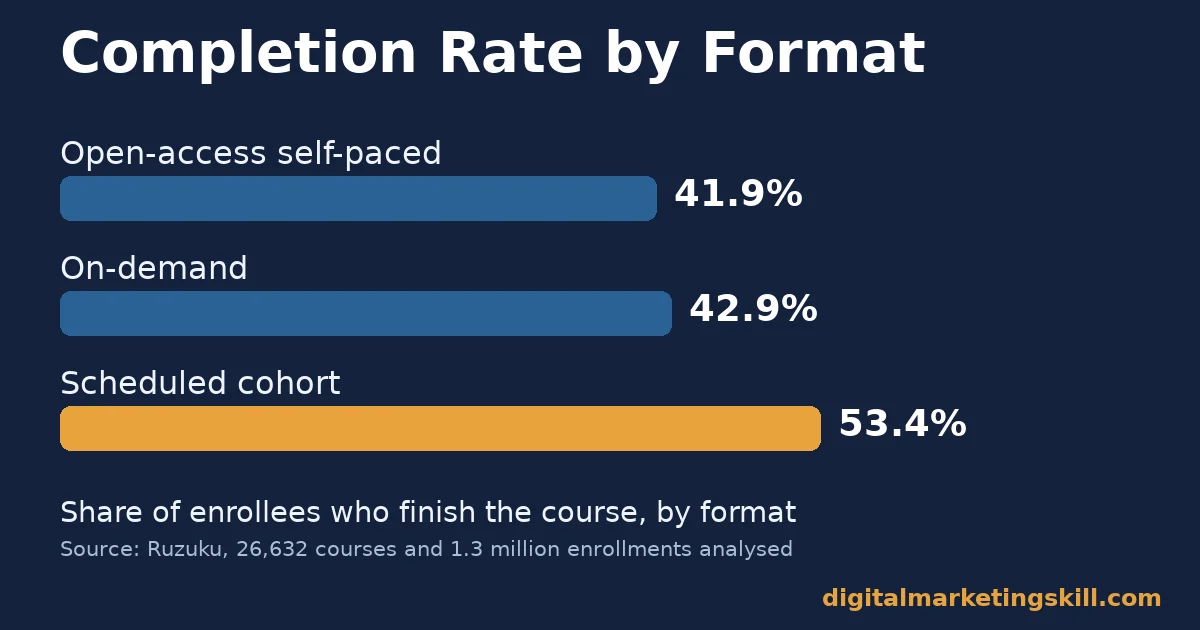
- Format predicts finishing. Scheduled cohort courses complete at 53.4%. Open-access self-paced courses complete at 41.9%. The data comes from 26,632 courses and 1.3 million enrollments, tracked by course platform Ruzuku.
- The first week decides the outcome. In the same dataset, learners who finished one lesson in week one went on to complete the course at 78.3%. Learners who did not finish a lesson in week one dropped to 17.2%.
- Discussion changes the odds. Courses with lesson-level discussion completed at 50.9%. Courses without it completed at 37.3%.
- Most free, open courses are not finished. Class Central tracks MOOCs worldwide, and its figures are compiled in Ruzuku’s course statistics report. Its median completion rate sits at 12.6%, and it has stayed low for years.
- A certificate can help, but read the fine print. 75% of graduates of one Google certificate on Coursera reported a positive career outcome within six months. The figure comes from a US graduate survey, and it is self-reported.
In this guide
- Why It Is Hard to Choose a Digital Marketing Course
- How Course Completion Actually Works
- What Differs by Format
- How to Get the Most From Each Format
- Match the Format to Your Real Constraint
- Red Flags That Predict You Will Not Finish
- How to Measure a Course Before You Commit
- The Rule That Makes It Easy to Choose a Digital Marketing Course
- A Real Case: Why Skills Mattered More Than Location
- Frequently Asked Questions About How to Choose a Digital Marketing Course
- Where to Go Next
Why It Is Hard to Choose a Digital Marketing Course
Most “best courses” articles compare price and syllabus. However, they rarely say how many people finish. That is the real gap. Almost no course page volunteers its own completion rate, so buyers compare the wrong column entirely. That gap matters because the pay and demand data for a digital marketing career depend far more on finished, demonstrable skills than on which course logo appears on your certificate.
Two ground rules before you compare anything. First, a completion rate is a signal, not a guarantee. It describes past learners, not you specifically. Second, ignore any number with no stated sample size or date.
For instance, “thousands of successful graduates” is not a statistic, while a dated, named survey is. Because of this, the checks below focus on numbers you can actually verify, not marketing language. The goal of this guide is simple: give you a repeatable way to choose a digital marketing course, so the decision takes minutes rather than weeks of comparing landing pages.
How Course Completion Actually Works
Course platforms that publish completion data consistently see the same pattern: structure beats content. The topic and the instructor matter less than the schedule and the group. For example, Ruzuku’s analysis of 26,632 courses found cohort courses finishing at 53.4%. On-demand courses finished at 42.9%. Meanwhile, open-access self-paced courses finished at 41.9%.
The gap is not about subject difficulty. A cohort and a self-paced course can teach the exact same material. Even so, they finish at different rates, because the schedule and the group do work the content alone cannot do. In other words, two identical lessons can produce opposite outcomes depending only on the format around them.
One single number predicted completion better than format did: whether a learner finished a lesson in week one. Learners who did went on to finish at 78.3%. By contrast, learners who did not dropped to 17.2%. That gap explains why “I will start it this weekend” so often becomes a course nobody opens again.
Five Checks Before You Choose a Digital Marketing Course
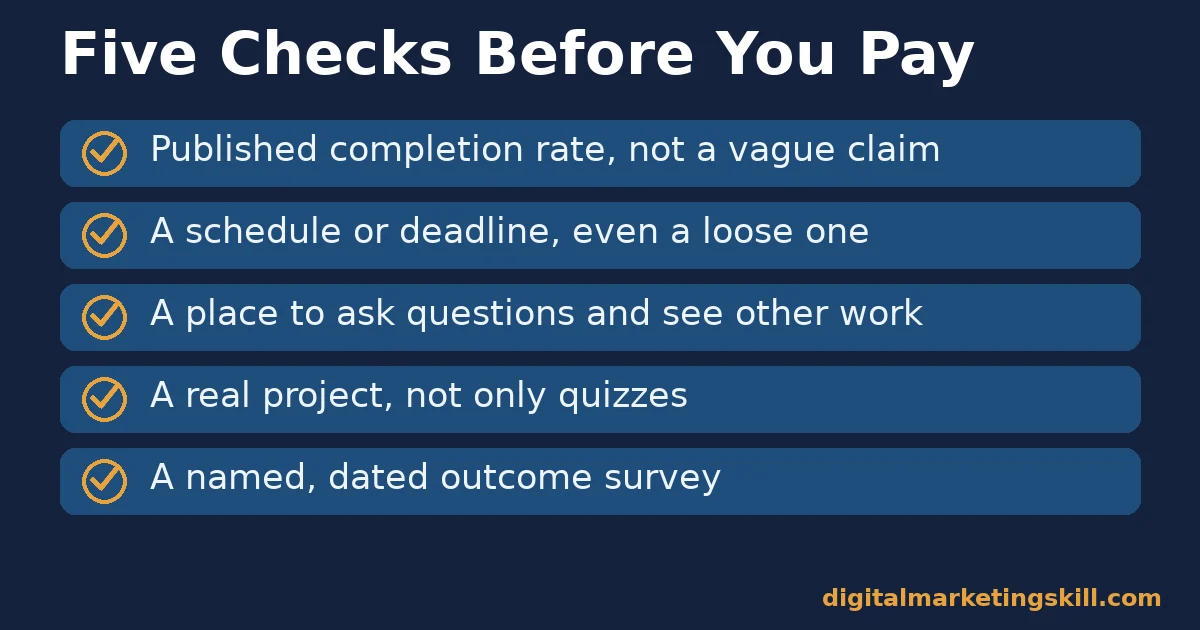
- Is there a published completion rate? If a provider will not say, assume it sits near the 10-20% self-paced average.
- Is there a schedule or deadline? Even a loose one removes the biggest lever a course has over your behaviour.
- Is there a place to ask questions? Discussion-enabled courses in the Ruzuku data finished 36% more often than courses without it.
- Is there a real project, not just quizzes? A project you can show an employer beats a certificate alone.
- Is there a named, dated outcome survey? “Our graduates get jobs” is not proof. A sized, dated figure is.
What Differs by Format
Self-Paced Courses: Built for Flexibility
Self-paced courses let you start any day, and you can move at any speed. That flexibility suits anyone fitting study around a job or care duties. Still, the trade-off is completion. No cohort data shows self-paced formats beating scheduled ones, and the honest average sits at 10-20% finishing at all.
The format itself is not broken. Rather, it simply removes every outside reason to keep going. It only works if you supply your own schedule, your own deadline and your own accountability.
Cohort Programs: Built for Completion
Cohort and mentored programs run a group through the same material on a calendar. Most add a mentor, live sessions or peer review. As a result, cohorts finish at higher rates across every dataset that measures it. In Ruzuku’s cohort comparison, named programs with active peer discussion report completion as high as 85% and above, and one cohort program is cited at 96%.
The trade-off, however, is flexibility. You commit to a start date and a pace, usually at a higher price. In exchange, you get the calendar pressure and social pressure that a self-paced course simply cannot match.
How to Get the Most From Each Format
Self-Paced Courses: Protect Your First Week
If you choose self-paced, put lesson one on your calendar within 48 hours. Do not wait for “this weekend.” After all, finishing one lesson in week one roughly quadrupled completion odds in the Ruzuku data.
That single calendar entry is the highest-leverage step you can take, before you learn anything else. In addition, pair it with an accountability partner, or simply tell a friend your start date out loud. Both habits replace the structure a cohort gives you for free.
Cohort Programs: Use the Mentoring You Are Paying For
Paying more for a cohort only pays off if you use the mentoring that comes with it. Bring one real question to every live session, and submit work for feedback even when it feels unfinished.
Furthermore, ask the provider directly for their outcome data, and how it was measured. If the program pairs you with an individual coach, treat that relationship like finding a digital marketing mentor outside a course too: the goal is feedback on real work, not just a checklist of modules.
Otherwise, a mentored program behaves exactly like the cheaper self-paced course you tried to avoid, if its office hours go unattended and its project goes unsubmitted.
Match the Format to Your Real Constraint
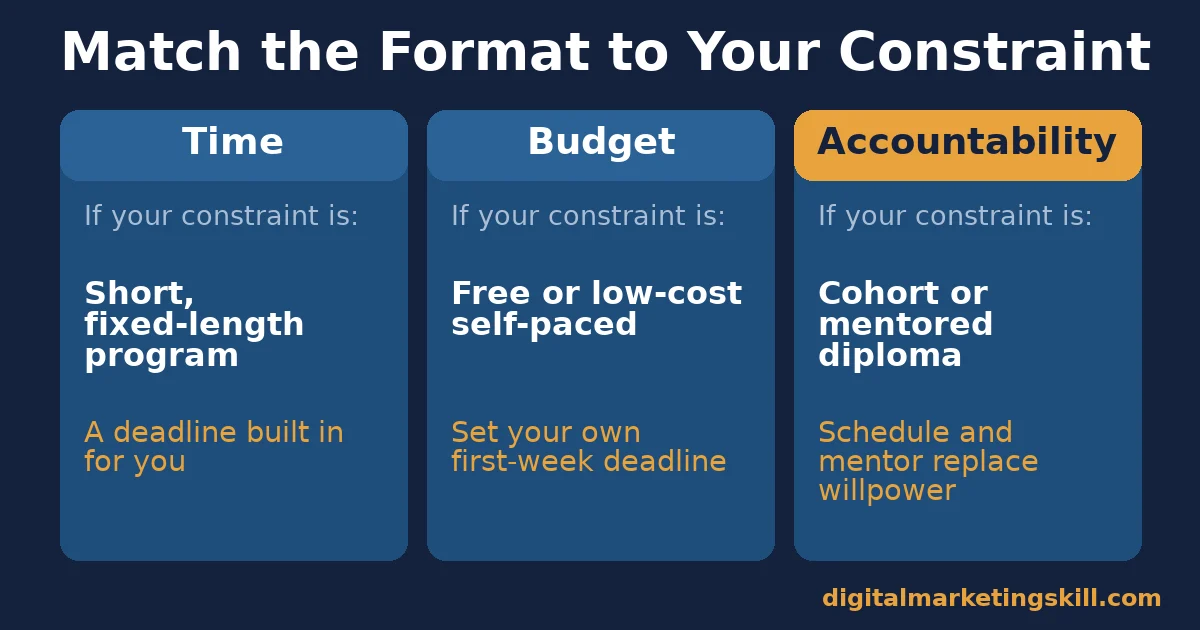
The checks above work for any provider, but which format to choose a digital marketing course from still depends on your biggest constraint right now. Three constraints come up most often: time, budget and accountability.
Each points toward a different trade-off, not a different quality level. Identify yours honestly before you read the three options below, since picking the wrong one for your real situation is the most common reason a course goes unfinished.
If Your Constraint Is Time
A short, intensive program that runs for a few fixed weeks can beat both a long self-paced course and an open-ended cohort, because the deadline is built in rather than self-imposed. Ask the same five checks regardless: a tight schedule with no completion data or project is still just a fast way to not finish.
If Your Constraint Is Budget
Free and low-cost self-paced options are reasonable here, but go in with eyes open about the 10-20% completion average. Treat the course as a trial rather than a commitment, and set your own first-week deadline manually, since the provider will not set one for you.
If Your Constraint Is Accountability
If you have tried and abandoned self-paced courses before, the data above says the problem is probably the format, not you personally. A cohort or mentored diploma replaces the willpower a self-paced course demands with a schedule, a mentor and a group, which is exactly the structure that produces higher completion in every dataset cited in this guide.
Red Flags That Predict You Will Not Finish
Beyond the five checks above, a few warning signs show up again and again in course reviews. First, a syllabus with no mention of a final project usually means the “skills” are theoretical only. Second, a provider that cannot name its own completion rate is, in effect, telling you it has not measured one.
Third, testimonials with no name, photo or verifiable detail are not evidence, regardless of how specific the number sounds. A genuine list of in-demand digital marketing skills is a far better yardstick for a syllabus than a wall of unverifiable quotes.
Finally, watch for urgency language instead of outcome language: “enrol before the price rises” says nothing about whether you will finish or benefit, while a published completion rate and project sample say everything. When a course page leads with scarcity rather than evidence, treat that as a signal in itself.
None of these red flags are fatal on their own. A course with one weak spot can still be worth choosing if the other checks hold up. It is the combination, not any single flag, that should change your decision.
How to Measure a Course Before You Commit
Five Numbers Worth Asking For
- Completion rate. The share of enrollees who finish. Under 20% is normal for open self-paced courses, so judge a paid cohort against the 50%+ range instead.
- Time to first lesson. The average days between enrolling and starting. A provider that cannot answer is likely not tracking it, and that silence is itself a signal.
- Practical-hours ratio. The share of course hours spent on a real project, not videos. A higher ratio usually means more employer-visible output per hour.
- Outcome rate and its sample. The share of graduates reporting a job or promotion, plus the survey’s size and date. Treat self-reported figures, like Coursera’s 75%, as a signal, not a promise.
- Cost per completed hour. Price divided by course length, multiplied by its completion rate. As a result, a cheap course finished by few people can cost more per completed hour than a pricier one most people finish.
Taken together, these five numbers do more work than any star rating or testimonial page. A course that can answer all five with a dated, named source is rare, and that rarity is exactly why it is worth the extra search time when you choose a digital marketing course.
Three Options, Side by Side
Here is how the five numbers might look across three real-world formats. These specific figures are illustrative, invented numbers, built from the completion ranges verified earlier in this guide, not a single provider’s real results.
- Free self-paced course: completion rate 15%, no mentor contact, no project, outcome data not published. Cost per completed learner is effectively infinite if nobody can confirm outcomes.
- Mid-priced fixed-length bootcamp: completion rate around 45%, light mentor contact, one project, an outcome survey with a stated sample of a few hundred graduates.
- Mentored cohort diploma: completion rate around 55%, weekly mentor contact, a real project with a named partner, and a dated outcome survey.
Laid out this way, the decision to choose a digital marketing course stops being about which provider has the nicest landing page, and starts being about which row you can actually verify.
A Two-Minute Script to Use Before You Pay
Use this short script on any sales call or chat widget, before you choose a digital marketing course. Keep each question short. Expect a short, specific answer back.
- “What share of students who start this course actually finish it?”
- “Is there a real project, and can I see a sample of finished work?”
- “What is your outcome rate, and what year and sample size is it based on?”
- “Will I have a named mentor, and how often can I contact them?”
- “Is there a fixed schedule, or is this fully self-paced?”
A confident provider answers all five in under two minutes, with numbers attached. A hesitant answer, or a pivot back to price and bonuses, is itself useful data.
The Rule That Makes It Easy to Choose a Digital Marketing Course
If a course cannot show you a completion rate, a real project and a dated outcome survey, treat its price as the least reliable number on the page. A free course you never finish costs more in time than a paid program you complete.
Worked example: a free self-paced course finished by 15% of enrollees, and a $600 cohort finished by 55% of enrollees, mean the cohort’s real cost per completed learner is lower, in time-adjusted terms, even though its sticker price is higher. In short, four times as many paying learners in that example actually get the result, so the “expensive” option is the cheaper one once you adjust for who actually finishes.
A Real Case: Why Skills Mattered More Than Location
The Digital Marketing Skill Institute publishes named student outcomes on its reviews page. Graduate Kofi B. described the deciding factor in a remote hiring process this way: “What won me the remote role in Canada was my AI marketing knowledge. I could do the work of a 3-person team. My location became irrelevant.”
This is one real, named testimonial. It is not a representative sample, and it carries no income figure or guarantee. Still, it shows that in this documented case, an employer weighed demonstrated skill over geography. It does not mean every graduate gets the same result, and no course can honestly guarantee income or a job, consistent with the Institute’s own earnings disclaimer.
Frequently Asked Questions About How to Choose a Digital Marketing Course
What should I check before I choose a digital marketing course?
Ask for a published completion rate, and confirm there is a real project, not just quizzes. In addition, check for a schedule or mentor contact, and ask for the outcome survey’s sample size and date, not a vague success claim. The five checks earlier in this guide work as a short script for that conversation, whichever provider you are speaking with.
Is a free course as good as a paid one?
Free, open courses teach similar material. However, MOOCs finish at a median of around 12.6%, well below cohort formats. Therefore, a free course is a fine way to sample a topic, but it is a weaker bet if your goal is a finished credential or a portfolio piece.
Does a certificate from an online course actually help job applications?
It can, especially when paired with a visible project. For example, one Coursera certificate’s US graduate survey found 75% saw a positive career outcome within six months. That number is self-reported by graduates who chose to respond, so treat it as a signal, not a promise.
How long should a good digital marketing course take?
Long enough to include a real project, yet short enough that you finish lesson one within a week of enrolling. Typically, a 10-12 week program, with weekly live contact and a final project, is common among mentored diploma programs for this reason.
What is the difference between a MOOC and a mentored diploma program?
A MOOC is usually free, self-paced, and has no mentor or cohort, which is why completion stays low. A mentored diploma program, on the other hand, runs on a schedule, adds coaching, and usually requires a real project, which is why its completion rate runs far higher.
Can I learn digital marketing without a marketing background?
Yes. Entry-level digital marketing roles rarely require a marketing degree. For context, the US Bureau of Labor Statistics projects about 7% growth over its ten-year outlook window for market research and marketing specialist roles, and employers in the field typically look for a portfolio over a specific prior credential. This lines up with the broader pattern covered in how a digital marketing career path rewards proof over credentials.
Should I just pick the cheapest course?
Not automatically, since price barely relates to completion or outcome. A cheap course you never finish has a real cost in time, so weigh price against completion rate, project quality and mentoring access first. That order, not price first, is the fastest way to choose a digital marketing course you will still be using in six months.
Does the platform matter more than the course?
No. Platform brand recognition does not appear in any of the completion or outcome data cited in this guide.
A well-known platform hosting a self-paced, unmonitored course still finishes at the self-paced average. A lesser-known provider with a cohort, a mentor and a published outcome rate is the stronger bet by the numbers, regardless of name recognition. When you choose a digital marketing course, treat the brand as background noise and treat the five checks earlier in this guide as the actual signal.
Where to Go Next
Use this guide to choose a digital marketing course, and the five checks above work on any provider you are considering, not only the one you pick in the end.
If you want a program built around them, the Digital Marketing Skill Institute’s Master Diploma in Digital & AI Marketing includes ten practical courses across four AI-powered tracks, unlimited 1-on-1 coaching and mentoring, and real project work inside a U.S. partner company from day one.
It is dual US and UK accredited, recognised in more than 100 countries, and delivered 100% online, so you can study wherever you live. This guide will not tell you which single provider to pick, because the right answer depends on your constraint, your budget and how you personally respond to deadlines; it will tell you which five numbers to demand before you pay anyone.
Read more on the digital marketing blog, see real outcomes on the reviews page, and when you are ready, check the Master Diploma program page or apply. Everything the Institute publishes about itself is on digitalmarketingskill.com, so you can verify any claim here before you enroll anywhere.
Every figure in this guide was checked against its original source before publication. Figures marked as illustrative are invented examples, not real results.
![9 Amazing Digital Marketing Skills to Make Money Online [With Proof]](https://digitalmarketingskill.com/wp-content/uploads/2019/07/9-Amazing-Digital-Marketing-Skills-to-Make-Money-Online-With-Proof-17.png)