
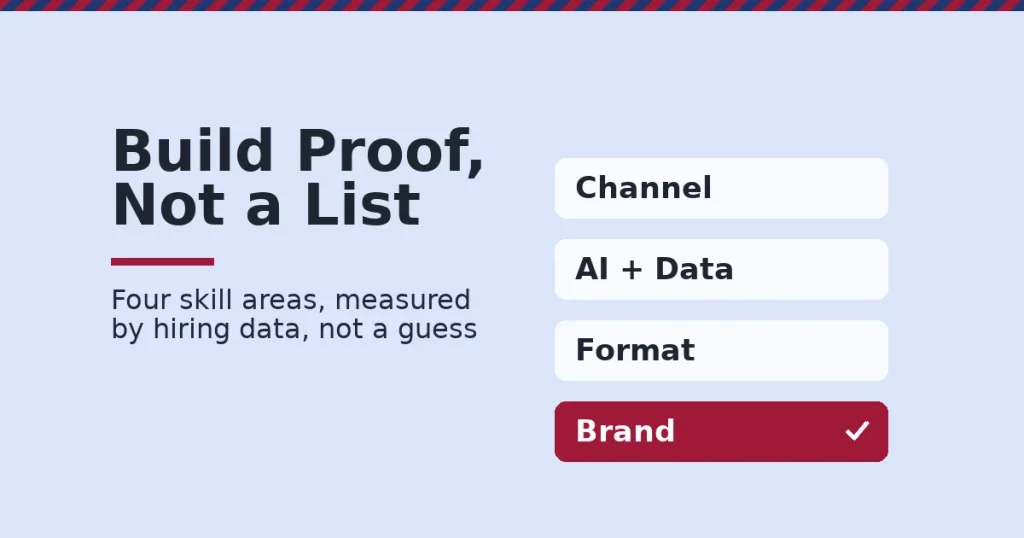
In-demand digital marketing skills are the ones employers are actually hiring for, not the ones a listicle guesses at. Real demand shows up in job postings, who gets hired, and what people add to their profiles. This guide groups them into four areas and shows how to build proof employers trust.
Key Takeaways
- Demand is measurable, not a guess. LinkedIn’s Skills on the Rise research tracks skill growth through three signals: skill acquisition, hiring outcomes and job-posting presence, not opinion.
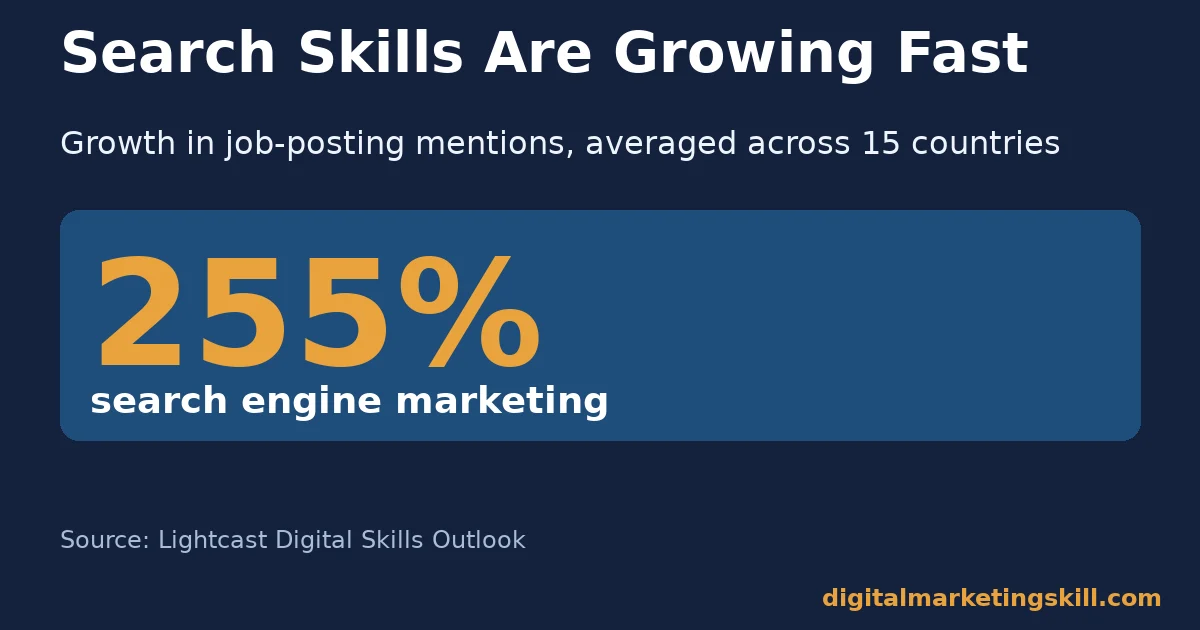
- Search skills are growing fast. Lightcast’s Digital Skills Outlook found that search engine marketing mentions in job postings grew 255% on average across 15 countries.
- AI literacy already ranks top. LinkedIn’s Skills on the Rise research places AI literacy among the top five fastest-growing skills across most regions. It ranks first in the US, Australia and Brazil.
- Video is now baseline, not optional. Wyzowl’s State of Video Marketing report, cited by Piktochart, found that 91% of businesses now use video as a marketing tool.
- Employers are acting on this now. HubSpot’s State of Marketing survey found that 86.4% of marketers already use AI tools, mainly for content and media creation.
In this guide
- What Most “Skills in Demand” Lists Get Wrong
- How In-Demand Digital Marketing Skills Are Actually Measured
- In-Demand Digital Marketing Skills Group Into Four Areas
- How to Build Proof for Each In-Demand Digital Marketing Skill
- The Decision Rule: Build One Skill Deep Before You Spread Thin
- How to Measure Whether Your Skill-Building Is Working
- A Real Case: What Lightcast’s Job-Posting Data Actually Showed
- How to Check In-Demand Digital Marketing Skills Yourself
- Frequently Asked Questions About In-Demand Digital Marketing Skills
- Pick One Channel Skill and Build Real Proof First
What Most “Skills in Demand” Lists Get Wrong
Most ranked lists of in-demand digital marketing skills are a writer’s best guess, dressed up as a forecast. They name a dozen skills, tie them to a single year, and move on. None of that tells you whether employers are actually hiring for any of it.
This guide uses a different standard. A skill counts as genuinely in demand only if it shows up in real labor-market signals. Those signals are job-posting growth, hiring data, or a named survey of marketers and businesses. That is a higher bar than a blog post’s opinion, and it ages better too.
Ground rules before you read on. Job-posting and skill-growth figures are a snapshot of one measurement period, not a permanent ranking. Demand shifts as the market does. Survey figures are self-reported by the people and companies who answered them. Treat every number here as directional evidence, not a guarantee.
How In-Demand Digital Marketing Skills Are Actually Measured
Labor-market data uses three types of signal. Each one measures something different. The first is skill acquisition: how fast people add a skill to their public profile. That shows interest. It is not proof employers want it.
The second is hiring outcomes: the share of people with a given skill who actually got hired. LinkedIn uses this exact method in its Skills on the Rise research.
The third is job-posting presence: how often a skill appears inside real job listings. This is what Lightcast’s Digital Skills Outlook tracks across 15 countries.
Hiring outcomes and job-posting presence matter more than acquisition alone, because anyone can list a skill on a profile. A skill only earns a place in this guide when one of those two harder signals backs it up. That filter separates in-demand digital marketing skills from skills that just sound current.
In-Demand Digital Marketing Skills Group Into Four Areas
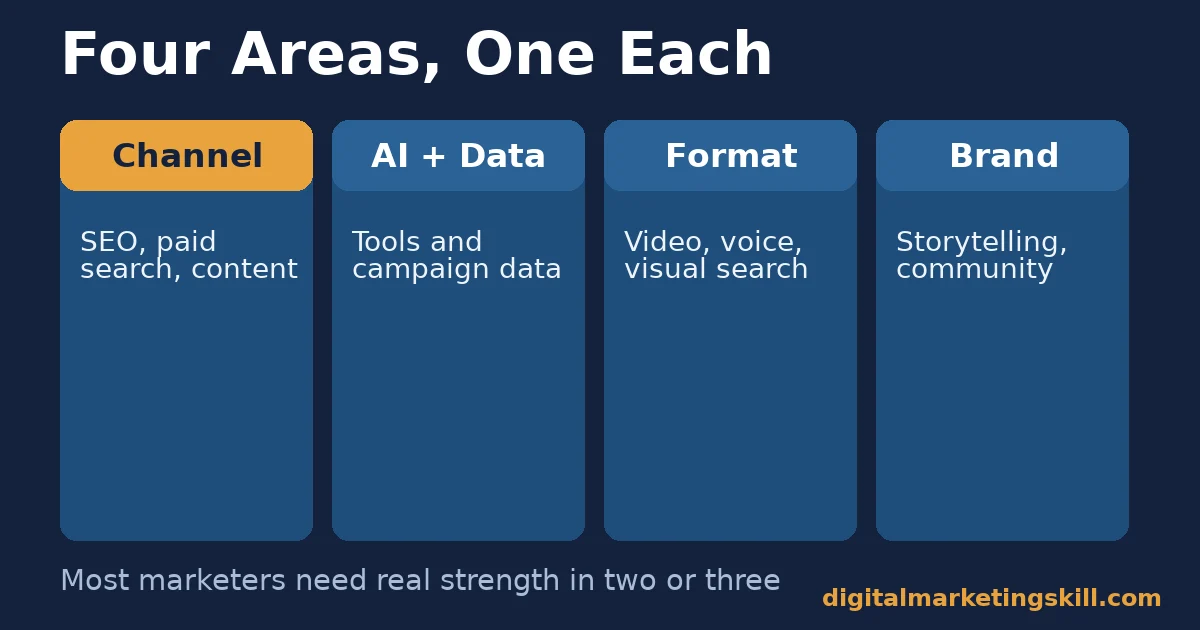
Instead of a flat list of fourteen skills, group them by the kind of work they do. Each area answers a different employer need. Most marketers only need to be strong in two or three of them. Taken together, these four areas cover the in-demand digital marketing skills that keep showing up across job postings, hiring data and survey research, rather than fourteen loosely related tags.
Channel Skills: Built to Run the Core Campaigns
Channel skills are SEO, paid search and email or content marketing. They run the campaigns that most marketing budgets still depend on. They are also the skills most job postings name first.
Lightcast’s Digital Skills Outlook found that search engine marketing mentions in job postings grew 255% on average across the 15 countries it studied. That is the single largest jump of any marketing skill in its data, and it is a job-posting signal, the harder kind, not just profile growth.
AI and Data Skills: Built to Direct the Work, Not Just Do It
AI and data skills cover applying AI tools to marketing tasks and reading campaign data to make decisions. They matter because they change how the channel skills above get executed. They do not replace those channel skills.
HubSpot’s State of Marketing survey found that 86.4% of marketers already use AI tools, mainly for content and media creation. LinkedIn’s research places AI literacy among the top five fastest-growing skills across most regions studied, and first in the US, Australia and Brazil.
Format Skills: Built to Reach People Where They Actually Look
Format skills cover video, short-form video and optimising content for voice and visual search. They matter because the places people search and watch keep changing. A channel skill without a format to match it reaches fewer people.
Wyzowl’s State of Video Marketing report, cited by Piktochart, found that 91% of businesses now use video as a marketing tool, from a survey of 266 respondents. That makes video closer to a baseline expectation than a differentiator.
Brand and Community Skills: Built to Keep People Once You Reach Them
Brand storytelling and community building cover why someone stays a customer after the first purchase. The channel and format skills above only get a person’s attention. These skills are what keeps it.
These skills are harder to measure with job-posting data alone, since they show up inside broader titles like “content marketing” or “community manager” rather than as a standalone listing. Treat them as a real, high-value skill set, with softer evidence than the three areas above.
How to Build Proof for Each In-Demand Digital Marketing Skill
Knowing a skill area is in demand does not get you hired for it. The sections below mirror the four areas above, with one way to build real proof for each.
Channel Skills: Lead With One Campaign You Can Show
Pick one channel, SEO, paid search or email, and run one real or simulated campaign from start to finish. Document the goal, what you changed, and the result, even if the result is modest. A single real campaign beats a list of courses completed.
For SEO specifically, our step-by-step SEO guide for beginners covers the fundamentals employers expect a junior hire to already know.
AI and Data Skills: Lead With a Before-and-After, Not a Tool List
Do not just list the AI tools you have tried. Show one task you used to do manually, how you used an AI tool to do it faster or better, and what changed in the output. That before-and-after is what a hiring manager actually wants to see.
For the data side, learn to read one dashboard well before you learn five badly. Our guide to Google Analytics for beginners is a practical place to start.
Format Skills: Lead With Range, Not Just Volume
Do not just publish a lot of video. Show that you can work in more than one format: a short social clip, a longer explainer, and one piece optimised for how people actually search by voice or image. Range signals adaptability, which is what changing platforms reward.
Our guide on video marketing for beginners covers the format most employers are asking for right now.
Brand and Community Skills: Lead With a Retention Story
Instead of claiming you are “good at storytelling,” point to a specific case. Name an audience you built, grew or kept engaged, and what you did that made people stay. A retention story is concrete in a way a generic claim about creativity is not.
Our guide to brand storytelling breaks this down into a repeatable method rather than a vague skill.
The Decision Rule: Build One Skill Deep Before You Spread Thin
If you take one rule from this guide, make it this: get genuinely strong in one channel skill before you add AI, format and brand skills around it. A shallow grasp of four areas is weaker to an employer than real depth in one, backed by a second skill layered on top.
Here is an illustrative example, with invented numbers. A marketer spends three months going deep on SEO. They then spend one month each layering in AI-assisted content workflows and short-form video. By month five, they can show one strong core skill plus two supporting ones. That reads as a focused specialist, not someone who dabbled in everything at once.
Compare that with a marketer who spreads the same five months evenly across all four areas from day one. They finish with a shallow familiarity in everything and real proof of nothing. That is a weaker position in an interview, even though the total hours invested were identical.
The order matters because channel skills are what most job postings name first, per Lightcast’s data, so they get you shortlisted. Skip the channel skill and lead with AI or format work alone, and you risk reading as someone who can polish a campaign but cannot run one.
Already Employed? Apply the Same Rule to What You Learn Next
Pick the one gap most likely to show up in your next performance review, not the one that sounds most exciting in a headline. The other three areas are what help you stand out once the core skill is solid.
How to Measure Whether Your Skill-Building Is Working
Judge your own progress in in-demand digital marketing skills the same way employers judge demand: by real signals, not by how many courses you finish. Each metric below is defined in one sentence.
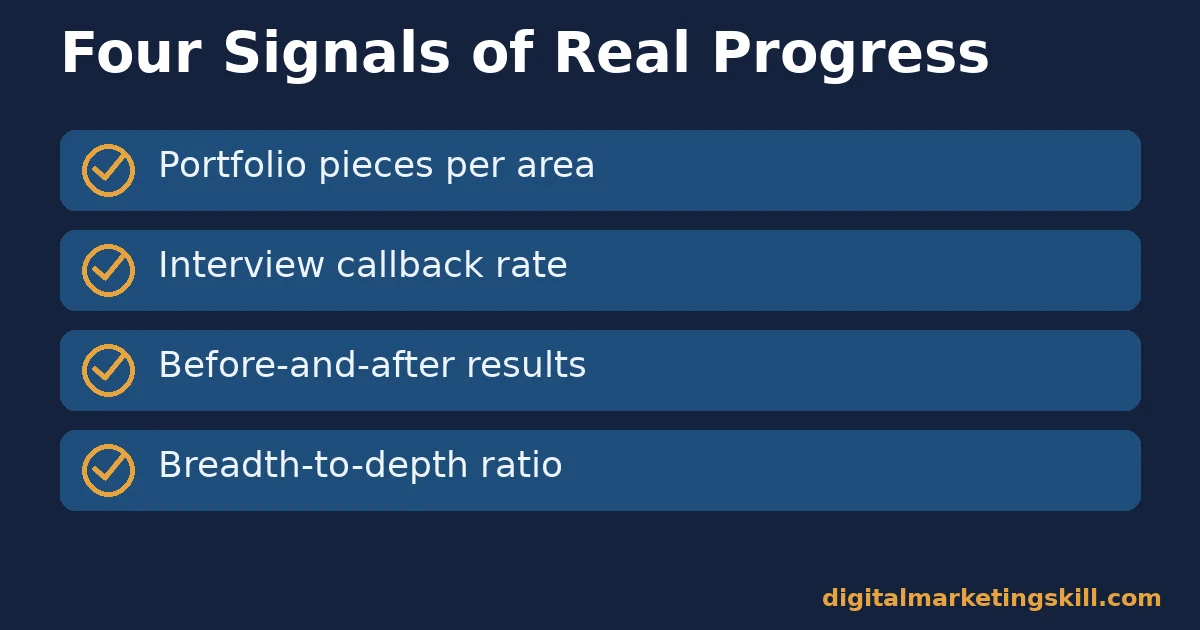
Four Signals That Show Real Progress
- Portfolio pieces per area. The number of real, documented pieces of work you can show for a skill area. One strong piece beats three vague ones.
- Interview callback rate. The share of applications that lead to a conversation. A rising rate after you add a skill is a direct signal it is landing with employers.
- Before-and-after results. Whether you can point to a measurable change you caused, even a small one, rather than only describing a task you performed.
- Breadth-to-depth ratio. How many areas you claim versus how many you can back with a real example. Keep this ratio close to even.
How to Read These Signals Together
Start with portfolio pieces, since the other three depend on having something real to point to. If your callback rate stays flat despite a growing portfolio, the issue is usually how you present the work, not the skill itself.
Review all four signals together every few months, rather than after a single application. One rejection does not mean a skill is not in demand. A pattern across many applications does. Keep a simple log of these four signals so that six months from now, you can see whether your chosen in-demand digital marketing skills are actually paying off, instead of relying on memory.
A Real Case: What Lightcast’s Job-Posting Data Actually Showed
Lightcast built its Digital Skills Outlook by tracking job postings across 15 countries, including the US, UK, Canada, Australia, New Zealand and ten EU countries. Rather than asking marketers what they think is in demand, it measured what employers were actually posting for.
The standout finding for marketing was specific. Search engine marketing grew 255% on average across those 15 countries, the fastest-growing digital marketing skill in the dataset. Lightcast’s own researchers describe this as one slice of a much larger dataset, not the full picture of every marketing skill.
The limit on this case is scope. It covers 15 countries, mostly wealthier economies, and one measurement period. Treat the exact figure as a strong directional signal, not a number that holds everywhere, forever.
What this case means in practice: if you are choosing between two channel skills and have no other information, the one with growing job-posting mentions is the safer bet. That is a more solid basis than a listicle’s opinion.
How to Check In-Demand Digital Marketing Skills Yourself
You do not need a research subscription to check whether a skill is genuinely in demand. A few free, repeatable checks will tell you more than another “top skills” article.
Search Job Boards for the Skill, Not the Job Title
Search a major job board for the exact skill name, such as “search engine marketing” or “AI content tools,” rather than a job title like “digital marketer.” Count how many postings mention it, and note whether that count has grown over the past few months. A rising count across multiple boards is a real signal, not a guess.
Check What Skills Appear on Senior Profiles
Look at the public profiles of people a few years ahead of you in the role you want. The skills that repeat across several of those profiles, not just one, are a reasonable proxy for what the role actually rewards over time.
Combine this with the harder signals from earlier in this guide: job-posting growth and hiring outcomes. Profile patterns alone can lag behind real demand, so use them to confirm a trend you have already seen elsewhere, not to discover one on their own.
Cross-Check Against Public Salary Data
Where a role pays more for a specific skill, that premium is itself a demand signal, separate from job-posting counts. Many salary-comparison sites let you filter or search by named skill, not just job title, so you can see whether a skill moves the number up.
Use this as a third, independent check, not your only one. A single high-paying listing proves little; a pattern across several sources, alongside rising job-posting counts, is what turns a guess about in-demand digital marketing skills into a reasonably confident bet.
Run all three checks, job boards, senior profiles and pay data, on the same skill before you commit real time to it. Each one catches something the others miss, and together they are harder to fool than any single source, including this guide.
Frequently Asked Questions About In-Demand Digital Marketing Skills
Which digital marketing skill is most in demand right now?
Search engine marketing shows the clearest job-posting growth, per Lightcast’s Digital Skills Outlook, which found a 255% average increase across 15 countries. AI literacy and content marketing also rank consistently high across multiple sources.
Is SEO still a high-demand skill?
Yes. SEO remains one of the channel skills named most often in job postings, because it directly affects a website’s visibility and a business’s ability to attract customers without paying for every click.
Do I need to learn AI tools to stay competitive in digital marketing?
It helps significantly. HubSpot’s State of Marketing survey found 86.4% of marketers already use AI tools, mostly for content and media creation, which makes AI literacy closer to an expectation than an edge.
What is the biggest skills gap in digital marketing?
The clearest gaps sit in technical and data-driven areas: applying AI tools with judgment, reading campaign data, and executing search engine marketing well. These are the skills companies report struggling most to hire for.
Are soft skills still part of in-demand digital marketing skills?
Yes, alongside technical skills, not instead of them. Communication, problem-solving and adaptability determine whether a technically skilled marketer can actually collaborate, explain decisions and adjust when a campaign underperforms.
How many digital marketing skills should I focus on at once?
One channel skill in depth, plus one supporting skill from the AI, format or brand areas. Spreading across many areas at once usually produces shallow proof in all of them, rather than real strength in any.
Do in-demand digital marketing skills change quickly?
The underlying channels change slowly, but the tools and formats inside them shift fast. That is why this guide measures demand by job postings and hiring data, not by a single year’s trend list, which goes stale within months.
Where can I check in-demand digital marketing skills for myself?
Search a major job board for the exact skill name and track how often it appears over a few months, check which skills repeat across the public profiles of people already in the role you want, and compare pay where a skill is named. Together those three checks are more reliable than any single ranked list.
Pick One Channel Skill and Build Real Proof First
Pick the one channel skill, SEO, paid search or content, that fits the role you actually want. Build one documented piece of proof for it before adding anything else. Layer in an AI, format or brand skill only once that first piece is solid. That order, proof first, breadth second, is the fastest route through the in-demand digital marketing skills covered in this guide.
If you want structured, guided practice rather than piecing skills together alone, Digital Marketing Skill Institute‘s Master Diploma in Digital & AI Marketing covers all four areas in this guide across ten courses and four AI-powered tracks, with a Full Stack option for completing all four.
It includes unlimited 1-on-1 coaching and mentoring and a U.S. Project Internship that ends with a verified U.S. Work Reference Letter. The diploma is dual US and UK accredited, and recognised in more than 100 countries, so you can build these skills from anywhere in your country.
Browse more guides on the Digital Marketing Skill Institute blog, or when you are ready, apply for the Master Diploma from the Digital Marketing Skill Institute homepage.
Every figure in this guide was checked against its original source before publication. Figures marked as illustrative are invented examples, not real results.
![9 Amazing Digital Marketing Skills to Make Money Online [With Proof]](https://digitalmarketingskill.com/wp-content/uploads/2019/07/9-Amazing-Digital-Marketing-Skills-to-Make-Money-Online-With-Proof-17.png)






