

Content marketing facts matter more than content marketing opinions. Most teams already believe in the idea and still get stuck on execution. The real blockers are discovery, conversion, and proof, not a shortage of ideas. This guide covers seven verified content marketing facts and what each one actually changes about your plan. It also shows how to measure whether your content is working at all, section by section.
Key Takeaways
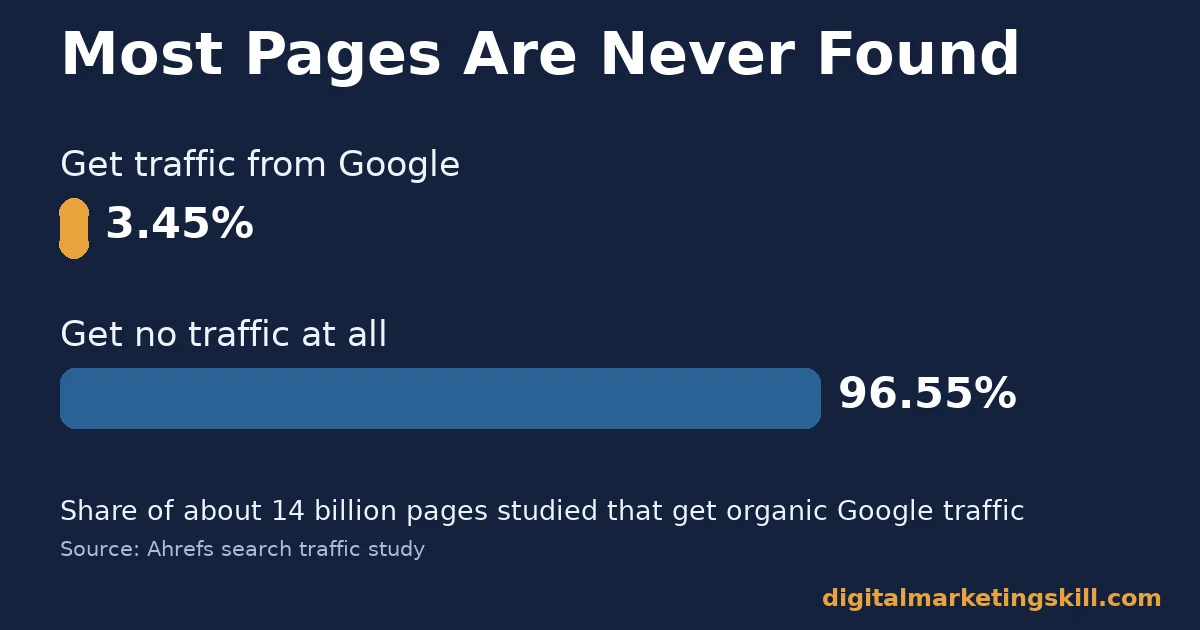
- Most content is never found. Ahrefs studied about 14 billion pages and found that 96.55% get no traffic from Google. Discovery is a bigger problem than output.
- Blogging is common, but rising results are not guaranteed. 65% of marketers work at companies that maintain a blog. Only half of those teams saw higher return than the period before (HubSpot).
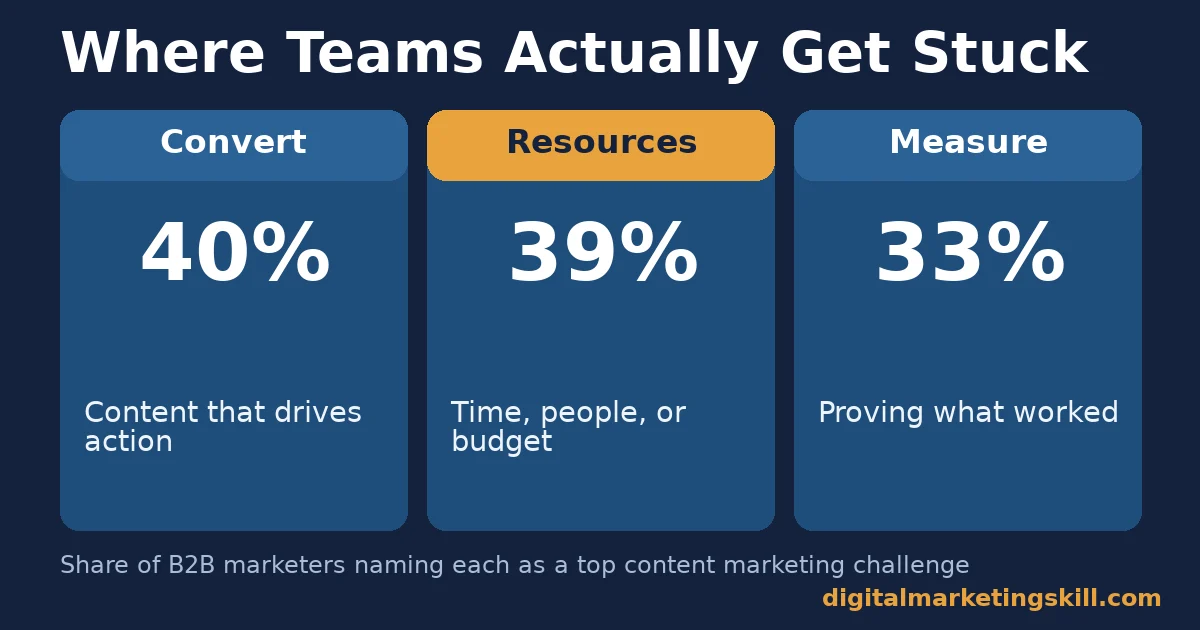
- The top struggle is conversion, not ideas. Creating content that prompts a clear action is the most cited challenge among B2B marketers. 40% of teams name it as their top problem (Content Marketing Institute).
- Thin resourcing is nearly as common a blocker. 39% of teams cite resource constraints, meaning time, people, or budget, as a top content marketing challenge (Content Marketing Institute).
- Measurement is the third major gap. 33% of B2B marketers name measuring content effectiveness as a top challenge (Content Marketing Institute). That is why so many teams cannot prove a result. This happens even when the content is genuinely working well.
In this guide
- What Most Content Marketing Facts Lists Get Wrong
- How Content Marketing Actually Earns Attention
- Three Content Marketing Facts About Where Teams Struggle
- How to Fix Each Struggle
- Five Reasons Content Marketing Facts Don’t Change Behavior
- How to Measure Whether Content Marketing Is Actually Working
- The Most Useful Rule: Fix Discovery Before You Make More Content
- A Four-Week Plan to Apply These Content Marketing Facts
- A Real Case: Turning One Project Into Paying Work
- Frequently Asked Questions About Content Marketing Facts
- Start With Your Ten Weakest Pages
What Most Content Marketing Facts Lists Get Wrong
Most lists of content marketing facts are trivia. They offer interesting numbers with no next step attached. That format entertains, but it rarely changes what a team does on Monday morning.
This guide ties each content marketing fact to one change worth making. It groups the evidence into three struggles that show up across most teams. It explains what to do differently for each, and gives a way to measure whether the change actually worked.
Ground rules first. The figures below come from named research firms, each surveying a specific, stated group. Treat every number as a strong signal rather than a universal law. This guide’s three-struggle framework is an informed way of grouping that evidence. It is not an industry-standard classification. Numbers will shift as platforms, algorithms, and surveys change. That is exactly why a list of content marketing facts needs re-checking every so often, rather than being trusted forever as fixed truth.
How Content Marketing Actually Earns Attention
Content earns attention in two stages. First it has to be found. Then it has to move someone to act. Most content marketing facts lists focus heavily on the first stage and barely mention the second. That gap is exactly where a lot of real effort quietly goes to waste.
Most Content Never Gets Found
Ahrefs looked at about 14 billion pages in its search traffic study and found that 96.55% get no traffic from Google at all. That is the blunt version of the first content marketing fact worth internalizing. Publishing is not the same as being discoverable, and no amount of good writing fixes a page that nobody can find. Google’s own guidance on writing titles for search results is a useful starting checklist: descriptive, specific titles, rather than vague ones, give search engines and readers an honest signal of what the page actually covers.
Blogging Is Common; Rising Results Are Not
65% of marketers are employed by companies that maintain a blog, according to HubSpot’s State of Blogging research, based on a survey of more than 500 marketers. Only half of marketers at those blogging companies saw a higher return than the period before. A blog that exists is not the same as a blog that is improving. That gap between the two is where most teams quietly stall, publishing on schedule while the actual numbers stay flat for months at a time.
Three Content Marketing Facts About Where Teams Struggle
Three challenges consistently outrank every other problem marketers report. Naming them precisely matters. A team that thinks its problem is “not enough content” often has a completely different problem underneath, and no amount of extra output will fix the real one.
Most Teams Struggle to Convert, Not Create
Creating content that prompts a clear action is the single most cited content marketing challenge, named by 40% of B2B marketers (Content Marketing Institute). That ranks above having too little content. The usual fix, publishing more, treats the wrong symptom entirely, and often leaves the actual conversion problem untouched.
Most Teams Are Stretched Too Thin
39% of marketers cite resource constraints, meaning time, people, or budget, as a top challenge (Content Marketing Institute). This explains why so many good content calendars quietly die around month three. The plan assumed capacity the team never actually had, so it was always going to collapse under its own ambition.
Most Teams Cannot Prove the Win
33% of B2B marketers name measuring content effectiveness as a top challenge (Content Marketing Institute). Teams without a clear measurement framework often look busy without being able to show whether that busyness produced anything. The Search Console performance report is a free, direct way to start closing that gap, since it shows clicks and impressions by page without needing any extra tooling.
How to Fix Each Struggle
Each struggle above needs a different fix, not a generic “create more, better content” plan. The sections below mirror the three struggles, in the same order.
Conversion: Lead With One Clear Next Step
Give every piece of content exactly one next step, placed where a reader naturally finishes reading. Content that offers five possible actions usually produces none of them, because choice itself becomes the obstacle. The content’s own quality rarely gets a fair test. Pick the single most useful action for that specific piece, and remove the rest. This is one of the simplest content marketing facts to act on immediately, because it costs nothing and can be applied to pages you have already published.
Resources: Lead With a Smaller, Repeatable Scope
Cut the content calendar down to whatever your actual team can sustain for three straight months, then hold that pace before adding anything back. A smaller plan that survives beats an ambitious one that collapses by month two. An abandoned content plan produces less, over a full year, than a modest one that simply keeps running without interruption.
Measurement: Lead With One Defined Number
Pick one metric per piece of content before you publish it, not after. Deciding what counts as success in advance stops the common trap of judging results by whichever number happens to look good once the post is live. Google’s own guidance on helpful, people-first content asks a useful self-check question here too: would a reader leave feeling they learned enough to reach their goal? A piece that fails that question rarely produces a strong number on any metric.
Five Reasons Content Marketing Facts Don’t Change Behavior
Teams read the same statistics and still repeat the same mistakes. Knowing content marketing facts is clearly not the same as acting on them. The gap between knowing and doing usually comes down to one of five problems.
- The fact has no owner. A statistic that nobody is responsible for acting on quietly becomes trivia instead of a decision.
- The fix is too big to start. “Improve conversion” is not a task; “add one next step to the three most-visited posts” is.
- There is no before-and-after number. Without a baseline, nobody can tell whether a change actually worked.
- Too many changes happen at once. When five things change together, no one can tell which one mattered.
- The team optimizes for output, not outcome. Publishing volume is easy to track and feels like progress, even when it is not the thing that was actually broken.
Which Problem to Fix First
Start with whatever your own content calendar reveals. If pieces get traffic but nobody acts, fix conversion first. If the calendar keeps collapsing, fix scope before anything else. Nobody being able to say which posts actually worked last quarter points to measurement as the real starting point, regardless of what the content itself looks like or how much of it exists.
How to Measure Whether Content Marketing Is Actually Working
Measurement does not need to be complicated to be useful, and this is one of the more practical content marketing facts in this whole guide. Each number below is defined once, with a note on how to read it, so a small team can start tracking all six within a single afternoon.
Six Numbers That Separate Real Results From Busywork
- Organic sessions per published piece. Visits from search divided by the number of live pieces. A flat or falling number, even as output rises, points straight at the discovery problem.
- Conversion rate per piece. The share of readers who take the one defined next step. This is the clearest signal of whether content actually persuades anyone.
- Time to first ranking. How long a new piece takes to appear anywhere in search results for its target topic. A consistently slow number suggests a site authority or technical issue, not a writing one.
- Repurposing rate. The share of published pieces reused into at least one other format, such as a short video or an email. A low rate usually means good material is being produced once and then wasted. Short-form video in particular already delivers strong returns on its own, per HubSpot’s marketing channel data, which makes it one of the more valuable formats to repurpose existing writing into.
- Content half-life. How long a piece keeps producing meaningful traffic after publication. A short half-life across the board means the library depends entirely on constant new output to survive.
- Cost per qualified lead from content. Total content cost divided by qualified leads it produced. This is the number that ultimately justifies, or does not justify, the resourcing argument.
How to Read These Numbers Together
Read them in sequence. If organic sessions are healthy but conversion rate is weak, the discovery problem is solved and the real issue is the page itself. If both are weak, fix discovery before touching anything else, since a persuasive page with no visitors cannot prove its own value. And if repurposing rate and content half-life are both low, the team is likely producing more than it needs to while getting less value from each piece. These four numbers, read together rather than one at a time, usually point to a single clear starting place instead of a long list of equally urgent fixes.
Track one change at a time. Note the date whenever you change a format, a call to action, or a publishing pace, and compare the following month against the month before, so the numbers reflect the change rather than normal noise.
The Most Useful Rule: Fix Discovery Before You Make More Content
If this guide leaves you with one decision rule, make it this one. Before producing another new piece, confirm your existing top pages can actually be found in search for the terms people use. More output on top of a discovery problem only multiplies pages nobody sees.
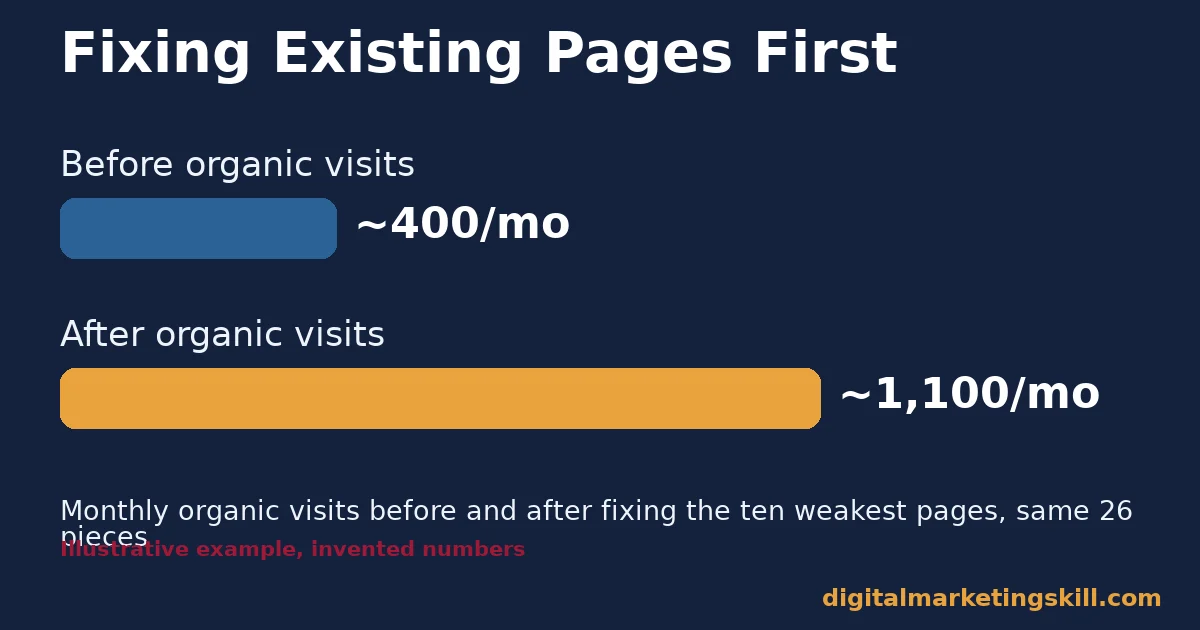
Here is an illustrative example, with invented numbers. A small consultancy publishes two posts a week for three months, ending with 26 live pieces and about 400 monthly organic visits total across the whole site, spread thinly enough that no single page stands out. The team pauses new publishing for a month, fixes titles, internal links, and target keywords on the ten weakest pieces, and adds one clear next step to each. Monthly organic visits rise to roughly 1,100 over the following two months, from the same 26 pieces.
The lesson is about sequence. Those ten pieces already existed, so fixing them changed what thousands of potential readers could actually find, without writing a single new page. A new piece, by contrast, starts from zero visibility and takes months to catch up to where an existing page already sat, even with better writing behind it.
A Four-Week Plan to Apply These Content Marketing Facts
This plan fits around existing work and does not require new tools to start. It turns the content marketing facts in this guide into four concrete weeks rather than leaving them as something to think about eventually.
- Week one: audit your top ten pages. Note current organic sessions, whether each has one clear next step, and whether it is reused in any other format.
- Week two: fix discovery on the weakest five. Tighten titles, headings, and internal links around the exact terms people search for.
- Week three: add one next step to every page you touched. Keep it singular. One clear action beats several vague ones.
- Week four: define one success number per page. Write it down before you move on, so next month’s comparison is honest.
At the end of the month, compare organic sessions and conversion rate against the week one audit. Keep whatever moved the numbers, drop whatever did not, and repeat the cycle with the next ten pages rather than starting over from scratch each time.
A Real Case: Turning One Project Into Paying Work
Eunice Bolaji’s story is published on Digital Marketing Skill Institute’s reviews page. She built her own e-commerce site as a real project, then used that same site as proof of skill when talking to prospective clients. In her own words: “I got back more than course fees from just one client within weeks.”
The pattern mirrors this guide’s core lesson. A small, finished body of real work, properly presented, moved faster than a larger pile of unfinished ideas would have. One real, specific example did more work than a dozen vague claims could have managed on their own. Treat this as one documented example, not a guaranteed outcome; results vary by niche, effort, and market, and DMSI’s earnings disclaimer sets out those limits in full.
Frequently Asked Questions About Content Marketing Facts
What is the single most important content marketing fact to know?
That most published content is never found at all. Ahrefs found 96.55% of pages studied get no traffic from Google, which makes discovery the first problem to solve, ahead of volume or polish.
Does content marketing still work?
Yes, but unevenly. Many teams maintain a blog, yet only about half see rising returns, which shows that having content and having improving content are not the same thing.
Why does my content get traffic but no conversions?
Most likely because the content offers no single clear next step. Conversion is consistently the top-cited content marketing challenge among surveyed marketers, ahead of resourcing and measurement.
How much content should a small team realistically publish?
Whatever pace your team can sustain for at least three straight months without quietly stopping. A smaller, consistent schedule outperforms an ambitious one that collapses.
What should I measure if I can only track one content marketing number?
Conversion rate per piece, since it answers whether content actually persuades anyone, which traffic alone cannot show. Organic sessions still matter, but they only tell you whether people arrived, not whether the visit was worth anything to the business.
Is repurposing content worth the extra effort?
Generally yes, because it lets one piece of research or writing produce value in more than one format, which directly addresses the resourcing challenge most teams report. A single well-researched article can become a short video, an email, and a handful of social posts. None of those formats need the research repeated from scratch.
How do I know if my content marketing problem is discovery or conversion?
Check organic sessions first. If they are already healthy and conversion is still weak, the problem is the page itself, not whether people can find it.
How many content marketing facts actually matter for a small team?
Far fewer than most lists suggest. Discovery, conversion, and measurement cover the majority of real-world problems, so a small team can ignore most other advice until those three are solid.
Should I trust a content marketing fact if it is more than a year or two old?
Treat it carefully. Platforms, algorithms, and buyer behavior change quickly. Re-check any older figure against a current source before building a decision around it, especially if the original number came from a single company’s own case study. A number that once drove real decisions can quietly stop being true while still getting repeated in blog posts and slide decks years later.
Start With Your Ten Weakest Pages
Content marketing facts only matter once they change a specific page. Pick your ten weakest-performing pieces, fix discovery and the next step on each, and measure the result for a month before you publish anything new. That sequence, fix before you add, is worth repeating every quarter, not just once.
None of the content marketing facts in this guide require a large team or a large budget to act on, just a willingness to fix existing pages before adding new ones. If you want structured, hands-on practice rather than building this alone, Digital Marketing Skill Institute teaches these skills through real client-style work. The Master Diploma in Digital & AI Marketing is built around four AI-powered tracks, including AI-Powered Google Specialist and AI-Powered WordPress and SEO Specialist. A Full Stack option covers all four tracks across ten courses. It includes unlimited 1-on-1 coaching and mentoring and a U.S. Project Internship with a verified U.S. Work Reference Letter, and the diploma is dual US and UK accredited and recognised in more than 100 countries.
The programme runs 100% online, so you can build these skills from anywhere in your country. Browse more guides on the Digital Marketing Skill Institute blog, and when you are ready, apply for the Master Diploma or start from the Digital Marketing Skill Institute homepage.
Every figure in this guide was checked against its original source before publication. Figures marked as illustrative are invented examples, not real results.
![9 Amazing Digital Marketing Skills to Make Money Online [With Proof]](https://digitalmarketingskill.com/wp-content/uploads/2019/07/9-Amazing-Digital-Marketing-Skills-to-Make-Money-Online-With-Proof-17.png)






