You find customers on Facebook by combining three things: a page that shows up consistently, content worth engaging with, and a small paid budget pointed at the right audience. Each piece alone gets weak results. Together, they turn a page with no history into one that reaches real buyers.
The data below shows how each piece works, which one to fix first, and what to measure once the first results start coming in.
Key Takeaways
- DataReportal’s ad-planning data puts Facebook’s potential ad reach at roughly 2.35 billion accounts. It stresses this is a planning estimate, not a count of buyers.
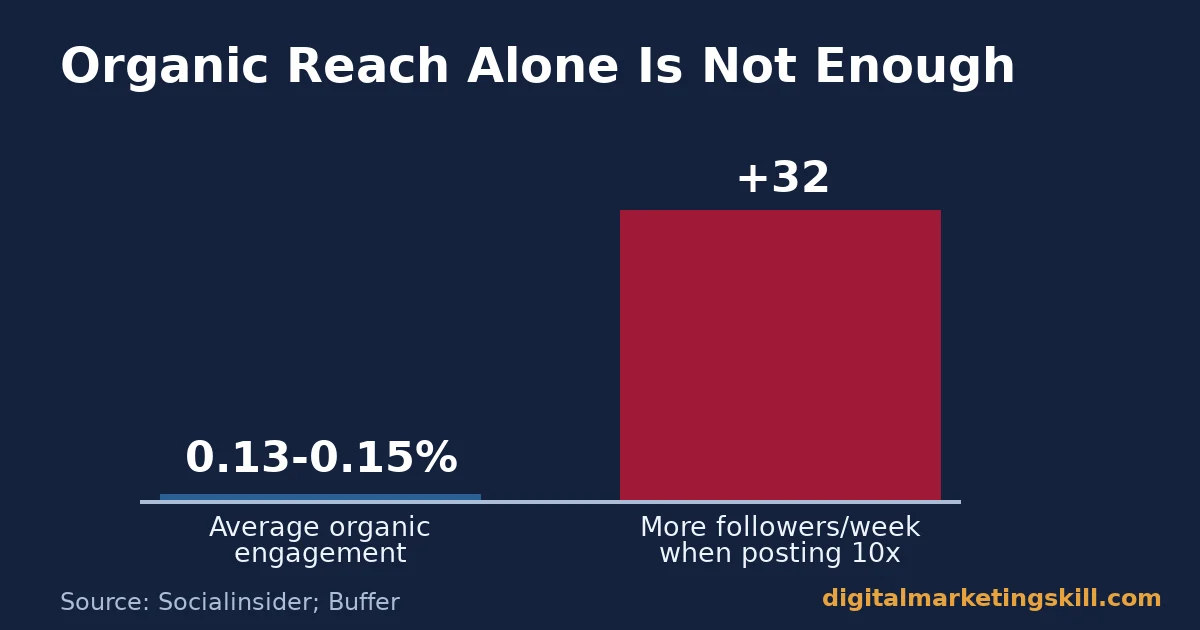
- Socialinsider’s analysis of roughly 25 million Facebook posts found average organic engagement sits at just 0.13% to 0.15%. Organic posts alone rarely find new customers at scale.
- Buffer’s analysis of 4.8 million channel-weeks found a “no-post penalty.” Pages posting 10 or more times a week averaged 32 more followers than silent weeks.
- HubSpot’s global marketer survey ranks Instagram and Facebook equally at 47.4% for B2C return on investment. That ties them for the top spot among all channels marketers rated.
- Meta’s own guidance recommends a clear page goal, a steady posting cadence, and keeping promotional posts a minority of total content. That matches what the engagement data shows works.
In this guide
- Find Customers on Facebook: What Most Advice Skips
- How Facebook Actually Surfaces a Page to New Customers
- What Differs by Approach: Organic, Local or Paid
- How to Lead With Each Approach
- Which Content Actually Helps You Find Customers on Facebook
- Does Finding Customers on Facebook Work the Same Everywhere?
- Measuring Whether You Are Finding New Customers on Facebook
- What AI Changes About Finding Customers on Facebook
- The One Decision Rule
- Three Mistakes That Quietly Block New Customers
- What Finding Customers on Facebook Looks Like in Practice
- Frequently Asked Questions About Finding Customers on Facebook
- Your Next Step to Find Customers on Facebook
Find Customers on Facebook: What Most Advice Skips
Most advice on how to find customers on Facebook lists tactics: post more, run ads, reply to comments. The tactics are not wrong, but they skip a sequencing problem. Posting into a page nobody follows wastes effort. Running ads to an unclear offer wastes budget. The real question is which piece to build first, and in what order.
What follows is an informed read of current platform data, not a fixed formula, because reach and algorithms shift and a small business budget differs from a large one. The arc below covers how Facebook surfaces a page to new people, what differs between organic, local and paid approaches, and how to lead with each one.
It also covers how to measure progress, one decision rule, a real case, and a direct FAQ.
None of this requires a large team or a specialist agency to start. Every tactic below runs from a standard Facebook Page and Meta Ads Manager account. The smallest version of each one can be tested for less than the cost of a dinner out.
How Facebook Actually Surfaces a Page to New Customers
Facebook decides what to show someone based on signals. These include who they already follow, what they engage with, and how recently a page posted. A page with no recent activity and no engagement history gets shown to almost nobody outside its existing followers, no matter how good its products are.
Think of it as a trust score. It resets a little every time a page goes quiet, and builds a little every time real people respond.
This is why organic reach alone struggles to help you find customers on Facebook. Socialinsider’s benchmark study of roughly 25 million posts across more than 130,000 business pages found average organic engagement of just 0.13% to 0.15%. That is Socialinsider’s own tracked panel, not a random sample. Still, the scale of the dataset makes the pattern hard to dismiss.
At that rate, a page with 1,000 followers might expect one or two genuine reactions per typical post. That is not enough signal on its own to convince the algorithm to show that post to strangers.
Buffer’s separate analysis of 4.8 million channel-week observations found a clear posting-frequency effect. Pages posting 10 or more times a week averaged 32 more followers a week than their own silent weeks. Consistency itself is a signal Facebook rewards, independent of any single post’s quality. Our guide to social media marketing principles covers more of what actually grows a page.
What Differs by Approach: Organic, Local or Paid
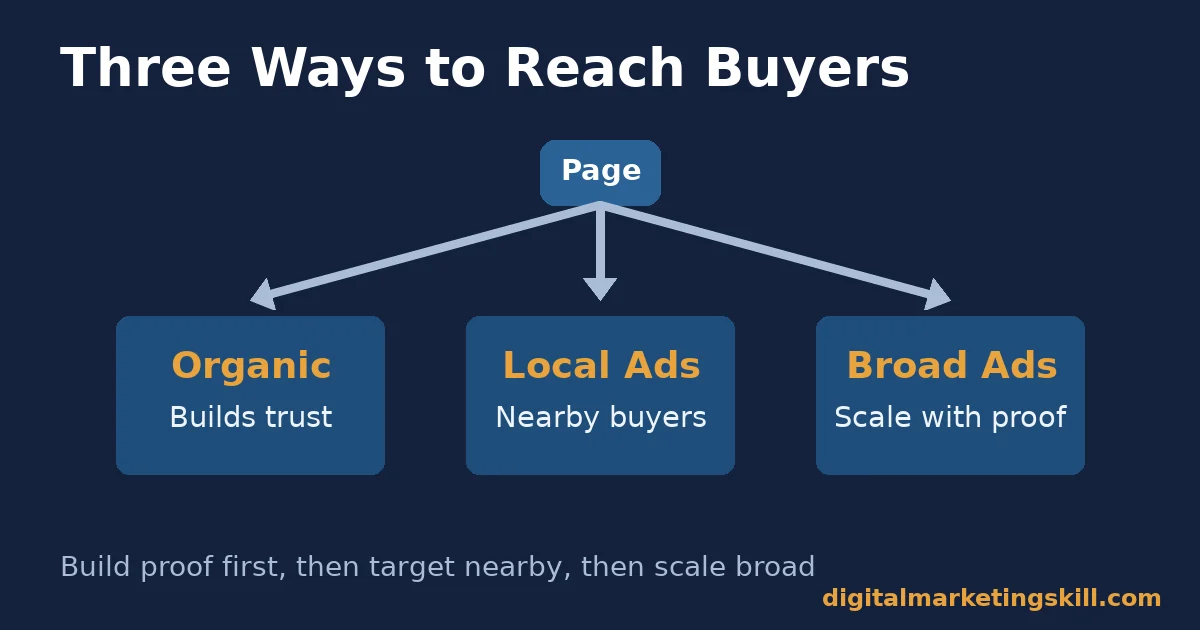
Three approaches help you find customers on Facebook, and each one solves a different part of the problem.
Organic Posting: Built for Trust Over Time
Organic posts build a relationship with people who already know the business. They rarely reach strangers at scale because of the low engagement rates above. But they give paid ads something credible to point to: real comments, reviews and a visible history.
Local Awareness Ads: Built for Nearby, Ready Buyers
Facebook’s location-based ad tools target people physically near a business. This suits anyone serving a local area: a shop, a clinic, a restaurant. These ads typically cost less to run because the audience is narrow and the intent is high. Someone nearby is more likely to act the same day.
Broader Paid Ads: Built for Scale Beyond Existing Followers
Standard Facebook ads reach far beyond a page’s follower base. Our guide to Facebook ad setup covers the five choices that decide a campaign’s results in more depth. DataReportal’s ad-planning data shows a potential reach of roughly 2.35 billion accounts through Meta’s own planning tool. DataReportal is explicit that this is only a planning estimate. It does not measure how many real people will actually see or respond to any single campaign.
How to Lead With Each Approach
Knowing the three approaches is only half the job of learning to find customers on Facebook. Here is what to lead with inside each one.
Organic Posting: Lead With a Predictable Cadence
Meta’s own Business Help Center recommends a clear page goal and a predictable posting schedule. Keep promotional content a minority of what you post. Pick a cadence you can sustain for months, not a burst you cannot repeat. Buffer’s data shows the penalty comes from silence, not from any single bad post.
Local Awareness Ads: Lead With One Clear, Time-Limited Offer
Local ads work best with a specific reason to act now: a discount, a limited stock item, an event. A vague “check us out” ad wastes the high buying intent that local targeting already gives you.
Broader Paid Ads: Lead With Your Best Organic Proof
Before scaling a paid campaign, find the organic post that already performed best. Look for the one with the most genuine comments or shares. Turning a proven post into an ad usually outperforms a cold ad built from nothing, because it carries real social proof into the auction.
This matters more as budgets grow. A small local campaign can survive weak creative, because intent is already high. A broader campaign competing for attention from strangers needs every advantage it can get, since nobody there already knows the business. An ad with visible comments and reactions gives a cold viewer a reason to trust it before they even read the offer.
Which Content Actually Helps You Find Customers on Facebook
Not all posts carry the same weight toward finding new customers. Buffer’s engagement dataset covers nearly 2 million posts across six platforms. It found Facebook posts that actively asked for replies lifted engagement by 9%. That is a smaller effect than on newer platforms like Threads, but still a real gain. The lesson applies directly: a caption that asks a genuine question outperforms one that only announces a product.
Video also carries real weight on Facebook, even though direct Facebook-specific figures are harder to isolate than platform-wide ones. Wistia’s survey covered more than 900 marketing professionals. It found that 34% of marketers who share video clips distribute them on Facebook. Shorter clips tend to see higher engagement rates, even though longer videos can earn more total watch time from a dedicated audience.
For a page just starting out, a short, specific video of the product in use tends to outperform a long, polished advert nobody finishes watching.
Does Finding Customers on Facebook Work the Same Everywhere?
Facebook’s underlying mechanics, the engagement signals, the ad auction, the local targeting tools, work the same worldwide. What changes by market is how many people you can realistically reach and how much competition exists for their attention.
DataReportal’s global overview counts more than 6 billion people online worldwide. It tracks roughly 5.66 billion social media user identities, compiled with Meltwater and We Are Social. Pew Research Center’s survey of US adults separately found 71% use Facebook. That figure varies by country, but it confirms the platform remains one of the largest reachable audiences almost anywhere a business operates.
Local awareness ads travel well across markets, because they depend on GPS and local targeting data, not any country-specific feature. Wherever you run a business, the same sequencing applies. Build proof, target the people closest to a sale, then scale once the proof holds.
What does change by market is realistic cost and expected competition. A crowded, high-income market typically costs more per click than a smaller one. Check current costs in your own Ads Manager account rather than assuming figures from elsewhere will transfer directly. A quick test campaign of a few dollars usually tells you more about local costs than any outside benchmark.
Measuring Whether You Are Finding New Customers on Facebook
Four numbers tell you whether the work is paying off, and each one means something different.
- Engagement rate: reactions, comments and shares divided by reach. Socialinsider’s benchmark puts typical business pages at 0.13% to 0.15%. Judge your own page against that baseline, not against viral outliers.
- Reach versus followers: if reach stays close to follower count for weeks, the page is only talking to people who already know it. That signals a need for paid or local tactics.
- Cost per result: what a single ad-driven lead, message or sale actually costs. Track this per campaign, since local and broad campaigns behave very differently.
- Repeat engagement: whether the same new followers interact again within a month. One-time reach that never returns rarely becomes a paying customer.
Review these four numbers monthly inside Meta’s own ad and page insights tools. A campaign that reaches many people but produces no repeat engagement usually means the offer or targeting is wrong. It does not mean Facebook failed to deliver. The platform surfaced the page to the right size of audience; the message itself simply did not land.
Keep a simple log: campaign, audience type, spend, and the one change made each month. A few months of this habit shows whether local or broad campaigns perform better for your specific offer. That matters more than any general industry benchmark.
What AI Changes About Finding Customers on Facebook
Ad automation is now standard practice, not an edge case. HubSpot’s global marketer survey found 34.1% of marketing teams report extensive use of AI for ad automation specifically. That sits inside a broader pattern: 86.4% of teams use AI in at least some areas of their work.
Meta’s own bidding system already automates much of the targeting decision. It evaluates a campaign’s bid strategy and the likelihood of reaching its stated goal before it ever shows an ad.
That shifts where a small business should spend its own time. Skip manually guessing at audience segments. The higher-value work is writing a clear offer and picking a real goal, then letting the platform’s own optimization handle delivery.
Meta’s ad-set documentation describes a “learning stage” during which its delivery system is still calibrating. That is one reason a campaign often performs better after a few days than it does on day one.
AI does not replace the need for genuine proof, though. An automated system still optimizes toward whatever signal you give it. An ad built around a weak, unengaging post will simply get automated poor results faster. Feed it your strongest proof, and automation compounds that strength. Feed it a weak post, and it compounds the weakness just as quickly.
The One Decision Rule
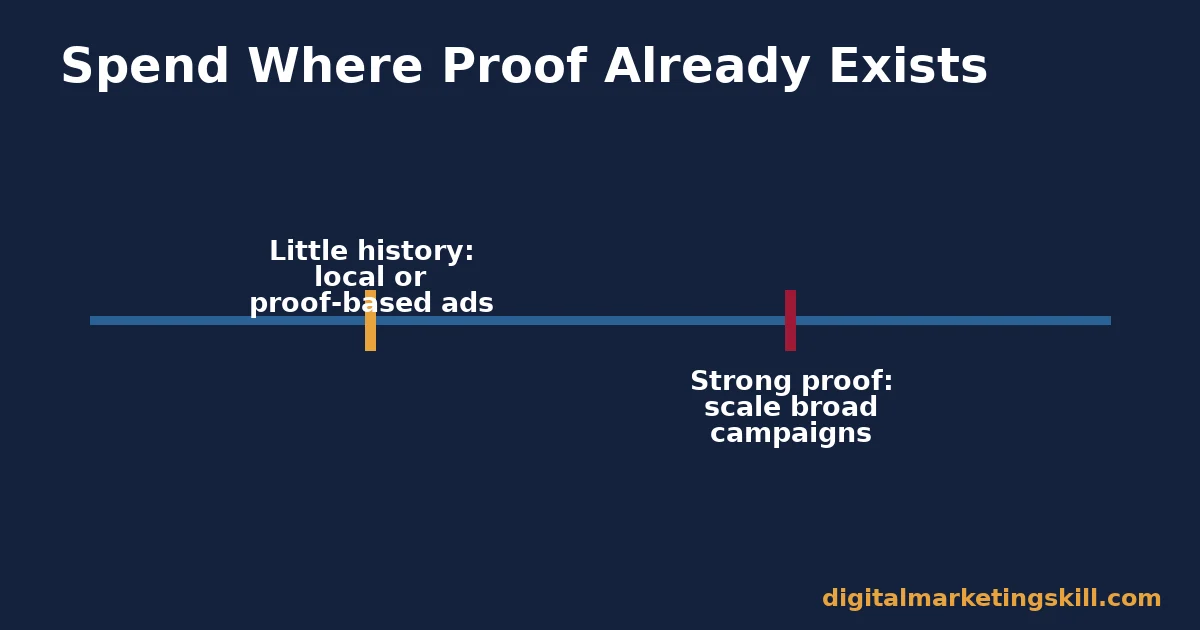
Here is the rule that cuts through most of the debate: if your page has little engagement history, spend first on local or proof-based ads rather than broad awareness campaigns. A page with no social proof wastes a broad budget on strangers who have no reason to trust it yet.
Illustrative, invented numbers: imagine two small businesses each spending $200. One runs a broad awareness campaign and reaches 40,000 strangers with almost no engagement. The other boosts its best-performing organic post to a local, nearby audience and gets 300 real clicks and a handful of messages. The second approach usually converts better, because it pairs proof with intent instead of chasing raw reach.
Revisit the rule every few months rather than setting it once. A page that built strong proof can lose it through a long quiet stretch, because Buffer’s no-post-penalty data shows the effect runs in both directions: consistent activity builds momentum, while silence erodes it.
Three Mistakes That Quietly Block New Customers
Our guide to Facebook marketing mistakes covers more ways reach quietly gets lost.
The first mistake is treating every post as a sales pitch. Meta’s own guidance explicitly recommends keeping promotional posts a minority of total content. A feed that only sells gives people no reason to engage, and engagement is the signal that earns future reach.
The second mistake is judging a campaign too early, often inside the first 24 to 48 hours. Meta’s ad-delivery system runs through a learning stage while it calibrates targeting. A campaign’s first few days often understate how it will perform once delivery stabilises. Pulling budget after one disappointing day throws away the data the system needs to improve.
The third mistake is spreading a small budget across too many audiences at once. A campaign split five ways to “test everything” rarely gathers enough data in any single audience to show what actually works. One focused test, run long enough to matter, beats five shallow ones running in parallel.
Each of these mistakes shares the same root cause: moving faster than the data can support. Facebook’s own systems need time and signal to work well, and rushing past either one tends to cost more than it saves.
What Finding Customers on Facebook Looks Like in Practice
Ayooluwa Osemi, a Master Diploma in Digital & AI Marketing graduate of Digital Marketing Skill Institute, describes a result in a testimonial on the Institute’s reviews page: spending $14 on Facebook and Instagram ads and making $878 in sales.
That is a single, self-reported result, not an audited case study. Ad costs and returns vary enormously by product, audience and season. Treat the ratio as evidence the channel can work, not a number to expect by default.
The pattern behind that result matches the data above: a small, targeted spend aimed at a specific offer, not a large budget spread across a vague audience.
Scale only after a small test proves the pattern holds. Doubling a budget on an untested offer multiplies the risk along with the potential reward. Doubling a budget on a proven offer usually multiplies the result instead.
Frequently Asked Questions About Finding Customers on Facebook
Do I need to pay to find customers on Facebook?
Not strictly, but organic reach alone is slow. Socialinsider’s data shows average organic engagement around 0.13% to 0.15%. A small paid budget aimed at a proven post or a local audience usually works faster than organic posting alone.
How often should I post to find customers on Facebook?
Buffer’s research found pages posting 10 or more times a week gained about 32 more followers weekly than their own quiet weeks. Pick a realistic, sustainable cadence rather than posting in bursts and going silent.
Are local awareness ads better than broad ads to find customers on Facebook?
For a business serving a specific area, usually yes, because the audience already has high intent. Broader ads suit businesses that can serve customers anywhere, including online-only sellers. They need more budget to find the right strangers.
How much does it cost to find customers on Facebook through ads?
It depends heavily on the audience, offer and season. Ayooluwa Osemi’s testimonial describes $14 producing $878 in sales, a single, self-reported result. Test with a small budget on your own offer before assuming any outside figure will repeat.
What is the biggest mistake businesses make trying to find customers on Facebook?
Running broad ads before building any organic proof. A page with no comments or shares gives a cold audience no reason to trust it. The ad then has to work much harder than one built on an already-popular post.
Does finding customers on Facebook still work with so much competition for attention?
Yes, but it rewards specificity. HubSpot’s global survey ranks Facebook among the top channels for B2C return on investment, at 47.4%, tied with Instagram. That suggests the channel still performs well for businesses that use it with a clear offer and audience.
Should I use video to find customers on Facebook?
It helps. Wistia’s survey of video marketers found 34% distribute clips on Facebook specifically. Shorter, specific clips tend to see stronger engagement than long, unfocused ones. A short video showing the actual product or service tends to outperform a purely promotional graphic.
How long does it take to find customers on Facebook through ads?
Meta’s own documentation describes a learning stage during which its delivery system calibrates targeting. Early results often understate a campaign’s real performance. Give a campaign at least several days of stable spend before judging whether it works.
Your Next Step to Find Customers on Facebook
Finding customers on Facebook rewards sequencing. Build a little organic proof, then put a small budget behind your best post, local audience first if you serve one area. Measure engagement rate and repeat interaction before scaling the spend.
The Master Diploma in Digital & AI Marketing at Digital Marketing Skill Institute includes a full AI-powered Social Media Marketing & Analytics course alongside AI-powered Google Advertising. It comes with unlimited one-on-one coaching and mentoring and real project-based work experience inside a US partner company from day one.
The diploma carries dual US and UK accreditation and is recognised in more than 100 countries. It runs 100% online, so you can build and test real campaigns from anywhere in your country.
Visit Digital Marketing Skill Institute to read more graduate stories and browse the blog for more guides. When you are ready, apply here.
Every figure in this guide was checked against its original source before publication. Figures marked as illustrative are invented examples, not real results.
![9 Amazing Digital Marketing Skills to Make Money Online [With Proof]](https://digitalmarketingskill.com/wp-content/uploads/2019/07/9-Amazing-Digital-Marketing-Skills-to-Make-Money-Online-With-Proof-17.png)