
An ad set is the middle layer of a paid social campaign, where you decide who sees your ads, where they appear, when they run and how much you spend. It sits between the campaign, which holds your objective, and the ads, which hold your creative. It matters because most of the choices that shape your results, from audience to budget, live at this level.
Key Takeaways
- Meta campaigns have three levels: campaign, ad set and ad. The middle level controls targeting, placements, schedule, budget and bidding.
- Every ad in the same group shares the same audience, budget and schedule.
- On Meta, the limits are 50 non-archived ads in each and 200 ad sets per campaign.
- TikTok calls the same layer an “ad group”. LinkedIn keeps Meta’s name.
- Splitting ad sets by audience lets you compare results cleanly. Too many small ones, however, spread your budget thin.
What Is an Ad Set?
Meta’s developer documentation gives a clear definition. It describes this level as “a group of ads that share the same daily or lifetime budget, schedule, bid type, bid info, and targeting data.” In other words, it is the container that tells the platform how to deliver the ads inside it.
Think of a campaign as a shop, each ad set as a shelf and the ads as products on that shelf. The shop has one purpose. Each shelf faces a different type of customer. Then the products on each shelf compete for attention.
For example, a gym might run one campaign to get trial sign-ups. Inside it, the first group targets people near its city centre branch, while the second targets people near its suburban branch. Each of the two then holds three or four different video ads.
How an Ad Set Works
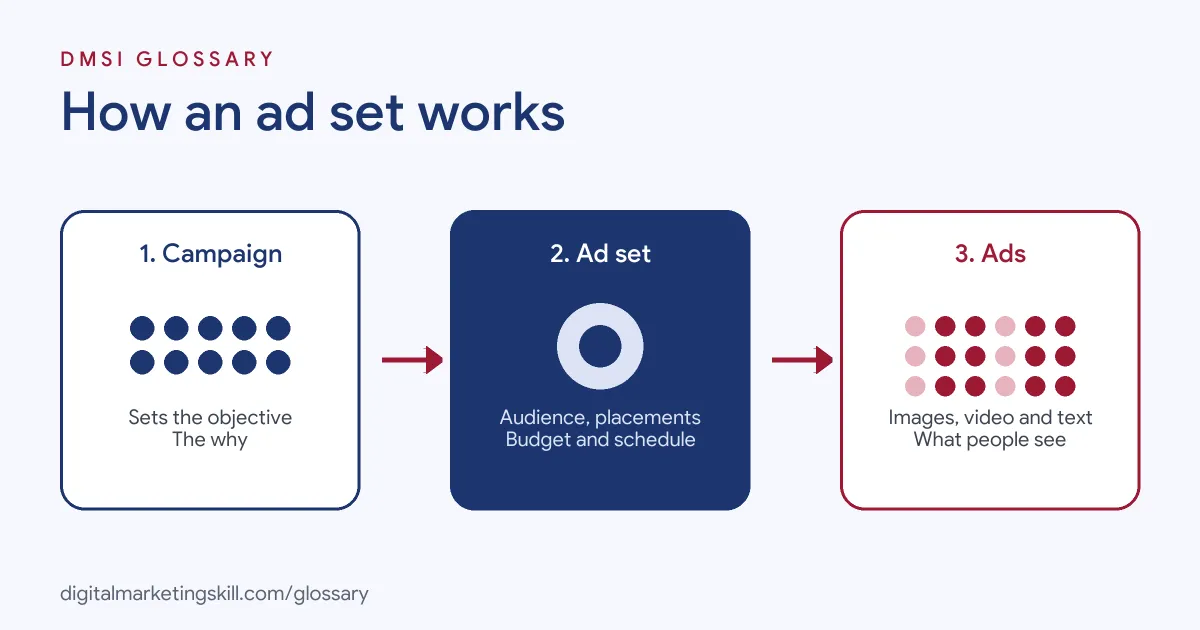
The campaign sits at the top. Meta describes a campaign as “a grouping of ad sets which are organized by the same business objective.” Below that, ad sets control delivery. At the bottom, each ad holds the image, video, text and link that people actually see.
What You Control at This Level
Meta’s documentation lists the main settings at this level:
- Targeting: locations, audiences and placements, such as Facebook or Instagram.
- Budget: a daily or lifetime amount. One of them must be greater than zero.
- Schedule: when delivery starts, stops and, if you choose, which hours it runs.
- Optimisation goal: the result the system should look for, such as link clicks or purchases.
- Bidding and billing: a bid cap or cost target, and the event you pay for.
Budget at Campaign or Ad Set Level
You can set the budget in one of two places. According to Meta’s documentation, you can set it at either level, but not both. With a campaign budget, all ad sets under that campaign share it. As a result, the system decides how to split the money between them.
The Learning Stage
New ad sets need time to learn. Meta’s documentation includes a field that shows “whether the ranking or delivery system is still learning for this ad set.” During this stage, delivery can be unstable. So it is best to avoid big edits until it settles.
Ad Set Examples
Here are three made-up examples of how teams split their ad sets:
- By audience: A skincare brand runs one group for a lookalike of past buyers and another for people interested in skincare. It then compares the cost per purchase of each.
- By location: A language school sells online courses in two countries. It uses separate ad sets per country, so it can set a separate budget for each market.
- By funnel stage: An online shop runs prospecting ad sets for new people and retargeting ones for recent site visitors. Each one shows different ads.
In each case, the split answers a clear question. That’s what makes the results easy to read.
Names on Meta, TikTok, LinkedIn and Google
Most ad platforms use the same three-level structure, but the names differ:
| Platform | Middle layer | What you set there |
|---|---|---|
| Meta (Facebook and Instagram) | Ad set | Targeting, placements, budget, schedule, optimisation goal and bids |
| TikTok | Ad group | Placements, audiences, budgets, schedules, optimisation goals and bids |
| Ad set | Objective, audience, budget and bidding, with related ad sets grouped in a campaign | |
| Google Ads | Ad group | Keywords or targeting and the ads that go with them |
TikTok’s help centre puts it simply: “At the ad group level, you set specific ad placements, audiences, budgets, schedules, optimization goals, and bids.” By contrast, LinkedIn asks you to choose your objective at this level.
How to Set Up an Ad Set in Meta Ads Manager
The steps below follow the usual flow in Meta Ads Manager. Menu names can change slightly over time, but the logic stays the same.
- Create a campaign and choose its objective.
- Decide whether to use a campaign budget or a lower-level budget.
- Open the next level down and give it a clear name, such as “UK – Lookalike 1% – Purchases”.
- Choose the conversion location and optimisation goal.
- Set your audience: location, age and any custom or lookalike audiences.
- Choose placements, or let Meta pick them automatically.
- Set the budget and schedule, then add your ads.
Before you publish, check that your pixel or conversion tracking is working. Otherwise, delivery will optimise for the wrong signal. If you are new to the tool, our guide to Facebook Ads Manager walks through the screens.
Best Practices for Ad Sets
- Test one thing at a time. If two ad sets differ only by audience, you know what caused the change in results.
- Name everything clearly. Include the market, audience and goal, so anyone on the team can read a report.
- Give each one enough budget. Many tiny ad sets compete with each other and learn slowly.
- Exclude overlapping audiences. For instance, remove past buyers from prospecting ad sets.
- Rotate creative, not settings. Add fresh ads to working ad sets instead of rebuilding them.
Common Mistakes to Avoid
Beginners often make the same few errors. First, they create far too many ad sets for a small budget. Second, they change targeting every day and reset the learning. Third, they let several ad sets target the same people, so the ads compete against each other. Finally, they judge results after a day or two, before there is enough data. Each of these is easy to fix with a simple, planned structure.
Campaign vs Ad Set vs Ad
Here is a quick summary of the three levels on Meta:
| Level | Main job | Example setting |
|---|---|---|
| Campaign | Sets the objective, and optionally a shared budget | Sales |
| Ad set | Decides who, where, when and how much | Women aged 25–44 in the UK, daily budget |
| Ad | Holds the creative people see | A 15-second video with a “Shop now” button |
In short, the campaign says why, the middle layer says who and how, and the ad says what. To see how the levels look on screen, read our entry on Meta Ads Manager.
Where You’ll Use Ad Sets at Work
Building ad sets is a daily task in paid social jobs. For example, remote job listings ask for people who can handle:
- “audience setup, ad set structure, creative uploads, UTM tagging, naming conventions” (DTC Paid Media Ads Buyer).
- Owning “everything before that: every ad set built correctly, named correctly, and ready to launch on time”, before a senior media buyer turns ads on (Creative Operations Coordinator).
So if you want to work as a Paid Social Specialist or Social Media Manager, employers will expect you to plan a clean structure, build ad sets without errors and explain the results. They will also want to see a real campaign you have run.
Learn It in the Social Media Track
You can learn to plan and build ad sets in the AI-Powered Social Media Management and Advertising track. There, you plan, create and run a paid social campaign for a real brand, so you finish with results you can show an employer. You also work on a U.S. Project Internship from day one, with unlimited 1-on-1 mentoring.
Frequently Asked Questions
What is an ad set in simple terms?
It is a group of ads that share the same audience, placements, budget and schedule. It sits inside a campaign and holds one or more ads.
How many ads should be in one ad set?
Meta allows up to 50 non-archived ads in each one. In practice, testing a handful at a time gives each ad enough delivery to judge.
What is the difference between an ad set and an ad group?
They do the same job. Meta and LinkedIn use one name, while TikTok and Google Ads say “ad group”.
Should the budget sit at campaign level?
A campaign budget lets Meta share money across ad sets automatically. A budget at the lower level gives you tighter control over each audience. You can’t use both in the same campaign.
Why are my ad sets stuck in learning?
New or heavily edited ad sets need data before delivery settles. So avoid frequent changes, and give each one enough budget to gather results.
Sources: Meta for Developers: Ad Set reference; Meta for Developers: Ad Campaign reference; TikTok Ads Help: About TikTok Ads Structure; LinkedIn Marketing Solutions Help; remote job listings on Himalayas.