
Affinity audiences are groups of people that Google Ads identifies by their long-term passions, habits and interests, such as yoga lovers, cricket fans or green living enthusiasts. You add them to campaigns to reach people who care about a topic linked to your brand, even if they aren’t shopping right now. They matter because they help you build awareness with the right crowd early, so your brand is familiar when they are ready to buy.
Key Takeaways
- Google now calls them affinity segments, one type of audience segment.
- Google says they reach people “based on what they’re passionate about and their habits and interests.”
- They suit awareness and reach goals more than immediate sales.
- Google says affinity segments are available in Search, Display, Standard Shopping and video campaigns, as well as Gmail and Display and Video 360.
- If you need a narrower group, a custom segment can target a specific niche instead.
What Are Affinity Audiences?
Google describes affinity segments as a way to reach people based on “a holistic picture of their lifestyles, interests and habits.” In other words, they focus on who people are over time, not on what they’re buying this week.
Here is a simple example. A person who runs three times a week, reads running blogs and watches marathon videos may sit in a running enthusiasts group all year. They aren’t necessarily shopping for trainers today. However, they are exactly the kind of person a running brand wants to know about it.
That’s the key difference from in-market segments, which target people actively researching a purchase. Affinity audiences cast a wider, interest-based net.
How Affinity Audiences Work
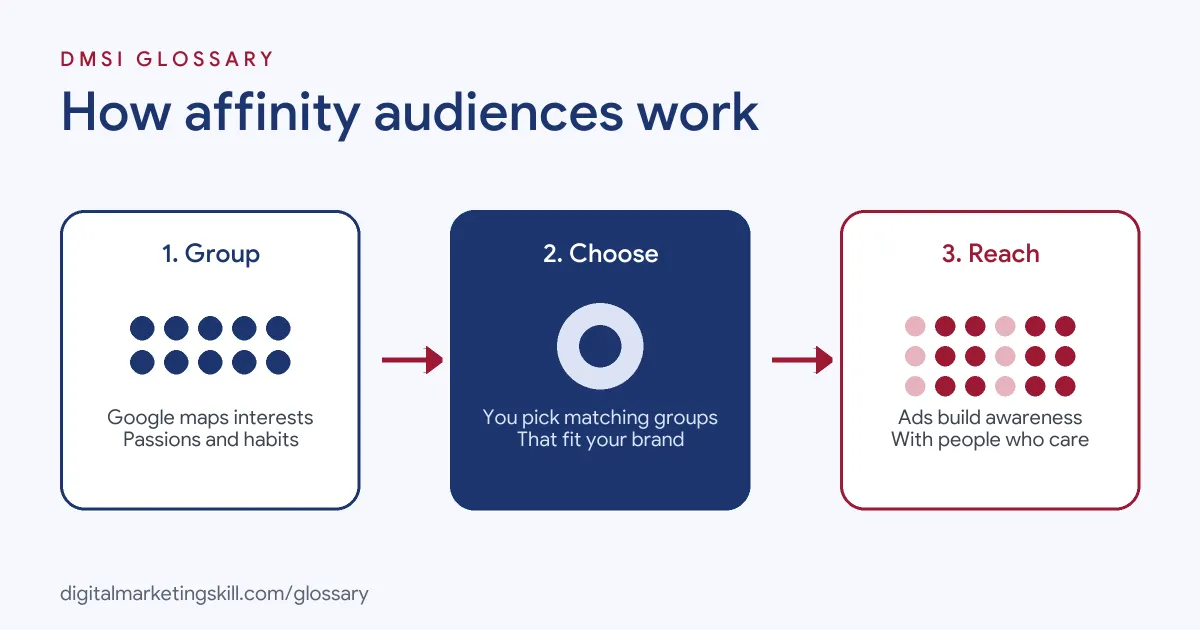
The process runs in three steps. First, Google builds interest groups from signals such as the content people engage with. Next, you choose the groups that match your brand. Finally, Google Ads shows your ads to people likely to be in those groups across its networks.
The Signals
Google says a video can receive an affinity label, such as “motorcycle enthusiasts,” based on “a combination of both contextual and personalised signals or based on only contextual signals.” It also explains that where personalised advertising isn’t permitted, it uses only contextual signals, including for videos made for kids.
The Categories
Google publishes a curated list of affinity categories, which you can download as a CSV file. They sit in a tree, from broad to narrow. For example, its health list includes Sports and Fitness, then Health and Fitness Buffs, then Yoga Lovers. It also lists groups such as Vegetarians and Vegans, Cricket Enthusiasts and Green Living Enthusiasts.
Sensitive Data
There are limits. Google states that it “will never use sensitive information like health, race, religion or sexual orientation to tailor ads to users.” So affinity groups describe interests, not personal characteristics.
Affinity Audiences Examples
Here are three made-up examples of how brands might use them:
- Plant-based food brand: Targets the Vegetarians and Vegans group with a YouTube video about new recipes.
- Yoga mat company: Uses the Yoga Lovers group on Display to introduce a new eco-friendly mat.
- Solar panel installer: Reaches Green Living Enthusiasts with a short video explaining how home solar works.
In each case, the goal is to get known by people who already care about the topic, not to close a sale on the spot. Sales come later, through other campaigns.
Affinity vs In-Market vs Custom Segments
| Segment | Based on | Best for |
|---|---|---|
| Affinity | Long-term passions, habits and interests | Awareness and reach |
| In-market | Recent purchase intent | Sales and leads |
| Custom | Keywords, URLs and apps that you choose | Niche audiences that ready-made groups miss |
Life events segments are another option. Google notes that, because life events are infrequent, they “may reach a smaller segment compared to affinities.” So affinity groups usually give you the widest reach of the three interest-style options.
Google gives a useful example here. Rather than reaching the broad Sports Fans affinity group, a running shoe company might build a custom segment to reach avid marathon runners instead.
How to Use Affinity Audiences in Google Ads
- Define your audience’s interests. Write down what your best customers love, read and watch.
- Browse the affinity list. Open the audience settings or Audience builder, and look through the categories.
- Pick close matches. Next, choose groups that fit your brand, from broad to narrow.
- Consider a custom segment. If the ready-made groups are too broad, build your own from keywords and URLs.
- Write awareness-style ads. Introduce your brand and what makes it different, rather than pushing for an instant sale.
- Choose sensible measures. Track reach, views and engagement, as well as later conversions.
- Review and refine. Finally, use the Audiences report to see which groups respond best.
A Worked Example
Here is a made-up example. A small brand that sells reusable water bottles wants more people to know its name. It runs a short YouTube video campaign aimed at two affinity groups: Green Living Enthusiasts and Health and Fitness Buffs. The video shows a runner refilling a bottle at a park fountain, with the brand name on screen from the first second.
After a month, the team looks beyond direct sales. It checks how many people watched most of the video and how many later searched for the brand name. Then it builds a remarketing list of people who watched, and shows them a product ad with a discount. As a result, the affinity campaign starts the journey, and remarketing finishes it.
How to Measure Affinity Campaigns
Because affinity audiences aim at awareness, judge them on the right signals. Useful measures include how many people you reached, how many watched most of your video, how engagement compares with other groups and whether searches for your brand rise over time. Later, you can check how many of those people return through remarketing and convert. Judging an awareness campaign only on same-day sales usually makes it look worse than it is.
Best Practices
- Match the goal. Use affinity groups for awareness, and pair them with in-market or remarketing for sales.
- Tell a story. Google’s ABCD guidance for awareness ads suggests making “people core to the story” and putting your brand “front and centre.”
- Go narrower when possible. A specific group such as Yoga Lovers often beats a broad one such as Sports and Fitness.
- Know how optimised targeting behaves. Google says ads may reach people outside your selections if they are likely to convert.
- Give it time. Awareness builds slowly, so judge results over weeks, not days, before you decide.
Common Mistakes
A common mistake is judging affinity campaigns only on immediate sales, which misses their purpose. Another is choosing groups that are only loosely linked to the brand, so the ads reach people who will never care. Some advertisers also use hard-sell ads for people who aren’t shopping yet. Finally, many forget to follow up. Without remarketing, the awareness you build can fade before people are ready to buy. Plan the follow-up before the first ad goes live, so nobody slips through the gap.
Where You’ll Use Affinity Audiences at Work
We didn’t find remote listings that mention this exact segment type by name, so here is how it fits the roles instead. A Google Ads Specialist chooses affinity groups for awareness and YouTube campaigns, then reports on reach and engagement. A PPC Specialist compares them against in-market and remarketing segments to decide where budget works hardest. Meanwhile, a Web Analytics Specialist tracks whether people who first saw an awareness ad later come back and convert.
Learn It in the Google Specialist Track
The AI-Powered Google Specialist track covers Google Ads across Search, Display, Discovery, Gmail and YouTube, plus Google Analytics. You launch and measure a Google Ads campaign with conversion tracking, so you can test affinity audiences against other segments. You also get unlimited 1-on-1 mentoring and a U.S. Project Internship from day one.
To compare segment types, read our glossary entry on in-market audiences. For video campaigns, see our guide to YouTube marketing.
Frequently Asked Questions
What are affinity audiences in Google Ads?
They are groups of people that Google identifies by their long-term passions, habits and interests, such as sports fans or green living enthusiasts.
What is the difference between affinity and in-market audiences?
Affinity groups reach people by lasting interests. In-market groups reach people who are actively researching a purchase.
Where can I use affinity audiences?
Google says they are available in Search, Display, Standard Shopping and video campaigns, plus Gmail and Display and Video 360.
Are affinity audiences good for sales?
They are better for awareness. For sales, pair them with in-market segments or remarketing.
What if no affinity group fits my brand?
Create a custom segment using keywords, URLs and apps related to your product. Google then finds people likely to be interested in those topics.
Sources: Google Ads Help: About audience segments; Google Ads Help: About your data segments; Google Ads Help: About the ABCDs of effective video ads.