Facebook engagement strategies work by matching what you post to what Meta’s own ranking system actually rewards. That system predicts value to the specific viewer, not raw reach. Organic engagement on Facebook now averages just 0.15% of fans per post.
A strategy built only around posting frequency rarely moves that number. Format, audience targeting and how you respond to comments each move engagement independently. Most pages only fix one of the three.
Key Takeaways
- Facebook organic engagement is genuinely low industry-wide. Socialinsider analysed 25 million posts across 130,683 business pages. It found an average engagement rate of 0.15% of fans, so a low number on your own page is not necessarily a sign something is broken.
- The ranking system values predicted relevance, not volume. Meta’s Transparency Center describes Facebook Feed ranking as a four-step process: gather eligible posts, read signals, predict value, then rank by score.
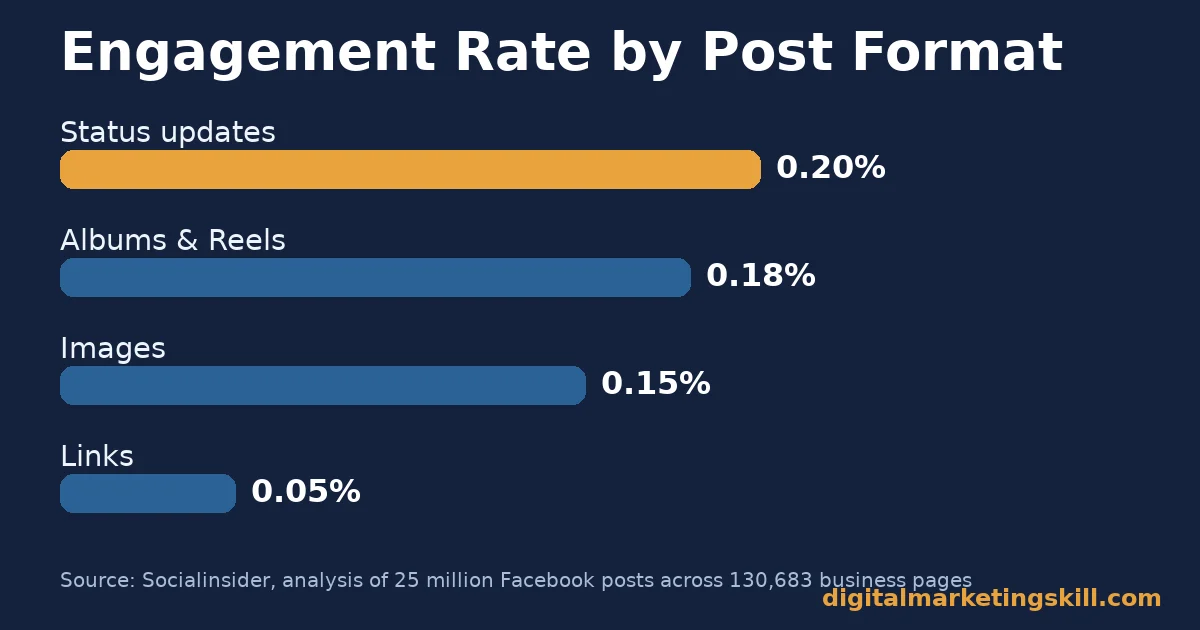
- Not all formats earn the same engagement. The same Socialinsider analysis broke results down by format. Status updates averaged 0.20% engagement, albums and Reels 0.18%, images 0.15%, and link posts trailed at just 0.05%.
- Meta has publicly said it favors person-to-person interaction over passive consumption. Its own announcement said the system would weigh engagement between people more heavily. Engagement with a brand Page counts for less.
- Ignoring comments has a measurable cost. Sprout Social’s Index found 73% of social users say they will buy from a competitor if a brand ignores them on social. That turns comment replies into a business decision, not just a courtesy.
In this guide
- What Most Advice on Facebook Engagement Strategies Misses
- How Facebook’s Ranking System Actually Works
- Facebook Engagement Strategies Rest on Three Levers
- How to Pull Each Lever in Facebook Engagement Strategies
- How to Measure Whether Your Facebook Engagement Strategy Is Working
- The Most Useful Rule: Fix the Lever With the Clearest Gap First
- A Real Case: Why a Small, Measured Test Beat Guessing
- A Four-Week Test Plan for Facebook Engagement Strategies
- Frequently Asked Questions About Facebook Engagement Strategies
- Start With Your Page’s Weakest Lever, Then Measure It
What Most Advice on Facebook Engagement Strategies Misses
Most advice on Facebook engagement strategies is a list of tactics: post more video, ask questions, use emojis. None of that is wrong. But it skips the mechanism those tactics are supposed to exploit. Readers end up applying tactics without understanding why some work and others quietly stop working.
This guide explains how Facebook’s ranking system actually evaluates a post. It then breaks engagement into three levers a page controls: format, audience targeting and response. It names what moves each lever and how to measure whether it actually worked.
A few ground rules first. Engagement benchmarks are a snapshot from one analytics vendor, not a permanent ranking. Meta changes its ranking signals often and does not publish exact weights. Meta’s own statements about ranking describe general principles, not a formula you can reverse-engineer post by post. Treat every tactic below as an informed, testable idea, not a guarantee.
How Facebook’s Ranking System Actually Works
Meta’s Transparency Center describes Facebook Feed ranking as a four-step process. First, the system gathers eligible posts from friends, followed Pages and joined groups.
Then it reads signals about each post. Those signals include who created it, how you previously interacted with that creator, and the post’s format.
Next, prediction models estimate how much value the post will provide to that specific viewer. Finally, the system ranks roughly 500 candidate posts by that predicted score, showing the highest-scoring ones first.
A page cannot see its own score. Every tactic in this guide, though, works by improving one of those input signals.
Scale is why this matters at all. DataReportal’s global social media user figures put the worldwide total at roughly 5.79 billion social media identities, more than two in three people on Earth. Even a tiny shift in a ranking signal affects what a meaningful share of that audience actually sees.
Meta has also been explicit about one principle behind those signals. Its own announcement of the “meaningful social interactions” ranking shift said the system would weigh person-to-person interactions more heavily than interactions between a person and a Page.
That is the structural reason business Pages see lower organic engagement than personal profiles. Content quality alone does not close that gap.
Facebook Engagement Strategies Rest on Three Levers
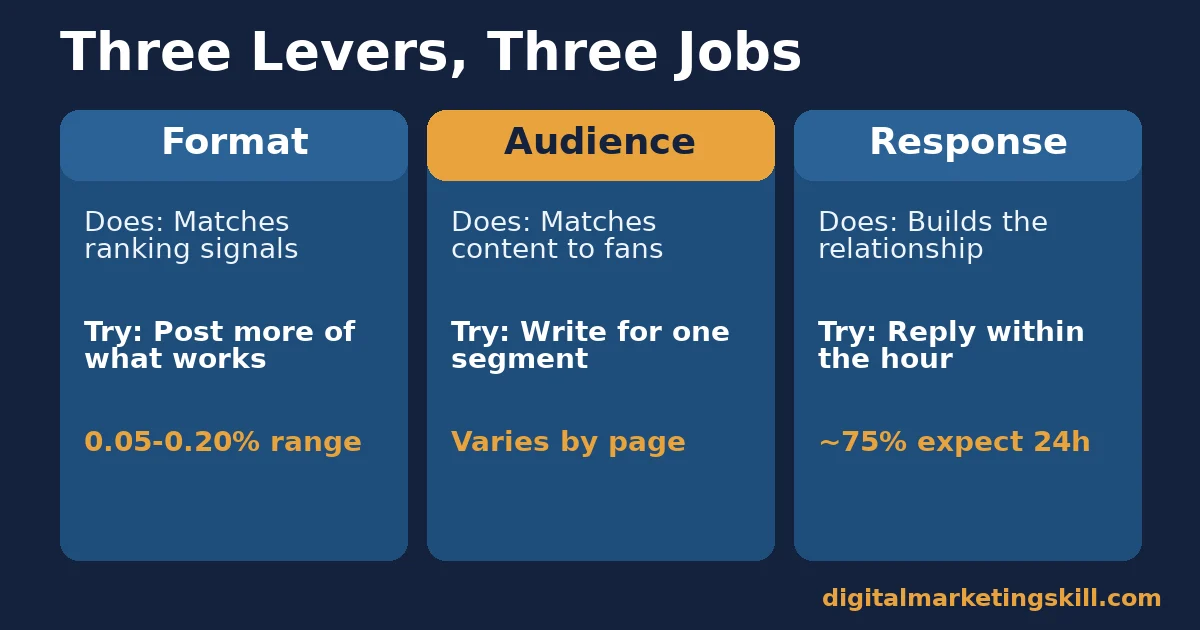
Almost every tactic for improving Facebook engagement falls under one of three levers. Pulling the wrong lever wastes effort, because each one fixes a different problem.
Format: Built to Match What the Ranking System Already Rewards
Format is the easiest lever to test. It is visible in your own page’s post history without any special tool. Socialinsider’s Facebook benchmark data found meaningful gaps by format. Status updates reached 0.20% engagement, albums and Reels 0.18%, images 0.15%, and link posts just 0.05%.
Audience Targeting: Built to Match Content to the Right Fans
Audience targeting exists because a page’s fan base is rarely one audience. A page selling two different products, or serving two different age groups, often sees wildly different engagement on the same post. The gap usually comes down to who actually saw it.
Response: Built to Turn a Comment Into a Relationship
Response is the lever most pages ignore, because it happens after publishing instead of before. Meta’s own signals include how a viewer has previously interacted with a creator. Responding to someone’s comment today can improve whether they even see your next post.
Why All Three Levers Matter at Once
A page can pull one lever perfectly and still see flat results, because the other two levers are still working against it. Strong format choices reach the wrong audience segment if targeting is off. Strong targeting still loses momentum if nobody replies to the comments it generates.
Treat the three levers as connected, not as a menu to pick one from. Effective Facebook engagement strategies usually improve all three over a few months, even when the first fix targets only one.
How to Pull Each Lever in Facebook Engagement Strategies
Pulling each lever correctly means matching the action to what that lever actually measures, not generic posting advice. Good Facebook engagement strategies treat format, audience and response as three separate experiments, each with its own evidence, rather than one combined guess.
Format: Lead With the Type That Already Performs for You
Pull your last 20 posts and sort them by engagement rate, not raw reach. Look for a format pattern before changing anything else. The cheapest fix available to any page is doing more of what its own history already shows works. Copying a format that works for someone else’s audience is a far weaker bet.
Avoid link posts as the default update. Socialinsider’s 0.05% figure for links was the lowest of any format measured. A page defaulting to “new blog post, link below” on every update is fighting its own ranking signals.
Illustrative, invented example: a page that switches its weekly schedule from three link posts and one image to one link post and three status updates, holding everything else constant, is testing exactly one variable. That is the kind of change among Facebook engagement strategies that produces a result you can actually trust.
Audience Targeting: Lead With One Clear Segment Per Post
Write each post for one specific segment of your audience rather than trying to speak to everyone at once. A post that is genuinely useful to a narrow group earns stronger engagement from that group than a vague post aimed at all of them.
Illustrative, invented example: a weak post reads “Check out our latest products!” aimed at an entire fan base.
A stronger version of the same update, aimed at one segment, reads “For anyone managing a small team: here’s the one feature that saves our customers the most time each week.” The second version names a specific reader and a specific reason to care. That is what a narrow, well-targeted post is built to do.
Check your Page’s own audience insights before assuming who that segment is. A brand’s actual engaged audience is often narrower, and different, from who the brand imagines it is talking to.
Write one post per segment rather than one post trying to cover every segment at once. A page serving both beginners and advanced customers, for example, usually gets stronger engagement from two focused posts than from a single post that hedges between both audiences.
Response: Lead With a Reply Inside the First Hour
Treat the first hour after publishing as part of the post, not a separate task. Early comments and reactions feed directly into the signals the ranking system reads. A page that replies quickly can extend a post’s early momentum instead of watching it fade.
Reply with a real sentence, not a generic thank-you. Sprout Social’s Index found close to three-quarters of social users expect a response within 24 hours or sooner. A substantive reply is also more likely to prompt a second comment, which keeps the thread active.
How to Measure Whether Your Facebook Engagement Strategy Is Working
A tactic that looks like it is working can still be flat against the page’s own history. These are the numbers that show real movement.
Five Metrics That Show Real Progress
- Engagement rate is reactions, comments and shares divided by fans, multiplied by 100. Socialinsider’s 0.15% average is a useful industry anchor. Compare your page against its own trailing average first.
- Comment rate is comments divided by reach. This isolates the signal Meta has said it weighs most heavily, person-to-person interaction, separate from the lighter-weight reaction button.
- Share rate is shares divided by reach. A share extends a post into a new audience’s feed, so it is the clearest sign content earned trust beyond its original viewers.
- Response time is how long a comment waits before a reply from the page. Track the average and the worst case, since one very slow reply can undo several fast ones.
- Link-click rate is clicks divided by impressions, for any post containing an outbound link. Because link posts rank lowest for engagement, this metric is how you judge whether a link post was still worth publishing.
Reading These Numbers Together
No single metric tells the full story. A high engagement rate with a low comment rate suggests reactions are doing most of the work. Meta’s own signals weigh comments more heavily than reactions, so that gap matters.
A high share rate with low fan growth suggests content is resonating with people the page has not yet converted into followers. A strong comment rate with a slow response time suggests the content lever is working while the response lever is not. Read engagement, comments and shares together before deciding a format failed.
The Most Useful Rule: Fix the Lever With the Clearest Gap First
Pull the lever where your own numbers show the biggest gap against the benchmark. Do not pull the lever that is simply easiest to talk about in a meeting. A page posting mostly links, when images and status updates outperform them on its own history, has a format problem to fix before touching audience targeting.
Illustrative, invented numbers to show the logic: a page with a 0.04% engagement rate that posts 80% links has a clear format problem. A page with a 0.20% engagement rate but a 48-hour average response time has a response problem, not a format problem. Each case points to a different fix, and working on the wrong lever wastes the easiest wins available.
A Real Case: Why a Small, Measured Test Beat Guessing
Ayooluwa Osemi, a published result on Digital Marketing Skill Institute’s reviews page, described spending a small amount testing Facebook and Instagram ads. The test generated measurable sales. The approach that worked was small, measured and specific. It used a defined spend and a defined audience, with a result that could be checked afterward, rather than a broad campaign with no way to isolate what caused the result.
One limit applies here: it is a single published, self-reported result from the Institute’s own reviews page, not an independent audit. Paid results also do not transfer directly to organic engagement tactics. Even so, it illustrates the value of a small, measurable test over a large, unmeasured one, a lesson that applies to organic format and audience tests just as much as to paid ones.
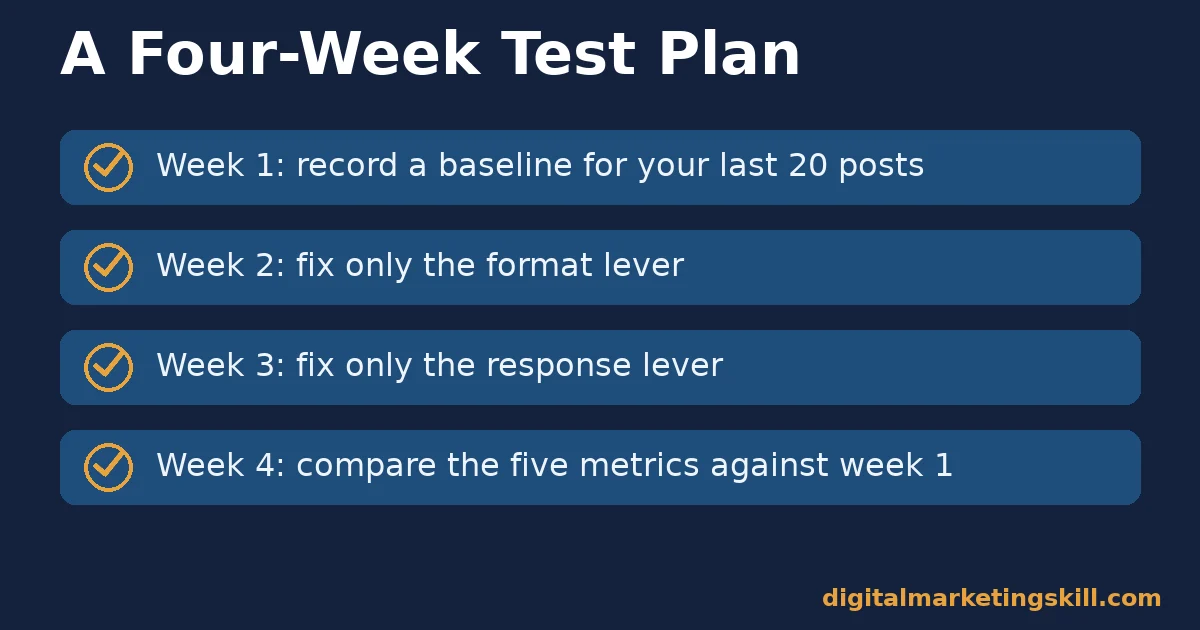
A Four-Week Test Plan for Facebook Engagement Strategies
A staged test beats changing everything at once, because it gives you real numbers to compare instead of a vague sense that “engagement feels better.”
- Week one: record a baseline. Pull engagement rate, comment rate and response time for your last 20 posts before changing anything. You cannot prove a tactic worked without a “before” number.
- Week two: fix only the format lever. Shift toward the format that already performs best in your own history, and avoid defaulting to link posts for the full week.
- Week three: fix only the response lever. Reply to every comment within the first hour, with a real sentence, and track whether response time actually improved.
- Week four: compare against the baseline. Check the five metrics again. A real improvement shows up as a rising comment rate and share rate, not just more reactions.
Changing one lever per week, rather than all three at once, is what lets you credit the right fix when a number moves. Meta’s own guide to analysing Page performance recommends checking reach, reactions, comments, shares and clicks together. That maps directly onto the five metrics this plan tracks.
Run the cycle twice before declaring a winner. One strong week can be noise; two strong weeks in a row, measured the same way, is a pattern worth keeping as part of your ongoing Facebook engagement strategies.
Frequently Asked Questions About Facebook Engagement Strategies
What is a good Facebook engagement rate?
Socialinsider’s analysis of 25 million posts put the average at 0.15% of fans, with status updates performing best at 0.20% and link posts lowest at 0.05%. Compare your page against its own trailing average first, since benchmarks vary widely by page size and industry.
Does posting more often improve Facebook engagement?
Not on its own. Meta’s ranking system scores each post individually based on predicted value to the viewer. More low-engagement posts do not compensate for a format or targeting problem. Fixing the weakest lever usually beats posting more often.
Why do link posts perform worse than other formats?
Socialinsider’s data found link posts at a 0.05% engagement rate, the lowest format measured. One likely factor is that a link invites the viewer to leave Facebook, which runs against the platform’s own incentive to keep people on the app, though Meta has not published an exact penalty.
Do comments matter more than likes for Facebook engagement strategies?
Meta’s own announcement of its “meaningful social interactions” ranking shift said person-to-person interaction is weighed more heavily than passive engagement with a Page. A comment, which usually sparks a reply, fits that definition more closely than a single reaction tap.
How fast should a business respond to Facebook comments?
Sprout Social’s Index found close to three-quarters of social users expect a response within 24 hours or sooner, and 73% say they will consider a competitor if a brand does not respond at all. Treat 24 hours as a maximum for any comment that asks a real question.
Should every business avoid posting links on Facebook?
No, but treat a link post as a trade-off. Track link-click rate separately from engagement rate, so a lower-engagement link post can still be judged a success if it drove meaningful traffic to a site or offer.
Do Facebook engagement strategies work the same way for small pages and large ones?
The mechanism is the same, since every page’s posts go through the same ranking process. What differs is scale: a small page needs fewer strong signals to see a visible lift, while a large page often needs a sustained pattern across many posts before an improvement shows clearly in its averages.
What happens when a business ignores comments completely?
The cost shows up elsewhere. A Zendesk customer experience survey of nearly 5,100 consumers across 22 countries found 63% would switch to a competitor after a single bad experience. Silence on a public comment often reads as exactly that.
Start With Your Page’s Weakest Lever, Then Measure It
Pull the lever where your own page’s numbers show the clearest gap, whether that is format, audience targeting or response speed. Track the five metrics above for a full month before changing strategy again. These Facebook engagement strategies work the same way anywhere in your country, because the ranking mechanism behind them is global, not regional.
If you want structured practice building and measuring Facebook engagement strategies inside real marketing work, the Institute’s Master Diploma in Digital & AI Marketing covers social media strategy alongside content, SEO, analytics and six other practical courses. It includes unlimited one-on-one coaching and mentoring and real project work inside a U.S. company.
It is dual US and UK accredited, recognised in more than 100 countries, and delivered 100% online, so you can apply these levers wherever you live.
Related reading on the skills a social media manager needs and social media management tools can help you put the response lever into practice.
Browse more guides on the digital marketing blog, read real outcomes on the reviews page, or see the full program and apply at digitalmarketingskill.com. Wherever you live, those free guides at digitalmarketingskill.com are a reasonable place to start testing your own Facebook engagement strategies.
Every figure in this guide was checked against its original source before publication. Figures marked as illustrative are invented examples, not real results.
![9 Amazing Digital Marketing Skills to Make Money Online [With Proof]](https://digitalmarketingskill.com/wp-content/uploads/2019/07/9-Amazing-Digital-Marketing-Skills-to-Make-Money-Online-With-Proof-17.png)