
An SEO Specialist is a marketing professional who improves a website so it earns more visits from search engines, through work on keywords, content, technical health and links. They study how people search, then shape pages to answer those searches well. As a result, the business can win steady traffic without paying for every click. So SEO specialists are found in agencies, in-house teams and freelance work across many industries.
Key Takeaways
- An SEO specialist helps websites earn more organic traffic from search engines.
- The job covers keyword research, on-page content, technical fixes and link building.
- Core tools include Google Search Console, analytics platforms and site crawlers.
- Google warns that “No one can guarantee a #1 ranking on Google.”
- Modern roles also cover AI-powered search features, not just classic blue links.
What Is an SEO Specialist?
An SEO specialist is the person who looks after a site’s search engine optimisation. Google’s own SEO Starter Guide puts the goal simply: SEO “is about helping search engines understand your content.” In turn, the specialist’s job is to make that happen across a whole website.
Think of a librarian who makes sure every book has the right label and sits on the right shelf. Then, when a reader asks for a topic, the right book is easy to find. In the same way, an SEO specialist labels, organises and improves web pages so search engines can match them to the right searches.
The role is wide. For example, one day you might research keywords for a new service page. The next day, you might fix broken links or write a brief for a blog post. Also, you might report results to a client or manager.
Google lists the kinds of help an SEO can offer. These include “Review of your site content or structure,” “Technical advice on website development,” “Content development” and “Keyword research.” So the job mixes analysis, writing and technical skills.
Why It Matters
Search is often where customers start. For instance, someone who needs a plumber or a new laptop usually searches first. If your site doesn’t appear, a competitor gets that visit. In addition, organic traffic keeps flowing after the work is done, unlike paid ads that stop when the budget ends. That is why many businesses hire SEO specialists, either in-house or through agencies.
How an SEO Specialist Works
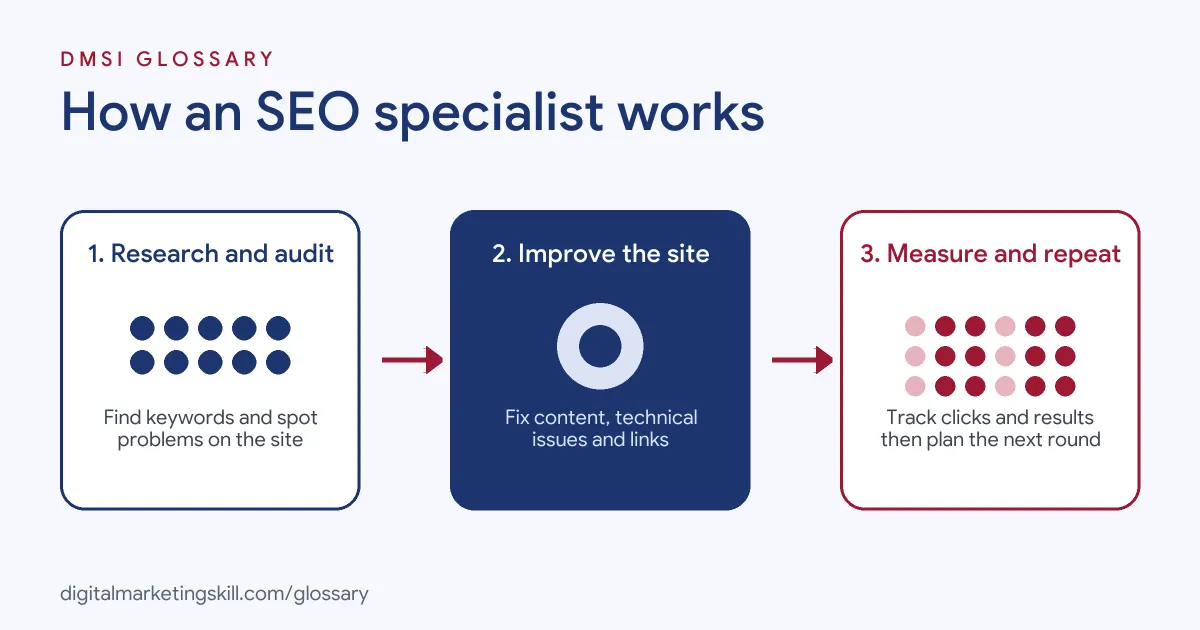
Most SEO work follows a cycle. First, you research and audit. Then you make changes to content and the site. Finally, you measure the results and plan the next round.
Research and audit
To start, an SEO specialist learns what people search for. Keyword research shows the words and questions your customers use. Next, a site audit finds problems such as slow pages, broken links or missing titles. Together, these show where the biggest gains are.
On-page and content work
After that, the specialist improves pages. This includes titles, headings, internal links and the content itself. For example, they might expand a thin service page with clear answers to common questions. This is the heart of on-page SEO.
Technical fixes
Meanwhile, technical SEO makes sure search engines can crawl and index the site. That covers sitemaps, redirects, page speed and mobile use. Often, the specialist finds the issue and works with developers on the fix.
Links and authority
In addition, specialists look at how other sites link to yours. Good links from relevant sites can help search engines trust your pages. However, Google warns against shortcuts, and notes, “You should never have to link to an SEO.” So ethical link building focuses on earning links with useful content.
Measuring results
As the last step in the cycle, the specialist tracks progress in Google Search Console and an analytics tool. They watch clicks, rankings and conversions. Also, they explain results in plain terms. Google notes that “Some changes might take effect in a few hours, others could take several months.” So patience and clear reporting are part of the job.
SEO and AI search
Search is also changing. For example, Google lists “Optimizing for generative AI” among the services an SEO may offer. So many specialists now track how their brand appears in AI answers, not just in classic results. This work is often called generative engine optimisation. Still, the basics stay the same. Clear, helpful and well-structured pages tend to do well in both places.
Skills you need
Good SEO specialists mix several skills. First, they are curious and like to dig into data. Second, they write clearly, because much of SEO is about content. Third, they understand how websites work, at least at a basic level. In addition, they can explain complex ideas to people who are not experts. Finally, they stay patient, since results often take time. You don’t need to master every skill at once. Instead, most people start with one area, such as content or technical SEO, and grow from there.
Examples of SEO Specialist Work
- An in-house specialist at an online shop. She finds that category pages lack helpful text. Then she adds short buying guides, so the pages can match more searches.
- An agency specialist for a local dentist. He improves the Google Business Profile and the service pages. As a result, the practice is easier to find for nearby searches.
- A freelance specialist for a software firm. She runs a technical audit and finds blocked pages in robots.txt. After the fix, those pages can be crawled again.
SEO Specialist vs Content Writer vs PPC Specialist
| Point | SEO Specialist | Content Writer | PPC Specialist |
|---|---|---|---|
| Main goal | More organic search traffic | Clear, useful content | Results from paid search ads |
| Key skills | Keywords, technical SEO, analysis | Writing, editing, research | Bidding, ad copy, budgets |
| Main tools | Search Console, crawlers, analytics | Docs, style guides, briefs | Google Ads, Microsoft Advertising |
| Speed of results | Often slow but lasting | Depends on promotion | Fast, but stops when spend stops |
In practice, these roles work closely together. An SEO specialist often writes briefs for writers. Similarly, they share keyword data with the paid search team.
How to Become an SEO Specialist
- Learn the basics. Start with Google’s SEO Starter Guide and its Search Central documentation.
- Build a practice site. Set up a small WordPress site, so you can test ideas safely.
- Connect the tools. Add Google Search Console and an analytics tool, then learn the main reports.
- Practise keyword research. Find the questions your audience asks and plan pages around them.
- Run an audit. Use a site crawler to find and fix technical problems on your site.
- Write and improve content. Publish helpful pages, then update them based on data.
- Show your work. Record what you changed and what happened, and build a simple portfolio.
- Get real experience. Finally, look for internships, junior roles or small freelance projects.
Best Practices for SEO Specialists
- Put people first. Write for the reader, then make sure search engines understand the page.
- Follow official guidance. Check advice against Google’s own documentation before you act.
- Measure what matters. Track leads and sales from search, not just rankings.
- Explain your work. Give clients and managers clear reasons for each change.
- Keep learning. Search features change, including AI Overviews, so stay up to date.
- Never promise rankings. Set honest goals based on effort and data.
Common Mistakes to Avoid
- Chasing tricks. Shortcuts that break Google’s spam policies can harm a site badly.
- Ignoring technical health. Great content can’t rank if search engines can’t crawl it.
- Focusing only on traffic. Visits that never convert don’t help the business.
- Making changes without tracking. If you don’t record changes, you can’t tell what worked.
- Overpromising. Google warns that if an SEO promises first place, you should “find someone else.”
Where You’ll Work as an SEO Specialist
SEO specialists work in agencies, in-house marketing teams and freelance roles. Many listings now include AI search as well as classic search. For example, real remote job listings say:
- “We’re looking for a Senior SEO Specialist to own and advance Solflare’s organic search strategy across traditional search engines and AI-powered discovery platforms.” (SEO Specialist).
- “We are looking for an SEO Specialist who understands that effective SEO goes beyond basic content creation.” (SEO Specialist).
- “Deep expertise in crawling, indexation, JavaScript SEO, sitemaps, canonicals, redirects, hreflang, internal linking, Core Web Vitals, performance, and mobile UX.” (Senior Technical SEO Specialist).
Learn It in the WordPress and SEO Track
You can build the skills an SEO specialist needs in the AI-Powered WordPress and SEO Specialist track. Every track includes a U.S. Project Internship from day one, with unlimited 1-on-1 mentoring.
Frequently Asked Questions
What does an SEO specialist do each day?
It varies, but common tasks include keyword research, content updates, technical checks and reporting. Many also write briefs and talk with developers.
Do I need a degree to become an SEO specialist?
Many employers focus more on skills and proof of results. So a portfolio of real work can matter a lot.
Do SEO specialists need to code?
Not much. However, basic HTML helps you spot problems and explain fixes to developers.
Can an SEO specialist guarantee first place on Google?
No. Google says no one can guarantee a number one ranking, so be wary of anyone who promises it.
Can SEO specialists work remotely?
Yes, many SEO roles are remote, because the work happens online. Still, each job sets its own location rules.
Sources: Google Search Central: Do you need an SEO?; Google Search Central: SEO Starter Guide; Google Search Central: Spam policies for Google web search; remote job listings on Himalayas, Himalayas and Himalayas.