
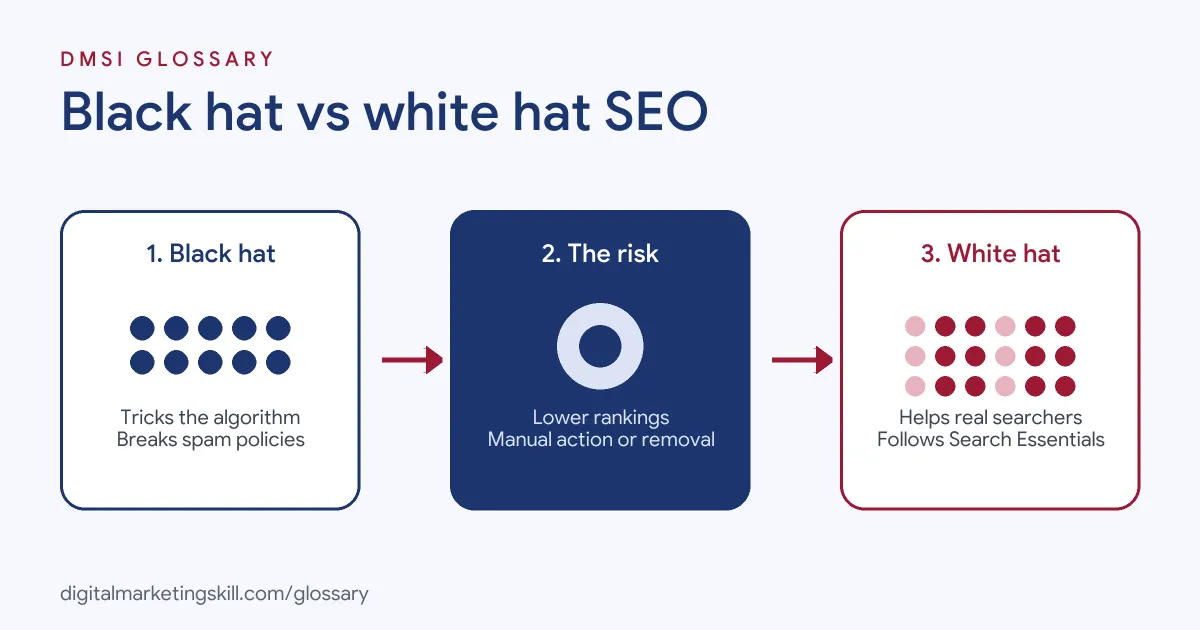
Black hat SEO is the use of tactics that break search engine rules to push a website up the rankings. Common examples are keyword stuffing, hidden text, cloaking, buying links and mass-producing low-value pages. These tricks aim to fool the ranking system rather than help the person searching. Google lists them in its spam policies and warns that sites using them may rank lower or vanish from results. The opposite approach, which follows the rules, is called white hat SEO.
Key Takeaways
- Black hat SEO means breaking search engine spam policies to gain rankings.
- Google’s spam policies name tactics such as cloaking, doorway pages, keyword stuffing, link spam and scaled content abuse.
- Penalties come from automated systems and from human reviewers, who can issue a manual action.
- You can see manual actions in Google Search Console and request a review once you fix the problem.
- White hat SEO builds rankings that last, which is why employers ask for it by name.
What Is Black Hat SEO?
The name comes from old Western films, where villains often wore black hats and heroes wore white. In search engine optimisation, black hat describes anyone who tries to win by gaming the system instead of earning their place.
The rules being broken are public. Google publishes its Search Essentials, including a page of spam policies. It says sites that break these policies may “rank lower in results or not appear in results at all”. Bing has similar webmaster guidelines. So black hat is not a grey area of taste. It is a clear choice to ignore published rules.
Common Black Hat SEO Techniques
Google’s spam policies list the tactics it acts on. The most common ones are below, explained in plain terms.
- Keyword stuffing: Cramming a page with the same keywords, numbers or place names until it reads badly.
- Cloaking: Showing search engines one version of a page and people another.
- Hidden text and links: Text or links that crawlers can read but visitors cannot see, such as white text on a white background.
- Link spam: Buying, selling or swapping links mainly to boost rankings, or using automated tools to create them. Paid links are fine if marked with a nofollow or sponsored tag.
- Doorway pages: Many near-identical pages built for slightly different searches, all funnelling to one place.
- Scaled content abuse: Publishing large numbers of low-value pages, whether written by hand or generated with AI, just to catch search traffic.
- Scraping: Copying other sites’ content, or lightly rewording it, without adding anything.
- Sneaky redirects: Sending visitors to a different page from the one they clicked.
- Expired domain abuse: Buying old domains with good history to host thin content.
- Site reputation abuse: Placing unrelated third-party pages on a trusted site so they borrow its ranking strength.
A private blog network, often shortened to PBN, is a common form of link spam. It is a group of sites built only to link to one main site.
Black Hat vs White Hat SEO
| Area | Black hat approach | White hat approach |
|---|---|---|
| Keywords | Repeat them as often as possible | Use them naturally in titles, headings and copy |
| Content | Mass-produced or copied pages | Original pages that answer the searcher’s question |
| Links | Bought, swapped or from link networks | Earned through useful content and outreach |
| Technical | Cloaking and sneaky redirects | Fast, crawlable pages and honest redirects |
| Result | Quick gains, high risk of losing everything | Slower gains that tend to last |
Some people talk about grey hat SEO, meaning tactics that are not clearly banned but push the limits. A safe test is simple: would you be comfortable explaining the tactic to a Google employee or to your client? If not, do not use it.
What Happens If You Use Black Hat SEO?
Google finds spam in two ways. Automated systems spot most of it and can lower rankings without warning. Human reviewers can also issue a manual action, which means a person at Google has decided some pages break the rules. Pages with a manual action may drop in rankings or be removed from results.
The damage often goes beyond traffic. Clients lose leads and sales, and rebuilding trust with search engines can take months. Google’s spam updates and broader algorithm updates also tend to wipe out gains from shortcuts that once worked.
How to Check for a Penalty and Recover
- Open the Manual actions report in Google Search Console. A green tick means there are none.
- Read the issue type and which pages it affects.
- Fix every affected page, for example by removing paid links or deleting thin pages.
- Request a review. Explain the exact problem, what you changed and the result.
- Wait for the decision. Google says reviews can take days or weeks, so do not resubmit in the meantime.
If traffic fell but there is no manual action, the cause is more likely an automated system or an algorithm update. In that case, review content quality and your links, then improve the pages over time.
Black Hat SEO Examples
These made-up examples show how black hat thinking shows up in real projects:
- A local plumber creates 200 pages that are the same apart from the town name. These are doorway pages, and they offer nothing unique.
- An online shop pays a seller for 500 links from unrelated blogs. This is link spam, and the links could trigger a manual action.
- A blog publishes 1,000 AI-written posts in a week with no editing or expertise. This can count as scaled content abuse.
The white hat fix in each case is similar: fewer, better pages, written for real people, with links earned because the content is worth citing.
How to Spot Black Hat SEO in an Audit
You may inherit a website that someone else optimised, or hire an agency and want to check its work. These warning signs suggest black hat tactics have been used:
- Odd backlinks. Your link report shows many links from unrelated foreign blogs, gambling sites or pages that exist only to list links.
- Exact-match anchor text everywhere. Hundreds of links all use the same keyword phrase as their anchor text, which rarely happens naturally.
- Clone pages. Large groups of pages differ only by a town or product name.
- Hidden content. Text appears when you select all on a page but cannot be seen normally.
- Guaranteed rankings. An agency promises the number one spot by a set date, or will not say how it gets links.
- Sudden drops. Traffic falls sharply right after a known spam update.
If you find these signs, document them, remove what you can, and ask link sellers to take down paid links. Fixing the problem early is far easier than recovering after a manual action. It is also a strong talking point with clients, because it shows you protect their business, not just their rankings.
Where You’ll Use This at Work
Employers want to know you can grow rankings without putting a client at risk. One remote web developer and SEO role asks for “Expertise in White Hat SEO, including on-page, off-page, and technical SEO.” Knowing what black hat looks like helps you spot it during an audit, explain risks to clients and turn down risky shortcuts with confidence.
Learn It in the WordPress and SEO Track
You can learn safe, lasting SEO in the AI-Powered WordPress and SEO Specialist track. There, you build a WordPress site or store and rank it with an SEO content plan. You also join a U.S. Project Internship from day one and get unlimited 1-on-1 mentoring.
Next, read our guides on how to build backlinks the right way and common SEO mistakes. You may also like our glossary entries on link building and E-E-A-T.
Frequently Asked Questions
What is black hat SEO in simple terms?
It is trying to rank higher by breaking search engine rules, for example by stuffing keywords, hiding text or buying links.
Is black hat SEO illegal?
Usually not illegal, but it breaks search engines’ published rules. Some tactics, such as hacking other sites to add links, can also break the law.
What is the difference between black hat and white hat SEO?
Black hat tries to trick search engines. White hat follows their guidelines and focuses on helpful content, sound technical work and earned links.
Does black hat SEO still work?
Some tricks give short-term gains, but automated systems and manual reviews often remove them, sometimes taking the whole site down with them.
How do I know if my site has a Google penalty?
Check the Manual actions report in Google Search Console. Google also sends a message and an email when it issues one.
Is buying backlinks black hat?
Buying links to pass ranking value breaks Google’s link spam policy. Paid placements are allowed only when the links are marked nofollow or sponsored.
Is using AI to write content black hat SEO?
Not by itself. Google judges the content, not the tool. Publishing large amounts of unedited, low-value pages to catch traffic is scaled content abuse, whether a person or AI wrote them. Edited, original pages that help readers are fine.
Sources: Google Search Central: Spam policies for Google web search; Search Console Help: Manual actions report; Google Search Essentials; remote job listing on Himalayas.