
Brand positioning is the place a brand aims to hold in a customer’s mind compared with its competitors. It sums up who the brand is for, what need it meets and why people should choose it over the alternatives. In practice, it guides every message, design choice and campaign, so the brand feels clear and consistent.
Key Takeaways
- Positioning is about perception. It describes how you want customers to see your brand next to rivals.
- It comes after you choose your segment and target, as part of the segmentation, targeting and positioning approach.
- A positioning statement is an internal document. Later, teams turn it into slogans, ads and website copy.
- A perceptual map helps you see where brands sit in a market and where a gap might exist.
- Positioning only works if the product and service live up to the promise.
What Is Brand Positioning?
Every market is crowded. So customers sort brands into simple mental boxes, such as “the cheap one”, “the premium one” or “the one for beginners”. Brand positioning is your plan for which box you want to own.
Wikipedia describes positioning as a strategy that “aims to make a brand occupy a distinct position, relative to competing brands, in the mind of the customer.” Qualtrics puts it more simply: positioning means “owning a unique position in the mind of the target consumer.”
The idea became popular through the advertising writers Al Ries and Jack Trout, especially their book Positioning: The Battle for Your Mind. Even earlier, the adman David Ogilvy wrote that “the most important decision is how to position your product.” In other words, marketers have treated this as a core decision for a long time.
How Brand Positioning Works
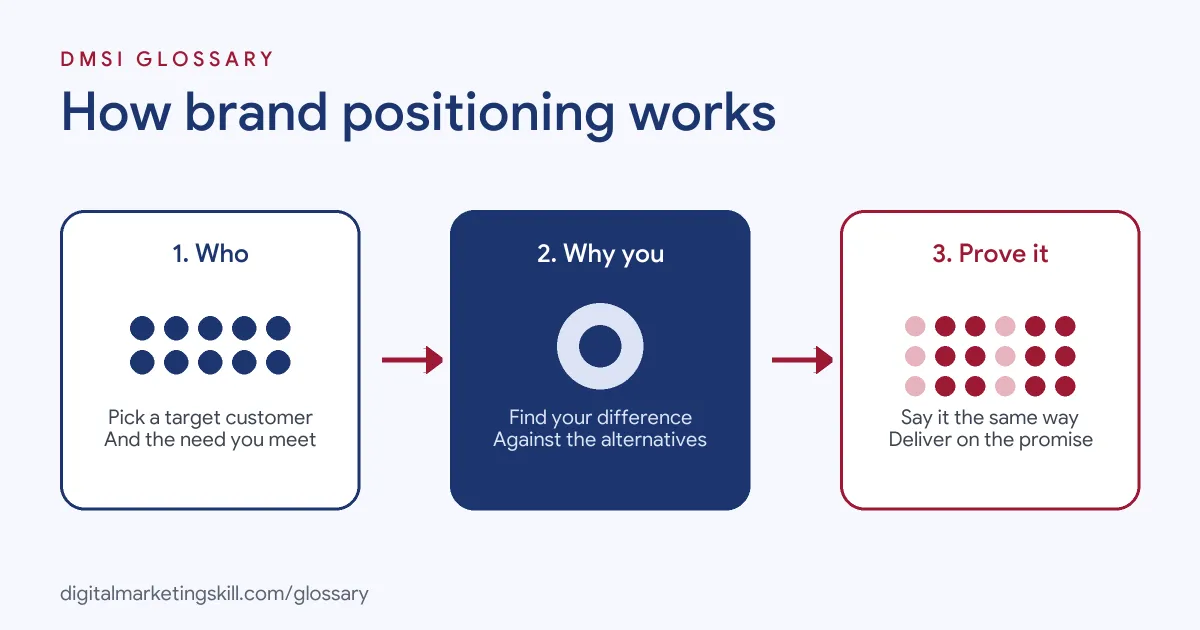
Positioning sits at the end of a three-step process. First, you split the market into groups, which is called segmentation. Next, you pick the group you want to serve, which is targeting. Finally, you decide how you want that group to see you. That final step is brand positioning.
The Positioning Statement
In practice, most teams capture their positioning in one short statement. According to Wikipedia, a positioning statement usually includes five parts:
- Target market: who you serve.
- Need: the problem or opportunity in that market.
- Product: its name and category.
- Benefit: the main thing it does for people.
- Difference: what sets it apart from the alternatives.
Qualtrics suggests a simple template that starts “For [target market], Brand X is the only brand amongst…” It also stresses that the statement should be short, simple and clear. Above all, it is for internal use, so customers never see it word for word.
Perceptual Maps
A perceptual map is also a simple chart of how customers see the brands in a market. Usually, you pick two factors, such as price and quality, and plot each brand on the grid. As a result, you can spot empty spaces. One of those gaps may become your position, as long as enough customers want it.
Types of Positioning
Brands can position themselves in several ways, too. Wikipedia lists three broad types. Functional positioning focuses on solving a problem. Symbolic positioning taps into self-image and belonging. Meanwhile, experiential positioning focuses on how the product feels to use. Qualtrics adds common starting points, such as price, quality, use or a direct comparison with a competitor.
Brand Positioning Examples
Here are three made-up businesses that show how positioning shapes everyday choices:
- Coffee shop: A small café positions itself as “the quiet place to work”. So it adds plugs and fast Wi-Fi, keeps music low and runs ads aimed at freelancers.
- Accounting software: A start-up positions itself as the simplest option for sole traders. As a result, its website avoids jargon, and every feature page shows how few clicks a task takes.
- Online course: A training provider positions itself on hands-on, practical learning. Therefore its ads show real projects, not lecture halls.
In each case, the position affects the product, the message and the channel, not just the slogan.
Positioning also makes digital marketing easier. For instance, a clear position tells you which keywords to target, which audiences to pick in an ad platform and which words to put in a headline. Without it, every campaign starts from a blank page. With it, you can brief a designer, a copywriter or an AI tool in one sentence. As a result, your ads, emails and posts all pull in the same direction, and customers start to remember what you stand for.
Brand Positioning vs Brand Identity vs Tagline
These terms often get mixed up, so here is a quick comparison:
| Term | What it is | Who sees it |
|---|---|---|
| Brand positioning | The place you want to hold in the customer’s mind | Mostly internal teams |
| Positioning statement | A short written summary of that position | Internal only |
| Brand identity | The name, logo, colours, fonts and voice that express the brand | Everyone |
| Tagline | A short public phrase that hints at the position | Everyone |
In short, positioning is the strategy. Identity and taglines are how you show that strategy to the world.
How to Create Your Brand Positioning
Use these steps to build a clear position from scratch:
- Research your market. List your main competitors and how each one presents itself.
- Choose your target customer. Then be specific about who they are and what they struggle with.
- Define the need you meet. Qualtrics frames this as the “who”, the “what” and the “why”.
- Find your real difference. It might be price, speed, quality, service or a niche focus.
- Draw a simple perceptual map. Check that your chosen spot is not already taken.
- Write a one-sentence positioning statement using the five parts above.
- Share it with every team. Then turn it into messages, ads and web copy that all say the same thing.
After launch, keep listening to customers. Their words will tell you whether the position has landed.
Best Practices for Brand Positioning
A few habits make positioning stronger:
- Pick one clear idea. Trying to be the cheapest and the most premium at once confuses people.
- Base it on proof. Choose a difference you can actually deliver, every time.
- Use the customer’s words. Reviews and interviews show how people really describe the problem.
- Stay consistent. Similarly, every ad, post and email should support the same position.
- Review it when the market shifts. New competitors or changing tastes can weaken a position over time.
Common Mistakes to Avoid
Many brands stumble in the same places. First, they choose a vague position, such as “high quality”, that any rival could claim. Second, they target everyone, so the message speaks to no one. Third, the promise and the experience do not match. Qualtrics warns that this kind of gap can wear a position down. Finally, some brands change direction too often. According to Wikipedia, repositioning is a deliberate attempt to change how people see a brand, and it carries real risk. So treat it as a big decision, not a quick fix.
Where You’ll Use Brand Positioning at Work
Positioning shows up in brand, content and marketing roles. For example, current remote job listings ask candidates to:
- “Own brand positioning, target audience strategy, key messaging and tone of voice” (Brand and Content Manager).
- “Develop, refine and execute brand positioning, messaging and engagement priorities” (Director of Brand Engagement).
- Lead work where “this role leads enterprise brand positioning and narrative” (Brand Strategy, Managing Director).
So whether you aim to become a Digital Marketing Manager, Growth Marketer or Freelance Digital Marketer, you will need to understand positioning. It shapes the ads you run, the content you write and the audiences you target.
Learn It in the Full Stack Programme
Brand positioning sits behind every channel, so it fits best in the Full Stack programme, which covers all four tracks and all ten courses. You complete one portfolio project from each track, from paid social to SEO. You also work on a U.S. Project Internship from day one, with unlimited 1-on-1 mentoring.
Want to keep reading? See our guide to building an online brand strategy, or learn how to shape a brand identity strategy that supports your position.
Frequently Asked Questions
What is brand positioning in simple terms?
It is the spot you want your brand to own in a customer’s mind. For example, “the fastest”, “the friendliest” or “the best value”.
What is a positioning statement?
It is a short internal sentence that names your target market, their need, your category, your key benefit and your difference.
What is the difference between brand positioning and brand identity?
Positioning is the strategy, while identity is the expression. Identity covers your name, logo, colours, fonts and voice.
How do you know if your positioning works?
Listen to how customers describe you. If their words match your intended position, it is working. Brand tracking surveys and perceptual maps can help too.
Can a brand change its positioning?
Yes. This is called repositioning. However, it is risky, so brands usually do it only when the market or their customers have clearly changed.
Sources: Wikipedia: Positioning (marketing); Qualtrics: What is brand positioning?; remote job listings on Himalayas and Himalayas.