A clear online brand strategy turns scattered social posts and a generic website into one identity people trust. It lines up your name, your look, and your voice across search, social, and your own site. Visitors then recognize you fast. That recognition turns into inquiries, sign-ups, and repeat sales over time.
Key Takeaways
- 6.12 billion people are online worldwide. The average user spends roughly 33 hours a week connected (DataReportal’s Digital Global Overview). If your brand is not visible there, a competitor already is.
- Businesses that publish 16 or more posts a month get about 4.5 times more leads than businesses that publish fewer (DemandSage). Frequency builds trust faster than one “viral” post ever will.
- The top search result earns roughly 27.6% average click-through. Position 10 earns roughly 2.6% (Semrush). Visibility is lopsided at the top of the page, not gradual.
- 97% of people read reviews before they choose a local business. 85% say positive reviews make them more likely to buy (BrightLocal’s Local Consumer Review Survey). Your reputation now lives outside your own website.
- Companies that present their brand the same way everywhere have reported revenue gains of up to 33% (a study of 600+ brand professionals from Lucidpress). Consistency is a business lever, not decoration.
In this guide
- Why Most Small Businesses Get Online Branding Wrong
- How an Online Brand Strategy Actually Works
- What Differs by Channel
- How To Lead With Each Channel
- How To Measure Your Online Brand Strategy
- The One Decision Rule
- A Real Case: Building A Brand Without An Agency Budget
- Frequently Asked Questions About Online Brand Strategy
- Your Next Step
Why Most Small Businesses Get Online Branding Wrong
Most small businesses do not fail online because they lack a logo. They fail because the brand looks and sounds different on every channel. The tone on social media is casual. A business listing shows a slightly different name. Email correspondence sounds formal. A visitor who sees three different versions of the same company in one week trusts none of them.
Two ground rules before you change anything. First, treat every number in this guide as a snapshot, not a settled formula. It is an informed inference from named public research, and it will not apply the same way in every market.
Second, an online brand strategy is not one campaign you finish and move on from. It is a system you maintain. Small, consistent choices, made everywhere a customer can find you, add up over months.
The real fix is rarely “more content.” It is the same identity, repeated everywhere, until people recognize it on sight. That is the same idea behind building an online brand presence. Show up the same way, every time, until strangers start to feel familiar.
Get this part wrong and every other tactic here works harder than it should. Get it right, and small efforts compound instead of resetting to zero each month.
This Applies Worldwide
This is worldwide advice, not advice for one market. The tools and exact numbers will vary by country. But the problem stays the same. People trust what they recognize, and they recognize what stays the same over time.
A business in any market runs into the same trap if it treats branding as an afterthought. Treat the research in this guide as useful evidence from the markets where it was collected, not a guarantee for your specific market.
How an Online Brand Strategy Actually Works
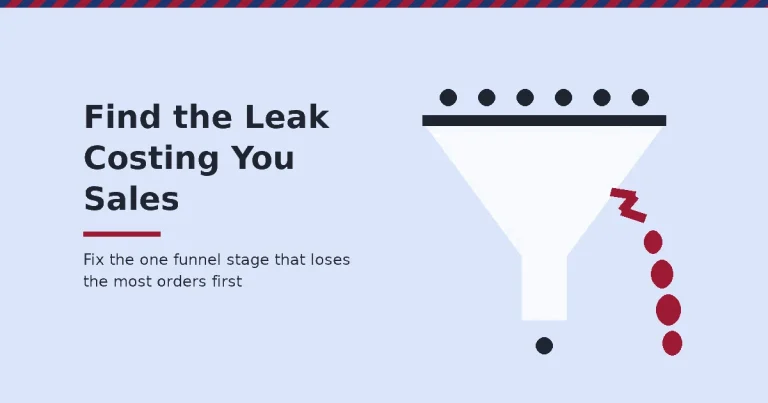
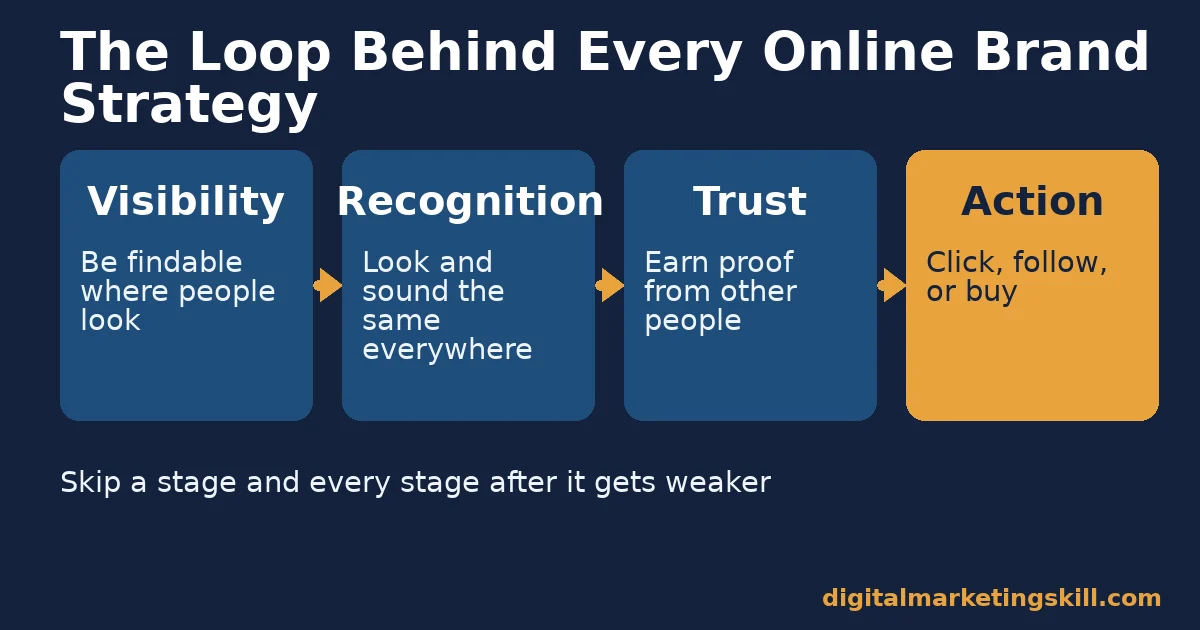
An online brand strategy runs as a loop, not a one-time launch. Visibility creates exposure. Repeated exposure creates recognition. Recognition plus proof creates trust. Trust converts into action. Each stage feeds the next one. Skip a stage, and the ones after it get weaker.
Visibility means being findable where people already look: search engines, social platforms, and referrals from other sites. If people cannot find you, nothing else in this loop can start.
Recognition is a simple psychological effect. Familiarity itself increases liking and trust. Researchers call this the mere-exposure effect. It is why the same logo, name, and colors, shown five times in a week, do more for trust than one perfect post shown once.
Trust comes from proof other people provide, not proof you provide about yourself. Reviews, case studies, and honest answers to real customer questions all count as proof. Today, customers weigh what other people say about a brand more heavily than what the brand says about itself.
Action is the click, the follow, or the purchase. It only happens reliably once visibility, recognition, and trust are already working together.
Skip visibility, and nobody sees you at all. Skip consistency, and visibility never compounds into recognition. Miss the proof stage, and recognition never turns into trust. The strategy only works when all four stages run at the same time, across every channel you keep active.
Why Repetition Beats Perfection
Here is a short worked example. A local bakery posts on social media once a month, with a different logo crop each time. A visitor sees the page once, scrolls past, and forgets it.
Now compare that to a bakery that posts weekly, always with the same logo, the same colors, and a reply to every comment. After eight weeks, the second bakery’s page name starts showing up in branded search. The first bakery’s page does not. Same effort level, roughly. Very different outcome, because one bakery built recognition on purpose and the other did not.
This is also why an online brand strategy rewards patience over intensity. One expensive video rarely beats twelve months of small, consistent posts that all look and sound like the same business. Consistency is also cheaper to sustain, since it needs no new creative idea each time, only the same identity on a new topic.
Most owners underestimate how fast small gaps add up: a logo resized slightly differently on three platforms, a bio written in three different tones, a color palette that drifts from post to post. Each one looks minor on its own.
Together, these small gaps quietly erase the recognition your strategy is trying to build. Audit every public profile once a quarter, side by side on one screen. That catches the drift before it costs you trust.
What Differs by Channel
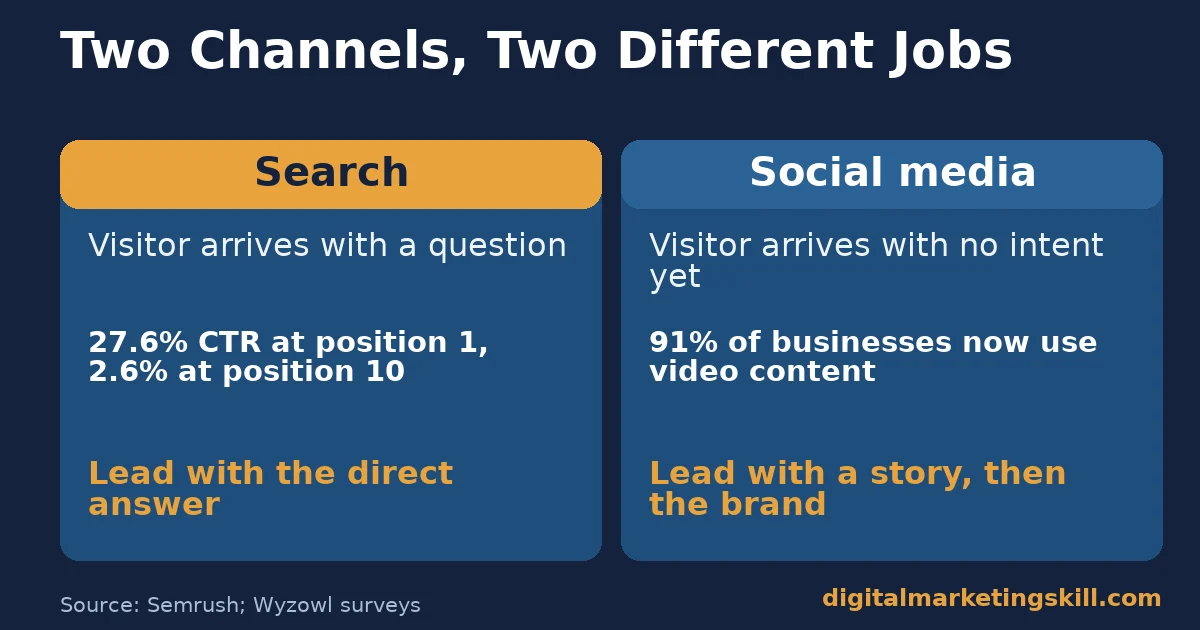
Search and social media look like the same job: “get found online.” In practice they solve opposite problems. Using one playbook for both wastes effort on each, and it is one of the fastest ways to undercut an otherwise sound online brand strategy.
Most small teams have one person handling “marketing.” Search and social often get written in the same sitting, in the same tone. That shortcut saves time. But it also means the content fights its own purpose on at least one channel. Separating the two jobs, even briefly, tends to improve both.
Search: Built For Intent
Search exists to answer a question someone already has. A person typing a search query has already decided they want information, a comparison, or a fix for a problem. Your job is to be the clearest, most specific answer on the page.
This is why ranking position matters so much. Semrush’s ranking research found the top organic result earns about 27.6% of clicks on average. Position 10 earns roughly 2.6%. The intent is already there. You are only competing on relevance and trust signals, like reviews and page experience. Tracking the right online marketing metrics matters more here than chasing rankings for their own sake.
Social Media: Built For Attention
Social media exists to create interest before anyone was looking for you. Nobody searches for “a business I have never heard of.” The content has to earn attention on its own, through a story, a useful tip, or a strong visual. Only after that does it introduce the brand.
According to Wyzowl’s self-reported survey of marketing professionals, 91% of businesses now use video. Among those video marketers, 93% say it has helped increase brand awareness. Attention is the scarce resource on social platforms. Relevance comes second. Learning how to drive traffic from social platforms is a different skill from ranking in search.
The practical difference shows up in what you measure day to day. On search, check whether the page answers the question well enough to rank and convert. On social, check whether the post stopped someone mid-scroll at all. Worry about conversion only after that. Treating both the same way usually means doing both jobs badly instead of one job well.
How To Lead With Each Channel
Once you know what each channel is actually built for, the next move in your online brand strategy becomes specific instead of generic.
Search: Lead With Answers
Write the direct answer to the real question in the first two sentences of any page. Support it right away with something specific: a number, a named source, or a short worked example.
Add your business name and contact details the same way everywhere, and keep genuine customer reviews visible. This lets both search engines and readers verify you are a real, trustworthy business, not just a page that happens to rank.
Publishing on a steady schedule also compounds this effect over time. That is the core idea behind building blog readership: each new post is a fresh chance to answer a real question and earn a little more trust.
Social Media: Lead With Story
Open with the moment of change: the problem, the turning point, the result. Mention the product or service only after that. Keep the same profile name, logo, and color treatment on every platform you use. A visitor who recognizes your look on a second or third platform is far more likely to trust the first one they saw.
Small, repeated visual cues do more work here than most businesses expect. A consistent profile photo and bio across five platforms can matter more than a single clever caption on one of them.
How To Measure Your Online Brand Strategy
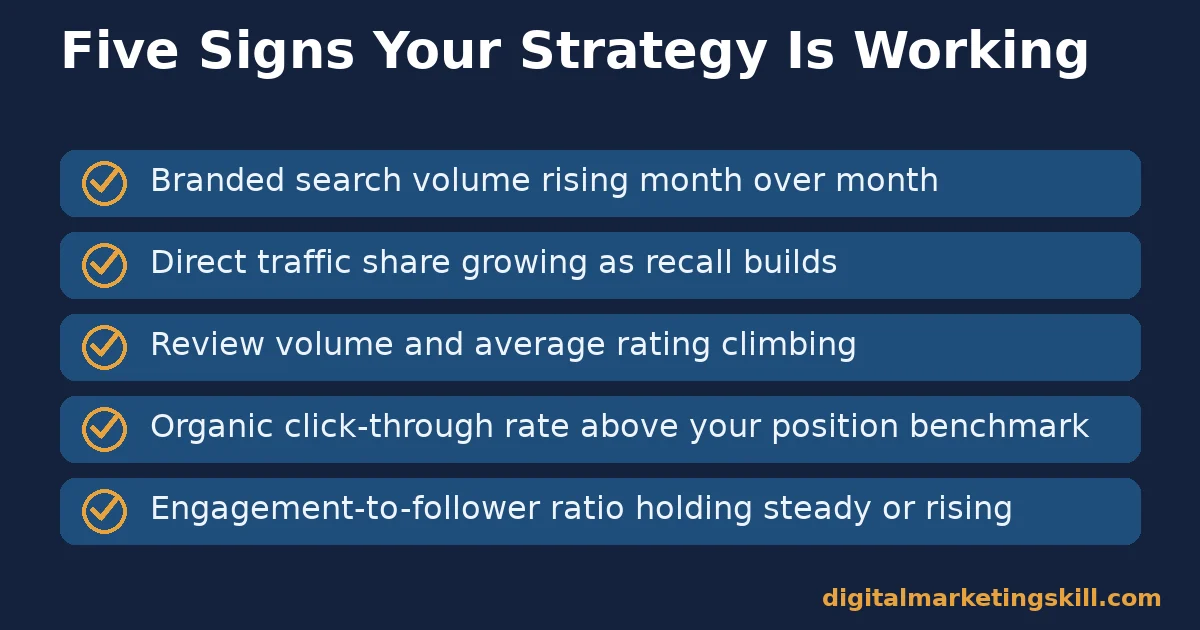
Five numbers tell you whether your online brand strategy is actually building a brand, rather than just generating one-off traffic.
- Branded search volume. This counts how many people search your business name directly. Read it monthly. A steady rise means strangers are turning into people who already know you.
- Direct traffic share. This is the percentage of site visits with no referring source. Read it as recall. People who type your website address from memory remember your brand, not just an ad they clicked once.
- Review volume and average rating. This tracks how many reviews you have and their average score across platforms. Read it as trust at scale, since 97% of people read reviews before they choose a local business.
- Organic click-through rate at your best position. This is the share of people who click your result out of everyone who saw it. Compare it against the 27.6% versus 2.6% benchmark for position 1 versus position 10. That tells you whether your title, description, and reviews are doing their job.
- Engagement-to-follower ratio. This divides comments and shares by total followers, not by raw follower count. Read it as whether your audience is actually paying attention. Follower counts can be old or inflated. Engagement is harder to fake.
Check these five numbers every month, not every day. A single good or bad week rarely means anything on its own. A steady trend across two or three months tells you whether your online brand strategy is working.
Reading The Numbers Together
Keep the five numbers in one simple sheet, side by side, so you can see them move together. A rise in branded search with flat direct traffic often means people are hearing about you but not yet typing your address from memory.
A rise in reviews with a flat click-through rate often means your reputation is strong. But your search listing itself, the title and description searchers see, needs work. Reading the numbers together, rather than one at a time, turns raw data into a real decision about where to spend your next month.
The One Decision Rule
If a channel does not turn attention into a measurable action within 90 days of steady effort, cut your time there in half and move it to the channel that already converts. A measurable action means a click, a reply, or a follow-through, not just a view.
Chasing every platform at once is the most common way small brands dilute an identity that would have worked if it had stayed focused on fewer places. Depth on two channels usually beats a thin presence on six.
Illustrative, invented numbers: say a business spends 10 hours a week split evenly across four platforms. Only one platform produces real inquiries. The rule says shift to roughly 7 hours on the platform that works, with 3 hours left for baseline upkeep elsewhere. Not zero, since an abandoned profile damages consistency. Just clearly weighted toward what is proven.
Apply the same rule to content formats, not only platforms. If video consistently gets shared and blog posts consistently sit unread, move more of your limited time into video, and keep blog posts only for the search traffic they already earn.
The decision rule is not about loyalty to a format you like. It is about following where attention already turns into action, and being willing to change course every quarter as that evidence comes in.
A Real Case: Building A Brand Without An Agency Budget
Damola Akanbi, a graduate of the Institute’s Master Diploma program, built a personal brand as a freelance digital marketer with no agency budget behind him. His account, published on the Institute’s own reviews page, says he left his job and now averages $1,500 per client running digital marketing campaigns under his own name.
Limits: this is one self-reported result from a single graduate, published voluntarily on the Institute’s own site. It is not typical. It depends heavily on effort, market, and circumstances the Institute cannot control. Read the full earnings disclaimer before treating any income figure as a benchmark for your own results.
What this case shows, within those limits, is the pattern this guide describes. Steady, consistent output under one recognizable name, kept up long enough for referrals and reputation to start doing some of the selling. No single post or client made the difference alone. The identity, repeated for months, is what a client eventually came to trust enough to pay for.
Frequently Asked Questions About Online Brand Strategy
What is an online brand strategy?
It is a deliberate plan for how your business looks, sounds, and behaves across search engines, social platforms, and your own website, so visitors recognize and trust you the same way everywhere they find you.
How long does it take to build a recognizable brand online?
Most businesses need several months of steady posting and matching visuals before recognition shows up clearly in branded search volume or direct traffic. It is a compounding effort, not a single campaign.
Do I need a large budget to build an online brand?
No. Consistency costs time and discipline more than money. Using the same name, logo, and tone everywhere, and answering real customer questions honestly, matters more early on than paid reach.
What is the difference between branding and marketing online?
Marketing drives one specific action right now, like a click or a sale. Branding is what makes people recognize and trust you before and after that action. The two should share one identity, but you measure them differently.
Should a small business try to be active on every social platform?
No. Spreading effort across every platform usually produces a weaker identity everywhere. It is better to be consistently strong on the one or two platforms where your actual customers already spend time.
How do I know if my online brand strategy is working?
Track branded search volume, direct traffic share, and review volume over months, not days. Rising numbers across all three mean strangers are becoming people who already recognize and trust your business.
Can a one-person business really compete with bigger brands online?
Yes, on consistency and specificity, even without a large budget. A smaller business can often answer narrow customer questions faster and more personally than a larger competitor, and that specificity builds trust quickly.
What is the single biggest mistake in an online brand strategy?
Inconsistency is the biggest mistake by far. A different logo here, a different tone there, and a stale profile somewhere else all teach visitors that the brand is not reliable, before the brand has said a single word about its product.
How often should I update my branding once it is set?
Rarely, and only on purpose. Small, frequent changes to a logo, color palette, or tone undo the familiarity you have been building. It is better to pick a direction, apply it everywhere, and leave it alone for a long stretch before reviewing it deliberately.
Your Next Step
Building a brand that people recognize and trust takes consistent execution more than raw talent. Digital Marketing Skill Institute teaches these skills hands-on through the Master Diploma in Digital & AI Marketing, ten practical courses including AI-powered SEO and content marketing, AI-powered content creation, and AI-powered social media marketing and analytics. It comes with unlimited 1-on-1 coaching and mentoring.
You also get real project work inside a U.S. partner company, so you practice building a brand on a real budget before you do it for your own business. The diploma is dual US and UK accredited and recognized in more than 100 countries, and it is 100% online, so you can study from anywhere in your country.
Whether you run a small business or want a career doing this work for others, you can start building an online brand strategy that works wherever you live. Explore the Master Diploma program, read more stories on student reviews, browse the digital marketing blog, or go straight to apply. Learn more at Digital Marketing Skill Institute, wherever you are.
Every figure in this guide was checked against its original source before publication. Figures marked as illustrative are invented examples, not real results.
![9 Amazing Digital Marketing Skills to Make Money Online [With Proof]](https://digitalmarketingskill.com/wp-content/uploads/2019/07/9-Amazing-Digital-Marketing-Skills-to-Make-Money-Online-With-Proof-17.png)