
A content brief is a short planning document that tells a writer what a piece of content should achieve, who it is for and what it must include, such as keywords and headings. It turns a vague idea into clear instructions on intent, structure and the call to action. It matters because a good brief saves rounds of edits and makes it far more likely that the first draft is useful, on brand and ready to rank.
Key Takeaways
- Clearscope calls it “a roadmap for content creators.”
- Semrush lists common elements: keywords, search intent, audience, brand voice, links, headings and a call to action.
- A clear brief helps writers deliver a strong first draft and cuts unnecessary revisions.
- It is useful for both in-house teams and freelance writers.
- Good briefs push for genuinely helpful, original content, not just keyword targets.
What Is a Content Brief?
Clearscope, an SEO content tool, defines it as “a detailed document that outlines the key requirements, goals, and guidelines for a piece of content.” It adds that the brief “acts as a roadmap for content creators.”
Semrush describes an SEO-focused version in similar terms. It says a content manager or strategist creates it “to help content writers understand the goals and objectives for a piece of content.” It includes details such as search intent, keywords, competitor analysis and the expected word count.
Think of it like an architect’s plan. A builder can work without one, but the result may not match what anyone wanted. With a clear plan, everyone knows the shape of the finished piece before the first word is written.
How a Content Brief Works
The process runs in three stages. First, a strategist researches the topic, the audience and what already ranks. Next, they write the brief with clear instructions. Finally, the writer uses it to create the draft, and the editor checks the draft against it.
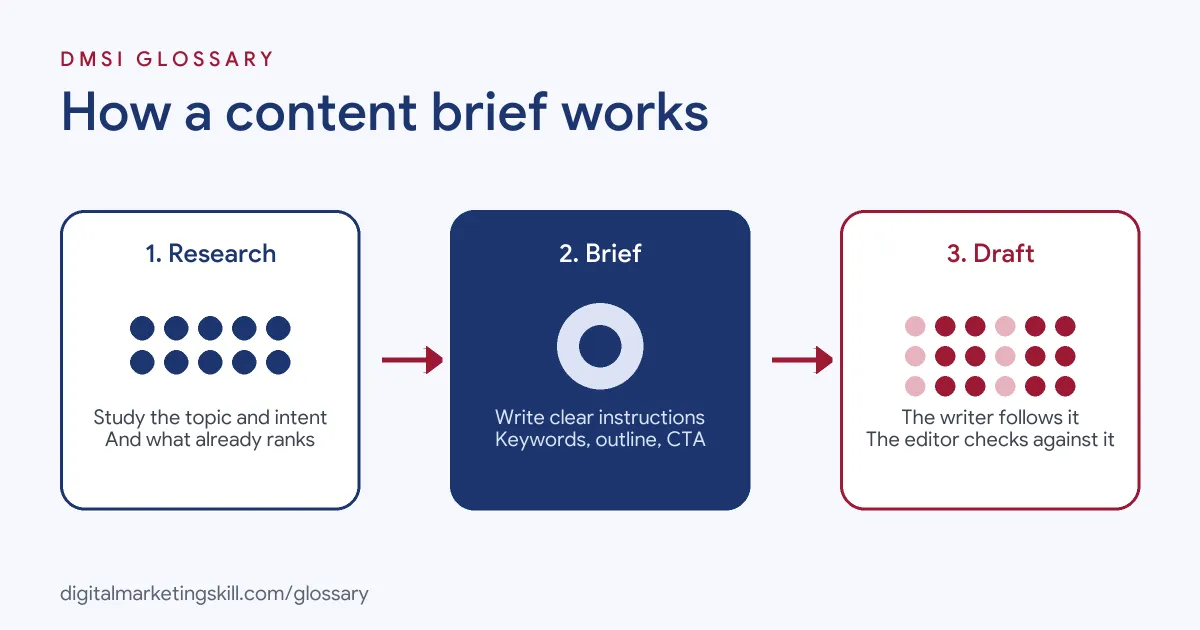
Research
Before writing the brief, look at the search results for your target keyword. What type of content ranks: guides, lists or product pages? What questions do they answer, and what do they miss? Clearscope notes that briefs can give insight into headings, typical word counts and the type of content that best serves search intent.
Instructions
The brief then turns that research into direction. Semrush says it should explain the topic, the target audience and “crucial SEO directives,” so the writer understands what a successful first draft looks like. Clear instructions also reduce the chance that the writer leaves out something important.
Review
Finally, the brief becomes the checklist for editing. If the draft covers every point, uses the right keywords naturally and ends with the agreed call to action, it is ready. If not, the brief makes feedback specific rather than personal.
What to Include in a Content Brief
Semrush lists these common elements:
| Element | What it tells the writer |
|---|---|
| Primary keyword | The main search term you want to rank for |
| Secondary keywords | Related phrases to include naturally |
| Search intent | What the searcher expects to find |
| Editorial direction | The core subject and angle |
| Expected word count | An approximate length, based on the topic and competitors |
| Target audience | Who the content is for |
| Brand voice | The style and tone to use |
| Internal and external links | Pages to link to and sources to reference |
| Headings | Main sections and key points |
| Call to action | What the reader should do next |
Semrush adds that you might include more or less, depending on your needs.
Content Brief Examples
Here are three made-up mini-briefs to show the idea:
- Blog post for a cycling shop: Keyword “how to fix a puncture.” Audience: beginner cyclists. Intent: step-by-step help. CTA: shop for repair kits.
- Service page for an accountant: Keyword “bookkeeping for freelancers.” Audience: self-employed creatives. Intent: compare options. CTA: book a free call.
- Guide for a software company: Keyword “project timeline template.” Audience: small business owners. Intent: download a template. CTA: start a free trial.
Each brief is short, but the writer now knows exactly who to write for and what success looks like.
How to Write a Content Brief
- Set the goal. Decide what the piece should achieve, such as traffic, sign-ups or sales.
- Choose the keyword. Pick one primary keyword and a few related phrases.
- Check the search intent. Next, study the top results to see what searchers expect.
- Define the reader. Describe the audience and their main question in a sentence or two.
- Outline the headings. List the main sections and the points each one must cover.
- Add links and sources. Note internal pages to link and trusted sources to reference.
- Set voice, length and CTA. Give the tone, a rough word count and the next step for readers.
- Share and agree. Finally, send it to the writer and answer questions before they start.
A Sample Brief in Full
Here is a made-up brief for the cycling shop example above:
- Goal: bring beginners to the site and sell more repair kits.
- Primary keyword: how to fix a puncture. Related: bike puncture repair, inner tube patch.
- Reader: a new cyclist with a flat tyre and no tools, probably reading on a phone.
- Angle: calm, simple steps that work at the roadside, with photos.
- Headings: what you need, step-by-step fix, how to avoid the next puncture, when to replace the tube.
- Length: roughly 1,000 to 1,200 words.
- Links: the repair kit product page and the “bike maintenance basics” guide.
- Call to action: “Carry a kit on every ride. Shop our beginner repair kit.”
With this in hand, a writer who has never met the shop can still produce a useful first draft.
Briefs for Freelance Writers
Semrush notes that briefs help both in-house and freelance writers understand your expectations. With freelancers, this matters even more, because they don’t sit in your meetings or know your brand history. So add a short note on your audience, a link to your style guide and one or two example pages you like.
Best Practices
- Keep it scannable. Bullet points and short notes are easier to follow than long paragraphs.
- Ask for something new. Clearscope highlights “information gain,” meaning content that adds more than the pages already ranking.
- Put people first. Google says helpful content should give “original information, reporting, research, or analysis.”
- Explain the why. For instance, say why a section matters, not just that it must be there.
- Use a template. A consistent format makes briefs faster to write and easier to read.
Common Mistakes
A common mistake is writing a brief that is just a keyword and a word count, which leaves the writer guessing. Another is the opposite: a brief so long and rigid that it leaves no room for expertise. Some teams also skip the audience and intent, so the draft targets the wrong reader. Finally, many forget the call to action, so a well-written piece doesn’t lead anywhere.
Where You’ll Use Content Briefs at Work
Briefs come up in content, SEO and copywriting roles. For example, real remote job listings include lines like these:
- “Review content briefs and clarify requirements before starting assignments.” (Content Writer).
- “Review content briefs and make suggestions for content enhancements” (Content Marketing Manager).
- “Help manage the freelance writers on your accounts, write briefs they can succeed with, and maintain customer brand guides and other assets for reference.” (Senior Content Marketer, SEO).
So as an SEO Specialist or Website Manager, you will often write briefs for writers. If you write content yourself, you will work from them every day.
Learn It in the WordPress and SEO Track
The AI-Powered WordPress and SEO Specialist track covers search engine optimisation and content marketing. You build a WordPress site or store and rank it with an SEO content plan, which means planning pages before you write them. You also get unlimited 1-on-1 mentoring and a U.S. Project Internship from day one.
For a step-by-step method, read our blog guide on how to write a content brief writers actually follow. To plan intent properly, see our glossary entry on search intent.
Frequently Asked Questions
What is a content brief?
It is a planning document that tells a writer what a piece of content should achieve, who it is for and what it must include.
Who writes the content brief?
Usually a content manager, SEO specialist or strategist writes it, then shares it with the writer.
How long should a content brief be?
Long enough to be clear, and no longer. Many fit on one or two pages.
Is a content brief only for SEO content?
No. Briefs help with any content, including social posts, emails and case studies. SEO briefs simply add keywords and search intent.
Can AI write a content brief?
AI tools can help with a first draft, such as suggesting headings. However, a person should check the research, intent and angle before sharing it.
Sources: Semrush: SEO content brief guide; Clearscope: What is a content brief?; Google Search Central: Creating helpful, reliable, people-first content; remote job listings on Himalayas.