
Search volume is an estimate of how many times people search for a particular keyword in a search engine, usually shown as a monthly average. Keyword tools work it out from past search data, so it tells you roughly how much demand exists for a topic. It matters because it helps you decide which topics are worth a page, a product or an ad budget.
Key Takeaways
- Search volume is usually a monthly average, worked out over the previous twelve months.
- Every figure is an estimate. Google rounds its numbers, and third-party tools model theirs.
- Different tools show different numbers for the same keyword, so compare within one tool.
- Seasonal keywords can be far above or below their average in a given month.
- High volume is not always better. Intent and difficulty matter just as much.
What Is Search Volume?
Think of it as a measure of demand. If a keyword has high volume, many people are looking for it. If it has low volume, only a few are. That simple signal helps you choose what to write about, what to sell and what to advertise.
Semrush defines it as “the average number of times a specific search query is entered on a search engine per month.” Google’s Keyword Planner uses a similar idea. It shows “the average number of times people have searched for a keyword and its close variants.”
For example, a broad term such as “running shoes” will usually show far more searches than “waterproof trail running shoes for women”. However, the longer phrase tells you much more about what the searcher wants. That is why volume is a starting point, not a final answer. Our guide to long-tail keywords explains why those smaller searches can still be valuable.
How Search Volume Works
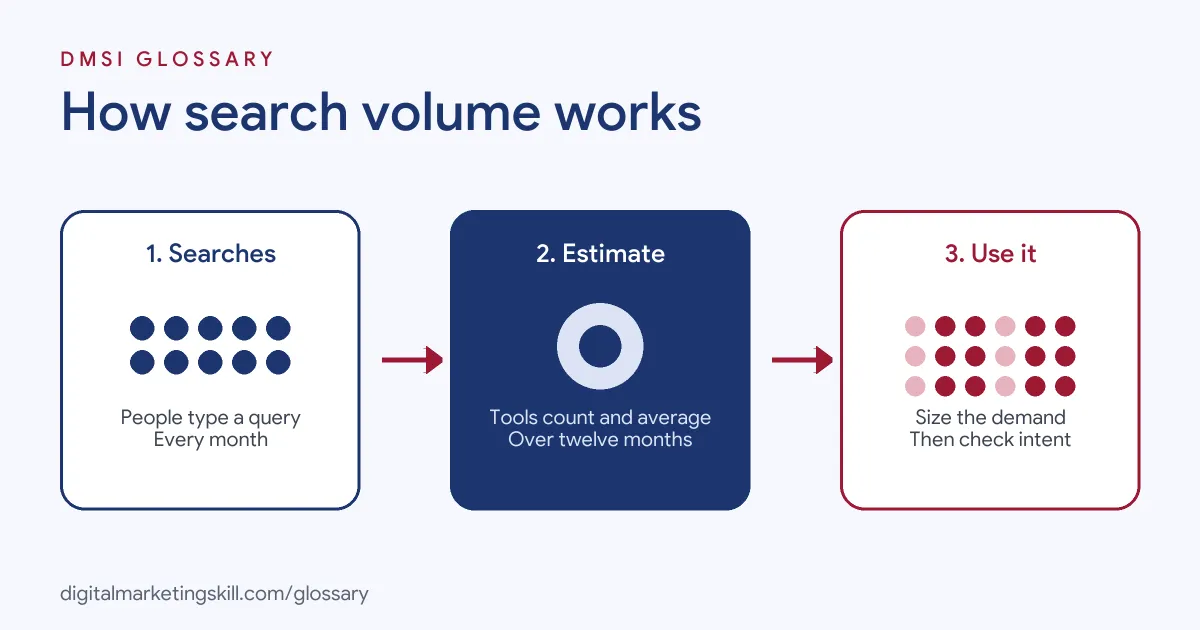
Every figure comes from the same basic process. First, people type queries into a search engine. Next, a tool counts or estimates those searches. Finally, it averages them into a single monthly number.
Where the Numbers Come From
Google’s Keyword Planner uses Google’s own search data. Even so, Google notes that “your search volume statistics are rounded”, so you will not see exact counts.
Third-party tools have no direct access to that data. Semrush, for instance, combines datasets from other providers with “historical clickstream data”, then uses machine learning to estimate volumes for “billions of keywords.” Its figures include both mobile and desktop searches.
The Twelve-Month Average
Most tools show an average over a year. Semrush explains that the figure is “calculated by dividing the total searches for the keyword over the past 12 months by 12.” Keyword Planner also averages over twelve months by default.
As a result, seasonal keywords can mislead you. A term like “Christmas jumper” might have a modest average, but nearly all of those searches happen in a few weeks. So always look at the monthly trend, not just the average.
Relative Interest
Google Trends works differently. It does not show search counts at all. Instead, it scales interest from 0 to 100, based on a topic’s share of all searches. Google notes that terms with low volume appear as 0, even if some people do search for them.
Search Volume Examples
Here are three ways marketers use search volume in practice:
- Blog planning: A gardening site compares “how to grow tomatoes” with “growing tomatoes in pots on a balcony”. The first has more searches, but the second matches its readers better. So it writes both and links them together.
- Product naming: A shop checks whether people search more for “sofa” or “settee” in its target country. Then it uses the more common word in its titles.
- Ad budgets: A Google Ads specialist uses Keyword Planner to see how much demand exists before setting a budget. If volume is tiny, a big budget will not find enough people to spend on.
In each case, volume shapes the decision, but it is never the only factor.
Why Volume Is Not the Same as Traffic
A common trap is to treat the monthly figure as the number of visitors you will get. In reality, you share those searches with every other result on the page. Ads, maps, videos and other websites all compete for the same clicks. Some people also find their answer on the results page and never click at all.
So a keyword with 5,000 monthly searches will bring you only a part of that, even if you rank well. The exact share depends on your position, your title and what else appears on the page. That is why it pays to check the live results before you commit, and to track real clicks once your page is published.
Search Volume Tools Compared
Each tool gives you a slightly different view. This table shows the main differences:
| Tool | What it shows | What to know |
|---|---|---|
| Google Keyword Planner | Average monthly searches for a keyword and its close variants | Uses Google’s own data, but figures are rounded |
| Semrush | Average monthly searches over the past twelve months | Modelled from third-party and clickstream data |
| Google Trends | Relative interest on a scale from 0 to 100 | Shows trends and seasonality, not search counts |
A good habit is to use one main tool for numbers and Google Trends for timing.
How to Use Search Volume in Keyword Research
Follow these steps to put volume to work:
- List your topic ideas. Start from your products, customer questions and competitors.
- Pull volume for each one. Use the same tool and the same country for every keyword.
- Check the trend. Look at the monthly pattern, or compare terms in Google Trends.
- Check the intent. Search the keyword and look at what kind of pages rank.
- Add difficulty. Compare the volume with the keyword difficulty score, so you know what it will take to rank.
- Prioritise. Pick keywords with a fair balance of demand, intent and difficulty.
- Track real results. Once a page is live, use Google Search Console to see the actual impressions you receive.
Best Practices
- Treat numbers as ranges. A keyword showing 1,000 searches is in the right area, not exact.
- Set the right location. Volumes change when you switch country or region.
- Group close variants. Plurals and small wording changes often belong on the same page.
- Value relevance over size. A small keyword with clear buying intent can beat a big vague one.
- Plan ahead for seasons. Publish seasonal pages early, so they are ready before the peak.
Common Mistakes to Avoid
Beginners often stumble in the same places. First, they target only the highest-volume keywords and compete with the biggest sites. Second, they skip keywords that show zero volume, even though tools often miss small but useful searches. Third, they compare numbers from different tools. Finally, they ignore seasonality and publish too late. Each of these mistakes comes from reading one number in isolation.
Where You’ll Use Search Volume at Work
Job listings rarely name the metric itself. Instead, they ask for keyword research and the tools that report it. For example, recent remote listings ask candidates to:
- “Own keyword research, search intent analysis, competitive research, and content/search opportunity identification.” (Growth Engineer, SEO, SEM and AI Search)
- “Conduct keyword research, entity mapping, and intent analysis to prioritize content” (SEO/AEO Manager).
- Show “proficiency with Google Search Console, GA4, and SEO tools such as Semrush or Ahrefs” (Senior SEO Specialist).
So if you want to work as an SEO Specialist, WordPress Developer or Website Manager, you will use search volume to size demand and plan content.
Learn It in the WordPress and SEO Track
You can learn to research and use search volume in the AI-Powered WordPress and SEO Specialist track. There, you build a WordPress site or store and rank it with an SEO content plan. You also join a U.S. Project Internship from day one, with unlimited 1-on-1 mentoring.
To understand the numbers in Google’s own tool, read our guide to Google Keyword Planner.
Frequently Asked Questions
What is a good search volume?
There is no single number. A good keyword has enough demand to matter, clear intent and a difficulty level you can compete with.
Why do search volume tools show different numbers?
Each tool uses its own data and model. Google rounds its own data, while third-party tools estimate theirs from other sources.
Is search volume monthly or yearly?
Most tools show a monthly average, worked out over the previous twelve months.
Should I ignore keywords with zero search volume?
Not always. Tools can miss small searches, and a very specific keyword can still bring visitors who are ready to act.
Is Google Trends the same as search volume?
No. Google Trends shows relative interest on a 0 to 100 scale. It is useful for spotting trends, but it does not give search counts.
Sources: Semrush Knowledge Base: Volume; Google Ads Help: Keyword Planner metrics; Google Ads Help: About Keyword Planner; Google Trends Help: How Trends data is adjusted; remote job listings on Himalayas.