
Customer retention rate tells you whether the customers you already won are staying. It is usually cheaper to lift than acquisition ever is. This guide shows how to calculate it correctly, what counts as healthy for your type of business, and the one check to run before you spend more on winning new customers.
Key Takeaways
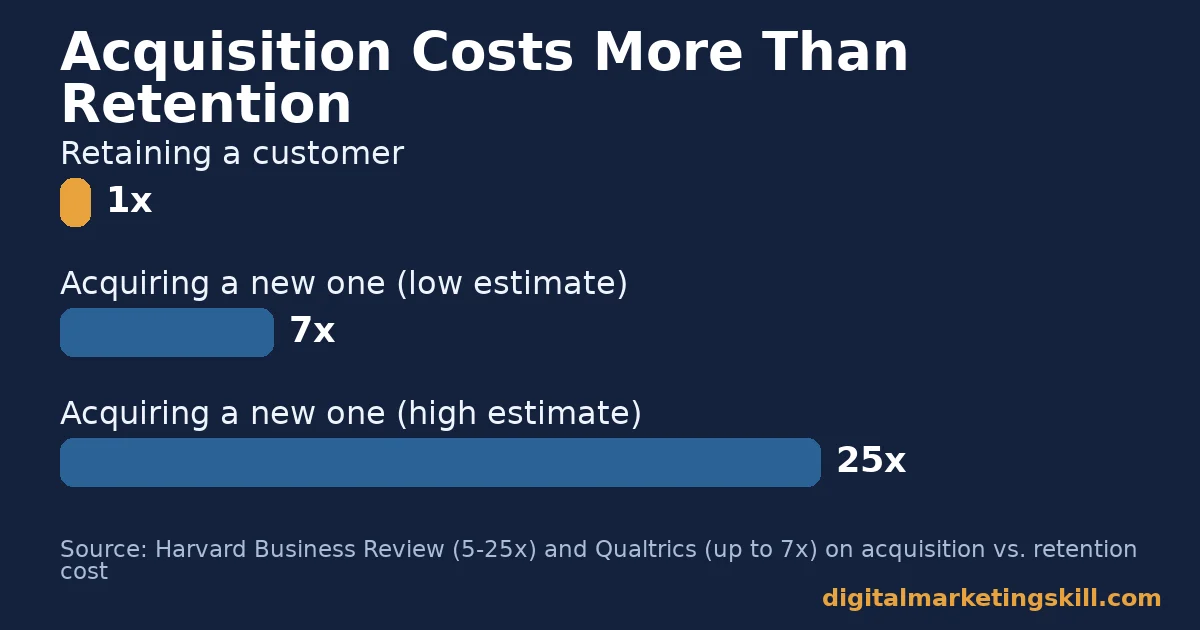
- Acquiring a new customer costs 5 to 25 times more than retaining an existing one, according to Harvard Business Review. It cites Frederick Reichheld’s research showing that lifting retention by 5% can raise profit by 25% to 95%.
- A Recurly survey of more than 1,500 subscription companies, reported by Paddle, found average monthly churn of 4.8% for SaaS businesses, rising to 10.54% for subscription boxes. “Good” churn varies a lot by business type.
- Paddle’s benchmark review also notes that a churn rate of 3% or less is generally considered good for software subscriptions, while 5% sits closer to the broad average.
- 60% of consumers have switched to a competitor after poor customer service, according to Microsoft Dynamics 365 research cited by Help Scout. Service quality is a direct input into customer retention rate.
- A 3:1 ratio of customer lifetime value to customer acquisition cost is a commonly cited healthy benchmark, according to Klipfolio’s LTV:CAC guide. Retention rate is the lever that moves lifetime value the most.
In this guide
- Why Customer Retention Rate Gets Measured Wrong
- How Customer Retention Rate Actually Works
- How To Lead With The Right Fix When Retention Drops
- If Early Customers Leave Fast: Lead With Onboarding
- If Churn Follows A Support Interaction: Lead With Service Quality
- If Long-Term Customers Leave: Lead With Changing Value
- If Churn Concentrates In One Price Tier: Lead With Segment-Specific Fixes
- If Churn Clusters By Acquisition Channel: Lead With Channel Quality
- How To Read Your Customer Retention Rate Numbers
- The One Decision Rule: Check Retention Before You Scale Acquisition
- A Real Case: What The Acquisition-Versus-Retention Gap Looks Like
- Frequently Asked Questions About Customer Retention Rate
- Turn Customer Retention Rate Into A Growth Lever
Why Customer Retention Rate Gets Measured Wrong
Most businesses track new customers closely. They track retained customers loosely. That imbalance is backwards. The cost difference between the two is large and well documented. Qualtrics cites a commonly repeated estimate that it costs up to seven times more to attract a new customer than to keep an existing one, close to the lower end of Harvard Business Review’s wider range above.
This guide is an informed framework, not a universal formula. A healthy retention rate in subscription software looks nothing like a healthy rate in a weekly consumer product. Treat every benchmark below as a starting comparison, not a fixed target.
Two ground rules keep this metric honest. First, always calculate retention rate over a fixed period that matches your buying cycle. A monthly rate means little for a business bought twice a year. Second, retention rate and churn rate are two sides of the same number, so check which one a report is actually showing before you compare it to a benchmark.
A third rule saves real confusion: always say whether you mean customer count or revenue. A business can retain 95% of its customers while losing a disproportionate share of revenue, if the customers who left were its biggest accounts.
How Customer Retention Rate Actually Works
Customer retention rate answers one question. Of the customers you had at the start of a period, how many were still customers at the end? The simplest formula subtracts new customers gained from customers at the end, divides by customers at the start, then multiplies by 100.
Churn rate is the mirror image. It is the share of customers you lost over the same period. The two numbers should add up to roughly 100%, so a quick way to sanity-check either figure is to confirm they do.
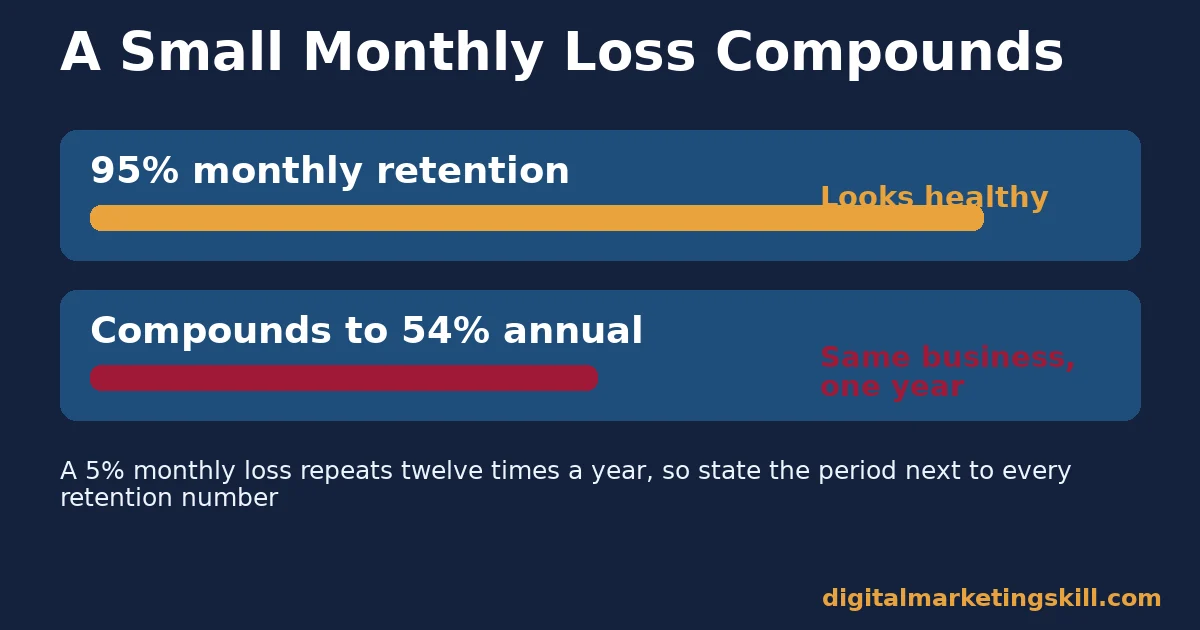
The period you choose changes the number a lot. A business with 95% monthly retention sounds healthy. Compounded over a year, that is closer to 54% annual retention, because the small monthly loss repeats twelve times. Always state the period next to the number.
Why Retention Compounds Faster Than It Looks
Each retained customer keeps buying, keeps referring others, and costs less to serve than a brand-new customer does. Harvard Business Review’s review of Reichheld’s research found a 5-point lift in retention can raise profit by 25% to 95%. That is far more than the retention percentage itself would suggest.
The compounding effect is why small, steady improvements in retention rate usually beat one dramatic acquisition push. A business rarely needs to double its retention rate to see the benefit. A few points, held consistently, is often enough. For the levers that move this number day to day, see our breakdown of customer retention strategies.
Why A Healthy-Looking Average Can Hide A Problem
A blended retention rate can hide a split between two very different customer groups. One stays for years; one leaves within months. Paddle’s review of churn data found that churn by price point varies sharply, from around 3 to 4% a month for higher-priced plans to 6 to 9% for lower-priced ones.
That gap means a single company-wide retention number can look acceptable while the lowest-paying segment quietly bleeds customers. Segment the number by plan, price tier, or customer type before deciding there is no problem.
Channel and acquisition source create a similar blind spot. Customers who arrived through a discount promotion often churn faster than customers who arrived through organic search or referral, because the promotion attracted price sensitivity rather than genuine fit. Break retention down by acquisition channel at least once a quarter to catch this early.
How To Lead With The Right Fix When Retention Drops
A falling retention rate has more than one possible cause, and the fix differs for each. Diagnose before you act.
If Early Customers Leave Fast: Lead With Onboarding
When most churn happens in the first weeks, the product rarely had time to prove its value. Fix the first experience before touching pricing or marketing. A customer who never reaches the “aha” moment was never going to renew. Our customer retention management guide covers a four-stage system for building that early experience.
If Churn Follows A Support Interaction: Lead With Service Quality
Help Scout’s review of customer service research found that 60% of consumers have left a brand after a poor service experience. If churn clusters around support tickets or complaints, the fix is service quality, not a discount or a win-back email.
If Long-Term Customers Leave: Lead With Changing Value
A customer who stayed for years and then left is usually responding to a real change. A price rise without added value, a competitor’s new feature, or a shift in their own needs are the usual causes. Interview a sample of these customers directly; guessing at this stage wastes the fix.
If Churn Concentrates In One Price Tier: Lead With Segment-Specific Fixes
Following the segment gap above, a low-price-tier churn problem often calls for a different fix than a high-price-tier one. Lower tiers usually need simpler onboarding and faster time-to-value. Higher tiers usually need dedicated support and account management.
If Churn Clusters By Acquisition Channel: Lead With Channel Quality
When one acquisition channel consistently produces shorter-lived customers, the fix is upstream of retention entirely. Tighten the targeting or the offer on that channel so it attracts customers who actually fit the product, rather than trying to retain customers who were never a good match to begin with.
How To Read Your Customer Retention Rate Numbers
Each signal below is defined in one sentence, with the reading that matters more than the raw number.
- Customer retention rate: the share of starting customers still active at period end. Read it against your own buying cycle, not a generic monthly figure.
- Churn rate: the mirror of retention rate. Read it alongside retention to confirm the two add up to roughly 100%.
- Revenue churn: the share of recurring revenue lost, separate from customer count. Read it next to customer churn; losing a few large accounts can hurt more than losing many small ones.
- Customer lifetime value (LTV): expected revenue per customer over the full relationship. Read it as the direct payoff of a higher retention rate.
- LTV:CAC ratio: lifetime value divided by acquisition cost. Read 3:1 as the commonly cited healthy line; retention rate is usually the fastest way to improve it. See how this ratio fits the rest of your funnel in our guide to online marketing metrics.
- Net revenue retention: revenue from existing customers, including upgrades and downgrades. Read a figure over 100% as existing customers growing their spend faster than any of them churn out.
The One Decision Rule: Check Retention Before You Scale Acquisition
Apply this rule before increasing acquisition spend: if customer retention rate has fallen for two periods in a row, fix retention before adding budget to acquisition. New customers poured into a leaking base only replace what you are already losing.
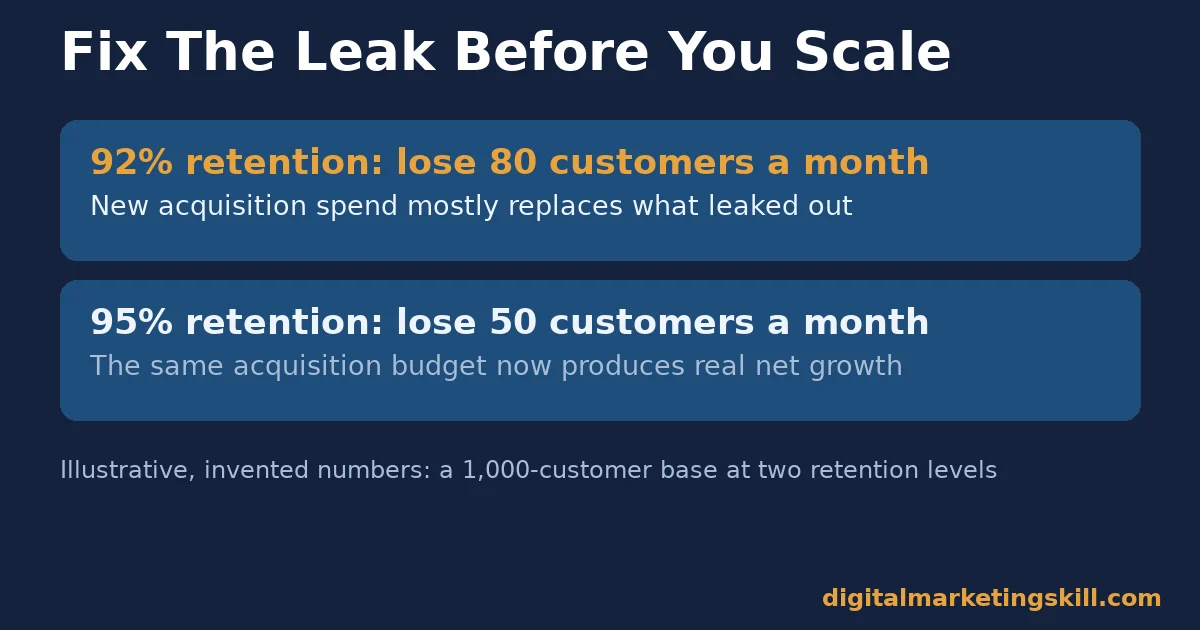
Illustrative, invented numbers: a business with 1,000 customers and 92% monthly retention loses 80 customers a month.
Spending more to acquire 80 new customers just to stay flat is treading water, not growing. Lifting retention to 95% cuts that monthly loss to 50 customers. That frees the same acquisition budget to produce real net growth instead. The same before-you-scale discipline applies to testing; see our guide to conversion rate optimisation myths for how to avoid trusting a result too early.
A Real Case: What The Acquisition-Versus-Retention Gap Looks Like
Harvard Business Review’s review of retention economics draws on Frederick Reichheld’s research for Bain & Company. It found that acquiring a new customer typically costs between 5 and 25 times more than keeping an existing one. The same review found that a 5-point lift in retention can raise profit by 25% to 95% in the businesses studied.
The limits matter here. That range is wide because it spans different industries and business models, and the underlying studies are not a single controlled experiment.
The direction is still consistent across the research, though. Retention delivers outsized financial value compared with its cost to improve. That is why it deserves at least as much attention as acquisition in a growth plan.
Frequently Asked Questions About Customer Retention Rate
What is a good customer retention rate?
It depends heavily on your business type. Paddle’s review of subscription data found SaaS businesses averaging around 4.8% monthly churn, roughly 95% monthly retention, while subscription boxes average closer to 10.54% monthly churn. Compare your rate to similar businesses, not a single universal target.
How do you calculate customer retention rate?
Subtract new customers gained during a period from your total customers at the end of that period. Divide the result by the number of customers you had at the start, then multiply by 100. Always state the time period next to the figure.
What is the difference between retention rate and churn rate?
They are mirror images of the same underlying number. Retention rate is the share of customers who stayed; churn rate is the share who left. The two should sum to roughly 100% for the same period.
Why does customer retention rate matter more than people think?
Because the cost gap between acquisition and retention is large. Acquiring a new customer typically costs 5 to 25 times more than retaining one, according to Harvard Business Review’s review of the research. Small retention gains compound into large profit differences over time.
How often should a business review its retention rate?
At least quarterly for most businesses, since retention needs enough time and customers to produce a reliable signal. A business with a short buying cycle, such as weekly subscriptions, can review monthly instead.
Can a high retention rate still hide a problem?
Yes. A blended company-wide rate can mask a struggling segment, such as a specific price tier or customer type with much higher churn. Always check retention broken down by segment, not only the company-wide average.
Does retention rate matter for a business that is not subscription-based?
Yes. Repeat-purchase rate and visit frequency are the retail and services equivalent of retention rate. The same acquisition-versus-retention cost gap applies: keeping an existing customer buying again is cheaper than finding a new one.
Should retention rate or acquisition get the next marketing dollar?
Check retention first. A business with falling retention gets a weaker return from every acquisition dollar, because new customers leak out almost as fast as they arrive. Fix the leak, then invest in acquisition with confidence.
Turn Customer Retention Rate Into A Growth Lever
Retention rewards consistency more than any single campaign. If you want a structured way to build retention skills alongside acquisition, conversion, and analytics, instead of treating retention as an afterthought, explore the Digital Marketing Skill Institute’s Master Diploma in Digital & AI Marketing. It covers four AI-powered tracks across ten courses, with unlimited one-on-one coaching and mentoring and real project work inside a U.S. company.
The program is dual US and UK accredited and recognised in more than 100 countries. It is delivered 100% online, so you can study and apply these skills wherever you live in your country.
Explore more breakdowns like this one on the Digital Marketing Skill Institute blog, read outcomes on the reviews page, and when you are ready, apply to start building a retention habit that compounds.
Visit digitalmarketingskill.com to see the full course catalogue, or come back to digitalmarketingskill.com any time you need another data-backed guide like this one.
Every figure in this guide was checked against its original source before publication. Figures marked as illustrative are invented examples, not real results.
![9 Amazing Digital Marketing Skills to Make Money Online [With Proof]](https://digitalmarketingskill.com/wp-content/uploads/2019/07/9-Amazing-Digital-Marketing-Skills-to-Make-Money-Online-With-Proof-17.png)






