
A customer acquisition strategy is the set of channels, offers and follow-up steps a business uses to turn strangers into paying customers. The real work is matching each channel to its true cost. Then you double down on the channels that still clear your margin after that cost.
Key Takeaways
- Average customer acquisition cost across industries now runs in the hundreds of dollars per customer, and paid channels climb fastest. A named cost-per-channel comparison belongs in every customer acquisition strategy, not one blended number.
- In a Databox survey of B2B marketers, more than 70% said they use paid search to generate leads. Yet organic search was the channel over 50% credited with generating “a lot” of leads. Reach and lead quality are not the same thing.
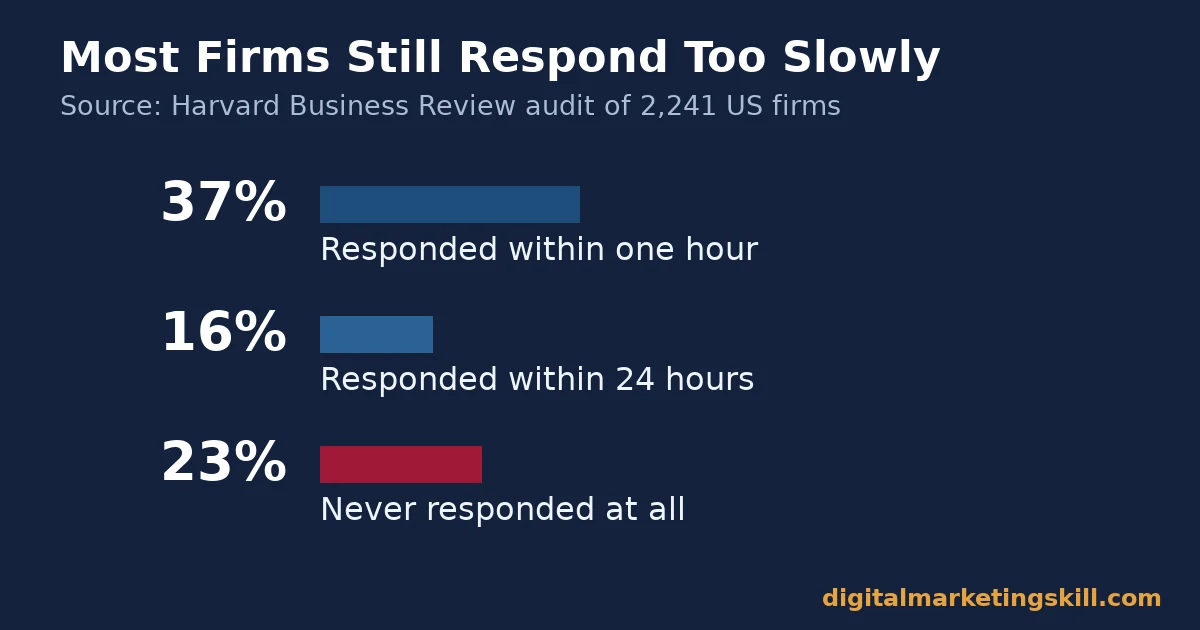
- A Harvard Business Review-published audit of 2,241 US firms found that firms contacting a new lead within one hour were roughly seven times more likely to qualify it. 23% of the firms in that audit never responded at all.
- Litmus’s State of Email research puts average email marketing return around $36 for every $1 spent, well above paid social. An owned list is one of the few channels in a customer acquisition strategy that gets cheaper to use over time, not more expensive.
- Bain & Company research, published in Harvard Business Review, found that raising customer retention by 5% raised profit by 25-95% in the cases studied. A customer acquisition strategy without a retention plan pays full price for every customer, forever.
In this guide
- Most Advice Skips The Cost Side Of A Customer Acquisition Strategy
- How Customer Acquisition Actually Works
- What Differs By Channel
- Turning Understanding Into Action, Channel By Channel
- Measuring A Customer Acquisition Strategy The Right Way
- The One Decision Rule: Check Your Customer Acquisition Strategy’s LTV-To-CAC Ratio Before You Scale Any Channel
- What This Looks Like When A Business Gets It Right
- Frequently Asked Questions About Customer Acquisition Strategy
- Where To Go From Here
Most Advice Skips The Cost Side Of A Customer Acquisition Strategy
Search “customer acquisition strategy” and most results hand you a list of channels: social media, email, content, paid ads, referrals. What they skip is the cost of each channel against what a customer is actually worth. A channel that brings in leads fast can still lose money quietly for months before anyone notices.
This guide treats channel choice as a cost decision first. The figures below are an informed snapshot, not a permanent ranking. Acquisition costs move with ad prices, algorithm changes and competition, so check your own numbers every quarter rather than trusting a number you read once. What does not move is the underlying mechanism, covered next.
How Customer Acquisition Actually Works
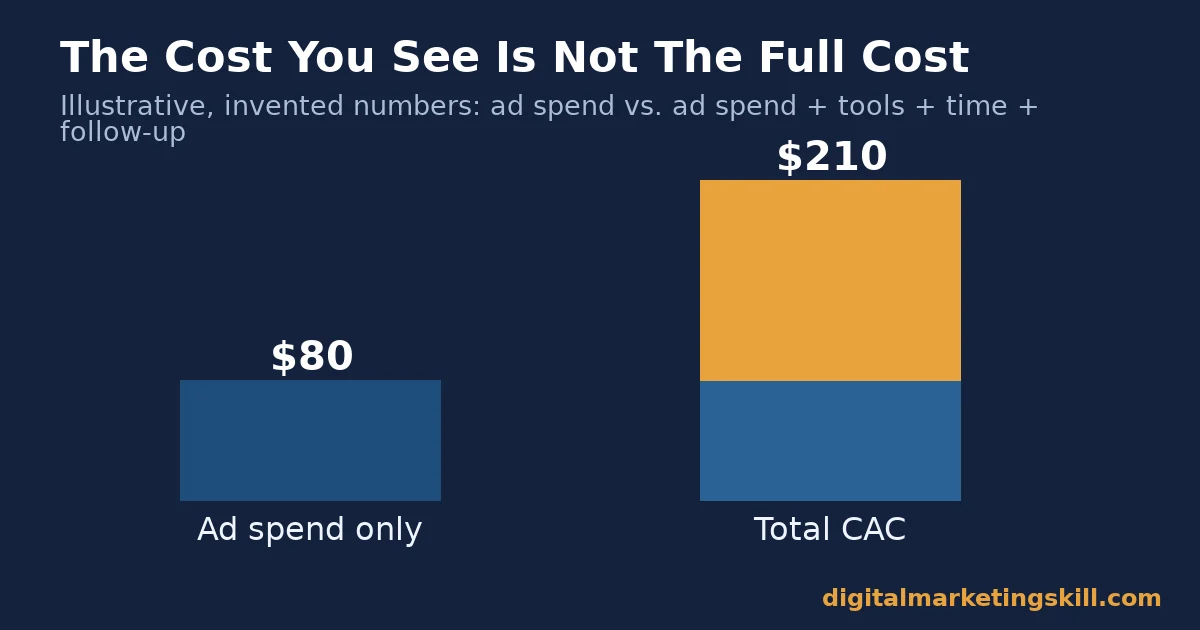
Every channel in a customer acquisition strategy pushes a prospect through the same four stages, mapped out in full in a sales funnel: awareness, interest, decision and action. Customer acquisition cost (CAC) is total sales and marketing spend for a period, divided by new customers that period produced. Customer lifetime value (LTV) is the gross margin a customer generates over their full relationship with you, not just their first purchase.
Here is why this matters more than channel choice. A cheap channel that only produces one-time buyers can cost you more per dollar of margin than an expensive channel that produces loyal repeat customers. CAC without LTV next to it is half a metric. Keep both numbers on the same page, for the same cohort, measured over the same window, or the comparison means nothing.
Funnel leakage is the other half of the mechanism. Most of the cost in acquisition is not the first click. It is everyone who clicked, engaged or submitted a form, then never converted. Fixing the leak at the bottom of the funnel is usually cheaper than adding more traffic at the top, because you already paid for that visitor’s attention once.
What Differs By Channel
Each channel below differs on three things: cost pattern, lead quality, and time to results. Treat these as ground rules to test against your own numbers, not settled facts.
Organic Search: Built For Compounding Reach, Not Speed
Organic search traffic costs nothing per click once a page ranks, but ranking takes months of consistent work. In the Databox survey of B2B marketers cited above, organic search was the channel over half of respondents credited with generating a large volume of leads. That beat channels they spent more cash on. The trade-off: you cannot switch it on for a launch next week. Fund it every quarter regardless of short-term pressure. Stopping resets the compounding you already paid to build. Pair it with the technical side of on-page optimization, since a strong page on a slow site still underperforms.
Paid Ads: Built For Speed, Not Margin
Paid search and paid social buy volume on a schedule, which organic cannot do. The cost: you pay for every visit, so your margin has to absorb that cost every single time, not just the first time. Use paid ads as a volume dial for a launch or a slow month. Keep it next to cheaper channels rather than running it as your only channel.
Email And Owned Lists: Built For Repeat Margin
Once someone is on your list, reaching them again costs almost nothing. That is why Litmus’s State of Email research puts average email return around $36 for every $1 spent, well above the roughly $2-3 reported for paid social in the same comparison. The catch: you only earn an email address by giving something worth the trade. A list nobody cleans or segments decays fast. Owned channels reward patience and punish neglect in equal measure.
Referral And Word Of Mouth: Built For Trust, Not Control
Nielsen’s global Trust in Advertising research, covering tens of thousands of respondents across dozens of countries, found that people trust recommendations from people they know far more than any paid ad format. That trust is why a referred customer converts faster and needs less convincing. The trade-off is control. You cannot force word of mouth on a schedule, only create the conditions for it: a product worth mentioning, an easy way to share it, and a reason to share it now.
Turning Understanding Into Action, Channel By Channel
Knowing how a channel behaves only matters if it changes what you do next. Here is the lead-with move for each channel above.
Organic Search: Lead With One Topic Cluster At A Time
Build one cluster of pages around a single buyer question instead of spreading thin across many keywords. Link the pages to each other and measure traffic to the whole cluster monthly. A cluster compounds faster than scattered pages because it signals depth, which both search engines and AI answer engines reward.
Paid Ads: Lead With A Tight Audience And A Hard Budget Cap
Set a maximum acceptable CAC before you launch a campaign, not after. Narrow the audience until cost per lead drops, even if volume drops with it. A smaller group of qualified leads beats a larger group you cannot afford to convert. Review spend weekly, not monthly, because paid costs move fast.
Email: Lead With Speed Of First Reply, Not Volume Of Sends
The Harvard Business Review-published audit of 2,241 US firms found that firms responding to a new lead within an hour were about seven times more likely to qualify it than firms that waited, and more than 60 times more likely than firms that waited a full day. Fix the speed of your first reply before adding more emails to a sequence. A fast, plain reply beats a slow, polished one, and it only works if the email actually reaches the inbox.
Referral: Lead With A Specific Ask At The Right Moment
Ask for a referral right after a customer gets a clear win, not at a random interval. A vague “let us know if you know anyone” converts worse than a specific ask, such as “who else on your team deals with this problem?” Make the ask while the value is fresh. Make sharing it a one-click action, not a form.
Measuring A Customer Acquisition Strategy The Right Way
Four numbers tell you whether your mix is working. Define each one the same way every time you report it, or comparisons across months mean nothing.
- Customer acquisition cost (CAC): total sales and marketing spend for a period, divided by new customers that period. Read it per channel, never only blended, since a blended number hides which channel is actually losing you money.
- Customer lifetime value (LTV): gross margin a customer generates across their full relationship with you, not just the first order. Read it per cohort, since customers who joined under different offers behave differently.
- Payback period: months it takes a new customer’s margin to cover what it cost to acquire them. Read it against your cash position; great LTV with a 14-month payback can still starve a small business of cash.
- Lead response time: minutes or hours between a lead arriving and the first reply. Read it against the one-hour benchmark from the HBR-published audit above, since this is usually the cheapest number on this list to fix.
Page speed belongs on this list too, even though it looks like an engineering metric. A Google and Deloitte study covering retail and travel sites found that a tenth-of-a-second improvement in mobile load time raised retail conversion rates by 8.4% and travel conversions by 10.1%. A slow landing page quietly taxes every channel sending traffic to it. That makes fixing friction on your landing page one of the highest-leverage, lowest-cost moves on this entire list.
The One Decision Rule: Check Your Customer Acquisition Strategy’s LTV-To-CAC Ratio Before You Scale Any Channel
Before putting more budget behind a channel, divide LTV by CAC for that channel alone. A ratio under 3:1 leaves too little margin to cover service, support and early churn. A ratio above 3:1, measured on a real cohort rather than a forecast, signals that a channel can absorb more budget safely.
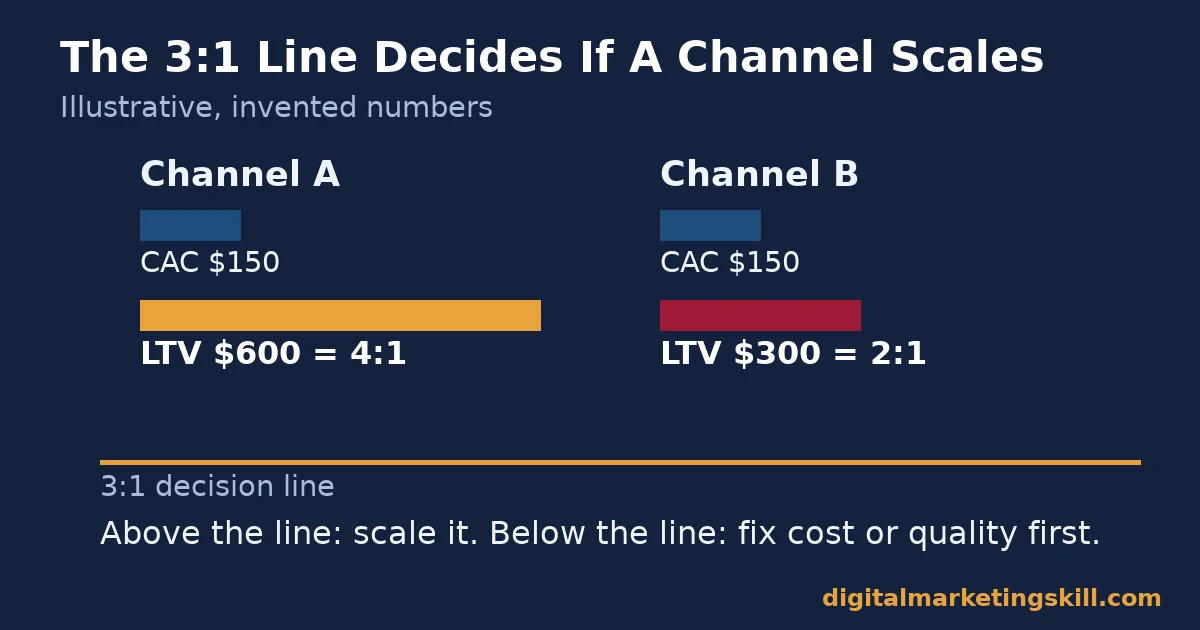
Illustrative, invented numbers to show the arithmetic: a channel acquiring customers at $150 each, where those customers generate $600 in gross margin over time, sits at 4:1 ($600 / $150). That is comfortably above the 3:1 line. A second channel acquiring customers at the same $150, who only generate $300 in margin, sits at 2:1. It should not get more budget until cost drops or lead quality improves.
What This Looks Like When A Business Gets It Right
Rakuten 24, documented in a published case study on Google’s web.dev developer site, rebuilt its site around Core Web Vitals performance targets instead of adding new acquisition channels. The reported result: a 33% increase in conversion rate, a 53% increase in revenue per visitor and a 15% increase in average order value. None of that came from a new channel. All of it came from removing friction that was quietly taxing every channel already sending traffic to the site. Check your existing channels first. See whether something fixable, such as page speed or lead response time, is throttling them before you add a new channel to your customer acquisition strategy.
Frequently Asked Questions About Customer Acquisition Strategy
What is a good customer acquisition strategy cost target?
There is no single good number. A CAC is good only relative to the lifetime value it buys. Use the LTV:CAC decision rule above, aiming for 3:1 or better, rather than comparing your CAC to an industry average that blends very different businesses together.
Which channel has the lowest customer acquisition cost?
Organic search and referrals typically cost less per customer than paid channels, because you are not paying for every click or impression. The trade-off is time. Both take longer to build before they produce volume, so most businesses run them alongside a paid channel rather than instead of one.
How is customer acquisition cost calculated?
Add all sales and marketing spend for a period, including salaries, tools and ad spend. Divide by the number of new customers that spend produced in the same period. Calculate it per channel whenever your tracking allows it, because one blended figure hides which channel is actually profitable.
Why do leads go cold so quickly?
A lead’s interest peaks the moment they raise their hand, whether that is filling out a form or asking a question, and it decays from there. The Harvard Business Review-published audit cited above found a roughly sevenfold qualification advantage for responding within an hour. That is why speed of first reply matters more than most teams assume.
Is referral marketing still effective for customer acquisition?
Yes. Nielsen’s trust research, cited above, found that people trust recommendations from people they know far more than paid advertising formats. That trust shortens the decision stage of the funnel. Referral only works, though, when the ask is specific and the sharing mechanism is effortless.
Should a small business focus on one acquisition channel or several?
Start with one channel you can measure cleanly. Prove a positive LTV:CAC ratio on it, then add a second channel. Running five channels badly usually costs more and teaches you less than running one channel well.
How often should a customer acquisition strategy be reviewed?
Review channel-level CAC and lead response time monthly, since paid costs and response habits drift quickly. Review LTV and payback period quarterly, since lifetime value moves more slowly and needs a full sales cycle to read accurately.
Where To Go From Here
Pick the one channel in your current customer acquisition strategy with the clearest numbers. Calculate its real LTV:CAC ratio this month. Fix the single biggest leak you find, whether that is lead response time, page speed or a missing follow-up step, before adding a new channel on top. A customer acquisition strategy built on measured channels beats one built on more channels, every time.
Want a structured way to build and run paid, organic, email and referral acquisition properly? The Digital Marketing Skill Institute’s Master Diploma in Digital & AI Marketing includes an AI-Powered Lead Generation and Email Automation track built around exactly this kind of channel measurement. It is one of four AI-powered tracks you can combine into the Full Stack option. The program pairs unlimited 1-on-1 coaching and mentoring with a U.S. Project Internship and a verified U.S. Work Reference Letter. It is dual US and UK accredited and recognised in more than 100 countries. It runs 100% online, so you can apply it anywhere in your country.
See the full program details on the Master Diploma page, read real outcomes on the reviews page, or browse more guides on the blog. Go straight to the application page to get started wherever you live, and visit digitalmarketingskill.com to learn more before you pick your first channel to measure properly. Start your customer acquisition strategy review at digitalmarketingskill.com today.
Every figure in this guide was checked against its original source before publication. Figures marked as illustrative are invented examples, not real results.
![9 Amazing Digital Marketing Skills to Make Money Online [With Proof]](https://digitalmarketingskill.com/wp-content/uploads/2019/07/9-Amazing-Digital-Marketing-Skills-to-Make-Money-Online-With-Proof-17.png)






