
Picking a tool is not a strategy. Email marketing automation only pays off when triggers, segments and a measurement point work together as one system. Get the system right and a small list can outperform a much bigger one that only sends broadcasts. This guide covers the mechanism, the tiers, compliance, measurement, and a real result.
Key Takeaways
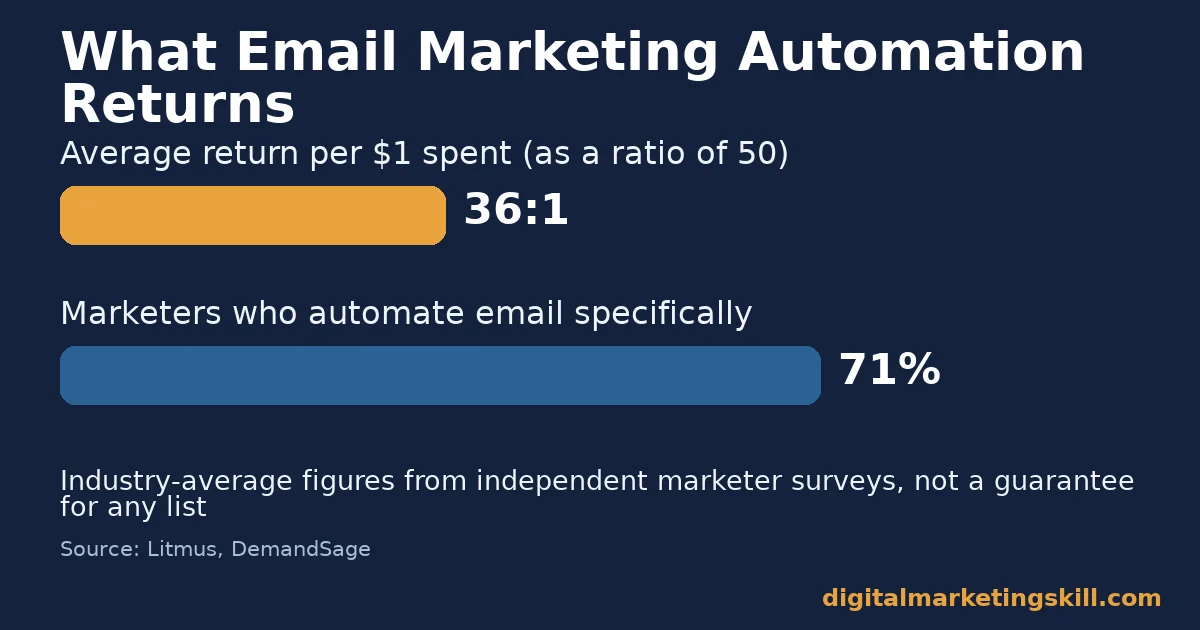
- Email marketing returns about $36 for every $1 spent on average, a 36:1 return (Litmus).
- Advanced AI adopters are 75% more likely to beat a 45:1 return than marketers who do not use AI in their email program (Litmus).
- More than 90% of marketers say segmentation boosts email performance, yet many lists still get one broadcast for everyone (Litmus).
- 96% of marketers have used or plan to use marketing automation, and 71% already automate email specifically (DemandSage).
- 78% of teams now take three days or less to build and send a campaign, down from a much slower pace before automation (Litmus).
In this guide
- The Gap: Email Marketing Automation Is Not the Tool You Buy
- How Email Marketing Automation Actually Works
- Email Marketing Automation By Tier: What Each One Is Built For
- Lead With the Right Move at Each Tier
- Compliance and Deliverability: The Part Automation Cannot Skip
- Measuring Email Marketing Automation: Five KPIs, Defined
- The One Decision Rule Behind Email Marketing Automation
- A Real Case: From $500 Set-Ups to $5,000 a Month
- Frequently Asked Questions About Email Marketing Automation
- Your Next Step
The Gap: Email Marketing Automation Is Not the Tool You Buy
Most guides compare tools feature by feature. Pricing tiers, drag-and-drop editors, chat widgets. None of that is the thing that makes email marketing automation actually work.
The thing that works is a system: a trigger, a segment, a sequence, and a measurement point. Any tool can run that system. Most businesses never build it.
Two ground rules first. Every figure in this guide is a snapshot from a survey or a platform’s own reporting, not a guarantee for your list. And no single tool is the permanent best option. The system below matters more than the brand name running it.
That matters because the market moves fast. A tier that looked generous two upgrades ago can look thin today. A platform’s own pricing page is the only reliable source for current limits, not a screenshot in an old blog post.
How Email Marketing Automation Actually Works
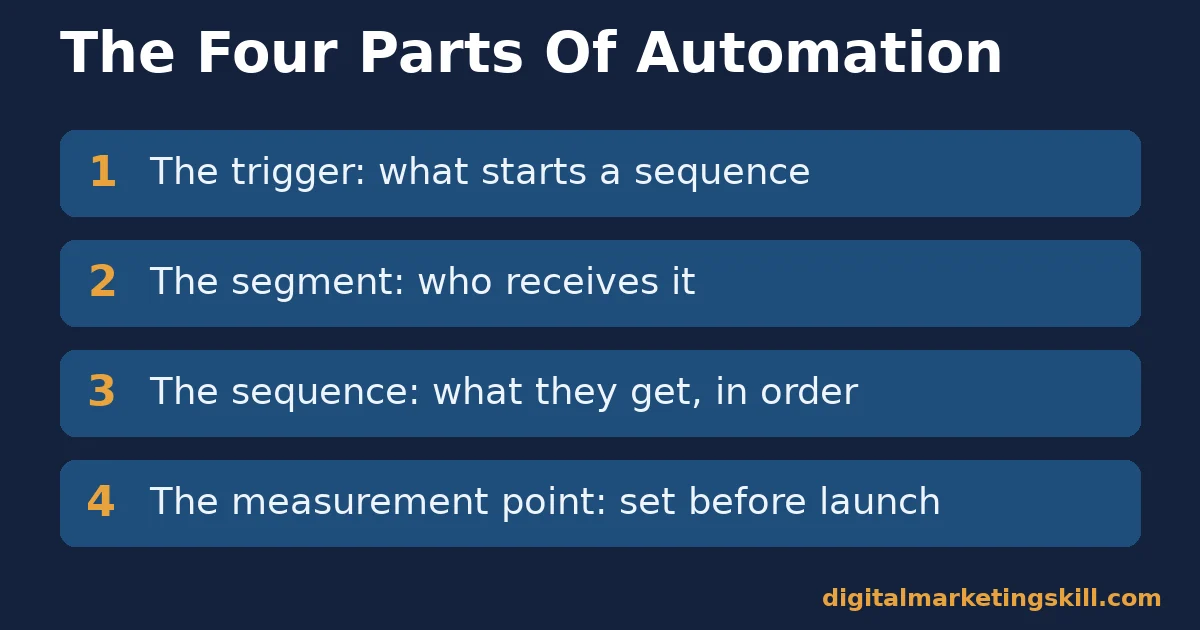
Four linked parts make a working automation run, in order. Skip one and the rest underperforms, no matter how good the platform is.
The Four Parts
- The trigger. An action that starts a sequence: a sign-up, a purchase, an abandoned cart, a date.
- The segment. Who receives it. Segmentation is the single tactic most marketers credit for better results.
- The sequence. What they receive, in what order, over what gap. One email rarely closes a sale alone.
- The measurement point. A date or number at which you read the results and decide what to change.
Everything else, including which platform you use, is implementation detail layered on top of these four parts. A visual drag-and-drop builder makes the sequence faster to build. It does not decide what the sequence should say or who should receive it.
Sequence Timing: The Setting Most People Never Touch
The gap between emails in a sequence is a setting, not a fixed rule. Most businesses leave it on whatever the platform suggested by default. A welcome sequence spaced one day apart suits a fast-moving offer. The same sequence spaced a week apart suits a longer, considered purchase.
Email marketing automation platforms let you change this gap per email, not just per sequence, so test it rather than assume the default fits every audience. A gap that is too short feels like pressure; one that is too long loses the momentum a trigger created in the first place.
Personalization: The Multiplier Most Lists Skip
Personalization is not just a first name in the subject line. It means the content itself changes based on what the segment already did: what they bought, what they clicked, how long since they last opened an email.
Most platforms, SendPulse included, support this through tags and conditional blocks inside a single email template. Few businesses ever turn it on, which is why two subscribers on the same list often receive nearly identical messages despite very different behavior.
Turning it on does not require custom code in most cases. It usually means adding one conditional block to an existing template. The platform then inserts the right version for each subscriber automatically, based on a tag you already collect at sign-up or at checkout.
Why Most Lists Underperform
A list without segments gets one email for everyone. A new subscriber and a five-year customer see the same message. That mismatch is the single biggest reason open and click rates fall over time.
It also explains why unsubscribe rates creep up even when nothing about the business has changed. A long-time customer who keeps receiving beginner-level content eventually decides the list has nothing left to offer them. They leave, even though a better-targeted email could have kept them engaged for years.
Fixing it rarely means better copy. It means building two or three segments and giving each one a sequence suited to where they actually are.
This is also where email marketing automation earns its name. A segment built once keeps routing new subscribers correctly on its own, long after the person who set it up has moved on to other work. A manual broadcast list offers no such leverage; someone has to decide who gets what, every single time.
Email Marketing Automation By Tier: What Each One Is Built For
Most platforms, SendPulse included, group features into three rough tiers. The names differ, but the shape repeats across the market.
Starter Tier: Built For Simple Broadcasts
Starter and free tiers are built for one job: get a newsletter out to a small list on a schedule. They rarely include branching logic, so triggers are limited to basics like a welcome message.
That limitation is not a flaw. A business with a few hundred subscribers and one offer does not need branching logic yet, and paying for it early just adds a learning curve with no extra return.
Mid Tier: Built For Triggered Sequences
Mid-tier plans add automation builders, so a sign-up or a purchase can start a multi-step sequence instead of a single email. This is where most of the system described above becomes possible.
Most of SendPulse’s own automation features, including event-based triggers and branching flows, sit at this level, alongside comparable mid-tier plans from other providers.
Enterprise Tier: Built For Multi-Channel Orchestration
Top tiers add SMS, chatbots and web push alongside email, so one trigger can fire a sequence across several channels at once. That power is wasted on a list too small to segment meaningfully.
A multi-channel sequence also multiplies the number of things that can go wrong. Before adding a channel, make sure the single-channel version of the same sequence is already converting on its own.
Tool Names, Not Just Tiers
SendPulse is one option inside this shape, not the only one. Providers like Mailchimp and Brevo organize their own plans the same way. Each has a free or starter tier for broadcasts, a mid tier that unlocks automation builders, and a top tier that adds multi-channel features and priority support.
Price and exact feature names change often enough that this guide will not try to list them. Check each provider’s own current pricing page before you commit, since screenshots in any blog post, including this one, go stale fast.
What does not change is the shape. Whichever provider you choose, match the tier to the four-part system above, not to the longest feature list on the page.
Switching providers later is rarely as painful as businesses fear. Most platforms, SendPulse included, support importing an existing subscriber list and rebuilding a sequence inside a new builder within a day or two. That makes the choice of provider reversible, in a way that a poorly built sequence is not.
Lead With the Right Move at Each Tier
Knowing the tiers only helps if you use the one that matches your list size and goal.
Starter: Lead With One Welcome Sequence
Do not try to replicate enterprise automation on a starter plan. Build one welcome sequence of three emails, and get it right, before adding anything else.
Mid Tier: Lead With Two Segments, Not Ten
Resist the urge to build ten micro-segments on day one. Start with two: new subscribers and buyers. Expand only once both sequences are measured and working.
Enterprise: Lead With One Extra Channel, Not All of Them
Add SMS or web push to one existing sequence before rebuilding your whole program across four channels at once. Prove the extra channel earns its cost on one sequence first.
Compliance and Deliverability: The Part Automation Cannot Skip
A perfectly built sequence still fails if it never reaches the inbox, or if it breaks the law along the way. Both problems are avoidable with a short checklist.
The Compliance Checklist
In the United States, the FTC’s CAN-SPAM Act sets four core rules. Sender information must be accurate, the subject line must reflect the content, your physical postal address must appear, and a working opt-out link must be honored within ten business days. Violations carry real penalties per message. The law applies to business-to-business email too, not only consumer newsletters.
Outside the US, similar consent and opt-out rules exist under regional data protection laws; check what applies wherever your subscribers live before you launch a sequence, not after.
Deliverability Basics
Most automation platforms will happily send a broken sequence. None of them can force an inbox provider to deliver it. A sudden jump in send volume, a high bounce rate, or a spike in spam complaints can all quietly suppress future delivery. That happens even to subscribers who genuinely want your emails.
Warm up a new sending domain gradually. Keep your list clean of bounced addresses, and treat a rising unsubscribe or complaint rate as an early warning, not background noise.
A list cleaned of old, inactive addresses every few months protects deliverability for the subscribers who remain. It also makes every KPI in the next section more honest, since dead addresses dilute an open rate without ever being able to convert.
Inbox providers do not publish their exact filtering rules, so deliverability is read through its effects rather than a single published score. A previously healthy segment whose open rate drops sharply, with no change to your content, is a signal worth chasing. Check sender reputation and recent bounce history before assuming the audience simply lost interest.
Measuring Email Marketing Automation: Five KPIs, Defined
These numbers tell you different things. Mixing them up is the most common measurement mistake.
The Five KPIs
Each one isolates a different part of the sequence, so read them as a diagnostic set rather than a single score.
- Open rate is opens divided by delivered emails. It mostly reflects your subject line and sender reputation.
- Click-through rate is clicks divided by delivered emails. It reflects whether the body content matched what the subject line promised.
- Conversion rate is the share of recipients who completed your goal action. This is the number tied to revenue.
- List growth rate is new subscribers minus unsubscribes, divided by total list size. A growing list with falling engagement is still a warning sign.
- Unsubscribe rate is unsubscribes divided by delivered emails. A spike after a specific email tells you exactly what to fix.
Read these together, not one at a time. A high open rate with a low conversion rate points at the offer. A low open rate with a healthy conversion rate among the people who do open points at the subject line and sender reputation instead.
Most automation platforms, SendPulse included, show opens and clicks on a per-campaign dashboard. Conversion and list growth usually need a separate link tracker or a connection to your store, since the email platform alone cannot see whether a click became a sale.
The One Decision Rule Behind Email Marketing Automation
Most programs stall on the same judgment call: upgrade the tool, or fix the sequence. This rule settles it.
If open rates are healthy but conversion is weak, fix the sequence and the offer before you pay for a bigger plan. If open rates themselves are weak, fix your sender reputation and subject lines before you build anything new on top.
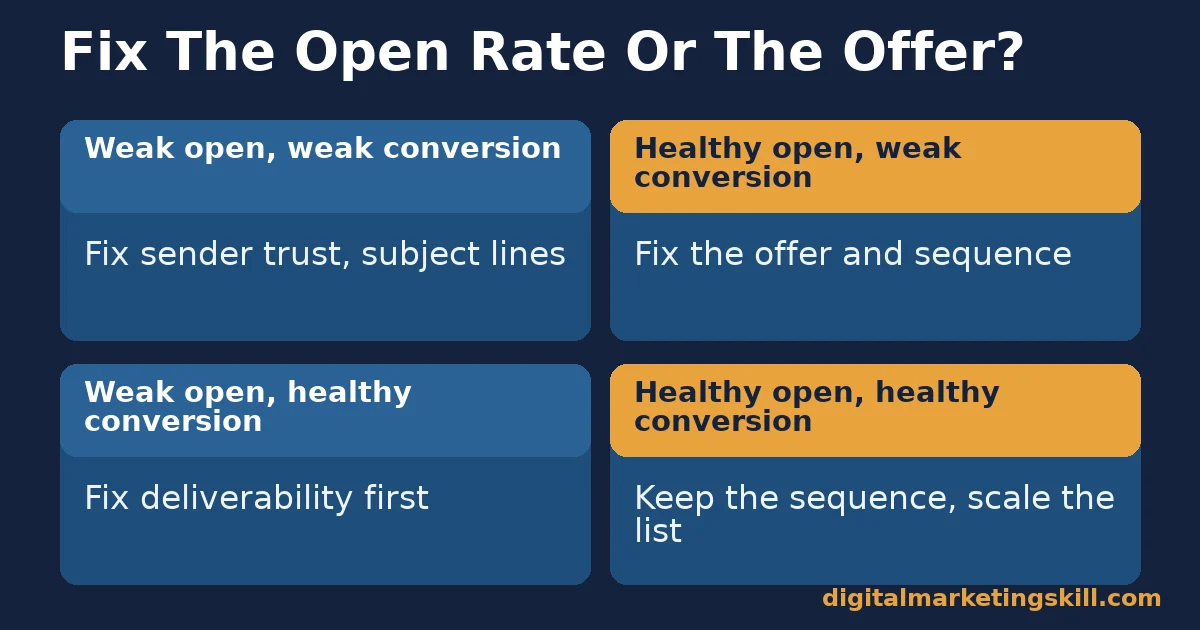
A bigger plan cannot fix a sequence nobody opens. And a perfect sequence cannot fix an offer nobody wants. Spending more on email marketing automation software before diagnosing which problem you actually have is the single most common way small businesses waste their marketing budget.
Illustrative, invented numbers: a sequence gets a 38% open rate but only a 1.2% conversion rate on clicks. Because opens are healthy, the fix is the offer inside the sequence, not a platform upgrade.
Apply the same rule to list growth. A shrinking list with a strong open rate among the people who remain is not automatically a failure; it can mean unqualified subscribers are leaving while the engaged core stays. Check conversion rate before assuming the smaller list is the problem.
A Real Case: From $500 Set-Ups to $5,000 a Month
Olajire Jacob, a graduate of the Digital Marketing Skill Institute, documented this result on the Institute’s published reviews page. Fresh from training, he charged an average of $500 to set up email marketing flows for clients, then expanded his services and scaled to $5,000 a month.
This is a single, self-reported result from one freelancer’s client work. It is not typical and it is not guaranteed, consistent with the Institute’s earnings disclaimer. What it shows plainly is that the underlying skill, building a working sequence, has direct market value on its own, independent of any single tool.
It also shows the limit of this case: it says nothing about what happens at ten times the client load, or on a product with a longer sales cycle. Treat it as evidence that the skill transfers to paid work, not as a promise of a specific income.
Frequently Asked Questions About Email Marketing Automation
Do I need a paid plan to start with email marketing automation?
No. Most platforms, including SendPulse, offer a free tier that supports a basic welcome sequence. Upgrade once your list and your sequence complexity outgrow it, not before. Paying early for features you are not yet using adds cost without adding results.
How many emails should a welcome sequence contain?
Three is a reasonable starting point. One delivers on the sign-up promise, one builds trust with a useful resource or story, and one carries a single clear offer.
What is a good open rate for a small business list?
There is no single universal number, since it varies by industry and list health. A healthy small-business list typically clears a noticeably higher open rate than a cold or purchased list ever will. Compare your own list against its own past performance first, and against the same segment over time, rather than against an industry-wide average that may not match your audience.
Should I automate social media the same way as email?
The same four-part system applies, but execution differs by platform. If social is part of your mix, pair this with a dedicated social media campaign strategy rather than forcing one plan to cover both channels identically.
How do I know when to add SMS or chatbots to my email program?
Only once your core email sequence is measured and converting. Adding channels to an unproven sequence multiplies the cost of a problem you have not diagnosed yet. Every new channel just repeats the same mistake across a wider surface instead of fixing it.
What is the biggest mistake businesses make with email marketing automation?
Sending one broadcast to an entire list instead of building segments. It is the single change most marketers point to when asked what improved their results. Segmentation is a setup choice on most mid-tier plans, not a paid add-on, so the cost of fixing it is almost entirely your own time.
How often should I review my automation’s performance?
Set a measurement point before each sequence goes live, then review it on that date, not on a whim. Monthly is reasonable for an established sequence; weekly suits a newly launched one, since early problems are cheaper to fix before a sequence has run against your whole list.
Can I reuse the same sequence across more than one product?
Only if the trigger and the audience genuinely match. Copying a working sequence onto an unrelated product usually fails. The segment that made the original sequence work is specific to that product’s buyers, not to email marketing automation in general.
Your Next Step
Email marketing automation rewards a system, not a subscription. One trigger, one segment, one sequence, and one measurement point will outperform a bigger plan used without a plan.
Structured feedback beats trial and error. The Master Diploma in Digital & AI Marketing at Digital Marketing Skill Institute includes an AI-Powered Lead Generation and Email Automation track. It sits inside a program of four AI-powered tracks and ten courses, with a Full Stack option for completing all four.
The program adds unlimited 1-on-1 coaching and mentoring, plus a U.S. Project Internship with a verified U.S. Work Reference Letter. It is dual US and UK accredited, recognised in more than 100 countries, and 100% online, so you can build and sell these systems for clients anywhere in your country.
Explore more strategies on the Digital Marketing Skill Institute blog, read verified student outcomes on the reviews page, or apply when you are ready to start. The system in this guide works on any list size, in any niche, and on any platform that supports triggers and segments.
Every figure in this guide was checked against its original source before publication. Figures marked as illustrative are invented examples, not real results.
![9 Amazing Digital Marketing Skills to Make Money Online [With Proof]](https://digitalmarketingskill.com/wp-content/uploads/2019/07/9-Amazing-Digital-Marketing-Skills-to-Make-Money-Online-With-Proof-17.png)






