
Incrementality is the extra result, such as sales, sign-ups or visits, that happens only because of your marketing and would not have happened without it. In other words, it tells you what your ads truly caused, not just what they were near. That matters because many people who see an ad would have bought anyway. So measuring incrementality helps you put budget where it makes a real difference.
Key Takeaways
- Incrementality measures the results your marketing caused, beyond what would have happened anyway.
- It is usually measured by comparing a group that sees ads with a group that doesn’t.
- The gap between the two groups is called the lift.
- Incremental cost per action and incremental ROAS show what each extra result really costs.
- Platform reports often take credit for sales that were not incremental, so tests add a reality check.
What Is Incrementality?
Most ad reports show how many conversions followed an ad. However, that does not prove the ad caused them. For example, a loyal customer might click a brand search ad on their way to buy. They were coming anyway. So the ad gets credit for a sale it did not create.
Incrementality fixes this by asking a simple question: what would have happened without the ad? The extra results above that baseline are incremental. Google describes its own test, Conversion Lift, as “the way to measure the causal impact of ads.” That word “causal” is the heart of incrementality.
Here is an everyday example. Imagine a café hands out flyers on one street but not on the next. Then it counts new customers from each street. If the flyer street brings far more new faces, the flyers worked. On the other hand, if both streets bring the same number, the flyers added little.
Why It Matters
Why does this matter to you? Because budgets are limited. For instance, a channel can look great in reports but add few real sales. Meanwhile, another channel can look weak but drive many new buyers. Without incrementality, you might cut the wrong one. As a result, testing helps you spend each pound or dollar where it truly adds growth.
Incrementality and Attribution
An attribution model shares credit for a conversion across the ads a person saw. That is useful for daily decisions. However, attribution only looks at people who converted. By contrast, incrementality compares people who saw ads with people who didn’t. So the two methods answer different questions, and many teams use both.
Where It Matters Most
Some campaigns need incrementality tests more than others. For example, brand search and retargeting often reach people who already plan to buy. So their reported results can look much better than their true effect. In Google Ads, automated campaigns such as Performance Max also spread spend across many placements. Then a lift test shows what that spend really adds.
Upper-funnel work is another case. Brand awareness campaigns rarely get last-click credit. However, they may still drive sales later. In that case, an incrementality test can show value that normal reports miss.
How Incrementality Works
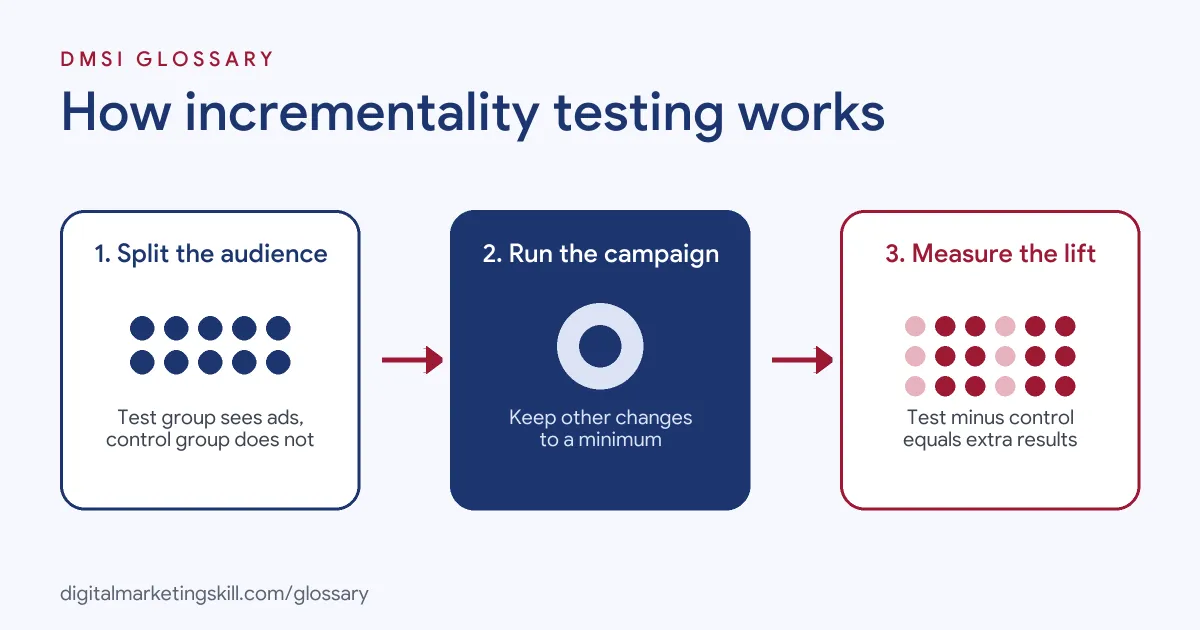
Incrementality testing follows a simple pattern. First, you split your audience into two groups. Then only one group sees your ads. Finally, you compare the results and measure the gap.
Step 1: Split Into Test and Control
The test group, also called the treatment group, sees your ads as normal. Meanwhile, the control group, or holdout, does not. The groups must be alike in every other way. Otherwise, any difference might come from the groups, not the ads.
Step 2: Run the Campaign
Next, you run the campaign for a set period. Both groups go about their lives as usual. Also, you keep other changes to a minimum, so the test stays clean. For example, don’t launch a big sale halfway through.
Step 3: Measure the Lift
Then you compare conversions in both groups. Google says incremental conversions reflect “the incremental conversions you were able to generate due to your ad campaigns.” In simple terms, it is test conversions minus control conversions. Relative lift is that gap shown as a percentage of the control group.
Step 4: Work Out the True Cost
Finally, you link the lift to spend. Google defines incremental cost per action (iCPA) as “the cost to acquire one incremental conversion that was driven by your ads.” Similarly, incremental ROAS shows revenue from incremental sales only. So iCPA is often higher than the CPA in platform reports, but it gives a more honest picture.
Types of Tests
There are two common designs. In a user-based test, people are split into groups. In a geo test, by contrast, whole regions are split, such as some cities seeing ads and others not. Geo tests also work for offline sales, such as shop visits. In addition, some teams feed test results into marketing mix models, like Google’s open-source Meridian.
Examples of Incrementality
- A retailer testing brand search ads. The team pauses brand ads in a few regions and keeps them on elsewhere. Then it compares total sales from search in both areas. As a result, it learns how many brand clicks were truly extra.
- A software company testing retargeting. A holdout group is kept out of retargeting ads. After a few weeks, the team compares sign-ups. So it can see if retargeting brings new trials or only reaches people who would sign up anyway.
- A food brand testing video ads. The brand runs a geo test with video in some cities only. Then it checks shop sales in test and control cities to measure lift.
Incrementality vs Attribution and A/B Testing
| Point | Incrementality | Attribution | A/B Testing |
|---|---|---|---|
| Main question | Did the ads cause extra results? | Which ads get credit for a conversion? | Which version works better? |
| Method | Test group vs no-ads control group | Rules or models over the customer path | Version A vs version B |
| Who is compared | People who saw ads and people who didn’t | Only people who converted | Two groups who both see something |
| Best for | Budget and channel decisions | Daily optimisation | Creative and page choices |
How to Measure Incrementality
- Pick one question. For example, “Do our YouTube ads drive extra sales?”
- Choose your metric. Decide on sales, sign-ups or another clear goal. Then make sure conversion tracking works.
- Choose a test design. Use a user-based test or a geo test, depending on your data and platform.
- Set up the groups. Use a platform tool, such as Google Ads Conversion Lift, or a geo split. Note that Conversion Lift isn’t available in every account.
- Run it long enough. Give the test enough time and volume to reach a clear result.
- Hold everything else steady. Avoid big changes to prices or other channels during the test.
- Read the results. Look at incremental conversions, relative lift and the confidence range.
- Act on it. Move budget towards channels with strong lift. Then test again later.
Best Practices for Incrementality
- Test big questions first. Start with your largest channels, where the money is.
- Keep groups alike. Make test and control groups as similar as you can.
- Use iCPA and iROAS. Compare channels on incremental cost, not just return on ad spend from platform reports.
- Respect the confidence range. A wide range means the result is uncertain.
- Repeat tests. Results change over time, so test again each season or year.
- Share results simply. Explain lift in plain words, so leaders can act on it.
Common Mistakes to Avoid
- Trusting platform numbers alone. Reported conversions often include sales that would happen anyway.
- Ending tests too early. Small samples give noisy, misleading results.
- Uneven groups. If one group is bigger or richer, the lift is not fair.
- Changing too much at once. A new offer during a test hides the real effect.
- Comparing relative lift across tests. Google warns this is hard when control sizes differ.
- Ignoring negative results. A test that shows low lift still saves you money.
Where You’ll Use Incrementality at Work
Incrementality shows up in performance marketing, growth and measurement roles. For example, real remote job listings ask you to:
- “Run structured tests – holdouts, geo splits, incrementality reads – supporting the AVP of Growth, and interpret the results honestly against platform-reported numbers.” (Senior Performance Marketing Specialist).
- “Create methodologies that demonstrate causal connections between brand spend and revenue incrementality where direct attribution is limited.” (Senior Growth Marketing Manager, Upper Funnel).
- “Understanding of attribution methodologies, incrementality testing, media mix modeling, and advanced measurement frameworks.” (Sr. Product Manager, Measurement Studies).
Learn It in the Google Ads and Analytics Track
You can learn incrementality, attribution and campaign measurement in the AI-Powered Google Specialist track. Every track includes a U.S. Project Internship from day one, with unlimited 1-on-1 mentoring.
Frequently Asked Questions
What is incrementality in simple terms?
It is the extra result your marketing caused. So it leaves out sales that would have happened without the ads.
What is a holdout group?
A holdout, or control group, is a set of people or regions that don’t see your ads. Then you compare them with the group that does.
How is incrementality different from ROAS?
Standard ROAS counts all revenue linked to ads. By contrast, incremental ROAS counts only the revenue the ads truly caused.
Can small businesses test incrementality?
Yes, with simple geo tests or pauses in some areas. However, you need enough sales for a clear result.
Does Google Ads offer incrementality tests?
Yes. Google Ads offers Conversion Lift studies based on users or geography. However, it isn’t available in every account.
Sources: Google Ads Help: About Conversion Lift; Google Ads Help: Understand your Conversion Lift based on users measurement data; Google for Developers: Meridian; remote job listings on Himalayas, Himalayas and Himalayas.