
A lead magnet is a free, useful resource, such as a guide, checklist, template or short course, that you offer in exchange for someone’s email address or other contact details. It turns an anonymous visitor into a lead you can follow up with. It matters because most people won’t buy on their first visit, but many will happily swap an email for something that solves a problem right now.
Key Takeaways
- A lead magnet is a fair swap: real value for contact details.
- The best ones solve one specific problem quickly, so people use them straight away.
- It should link closely to what you sell. Otherwise, you attract people who will never buy.
- Delivery is usually by email, which also confirms the address is real.
- In the UK, you need clear consent for marketing emails. Pre-ticked boxes don’t count.
What Is a Lead Magnet?
HubSpot defines a lead as “anyone who shares their contact information in exchange for something of value.” The lead magnet is that “something of value.” HubSpot gives examples such as a guide, a template, a free trial or a demo.
Think about how you behave online. You might read a blog post about saving money on groceries. At the end, the site offers a free weekly meal planner. You enter your email, and the planner lands in your inbox a minute later. You got something useful. Meanwhile, the business got a chance to stay in touch.
That is why a lead magnet often sits at the heart of a lead generation plan. It is the step that turns traffic into contacts.
How a Lead Magnet Works
Every lead magnet follows the same simple path. First, you offer something useful on a page, a pop-up or an ad. Next, the visitor fills in a short form and agrees to hear from you. Finally, you deliver the resource by email and start a follow-up sequence.
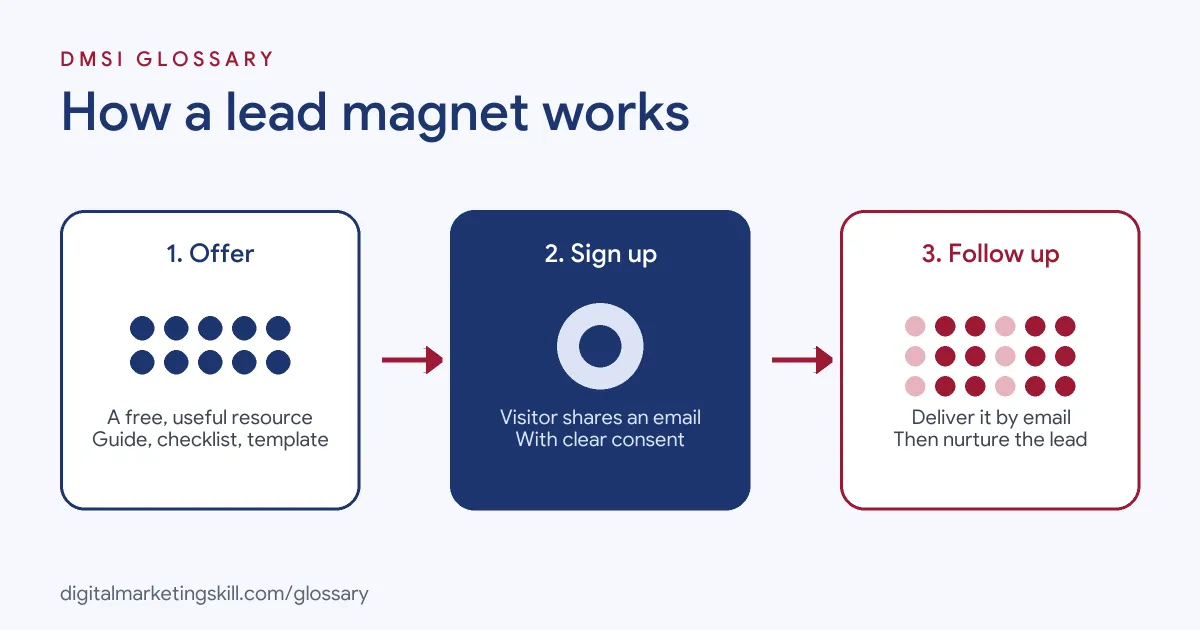
The Offer
The offer must feel worth more than an email address. So it should be specific. “A checklist for your first Google Ads campaign” works better than “Marketing tips”. It should also be quick to use, ideally in minutes rather than hours.
The Sign-Up
Next, the visitor fills in a form. Keep it short, often just a name and an email. At this point, consent matters. The ICO says that “silence, pre-ticked boxes or inactivity” should not count as consent. So add an unticked box or a clear statement about what you will send.
Delivery and Follow-Up
Most email tools send the resource automatically. For example, Kit (formerly ConvertKit) calls this the incentive email, which it describes as “the email that sends immediately, when someone subscribes to your content.” It also works as a double opt-in, so people confirm their address before they get the file. Kit says this has one main job: “keeping your list healthy and active.” After that, a short series of emails builds trust and, later, introduces your offer.
Where to Promote It
Even a great resource needs people to see it. Start with your own channels. Add the offer to related blog posts, your website menu and the bio link on your social profiles. Then mention it in posts and short videos that cover the same topic. When you are ready to grow faster, run ads that point to the landing page. For instance, Google Ads lets eligible advertisers add a lead form straight into an ad. Either way, track where each sign-up came from, so you know which channel to grow.
Lead Magnet Examples
Here are three examples from different kinds of business:
- Accountant: A free “self-employed tax checklist” for freelancers. It solves a real worry and leads naturally to a paid service.
- Online shop: A “how to choose the right running shoe” quiz that ends with product picks and a sign-up for the results.
- Training school: A free career guide that explains entry-level roles, followed by an invitation to a consultation.
In each case, the resource fits the buyer’s first question. As a result, the people who sign up are likely to care about the paid offer too.
Types of Lead Magnet Compared
Different formats suit different goals. Here is a quick guide:
| Type | Effort to create | Best for |
|---|---|---|
| Checklist or cheat sheet | Low | Quick wins and busy readers |
| Template or swipe file | Low to medium | Practical tasks, such as emails or plans |
| Guide or ebook | Medium | Complex topics that need explaining |
| Quiz or calculator | Medium to high | Personal results and product matching |
| Webinar or mini-course | High | Higher-value services and training |
| Free trial or demo | Varies | Software and products people need to try |
In short, start with something simple. You can always build a bigger resource once you know what your audience wants.
How to Create a Lead Magnet
Follow these steps to build your first one:
- Pick one audience. Describe the person you want to attract and the problem they face.
- Choose one promise. Decide the single result your resource will deliver.
- Pick a format. Choose something you can finish well, such as a checklist or template.
- Create it. Keep it short, clear and branded, with one next step at the end.
- Build a landing page. Explain the benefit, show a preview and add a short form.
- Set up consent and delivery. Add a clear opt-in, link to your privacy policy and set up the welcome email.
- Write the follow-up. Plan a few emails that help first and sell later.
- Promote and measure. Share it on social, in blog posts and in ads, then track sign-ups and sales.
Best Practices
- Solve one problem. A narrow topic feels more useful than a broad one.
- Make it fast. People should get value within minutes.
- Match it to your offer. The topic should lead naturally to what you sell.
- Be clear about emails. The ICO says you may “incentivise consent to some extent,” but you “must be careful not to cross the line and unfairly penalise those who refuse.”
- Offer an easy way out. Under PECR, you must give “a simple way to opt out” in every message.
Common Mistakes to Avoid
A common mistake is making the resource too big. A long ebook can look impressive, yet few people finish it. Another is choosing a topic that has nothing to do with your product. Some teams also hide the consent wording or use a pre-ticked box, which the ICO says is not valid consent. Others forget the follow-up, so new leads hear nothing until a sales email arrives weeks later. Finally, many people never test the form, so a broken link can lose every lead.
Where You’ll Use Lead Magnets at Work
This skill appears in content, inbound and marketing manager roles. For example, recent remote job listings ask for:
- “Experience building and promoting lead magnets” (Inbound Marketer).
- Skill in “designing lead magnets, ebooks, and guides that both educate and convert” (Content and Creative Marketing Specialist).
- The ability to “design and implement effective lead magnets to attract and convert prospects” (Marketing Manager).
Notice that each listing pairs creating the resource with promoting it. Building the file is only half the job.
So if you want to be a Lead Generation Specialist, Email Marketing Specialist or Marketing Automation Specialist, expect to plan, build and promote these offers. You will also need to show how many sign-ups and sales they produced.
Learn It in the Lead Generation Track
You can learn this skill in the AI-Powered Lead Generation and Email Automation track. It covers AI fundamentals, lead generation, and email marketing and automation. In fact, your portfolio project is to build a lead magnet and an automated email sequence that converts. You also join a U.S. Project Internship from day one, with unlimited 1-on-1 mentoring.
Need ideas? Browse our list of lead magnet ideas, then read how to grow your email list.
Frequently Asked Questions
What is a lead magnet in simple terms?
It is a free resource you give away in return for someone’s email address, so you can stay in touch and build trust.
What is a good lead magnet example?
A short checklist, template or quiz that solves one problem quickly. For instance, a “first-week social media plan” for new business owners.
Do lead magnets still work?
Yes, when they are specific and useful. Several job listings quoted on this page still ask for people who can build and promote them.
Can I make a lead magnet a condition of joining my email list?
The ICO says some incentive is allowed. However, you must not unfairly penalise people who refuse, and consent must be clear and freely given.
How do I deliver a lead magnet?
Most people use an automated welcome email from their email platform. It sends the file or link as soon as someone signs up.
Sources: HubSpot: The beginner’s guide to lead generation; Kit Help: The incentive email; Google Ads Help: About lead form assets; ICO: What is valid consent?; ICO: Electronic mail marketing; remote job listings on Himalayas.