
Pay-per-click (PPC) is a type of online advertising where you pay each time someone clicks your ad, rather than each time it is shown. Most PPC ads are bought through an auction, where your bid and the quality of your ad decide whether it appears and where. It matters because you can buy visits from people who are searching for what you sell, and you can measure what each click is worth.
Key Takeaways
- With PPC, you pay for clicks, not for views. Google notes that cost-per-click pricing “is sometimes known as pay-per-click (PPC).”
- Most platforms run an auction for every search or page view, so prices change all the time.
- Your bid is not the only factor. Ad quality, landing page quality and context also count.
- You set the most you will pay for a click, but you often pay less.
- PPC only pays off when you track what happens after the click, such as a sale or a lead.
What Is Pay-Per-Click?
Pay-per-click is a way of buying traffic. In simple terms, an advertiser pays a publisher, usually a search engine or website, each time a user clicks an ad. So the cost is linked to an action, not just to the ad being seen.
For example, a plumber in Leeds can bid on searches such as “emergency plumber Leeds”. When someone searches for that phrase, the plumber’s ad may appear above the normal results. If the person clicks, the plumber pays. If they scroll past, the plumber pays nothing.
That’s why PPC is popular with small businesses and large brands alike. You can start small, target people who already want something, and switch campaigns off at any time. However, it can also waste money quickly if nobody watches the results.
How Pay-Per-Click Works
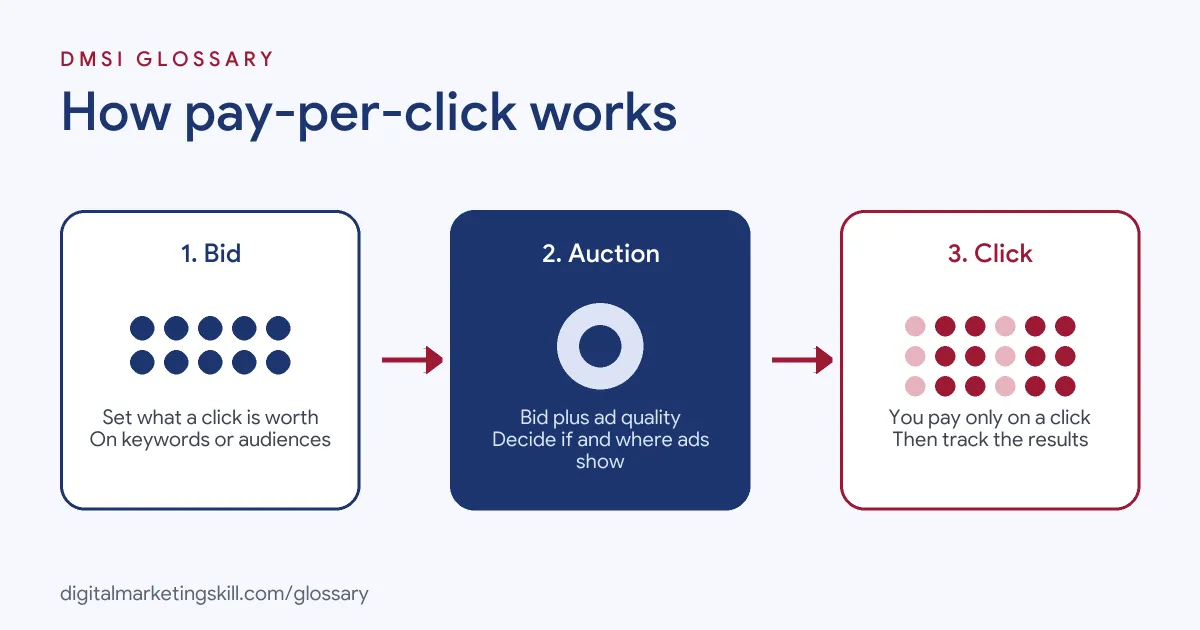
Every PPC ad goes through three steps. First, you set a bid. Next, the platform runs an auction. Finally, you pay when someone clicks.
The Bid
Your bid tells the platform what a click is worth to you. On Google Ads, the maximum cost-per-click is “the highest amount that you’re willing to pay for a click on your ad.” You can set it yourself with manual bidding. Alternatively, you can let Google set bids to try to get the most clicks within your budget, or to chase goals such as conversions.
The Auction
When someone searches, Google Ads runs an auction to decide which ads show, in what order, and whether they show at all. It does this with Ad Rank. According to Google, Ad Rank uses your bid, the quality of your ad and landing page, Ad Rank thresholds, auction competitiveness, the context of the search, and the expected impact of your assets.
As a result, the highest bid does not always win. Google says a more relevant ad can rank higher even when a rival bids more.
The Click and the Price
You never pay your full bid by default. Instead, Google says you pay only what is “minimally required” to clear the Ad Rank thresholds and beat the advertiser just below you. In fact, Google notes you’ll “often be charged less – sometimes much less” than your maximum.
Pay-Per-Click Examples
Here are three common ways businesses use PPC:
- Online shop: A shoe retailer bids on searches for its best-selling trainers. Then it sends clicks straight to each product page, so buyers land where they can check out.
- Lead generation: An accounting firm bids on “small business accountant” searches. Its ad leads to a short form for a free call, and it tracks every form sent.
- Local service: A dentist runs ads only within a few miles of the practice and only during opening hours. That way, it pays for clicks from people who can actually book.
In each case, the business decides what a click is worth by looking at what a customer is worth.
Where Pay-Per-Click Ads Appear
PPC is not limited to search engines. Here is where you will find it:
| Placement | How ads appear | What to know |
|---|---|---|
| Search engines | Sponsored ads above, beside or below the normal results | Targets people who are actively searching |
| Social networks | Ads in feeds and stories on platforms such as TikTok and X | Targets people by interests and behaviour rather than searches |
| Partner websites | Contextual ads placed by ad networks on other sites | Usually lower click-through and conversion rates than search ads |
There are also two pricing models. With flat-rate PPC, the advertiser and publisher agree a fixed price per click. With bid-based PPC, advertisers compete in an auction. The largest search ad networks use the bid-based model.
How to Set Up a Pay-Per-Click Campaign
These steps follow a typical search campaign. The exact menus differ by platform, but the logic is the same.
- Pick one goal. Decide whether you want sales, leads or website traffic.
- Set up conversion tracking. Google says this helps you “understand your return on investment (ROI)”. Without it, you only know what you spent.
- Choose your keywords. Start with specific phrases that show clear intent to buy or enquire.
- Write ads that match the search. Use the searcher’s words and give a clear reason to click.
- Send clicks to a relevant page. The landing page should deliver exactly what the ad promised.
- Set a daily budget and a bid strategy. Begin with an amount you can afford to test.
- Review results weekly. Pause keywords that spend without converting, and move budget to the ones that work.
To find a sensible bid, work backwards from value. Google’s own help gives a simple lead example. If one in ten leads becomes a $20 sale, each lead is worth about $2 in revenue. So paying much more than that per lead would lose money. Once you know this number, you can judge every keyword on facts rather than hunches.
Best Practices for Pay-Per-Click
- Work out what a click is worth. If one in twenty clicks becomes a customer, your bid must leave room for profit.
- Improve quality, not just bids. Google’s Quality Score rates expected click-through rate, ad relevance and landing page experience on a scale from 1 to 10. It is a diagnostic tool, so use it to find weak spots.
- Use negative keywords. Block searches that will never buy, such as “free” or “jobs”, if they do not fit.
- Test your ads. Run two versions and keep the one that brings more conversions.
- Watch for invalid clicks. Google’s systems try to filter fake or accidental clicks, but check for odd spikes in traffic.
Common Mistakes to Avoid
Beginners often make the same errors. First, they launch without conversion tracking, so they cannot tell good keywords from bad. Second, they target broad keywords and pay for vague searches. Third, they send every click to the home page. Finally, they judge success on clicks rather than on sales or leads. Each of these is easy to fix once you know to look for it.
Where You’ll Use Pay-Per-Click at Work
PPC skills appear in many marketing job listings. For example, recent remote listings ask candidates to:
- “Manage, analyze, and optimize pay-per-click (PPC) campaigns to increase ROI.” (Google Ads Specialist)
- Show “proven experience managing and optimizing digital campaigns across SEO, PPC, social media, and email marketing.” (Freelance Marketing Consultant)
- Have “basic knowledge of PPC structure and performance metrics.” (Amazon Split-Testing Specialist)
So if you want to work as a Google Ads Specialist, PPC Specialist or Web Analytics Specialist, employers will expect you to build campaigns, manage bids and prove what the clicks are worth.
Learn It in the Google Specialist Track
You can learn pay-per-click in the AI-Powered Google Specialist track. It covers Google Ads across Search, Display, Discovery, Gmail and YouTube, plus Google Analytics. For your portfolio, you launch and measure a Google Ads campaign with conversion tracking. You also join a U.S. Project Internship from day one, with unlimited 1-on-1 mentoring.
Want to go deeper? Read our guide to PPC campaign optimisation, or see how the Google Ads platform works.
Frequently Asked Questions
What is pay-per-click in simple terms?
It is online advertising where you pay only when someone clicks your ad. If people see the ad but do not click, you usually pay nothing.
Is PPC the same as Google Ads?
No. Google Ads is one PPC platform. However, social networks and ad networks on other websites also sell ads on a pay-per-click basis.
Do you always pay your full bid?
No. On Google Ads, you usually pay just enough to beat the advertiser below you. So your actual cost is often lower than your maximum bid.
Why do my rivals rank above me with a lower bid?
Ad Rank also looks at ad quality, landing page quality and context. As a result, a more relevant ad can beat a higher bid.
How much should I spend on pay-per-click?
Start with a budget you can afford to test. Then work out what a customer is worth to you, and set bids that leave room for profit.
Sources: Google Ads Help: Cost-per-click bidding; Google Ads Help: Actual cost-per-click; Google Ads Help: Ad Rank; Google Ads Help: About Quality Score; Google Ads Help: About conversion tracking; Google Ads Help: Determine your return on investment; Wikipedia: Pay-per-click; remote job listings on Himalayas.