PPC campaign optimization starts with the auction, not the budget. Google ranks ads by bid multiplied by quality, so a cheaper, more relevant ad can beat a bigger spender. This guide shows how that auction works, which bidding model fits which goal, and the one change to make before any other.
Key Takeaways
- The highest bidder does not always win. Google Ads Help says Ad Rank combines your bid with ad and landing page quality, Ad Rank thresholds, auction competitiveness, search context, and the expected impact of your ad assets.
- Quality moves the price, not just the position. Google says plainly that higher quality ads can lead to lower CPCs, because Quality Score sits inside the Ad Rank formula next to your bid.
- Quality Score has three named parts. Google Ads Help builds it from expected click-through rate, ad relevance, and landing page experience, scored 1 to 10 per keyword.
- Automated bidding still needs a target. Target CPA bidding sets bids to hit the average cost per conversion you choose. Maximize Conversions bidding spends your full budget to win as many conversions as it can, with no target at all.
- Relevance compounds. In Google’s own case notes, 1STOPlighting, a retail lighting store, grew profit by 214% after switching its Shopping campaigns from manual bids to Target ROAS.
In this guide
- What Most PPC Campaign Optimization Advice Gets Backwards
- How the Ad Auction Actually Decides a Winner
- Three Bidding Models Behave Differently Under the Same Auction Rules
- How to Lead With Each Bidding Model, Not Just Turn It On
- How to Measure Whether PPC Campaign Optimization Is Working
- The One Rule: Fix Quality Score Before You Touch the Bid
- A Real Case: Matching the Bidding Model to the Goal
- Frequently Asked Questions About PPC Campaign Optimization
- Where PPC Campaign Optimization Fits Into a Broader Skill Set
What Most PPC Campaign Optimization Advice Gets Backwards
Most PPC campaign optimization advice starts with the budget. Raise it, lower it, split it across campaigns. That treats cost as the main lever. But Google’s auction does not simply reward the biggest budget. It ranks ads by Ad Rank, a score built from your bid and your ad’s quality together. A cheaper, more relevant ad can beat a bigger bid, and a bigger bid alone can still lose to a more relevant competitor.
This reading comes from Google’s own documentation, not a fixed formula with published weights. Google does not share the exact multiplier behind each quality component, and it recalculates every auction fresh. What follows is the mechanism, the levers that differ by bidding model, and the one decision rule to apply first.
Getting this backwards is expensive over time. A low-quality ad that wins an auction on bid alone teaches the account nothing. It keeps costing more for the same position, while a cheaper, more relevant competitor slowly earns a better one. PPC campaign optimization means catching that pattern early, on your highest-spend keywords, instead of finding it months later in a budget review. By the time a budget review surfaces the problem, the account has already paid the inflated price on every auction in between, which is the real, compounding cost of optimizing the wrong lever first.
How the Ad Auction Actually Decides a Winner
Every search triggers a fresh auction among eligible advertisers. Knowing what feeds that auction is the foundation of PPC campaign optimization, because it shows which lever actually moves cost and position.
Quality Score: The Multiplier Most Advertisers Ignore
Quality Score is Google’s own estimate of how useful your ad and landing page are. It is scored 1 to 10 per keyword, against other advertisers chasing the same search. Google Ads Help’s guide to Quality Score names three parts. Expected click-through rate is how likely someone is to click your ad. Ad relevance is how closely your ad matches what the searcher wants. Landing page experience is how useful the page is once they land. A weak score on any one part drags the whole Quality Score down, even with strong ad copy. A weak landing page design is one of the fastest ways to sink it.
Ad Rank: Why the Biggest Bid Does Not Always Win
Ad Rank decides whether your ad can show at all, and where, against other advertisers in that auction. Google Ads Help’s explanation of Ad Rank lists the inputs. These are your bid, the quality of your ad and landing page, Ad Rank thresholds, and how competitive the auction is. Search context, like device and location, plays a role too. So does the expected impact of ad assets, such as sitelinks or images. Google recalculates Ad Rank for every single auction. That is why the same keyword can cost more on one device and less on another.
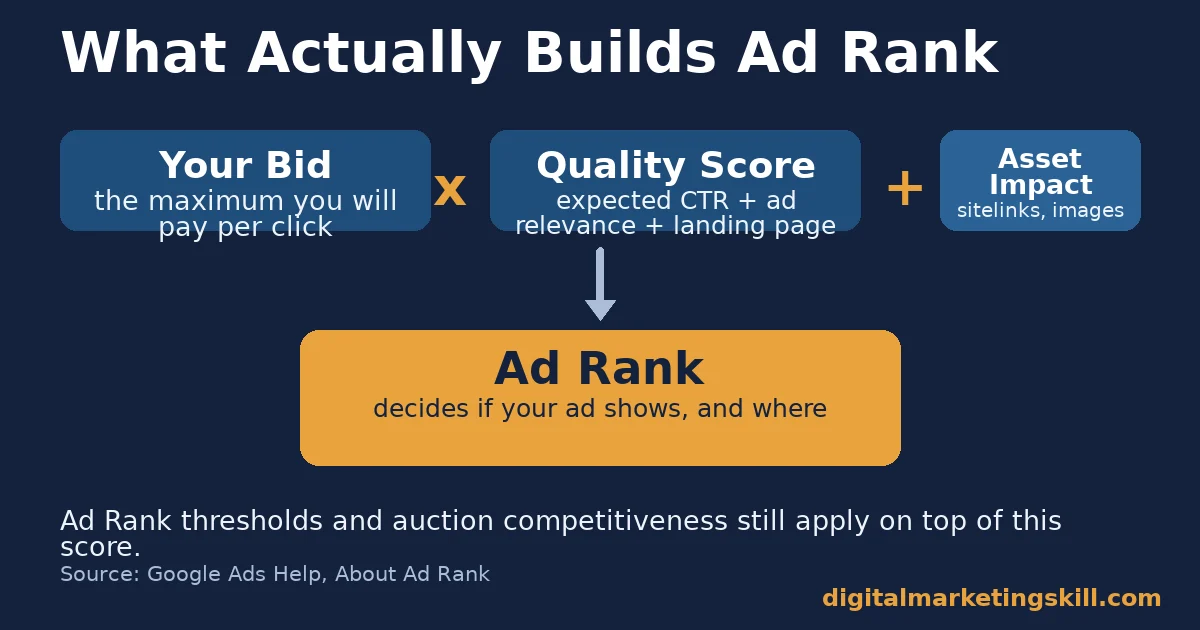
The practical result: Google states plainly that higher quality ads can lead to lower cost per click, because quality sits inside the same formula as your bid. Two advertisers can bid the same amount and still pay different prices for the same position, simply because one has a better Quality Score.
Three Bidding Models Behave Differently Under the Same Auction Rules
PPC campaign optimization is not one setting. It is a choice between bidding models that hand different amounts of control to you versus Google’s automated systems. Each model suits a different stage of a campaign. Picking the wrong one for the stage you are actually in, not the stage you wish you were in, is one of the most common and most fixable mistakes in a paid search account.
Manual CPC: Built for Control Over Every Keyword
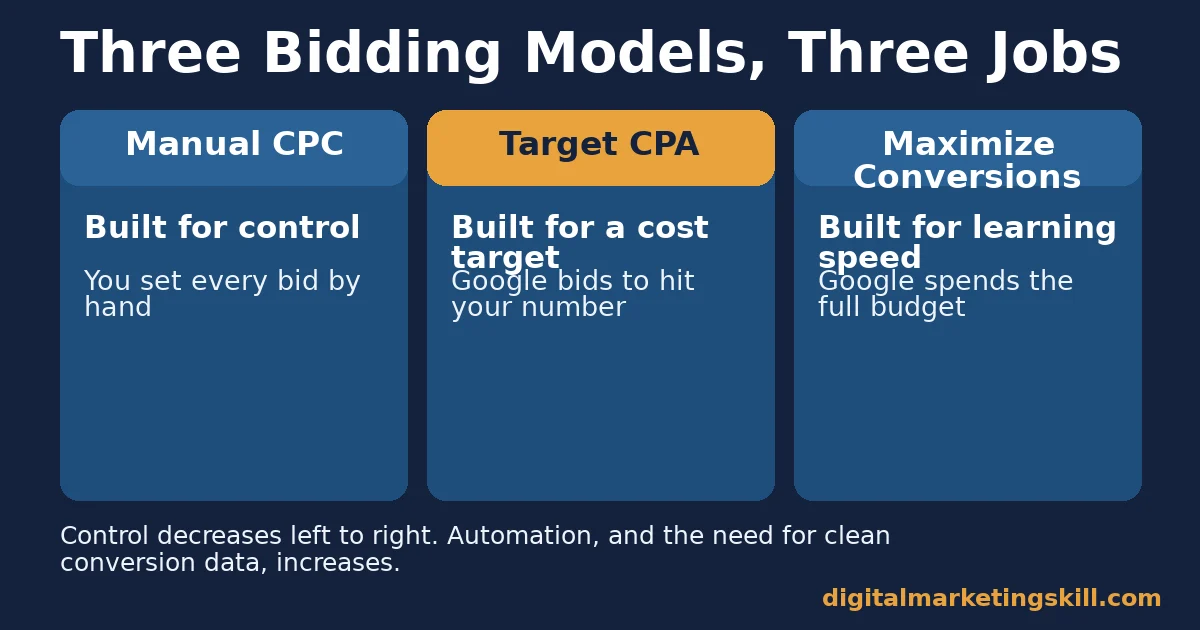
With Manual CPC, you set the maximum you will pay per click, at the keyword or ad-group level. Nothing changes until you change it. That gives the most granular control. It matters early in a new campaign, before Google has conversion history to learn from. It also suits small, tightly defined ad groups, where a handful of keywords justify hand-tuned bids. Treat it as a starting stage, not a permanent home. Once a keyword group earns enough conversion volume, manual bidding usually becomes a ceiling on performance, not a safeguard.
Target CPA Bidding: Built for a Fixed Cost Target
Google Ads Help’s Target CPA documentation describes an automated strategy that sets bids to win as many conversions as possible at the average cost per conversion you choose. It adjusts bids in real time using signals like device, location, time of day, and remarketing list, something no advertiser can track by hand across thousands of daily auctions. A gap in mobile conversion rate against desktop usually surfaces here first, since the system reacts to it before a human notices. Target CPA needs reliable conversion tracking and real conversion volume, or it bids inconsistently.
Maximize Conversions: Built for Learning Speed Over Cost Control
Per Google Ads Help’s Maximize Conversions documentation, this model spends your full daily budget to win as many conversions as it can. It carries no fixed cost target. It learns fast, which makes it useful for discovering what a campaign can do before you lock in a Target CPA. But it gives the least cost predictability of the three. It spends up to your budget cap regardless of cost per conversion on any given day.
How to Lead With Each Bidding Model, Not Just Turn It On
Switching bidding models without changing what feeds them rarely works. Each model needs a different first move before it can actually perform. Flip the switch on its own, and the new model simply inherits the old model’s problems, at a different pace.
Manual CPC: Lead With Negative Keywords, Not Higher Bids
Before you raise a manual bid, add negative keywords. Google Ads Help’s negative keyword definition describes a negative keyword as a term that stops your ad showing for a specific word or phrase. Every irrelevant click that a negative keyword blocks lowers your real cost per useful click, without touching your bid at all. It also protects Quality Score, because it keeps your click-through rate relevant to the keywords you actually want to win.
Target CPA: Lead With Conversion Tracking Accuracy, Not a Lower Target
Target CPA can only bid as well as the data it learns from. Before you tighten the target number, confirm every conversion fires once. Check that it attributes correctly. Check that it never double-counts across tools. A tracking error that inflates conversions, even slightly, teaches the automated system to chase the wrong signal across every future auction. Fix tracking first. Adjust the target second. A clean tracking setup is worth more than a week of bid tweaks on broken data.
Maximize Conversions: Lead With Budget Pacing, Not a Hard Cap
Maximize Conversions spends toward your budget ceiling, so set that ceiling on purpose, not as an afterthought. A ceiling set too low cuts off the learning period before the system finds its best auctions. A ceiling with no review lets cost per conversion drift upward on quiet days. Review pacing weekly for the first month, then monthly once performance settles. Note the day of week and time of day alongside each pacing check, since spend often clusters unevenly across a week even on a flat daily budget.
How to Measure Whether PPC Campaign Optimization Is Working
Each metric below answers a different question. Read them together, not alone, because one number can look healthy while the campaign underperforms overall. Pick two or three to check weekly. Save the rest for a monthly review, so you catch slow drift without chasing daily noise.
- Quality Score (1 to 10, per keyword): Google’s own estimate of ad and landing page relevance. A rising average on your top keywords should lower cost per click at the same position.
- Search impression share: Google Ads Help’s impression share definition divides the impressions your ads received by the impressions you were eligible for. A low share with a healthy budget usually points to a quality or threshold problem, not a spend problem.
- Click-through rate (CTR): clicks divided by impressions. A falling CTR on stable ad copy warns that your ad is losing relevance to the searches triggering it.
- Cost per acquisition (CPA): total spend divided by conversions. This is the number Target CPA bidding is built to hit. Compare it against your real margin per conversion, not last period’s average.
- Return on ad spend (ROAS): conversion value divided by spend. It beats CPA alone when conversions carry different dollar values, which is why Target ROAS exists as its own strategy.
- Conversion rate: conversions divided by clicks. A strong CTR paired with a weak conversion rate usually means the ad promises something the landing page does not deliver. That gap drags landing page experience, and Quality Score, back down. The same gap shows up in broader lead conversion strategies work, not only in paid search.
Pull these numbers from the dashboards you already use for organic traffic. Reading Google Analytics reports next to Google Ads data shows whether a paid visitor behaves differently from an organic one once both land on the same page.
Read all six together before you change anything. A high Quality Score paired with a low impression share usually means a budget decision, not a relevance problem. So raise the budget. A high impression share paired with a falling conversion rate usually means the auction is healthy, but the page is not. Fix the page, not the bid. Changing one metric alone, without checking the other five, is how PPC campaign optimization turns into guesswork.
The One Rule: Fix Quality Score Before You Touch the Bid
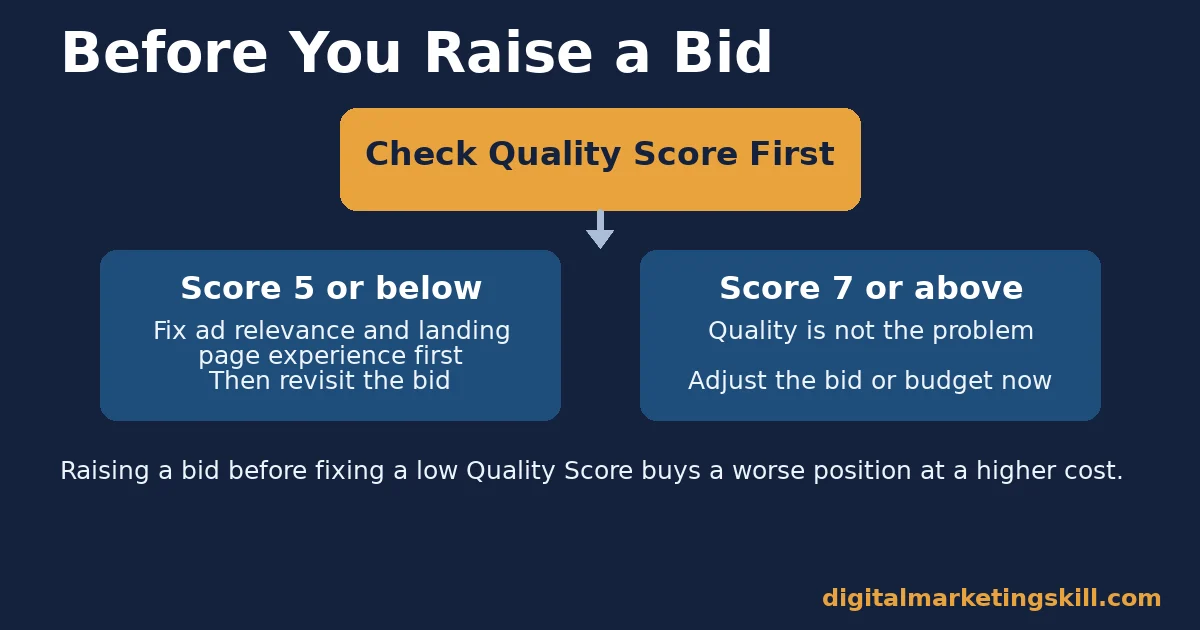
If you take one decision rule from PPC campaign optimization, make it this: diagnose and raise Quality Score on your highest-spend keywords before you raise a single bid. A higher bid on a low-quality ad buys a worse position at a higher cost than fixing the ad would. A higher bid on a high-quality ad just pays to confirm a position you may already hold.
Illustrative, invented numbers to show the arithmetic: a keyword with a Quality Score of 4 and a $2.00 bid competes against the same keyword at a Quality Score of 8 and the same $2.00 bid. Ad Rank multiplies bid by quality. So the second version can outrank the first at an identical bid. It can also match that rank at a lower bid. That is the entire mechanism behind Google’s statement that higher quality can mean lower CPCs. Run this comparison on your own account’s real numbers before you touch bids campaign-wide.
A Real Case: Matching the Bidding Model to the Goal
Google’s own Ads Help documentation on finding success with Smart Bidding cites 1STOPlighting. It is a retail lighting store selling indoor and outdoor fixtures, patio umbrellas, and furniture. The retailer moved its Shopping campaigns from manual bids to Target ROAS bidding. That strategy sets bids to hit a target return on ad spend, instead of a flat cost per click. Profit grew by 214%. The documented change was the bidding model and the metric behind it, not a bigger budget. The case does not report the starting Quality Score, budget size, or timeframe. So treat 214% as one retailer’s result under its own conditions, not a guaranteed multiplier.
What is repeatable here is the sequence, not the number. The retailer matched its bidding model to the metric that actually mattered, profit, instead of defaulting to the easiest metric to set, cost per click. The same sequence applies outside Shopping campaigns. A lead-generation account optimizing purely for cost per click can hit its target while generating leads that never turn into revenue. Switching the target to cost per qualified lead often matters more than any single bid change. The same is true of moving to a value-based strategy, once enough conversion-value data exists.
Frequently Asked Questions About PPC Campaign Optimization
What counts as a good Quality Score for PPC campaign optimization?
Google scores Quality Score from 1 to 10 per keyword and treats it as a diagnostic, not a pass-fail test. Keywords scoring 7 or above are rarely the problem. Spend optimization time on keywords scoring 5 or below, since that is where expected CTR, ad relevance, or landing page experience is most likely failing.
Does a bigger budget guarantee a better ad position?
No. Ad Rank combines bid and quality, along with Ad Rank thresholds and auction competitiveness, so a lower bid with a stronger Quality Score can outrank a higher bid with a weaker one. Budget decides how long your ads keep showing once they win auctions, not whether they win them.
How is Ad Rank different from Quality Score?
Quality Score is one input into Ad Rank, not the same thing. Ad Rank also factors in your bid, Ad Rank thresholds, auction competitiveness, search context, and the expected impact of ad assets. Quality Score describes your ad’s relevance. Ad Rank is the auction outcome that relevance feeds into.
Should a new campaign start with manual or automated bidding?
Manual CPC gives more control when there is little or no conversion history for an automated system to learn from, which usually describes the first weeks of a new campaign. Once tracking is confirmed accurate and conversion volume builds, Target CPA or Maximize Conversions typically out-learn manual adjustments, because they react to auction-level signals no advertiser can track by hand.
What is a healthy search impression share?
There is no single healthy number; it depends on budget and goals. What matters for PPC campaign optimization is the gap between your impression share and 100%, and why that gap exists. A gap caused by budget is a spend decision. A gap caused by low Ad Rank or Quality Score is an optimization problem that more budget will not fix alone.
How often should negative keywords be reviewed?
Review the search terms report at least monthly for an active campaign, and weekly during the first month of a new one. That is when irrelevant queries most often slip through, wasting spend and quietly lowering expected click-through rate. A quarterly pass across the whole account catches slower drift, such as a product line that quietly stopped matching the keywords it was built around.
Can PPC campaign optimization lower cost without lowering the budget?
Yes, within limits. Raising Quality Score, tightening negative keywords, and improving landing page experience can lower cost per click and cost per conversion at the same budget, because all three feed the Ad Rank formula directly. Budget then decides how far you can scale that efficiency, not whether the efficiency exists.
How long does PPC campaign optimization take to show results?
Quality Score and Ad Rank respond within days to weeks as click-through rate and relevance data build up. Automated strategies like Target CPA need a documented learning period of conversion data before bidding stabilizes, so judge a bidding change over two to four weeks, not the first few days.
Where PPC Campaign Optimization Fits Into a Broader Skill Set
PPC campaign optimization rewards the same habit that search and content work does: fix the mechanism before spending more to outrun it. Quality Score, Ad Rank, and the right bidding model for your goal are learnable skills, not a budget problem. They sit alongside landing page design, conversion tracking, and reporting as part of the same discipline.
The Digital Marketing Skill Institute’s Master Diploma in Digital & AI Marketing covers this inside its Google Specialist track. That track is one of four AI-powered tracks in a ten-course program. The program is dual US and UK accredited, and recognised in more than 100 countries. Every student gets unlimited 1-on-1 coaching and mentoring. Every student also gets real project work inside a US partner company, 100% online. That means the auction mechanics in this guide get applied to a live account, not left as theory. See the full curriculum at Digital Marketing Skill Institute, or go straight to the Master Diploma in Digital & AI Marketing program page for every track in detail.
If you manage PPC campaigns anywhere in your country, these auction rules apply the same way, regardless of currency or market. Google runs the same Ad Rank calculation worldwide. Start with your account’s highest-spend keyword. Diagnose its Quality Score components. Fix what is failing. Only then revisit the bid. Apply to the Master Diploma program, or browse more guides on the Digital Marketing Skill Institute blog, to build the rest of the skill set around it. Start that work today at digitalmarketingskill.com.
Every figure in this guide was checked against its original source before publication. Figures marked as illustrative are invented examples, not real results.
![9 Amazing Digital Marketing Skills to Make Money Online [With Proof]](https://digitalmarketingskill.com/wp-content/uploads/2019/07/9-Amazing-Digital-Marketing-Skills-to-Make-Money-Online-With-Proof-17.png)