
Price Anchoring is a pricing tactic where you show a first price, the anchor, so that the prices people see next seem better value by comparison. It works because buyers rarely judge a price on its own. Instead, they compare it with something. So the first number they see often shapes what they think is fair. As a result, price anchoring can change which plan, product or bundle people choose.
Key Takeaways
- Price anchoring uses a first price as a reference point for later prices.
- It is based on anchoring bias, a well-studied mental shortcut.
- Common forms include “was” prices, premium plans and suggested amounts.
- Anchors must be honest, because fake reference prices can break consumer law.
- You should test anchors with real users rather than rely on guesswork.
What Is Price Anchoring?
Price anchoring comes from a wider idea in psychology called anchoring bias. The Decision Lab describes it as “a cognitive bias that causes us to rely heavily on the first piece of information we are given about a topic.” In other words, the first number sticks. Then every number after it is judged against that start point.
Nielsen Norman Group puts it in similar terms. It calls anchoring “the tendency to rely on a single piece of information or aspect of an event.” So when a buyer sees a high price first, a lower price looks like a good deal. By contrast, if they see a low price first, a higher price can feel too much.
Here is an everyday example. Imagine you walk into a shop and see a coat for £300. Next to it hangs a similar coat for £150. Suddenly, £150 feels reasonable. However, if you had seen the £150 coat on its own, you might have thought it was expensive.
The idea goes back to well-known research by Amos Tversky and Daniel Kahneman. In one test, students had a few seconds to estimate a long multiplication. Those who saw the larger numbers first gave much higher guesses than those who saw the smaller numbers first. The starting point shaped the answer, even though the sum was the same.
Why It Matters
Why should marketers care? Because price is often the last hurdle before a sale. If the price feels too high, people leave. However, a clear anchor can frame the price as fair. In addition, anchoring can guide people towards the option you want them to pick, such as a middle plan. Finally, it supports your value proposition, because it helps buyers see what they get for the money.
How Price Anchoring Works
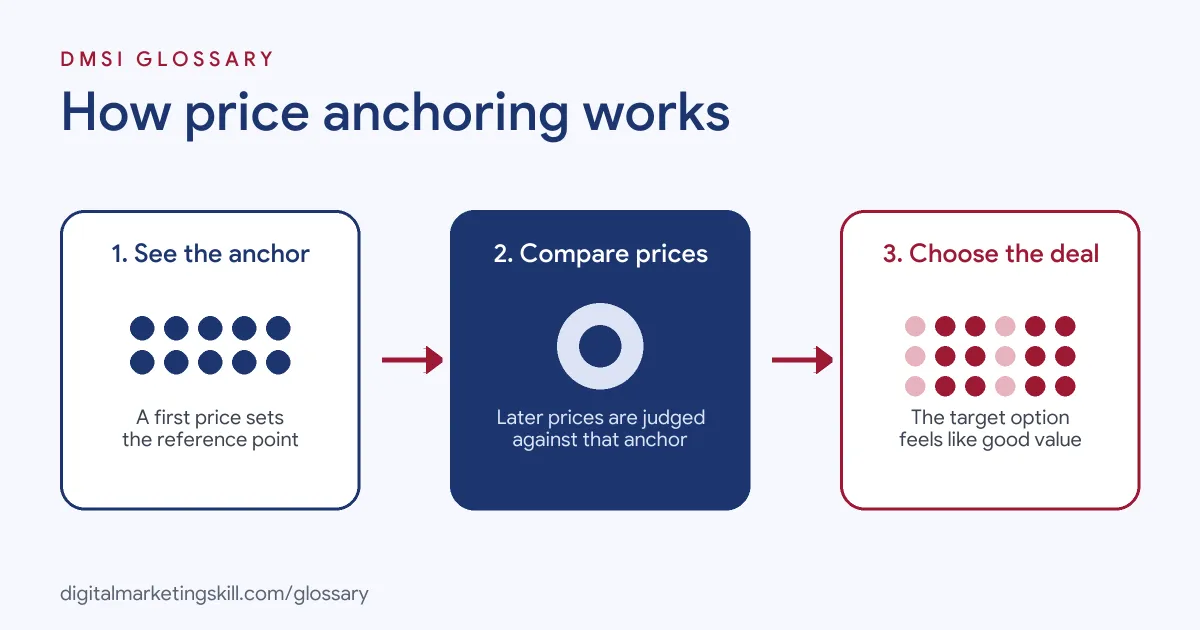
Price anchoring works in three simple stages. First, the buyer sees an anchor price. Then they compare other prices with that anchor. Finally, they make a choice that feels like good value against it.
The Reference Price
The most common anchor is a reference price. For example, a shop shows a crossed-out “was” price next to the sale price. The Decision Lab gives the example of a product first priced at $25, then shown at $20. The old price makes the new one look like a strong deal. Also, Nielsen Norman Group notes that showing the original price next to a sale price can raise how much users think an item is worth.
The Premium Option
Next, many pricing pages show a high-end plan first. This plan may suit only a few buyers. Still, it makes the middle plan look modest. So a software firm might list an enterprise plan beside its standard plan. As a result, the standard plan feels like the sensible choice.
Suggested Amounts and Defaults
Anchors also work with amounts people choose themselves. For instance, a charity form can show preset donation amounts. Nielsen Norman Group reports an A/B test where a version with suggested monthly amounts got 23% more form completions than a plain “Donate now” button. Similarly, default values in a form or calculator give users a starting point.
Bundles and Unit Prices
Bundles use the same idea. For example, a shop lists the price of each item on its own. Then it shows the bundle price for all of them together. The total of the single prices acts as the anchor, so the bundle looks like a saving. In the same way, a yearly plan can show its monthly cost next to the full monthly price. As a result, buyers see the gap at a glance. This also works well for upselling, because the bigger pack now feels like the smart buy.
Why the Order Matters
Order is a big part of the effect. If people see the cheapest option first, that low price becomes their anchor. Then every other plan looks costly next to it. However, if they see a higher price first, the rest look more modest. So think about where eyes land first on the page, on mobile as well as desktop.
The Decoy
Finally, some pages add a third option that few people will buy. This is often called a decoy. It sits close in price to the option you want to sell but offers less. So the target option looks clearly better. However, decoys need care, because a pointless option can confuse buyers.
Examples of Price Anchoring
- An online homeware shop. The shop shows the full price with a line through it and the sale price beside it. Then it checks that the full price was a real price it charged before.
- A software company’s pricing page. The page shows three plans, with the most expensive on the right. As a result, the middle plan, marked “Most popular”, feels like fair value.
- A local charity. The donation form offers three preset monthly amounts and an “other” box. So donors have a clear starting point instead of a blank field.
Price Anchoring vs Decoy Pricing vs Discounting
| Point | Price Anchoring | Decoy Pricing | Discounting |
|---|---|---|---|
| Main idea | A first price shapes how later prices feel | A weaker option makes another look better | The price itself goes down |
| Changes the real price? | No | No | Yes |
| Typical use | Sale tags, pricing pages, bundles | Three-plan or three-size layouts | Seasonal sales, promo codes |
| Main risk | Misleading reference prices | Confusing buyers | Lower margins and price expectations |
In practice, these often appear together. For example, a sale tag uses a discount, but the crossed-out price is the anchor.
How to Use Price Anchoring
- Know your real prices. List the honest prices you can use as anchors, such as a genuine past price or a real premium plan.
- Choose the anchor type. Decide if a reference price, a premium option or suggested amounts fits your page best.
- Place the anchor first. Show the anchor where people see it before the price you want them to pick.
- Explain the value. Use clear copywriting to show what each option includes.
- Highlight your target option. Use a label such as “Most popular” or a subtle colour change.
- Check the law. Make sure any “was” price or comparison is true and not misleading. In the UK, read the CMA’s guidance on unfair commercial practices.
- Test and measure. Run an A/B test and compare plan mix, revenue and conversion rate.
Best Practices for Price Anchoring
- Stay honest. Only use reference prices that are real and current enough to be fair.
- Make the anchor believable. An anchor that feels silly can damage trust instead of building it.
- Keep choices few. Two to four options are easier to compare than a long list.
- Pair it with proof. Add reviews or social proof so the value feels real.
- Match the page design. Put anchors on a clear landing page or pricing page with one main action.
- Measure more than clicks. Track refunds, complaints and repeat buying, not just first sales.
Common Mistakes to Avoid
- Using fake “was” prices. A reference price you never really charged can mislead buyers and break consumer rules.
- Setting an anchor that is too extreme. If the high price looks unreal, people stop trusting the page.
- Adding a pointless decoy. A third option with no clear role can confuse buyers.
- Combining it with fake pressure. Pairing anchors with false countdowns or stock claims harms trust. Instead, use honest urgency marketing only when the deadline is real.
- Never testing. What works for one audience may fail for another, so always check your results.
Where You’ll Use Price Anchoring at Work
We did not find a current remote job listing that names price anchoring directly. However, the skill shows up in several roles. For example, ecommerce marketers use it on product and sale pages. Growth and product marketers use it on pricing pages and plan layouts. Also, conversion specialists test anchors as part of conversion rate optimisation. Finally, copywriters frame offers so the value is clear next to the price.
Learn It in the Full Stack Track
You can learn pricing psychology, landing pages and testing across all four tracks in the Full Stack programme. Every track includes a U.S. Project Internship from day one, with unlimited 1-on-1 mentoring.
Frequently Asked Questions
What is an example of price anchoring?
A common example is a sale tag that shows a crossed-out original price next to a lower sale price. The original price is the anchor.
Is price anchoring legal?
Yes, when the anchor is honest. However, fake or misleading reference prices can break consumer protection law, so check the official guidance where you sell.
What is the difference between anchoring and the decoy effect?
Anchoring uses a first price as a reference point. By contrast, the decoy effect adds a weaker option so that another option looks better.
Where should the anchor go on a pricing page?
Place it where buyers see it first, often beside or before the option you want them to choose.
Does price anchoring work for services?
Yes. For example, a freelancer can show a full package first, then a smaller package that feels like good value next to it.
Sources: The Decision Lab: Anchoring Bias; Nielsen Norman Group: The Anchoring Principle; GOV.UK (CMA): Unfair commercial practices.