
Conversion rate optimisation (CRO) is the process of increasing the share of website visitors who take a desired action, such as buying, signing up or booking a call. It uses data, research and testing to find what stops people, then fixes it. It matters because getting more results from the traffic you already have is often cheaper than paying for more visitors.
Key Takeaways
- Conversion rate is the number of conversions divided by the number of visitors, shown as a percentage.
- CRO is a cycle: research, form a hypothesis, test a change, then learn from the result.
- Baymard Institute calculates an average documented online cart abandonment rate of about 70%, which shows how much room there is to improve.
- In Google Analytics, you track conversions by marking important events as key events.
- Good CRO improves the experience for users, not just the numbers for the business.
What Is Conversion Rate Optimisation?
Imagine a shop where 100 people walk in each day and three buy something. You could spend money on adverts to bring in 200 people. Or you could find out why the other 97 leave, and fix that. If five people buy instead of three, sales rise by two-thirds with no extra footfall.
Online, the same logic applies. A “conversion” is any action you care about, such as a sale, a form fill or a newsletter sign-up. The conversion rate shows how often visitors take that action. CRO is the work of raising that rate in a steady, measurable way.
It is closely linked to user experience. Many conversion problems are really experience problems: slow pages, confusing forms or unclear offers.
How Conversion Rate Optimisation Works
CRO follows a repeating cycle. First, you research where and why people drop off. Next, you form a hypothesis about a change that could help. Then you test that change against the current version. Finally, you keep what works and start again.
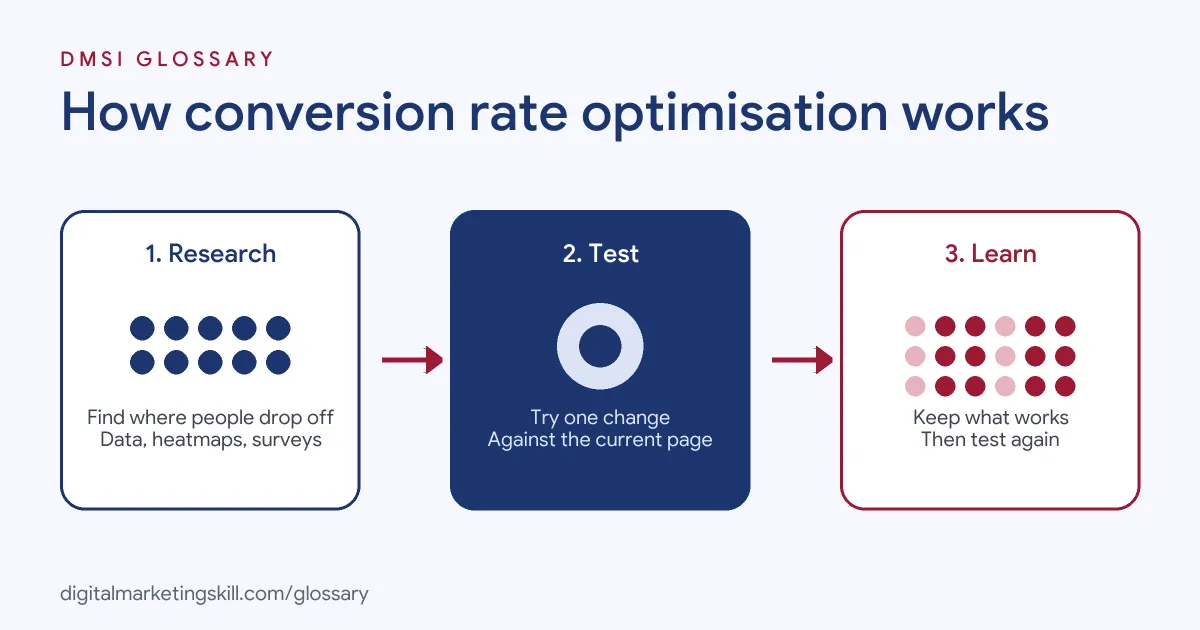
Measure the Baseline
You cannot improve what you do not measure. So start by tracking conversions properly. In Google Analytics, Google explains that you “create or identify an event that measures the important user interaction and then mark the event as a key event.” It also notes that newly marked key events can take up to 24 hours to show in standard reports. Read more in our key events entry.
Research the Problems
Next, find out where people get stuck. Analytics shows which pages lose the most visitors. Tools such as Microsoft Clarity add heatmaps and recordings. Clarity says it “tracks all visitor clicks and scrolls on mobile, desktop, and tablet” and builds heatmaps from them. Surveys and user tests then explain the “why” behind the numbers.
Wider research helps too. Baymard Institute’s checkout studies list reasons shoppers abandon. Excluding those just browsing, 40% cited extra costs such as shipping, tax and fees, and 17% said the checkout was too long or complicated.
Test and Learn
Then test your idea. An A/B test shows half of visitors the current page and half a new version. After enough traffic, you compare results. If the new version wins clearly, you roll it out. If not, you still learn something about your audience.
Conversion Rate Optimisation Examples
Here are three made-up examples:
- Online shop: A store notices many people leave at the delivery step. It shows shipping costs on product pages, and fewer shoppers abandon checkout.
- Lead generation: A consultancy’s contact form has nine fields. Cutting it to four increases form completions.
- Software trial: A heatmap shows visitors ignore the sign-up button below a long video. Moving the button above the video raises trial sign-ups.
In each case, research pointed to a specific problem, and a focused change fixed it.
A Worked Example With Numbers
Here is a simple made-up calculation. A landing page gets 20,000 visits a month and 400 sign-ups. Its conversion rate is 400 divided by 20,000, which is 2%. After a test, a new headline lifts the rate to 2.5%. With the same traffic, sign-ups rise to 500. That is 100 extra leads a month, without spending more on ads. As a result, the cost per lead falls by a fifth.
Common CRO Methods Compared
| Method | What it tells you |
|---|---|
| Analytics | Where visitors drop off and which pages convert |
| Heatmaps | Where people click and how far they scroll |
| Session recordings | How individual visitors move through a page |
| Surveys and user tests | Why people hesitate or leave |
| A/B tests | Whether a change really improves results |
The best programmes combine several methods. Numbers show what is happening, and research explains why.
How to Start Conversion Rate Optimisation
- Pick one goal. Choose the main action you want, such as purchases or demo requests.
- Set up tracking. Mark the right events as key events and check the data is accurate.
- Find the leaks. Look for pages with high traffic and low conversion.
- Gather insight. Use heatmaps, recordings and short surveys on those pages.
- Write a hypothesis. For example: “Showing delivery costs earlier will reduce checkout abandonment.”
- Test one change. Run an A/B test long enough to get a clear result.
- Roll out and record. Keep winners, note what you learned, and choose the next test.
Best Practices for CRO
- Fix the obvious first. Broken forms, slow pages and hidden costs need no test.
- Test big ideas, not tiny tweaks. A clearer offer usually beats a new button colour.
- Match the message. Make sure the landing page delivers what the ad promised.
- Mind mobile users. Test every change on phones as well as desktops.
- Look beyond the first click. Track whether extra sign-ups turn into paying customers.
For more ideas, see our guide to improving conversion rates and our list of common CRO mistakes.
Common Mistakes to Avoid
First, teams stop tests too early and trust a random swing. Second, they change several things at once, so they cannot tell what worked. Third, they copy another site’s design without knowing whether it suits their audience. Finally, they chase clicks rather than revenue. Each of these wastes traffic and time.
Conversion Rate Optimisation and Paid Traffic
CRO matters even more when you pay for every click. Here is why. If a page converts at 2%, you need 50 paid clicks for each sale. If it converts at 4%, you need only 25. So the same ad budget brings twice as many customers. That is why many advertisers improve landing pages before they raise budgets.
The link works both ways. Ads also bring useful test traffic, because you can send a steady flow of visitors to two page versions at once. As a result, paid campaigns and CRO often improve together. Start with the page that receives the most paid traffic, since even a small lift there pays back quickly.
Where You’ll Use Conversion Rate Optimisation at Work
CRO skills appear in many growth and web roles. For example, remote job listings ask candidates to:
- “Redefine our website as a growth channel, driving conversion rate optimization, messaging tests, and funnel improvements that directly support pipeline goals.” (Head of Marketing).
- “Own the website strategy and roadmap with a focus on conversion rate optimization, including automated A/B testing and publishing in Webflow.” (Director, Digital Marketing).
- “Experiment relentlessly. A/B testing, conversion rate optimization, landing page optimization, audience segmentation- every part of the funnel is a hypothesis worth testing.” (Director of Growth Marketing and Analytics).
So if you plan to work as an SEO Specialist, Website Manager or WordPress Developer, CRO will help you prove the value of your work. More traffic is good; more customers from that traffic is better.
Learn It in the WordPress and SEO Track
You can learn to build and improve high-converting sites in the AI-Powered WordPress and SEO Specialist track. Your portfolio project is a WordPress site or store that you rank with an SEO content plan. The track is about 90% hands-on, with unlimited 1-on-1 mentoring and a U.S. Project Internship from day one.
Frequently Asked Questions
What is conversion rate optimisation in simple terms?
It is the work of getting more of your visitors to take a key action, such as buying or signing up, by finding and fixing what stops them.
How do you calculate conversion rate?
Divide the number of conversions by the number of visitors or sessions, then multiply by 100. For example, 50 sales from 2,000 visits is 2.5%.
What is a good conversion rate?
It depends on the industry, offer and traffic source. The most useful comparison is your own rate over time.
What tools are used for CRO?
Common tools include Google Analytics for tracking, Microsoft Clarity or similar for heatmaps and recordings, and A/B testing software.
Is CRO part of SEO?
They are separate but connected. SEO brings visitors from search; CRO helps more of those visitors convert.
Sources: Baymard Institute: Cart abandonment rate statistics; Analytics Help: Mark events as key events; Microsoft Clarity: Heatmaps overview; remote job listings on Himalayas.