
A social media manager is the person who plans, creates and runs a brand’s presence on platforms such as Instagram, TikTok, Facebook and LinkedIn. They set the strategy, publish content, talk with the audience and report on what the work achieves. The role matters because social channels are often the first place customers meet a brand, ask a question or leave a review.
Key Takeaways
- The role mixes strategy, content creation, community management and reporting.
- Workable describes the job as providing “the voice for a company across social channels.”
- Many roles now include paid social, so you may run ads as well as organic posts.
- Data skills matter. You will be expected to analyse results and explain them clearly.
- There is no single route in. A degree, an apprenticeship, an assistant role or volunteering can all lead there.
What Is a Social Media Manager?
Workable’s job description template puts it simply: a social media manager “provides the voice for a company across social channels.” It adds that they are “responsible for responding to comments and creating content.”
The UK’s National Careers Service lists three core tasks. You “develop strategies and campaigns to increase audience size and participation,” “analyse data to check the effectiveness of campaigns and to spot trends,” and “produce reports, detailing insights and recommendations.”
In a small business, one person may do all of this alone. In a large company, by contrast, the manager may lead a team of designers, video editors and community staff. Either way, the job is to make social media work for the business, not just to post.
How the Role Works Day to Day
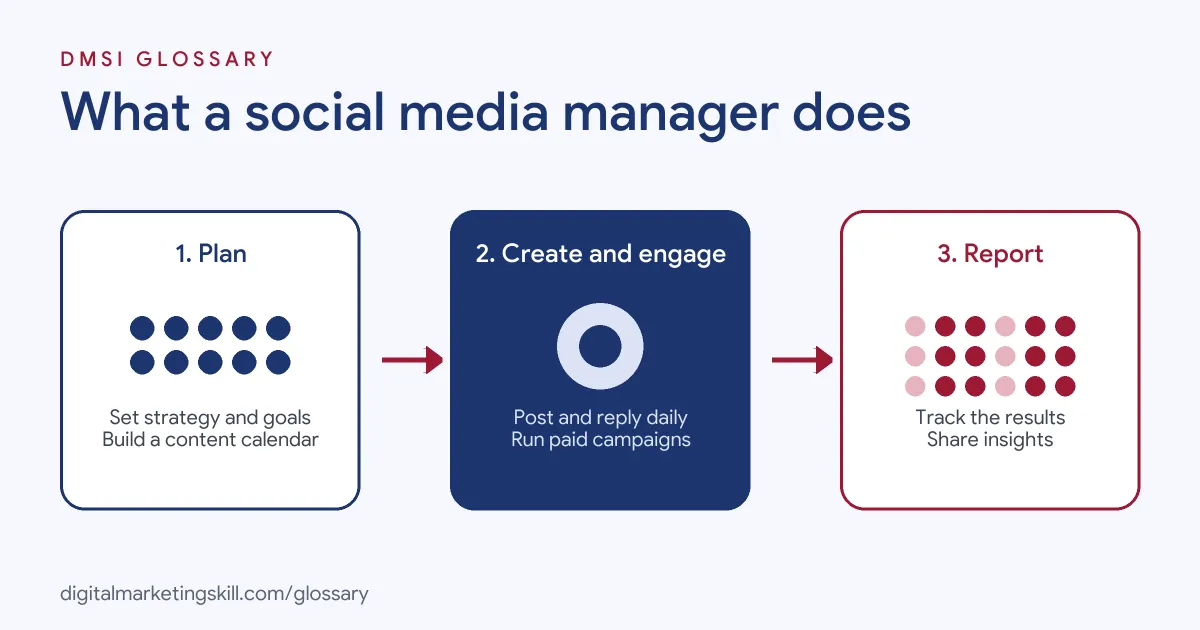
Most weeks follow a clear rhythm. First, you plan what to post and why. Next, you create and publish content, reply to people and run any paid campaigns. Finally, you review the numbers and share what you learned.
Strategy and Planning
Workable lists tasks such as researching “current benchmark trends and audience preferences” and designing a strategy “to align with business goals.” In practice, this means choosing platforms, setting goals and building a content calendar for the coming weeks.
Content and Community
Next comes the daily work. You write captions, brief designers or create graphics and short videos yourself. You also reply to comments and messages. Workable says the role includes the need to “communicate with followers, respond to queries in a timely manner and monitor customer reviews.”
Paid Campaigns
Many roles now cover ads as well. For instance, one German listing for a social media assistant includes entering and editing Meta, Facebook and Instagram ads in Meta Business Manager. So it helps to know how ad objectives, audiences and budgets work on each platform.
Reporting
Finally, you show what the work achieved. Workable lists the need to “set specific objectives and report on ROI.” Hootsuite also advises looking past vanity metrics like follower count, towards numbers such as clicks and conversion rate.
Tools of the Job
You don’t need a lot of tools to start. Most people use a few core ones. A scheduling tool lets you plan posts days or weeks ahead. A design app helps you make graphics and short clips. Each platform also has its own stats page, so you can see what worked. On top of that, a shared calendar or task board keeps the team in sync. Learn these well first. Then add more tools only when you have a clear need for them.
The same goes for skills. Good writing comes first, since every post starts with words. After that, learn to shoot and edit simple video on a phone. Finally, get used to reading the numbers each week, so you know what to keep and what to drop.
Social Media Manager Examples
Here is what the job can look like in three settings:
- Beauty clinic: The manager plans a monthly content calendar, films short treatment videos and replies to booking questions in direct messages.
- B2B software company: The manager runs the LinkedIn page, turns blog posts into short posts and reports on leads from social each month.
- Agency: The manager looks after several client accounts, runs paid campaigns and presents results on client calls.
In each case, the core skills are the same. What changes is the platform, the tone and the goal.
Social Media Manager vs Related Roles
These job titles often overlap, so here is a quick comparison:
| Role | Main focus | Typical output |
|---|---|---|
| Manager (social) | Strategy, content, community and reporting | Content calendar, posts, monthly reports |
| Paid social specialist | Running and optimising social ads | Ad campaigns, audience tests, cost per result |
| Content creator | Making posts, graphics and videos | Short videos, images, captions |
| Community manager | Replying, moderating and building loyalty | Replies, groups, customer insights |
In short, the manager usually owns the overall plan, while the others focus on one part of it.
How to Become a Social Media Manager
The National Careers Service lists several routes into the role. Here is a practical path:
- Learn the basics. Study how each platform works, including content formats, analytics and ads.
- Practise on a real account. The National Careers Service suggests “volunteering to manage a charity or community group’s social media channels.”
- Build your content skills. Learn to write short copy and create simple graphics and videos.
- Run a small paid campaign. Even a tiny budget teaches you how targeting and objectives work.
- Track and report. Write up the results with clear numbers and lessons learned.
- Build a portfolio. Show real posts, campaigns and reports, not just a list of skills.
- Start in an assistant role. You could begin “with a social media or marketing company as an assistant,” then move up.
Best Practices
- Plan ahead. A content calendar stops last-minute posting and keeps the message consistent.
- Write for each platform. A LinkedIn post and a TikTok video need different styles.
- Reply quickly and kindly. Your replies are public, so they shape how people see the brand.
- Label paid partnerships. In the UK, the ASA expects influencer ads to carry “a prominent ‘ad’ label upfront.”
- Report on business results. Link your work to traffic, leads or sales, not just likes.
Common Mistakes to Avoid
New managers often try to be on every platform at once and burn out. Another error is posting without a plan, which leads to random content and weak results. Some also ignore comments, so the brand looks absent. In addition, many people report only reach and likes. As a result, leaders can’t see how social helps the business. Finally, it is easy to forget the ad label on paid influencer posts, which can break UK advertising rules.
Where You’ll See This Role at Work
Social roles are common on remote job boards. For example, recent listings ask candidates to:
- “Create engaging social media post calendars for assigned creators, ensuring alignment with their brand and target audience” (Social Media Manager).
- “Manage social media content calendars, connecting with internal teams for alignment and planning purposes” (Social Media Brand and Content Manager).
- “Engage with the audience, respond to comments, and build genuine relationships with customers and creators” (Social Media Manager, health and wellness).
So employers want someone who can plan, create, engage and report. Above all, they want proof, such as a campaign you ran and the results it produced.
The good news is that you can practise all of this on a small account. Pick one brand. Post each week, reply to each comment and write a short report each month. Over time, that record becomes your proof.
Learn It in the Social Media Track
You can train for this role in the AI-Powered Social Media Management and Advertising track. It covers AI fundamentals, content creation for graphics and video, social media marketing and analytics, and social media advertising. For your portfolio, you plan, create and run a paid social campaign for a real brand. You also join a U.S. Project Internship from day one, with unlimited 1-on-1 mentoring.
For more detail, read our guide to the skills you need for this job and our pick of social media management tools.
Frequently Asked Questions
What does a social media manager do?
They plan a brand’s social strategy, create and publish content, reply to the audience, run campaigns and report on results.
Do you need a degree to be a social media manager?
Not always. The National Careers Service lists university, apprenticeships, starting as an assistant and volunteering as possible routes. Some employers may still expect a relevant degree.
What skills does the role need?
Workable lists copywriting, creative content, analytics, communication and multitasking. Many roles also want paid social and video skills.
What is the difference between a social media manager and a content creator?
A content creator mainly makes posts and videos. The manager owns the plan, the community and the reporting as well.
Can you do this job remotely?
Many can. Several listings quoted on this page are for remote roles, because most of the work happens online.
Sources: National Careers Service: Social media manager; Workable: Social media manager job description; ASA: Recognising ads on social media; Hootsuite: Social media marketing strategy guide; remote job listings on Himalayas.