

Social media manager skills fall into three groups: strategy and analytics, content and copy, and community and paid promotion. Employers rarely need equal strength in all three. This guide names the skills that matter most, how they differ by role type, and the one sourced number that shows whether your work is actually paying off.
Key Takeaways
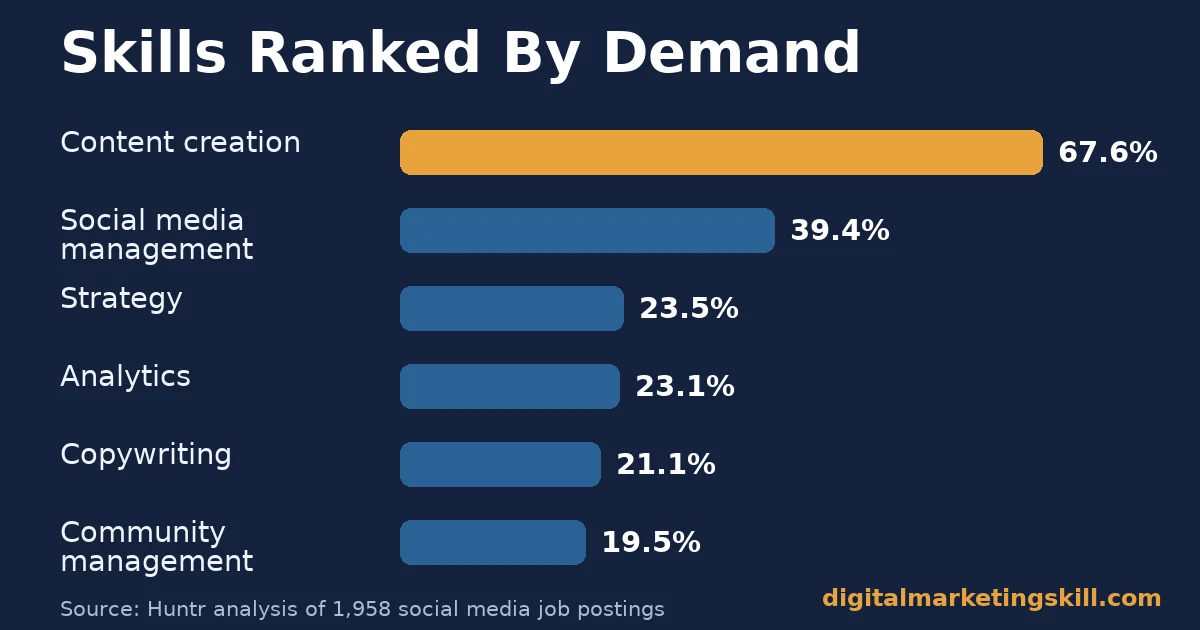
- Content creation leads every job post. It appears in 67.6% of postings analysed from 1,958 real listings, per Huntr’s job-posting skills data.
- Analytics is required more than it is optional. The same data shows analytics named in 23.1% of postings, mostly as a required skill rather than a preferred one.
- Design tools are preferred, not required. Canva appears in 15.5% of postings, but mostly as “preferred,” unlike content and analytics.
- Pay varies widely by experience and location. Glassdoor data puts the typical US range between $53,920 and $94,830 a year.
- A portfolio can open doors analytics alone cannot. One Digital Marketing Skill Institute graduate credits hands-on project experience, not a job title, with landing a management role (see the real case below).
In this guide
- What Most Advice On Social Media Manager Skills Gets Wrong
- What A Social Media Manager Actually Does
- How The Three Role Types Differ
- What To Lead With For Each Role Type
- Social Media Manager Skills, Ranked By Demand
- The One Metric That Separates Busy From Effective
- The One Rule For Prioritising Which Skill To Build First
- A Real Case: A Portfolio That Opened A Management Role
- Frequently Asked Questions About Social Media Manager Skills
- Where To Build These Skills Properly
What Most Advice On Social Media Manager Skills Gets Wrong
Most lists of social media manager skills read the same way. Content. Analytics. Communication. Creativity. Strategy. Repeat. That list is not wrong. But it treats every social media manager role as identical. The actual mix of skills a job needs depends heavily on what kind of role it is.
This guide names that gap directly. It breaks social media manager skills into three role types. It shows what each one actually demands day to day. It also names the one metric that separates busy accounts from effective ones.
Read the job-posting percentages here as a snapshot of current hiring patterns, not a fixed ranking. Postings change by industry and by season. Treat the salary range as a general US guide, not a promise, since pay varies by location, company size, and experience.
What A Social Media Manager Actually Does
A social media manager plans, creates, publishes, and measures content across an organisation’s social accounts, then adjusts based on what the data shows. The role sits at the intersection of marketing, customer service, and data analysis. That is why social media manager skills span so many categories, and why a candidate strong in only one area often struggles in a generalist role.
In fact, this breadth is the single biggest reason beginners feel overwhelmed when they first look into the role. For example, a single job posting might ask for copywriting, basic graphic design, paid ad setup, and customer service tone, all in one role description. Therefore, the most practical first step is not trying to master everything at once. It is identifying which of the three role types covered below actually matches the jobs you want.
The Five Recurring Tasks
Day to day, the job usually covers five recurring tasks. Planning a content calendar. Writing and producing posts. Scheduling and publishing them. Responding to comments and messages. Reviewing performance data to decide what to do differently next. Each task draws on a different skill. That is why no single course or certificate covers the whole role equally well.
Smaller organisations often need one person to cover all five tasks. Larger teams split the role. One person focuses on content and copy. Another handles paid promotion. A third covers community and customer response. Demand for this broader category of marketing role is growing, too: the US Bureau of Labor Statistics projects employment for marketing managers, the wider category social media management sits inside, to grow 7%, faster than the average for all occupations, over the coming decade. That is a US-only figure, so growth elsewhere will differ by market.
One Person Or A Split Team
Knowing which version of the role you are building toward changes which social media manager skills to prioritise first. Meanwhile, the skills themselves keep shifting as platforms change their algorithms and formats, so no list of social media manager skills stays fixed for long; treat the ranking later in this guide as a current snapshot, not a permanent order. For a broader view of where this role fits inside a marketing team, our guide to social media marketing covers the strategy layer above individual day-to-day tasks.
Robert Half’s career guidance for the role puts it plainly: “the social media manager salary range shifts depending on where you live, what industry you’re in and how much the role asks of you.” That same logic applies to the skills the role demands, not just the pay. No two social media manager postings ask for exactly the same mix of skills, even when the title is identical. That variation is precisely why naming the three role types below matters more than memorising a single generic list.
How The Three Role Types Differ
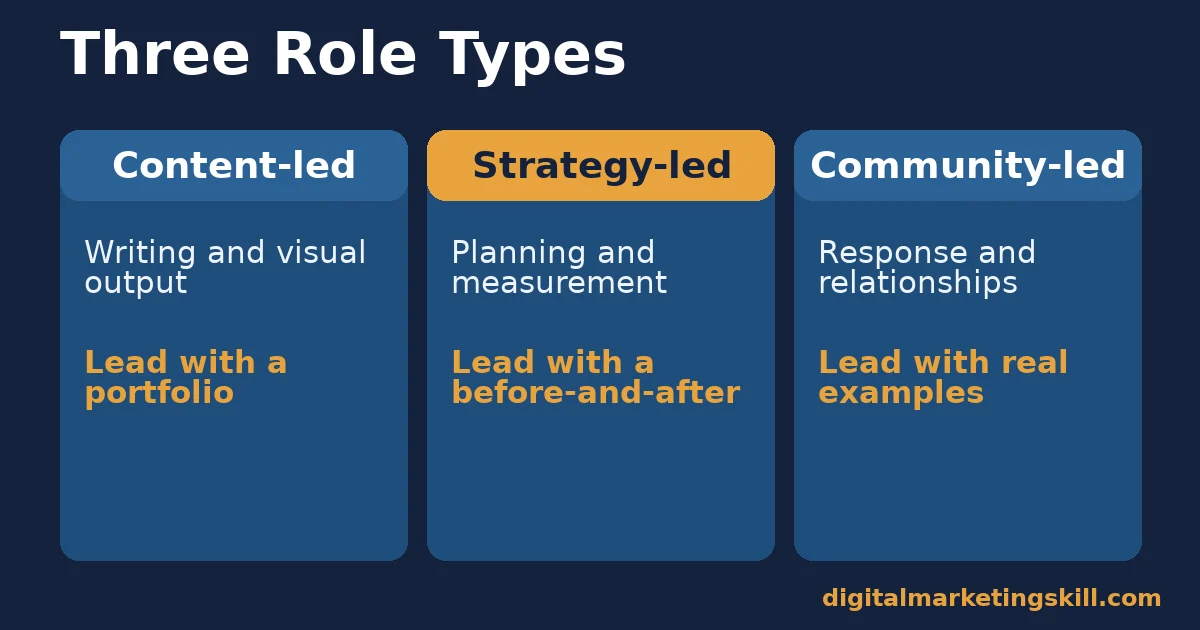
Most social media manager jobs lean toward one of three emphases, even when the job title looks identical. Knowing which one a role actually is, before you apply or before you hire, saves wasted effort on both sides.
Content-Led Roles: Built On Writing And Visual Output
These roles centre on producing a steady stream of posts, captions, short video, and graphics. Content creation is the single most common requirement in social media job postings. It appears in 67.6% of the 1,958 postings Huntr analysed. A content-led role rewards strong copywriting, basic design or video skill, and a fast, consistent production pace.
Strategy-Led Roles: Built On Planning And Measurement
These roles centre on deciding what to post and why, then proving it worked. Social media strategy and analytics each appear in roughly a quarter of postings in the same dataset. A strategy-led role rewards comfort with spreadsheets and dashboards. It rewards the ability to turn a number into a decision, more than raw content output.
Community-Led Roles: Built On Response And Relationships
These roles centre on the conversation happening around a brand: comments, messages, reviews, and real-time response. Community management appears in about a fifth of postings in the same data. A community-led role rewards patience and clear writing under time pressure. It also rewards judgment about when to escalate a problem rather than answer it directly. Even so, most real job postings blend elements of all three types in different proportions, so treat these as emphases rather than strict categories.
What To Lead With For Each Role Type
The sections below mirror the three role types above. Each names the one habit that makes a candidate or a new hire effective fastest in that specific role.
Content-Led: Lead With A Portfolio, Not A Resume
A content-led hiring manager wants to see actual posts, not a bullet-point description of posts. Build a small portfolio of real or practice content before you apply. Organise it by platform and goal. A few strong, varied examples beat a long list of vague duties every time.
Strategy-Led: Lead With One Clear Before-And-After
A strategy-led hiring manager wants evidence you can move a number, not just read one. Find one clear example, even a small one. Show a metric before your involvement and after it, explained in plain language. That carries more weight than a long list of tools you know.
Community-Led: Lead With Response Examples, Not Just Tone Words
A community-led hiring manager wants to see how you actually handled a hard comment or complaint. A claim that you are “great with people” proves nothing on its own. Bring two or three real or practice examples of a tricky interaction and how you resolved it.
Social Media Manager Skills, Ranked By Demand
Based on the same analysis of 1,958 job postings, here is how often each skill actually appears. That is a more reliable guide than a generic list.
- Content creation (67.6% of postings): writing and producing posts across formats.
- Social media management (39.4%): running the day-to-day calendar and publishing workflow.
- Social media strategy (23.5%): planning what to post and why, tied to a goal.
- Analytics (23.1%): reading performance data and turning it into a decision.
- Video editing (23.0%): producing and editing short-form video specifically.
- Copywriting (21.1%): writing concise, on-brand captions and ad copy.
- Communication (20.8%): clear writing for both internal teams and public audiences.
- Community management (19.5%): responding to comments, messages, and reviews.
Design tools like Canva and general graphic design sit lower on this list. They are more often marked “preferred” than “required.” That means they help a candidate stand out but rarely gate a hire on their own. A beginner choosing where to spend limited study time should weight that against the higher-demand skills above. In other words, learn to write and plan before you learn to design, since the data shows employers ask for the first two far more often than the third. For hands-on practice with the writing side specifically, our guide to social media campaign strategies walks through planning a real campaign end to end.
The One Metric That Separates Busy From Effective
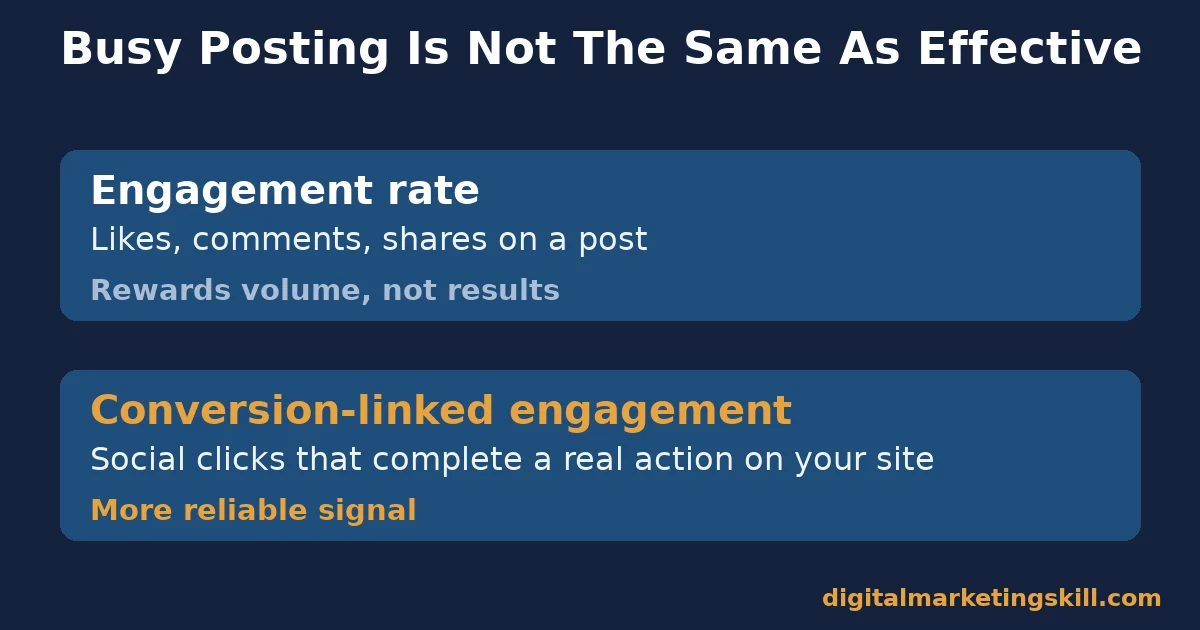
Engagement rate is the share of people who saw a post and actually reacted, commented, or shared it. It is a reasonable early signal, but it rewards volume as much as quality. A social media manager can post constantly and still fail to move the business forward.
The more reliable number is conversion-linked engagement: the share of social traffic that completes a real action on your website. A signup, a download, a purchase. Track it through a tool like Google Analytics rather than the platform’s own dashboard. A post with modest likes but strong click-through to a converting page is doing more for the business than a viral post that sends no one anywhere.
Track this weekly, not daily. Social performance is noisy at low volume. One post catching an algorithm’s favour can skew a single day’s numbers. A week of data gives a far steadier read than any single post. Reviewing on a fixed day also builds the habit of treating social media manager skills as something you measure and refine, not something you simply perform and hope works.
The One Rule For Prioritising Which Skill To Build First
Build the skill that matches the role type you are actually targeting. Do not build the skill that is easiest to learn first. This single rule resolves most of the confusion beginners feel when they see long, generic lists of social media manager skills and do not know where to start.
Here is why, in an illustrative example with invented numbers. Two candidates each spend three months preparing. The first masters graphic design tools, which appear in under 13% of postings as a required skill. They apply to strategy-led roles that barely mention design. The second spends the same three months building one real campaign with a measurable before-and-after. That directly matches what strategy-led postings ask for. The second candidate is more likely to get an interview. Not because they worked harder, but because their preparation matched the actual role type they were targeting.
A Real Case: A Portfolio That Opened A Management Role
A graduate of the Digital Marketing Skill Institute’s program, identified as Grace A. in the Institute’s published student outcomes, said the U.S. project experience inside the program “gave me the portfolio I needed to become a Digital Marketing Manager.” The case does not involve a dollar figure. Results like this are not typical for every learner. Building a portfolio is necessary but not sufficient on its own, since hiring also depends on the market, the company, and timing outside any individual’s control.
The pattern behind the case matters more than the title itself. Real, demonstrable project work carried more weight in the hiring process than credentials alone. That lines up directly with the lead-with-a-portfolio approach covered above for content-led and strategy-led roles. It also reinforces a point worth repeating: social media manager skills only become persuasive to an employer once they are attached to something you actually built, not just a list on a resume.
Frequently Asked Questions About Social Media Manager Skills
What is the single most important social media manager skill?
Content creation, since it appears in more job postings than any other named skill, at 67.6% in the Huntr dataset of 1,958 listings. That said, which skill matters most for you specifically depends on which of the three role types you are targeting: content-led, strategy-led, or community-led.
Do I need a degree to become a social media manager?
No specific degree is legally required. Many working social media managers do not have a marketing degree. Most employers care far more about a demonstrable portfolio and measurable results than the specific credential behind them.
What does a social media manager typically earn?
Pay varies widely by experience, location, and company size. US data from Glassdoor puts the typical range between roughly $54,000 and $95,000 a year. Entry-level and smaller-market roles sit at the lower end; senior, major-city roles sit higher. Figures outside the US vary by local market and are not reflected in this US-specific range.
What tools should a social media manager learn first?
Start with whichever platform’s native scheduler and analytics you will actually use daily. Then add one broader analytics tool, such as Google Analytics, to connect social activity to real website outcomes. Design and video tools matter, but the job-posting data shows they are requested far less often than content and analytics skills. Our roundup of social media marketing tools covers free and low-cost options for each stage of the workflow.
How do I get social media manager experience with no prior job in the field?
Manage a real set of accounts: your own, a friend’s small business, or a non-profit’s. Track the before-and-after results honestly. A small, real, measurable project carries more weight in hiring than a list of courses with no output attached to them.
Can a social media manager work freelance instead of being employed?
Yes. Many social media managers work as freelancers or contractors for multiple small clients rather than one employer. The core skills are the same either way. Freelancers also need basic client communication and invoicing skills that an employed role usually does not require.
Do social media managers need to know AI tools now?
Increasingly, yes, for drafting first versions of copy, summarising performance data, and speeding up routine production work. Industry guidance on in-demand skills notes that understanding how to use AI tools for content production can give a candidate an edge over others applying for the same role. Even so, AI tools do not replace judgment about brand voice, strategy, or community response. Those remain the parts of the role that are hardest to automate well.
What should go in a social media manager portfolio?
Include three to five real or practice examples, each with the goal, the content itself, and the result or a clear explanation of what you would measure. Organise examples by role type, content, strategy, or community, so a hiring manager can see the exact match for the role they are filling.
How many social media manager skills do I need before I apply for a job?
You rarely need every skill on the ranked list above before applying. As a result, most hiring managers expect a new hire to be strong in the two or three skills their specific role type demands most, with the rest learned on the job. Applying only once you feel fully ready on every skill usually means applying too late; in practice, strength in the top two or three skills for your target role type matters more than broad but shallow coverage.
Can social media manager skills be learned quickly, or do they take years?
The core production skills, writing captions, scheduling posts, basic reporting, can be learned in weeks with focused practice. The judgment skills, knowing what to post, reading data correctly, handling a public complaint well, typically take months of real practice to build confidence in, which is why hands-on project work tends to compress that timeline faster than theory alone.
Can I move between content-led, strategy-led, and community-led roles later?
Yes, and many working social media managers do exactly that over a career. The three role types described in this guide are not permanent labels; they are a practical way to decide what to focus on first. As your experience grows, picking up the skills of a second role type becomes far easier because you already understand the shared fundamentals underneath all three.
Where To Build These Skills Properly
Social media manager skills are easier to build with structured practice than by piecing together advice from scattered posts. The Digital Marketing Skill Institute’s Master Diploma in Digital & AI Marketing includes practical courses in AI-powered social media marketing and analytics, AI-powered social media advertising, and AI-powered content creation, backed by unlimited 1-on-1 coaching and mentoring and real project work inside a U.S. partner company that builds exactly the kind of portfolio covered above. The program is dual US and UK accredited and recognised in more than 100 countries, so the training applies wherever in your country you plan to work.
If you want structured feedback on your own content or strategy work rather than guessing alone, apply to the program, or keep reading on the Digital Marketing Skill Institute blog. Wherever you live, the approach here holds: match your skill-building to the role type you actually want, track one meaningful metric weekly, and build a real, demonstrable portfolio before you lean on a credential alone. Learn more at digitalmarketingskill.com, the Institute behind the training and the real case described above, at digitalmarketingskill.com.
Every figure in this guide was checked against its original source before publication. Figures marked as illustrative are invented examples, not real results.
![9 Amazing Digital Marketing Skills to Make Money Online [With Proof]](https://digitalmarketingskill.com/wp-content/uploads/2019/07/9-Amazing-Digital-Marketing-Skills-to-Make-Money-Online-With-Proof-17.png)






